Searching for a job was scary and one of the most difficult times in your life. But you made it. You landed the job you wanted. Your job search took longer than you would have liked, but you persevered for six months.
When you think about what led you through your journey and to this new opportunity, you can pinpoint 6 distinct reasons:
1. You demonstrated emotional intelligence (EQ).There were times when you felt like throwing in the towel. You felt like staying in bed dreading the days ahead. Your feelings of despondency were unseen by others, save for loved ones and your closest friends.
When you were networking in your community, attending networking groups three times a week, and taking workshops at the local career center, you showed a confident demeanor. You were positive and demonstrated a willingness to help others. Despite negative thoughts, you did your best to help yourself and others.
2. You developed a target company list. Taking the advice of your career advisor, you made a list of companies for which you wanted to work. She told you to spend time researching your target companies and contacting people for networking meetings before jobs were advertised.
You left each networking meeting with different people to contact. You had the sense that one person, a VP of Marketing and Sales, had an interest in you. He led you to the door saying, “We might be in touch with you real soon.” But you didn’t rely on this one occurrence.
You continued to build your target company list and ask for networking meetings. You were spending less time applying for jobs online and more time meeting with quality connections. You were optimistic. You felt productive.
3. You upped your LinkedIn campaign. You knew how important it is to be on LinkedIn in order to reach out to many people across the state, the country, the world. You were told how important LinkedIn can be to your job search, but you were skeptical.
There was a great deal of work to do, including creating a profile that was based on your résumé, but you developed it into more of a networking document. You personalized it, employing first-person point of view.
You learned the value of connecting with people on LinkedIn, how you can narrow your search to consist of quality connections who are in your industry. Despite all this, you are behind the eight ball because you started your campaign later than others. Your realized you needed to play catch up.
Your company list was not developed in vain, as you used it to connect with people within those companies. One advisor told you to build your foundation in companies for which you wanted to work.
4. You networked the proper way. At networking events you were attentive to others, while also willing to ask for help. Many people think only of their situation, not of helping others. Not you. You kept your eyes open for opportunities for your networking companions.
When people ask you for leads at companies of interest, you gave them the names of hiring managers in various departments. You became known as the “Connector.” Weeks later, you were happy to learn of one of your networking companions landing a position at a company, based on one of your leads.
You also networked in your community. Told everyone you knew that you were looking for a job and asked them to keep their ears to the pavement. Who would have known that your neighbor across the street would be the reason you landed your job?
He worked at one of your target companies and knew the VP of marketing and would deliver your résumé to him. Put in a good word. You were asked to come in to have a few discussions.
5. You wrote killer résumés. Yes, plural. Because you tailored as many of your résumés as possible to each job, knowing that every employer has different needs. A one-fits-all résumé doesn’t work. In addition, you eliminated fluff from your Performance Profile. It’s better to show, rather than tell.
Most importantly, you packed a punch in your Experience section by listing accomplishment statements with quantified results. Results like, “Increased productivity by 80%” sounds better than simply, “Increased productivity.”
Using your network was key in getting your résumé into the hands of the hiring managers, such as the time your neighbor delivered your value-packed résumé to that hiring manager.
6. You nailed the interviews at one of your target companies. There were five interviews for the job your neighbor led you to; two telephone, two group, and a one-on-one. You were prepared for each interview, having researched the company, the position, their competition, even the interviewers.
You used LinkedIn to discover who the interviewers were. One was a youth soccer coach, like you. Another had gone to your alma mater. And another was a veteran, so you were sure to thank her for her service. That went over very well.
After each interview you sent unique follow-up notes to every interviewer, ensuring that you mentioned a specific point of interest made by each one. You even sent a thank-you note to the receptionist. Smart move.
After 6 months, you received an email from the VP of marketing telling you they were offering you the position of marketing manager and were also exceeding your salary requirement.
7. Your work was not complete. You didn’t forget the people who helped you along the way, such as the person who helped you revise your résumé, the people with whom you formally networked, and certainly your neighbor who led you to your new job. They deserved thanks.
In the true spirit of networking, there were people who you could help in a more meaningful way, such as Sydney from your networking group who was looking for an engineering position.
There was a mechanical engineer position opening in your new company. You mentioned the position to Sydney and gave her a good word. Wouldn’t you know; you changed Sydney’s life for the better.
I’ve heard many stories from my clients who have similar plots to this one. Their job search wasn’t easy. Their landing was well deserved. But they had to display EQ, do their research, help others, and be willing to help themselves. If you are dedicated to do the same, your job search will be shorter.
My two daughters used to love writing. My oldest preferred expository writing, while my youngest loved dabbling in creative writing, primarily poetry that had taken on an inner angst slant. I loved reading their essays and stories. Proofreading and editing them was a pleasure.
My youngest daughter once asked me if I write. I told her that I do, and she asked if I write for work. This was a tough question to answer because I don’t get paid for blogging, but I see the doors it opens. Blogging is an investment in the future. How do you explain this to a 13-year-old kid?
Now, I tell my clients that blogging can be beneficial to their job search. I’m often met with reactions like, “Be real, Bob.” Here’s what I tell them about blogging for their job search.
Demonstrates your ability to write
If you enjoy writing and are particularly good at it, blogging gives you the perfect platform. Keep in mind that what you write will be read by people who hope to gain some advice from your writing, not your memoir or short stories based on your college years.
Enjoying the act of writing makes it easier to maintain a consistent schedule of posts. Start with one every other week and then increase them to a point where you are blogging once a week.
If you need trusted people to proofread your posts before sending them out, don’t be afraid to ask. Some of my clients have run their posts by me. My comments were usually: “You’re instincts are correct. Run with it.”
It enhances your brand
Blogging is one of many ways you can enhance your online presence. It demonstrates your expertise in your field, especially if what you write is educational and of use to your readers. This means you need to understand the needs of your audience.
I encourage my clients to blog to demonstrate their expertise. “Everyone in this room is an expert at what you do,” I tell them. This is true. From the purchasing agent to the nurse to the software engineer, they all have knowledge to share.
When recruiters, hiring managers, and HR read your posts, they’ll learn more about your expertise and personality than any résumé you write. Use your professional voice. Begin with a story, if you like. Just remember that the purpose of your posts are to educate your audience.
Also, keep your content positive; refrain from bashing former employers. This is one way to severely damage your brand. I’ve seen people submit negative posts on LinkedIn, which remain in the minds of LinkedIn users.
On the plus side, one of my clients went to an interview where the VP of marketing commented that he saw one of my client’s posts shared on LinkedIn. The VP was very impressed with my client’s expertise and offered him the job shortly after the interview.
It’s a great way to network
The third and final reason to blog is to network on social media like LinkedIn, Twitter, and Facebook. Provide links in your posts to other bloggers’ posts. They will receive a ping telling them you’ve done this.
Other ways to acknowledge bloggers is by sharing their posts with your LinkedIn connections, tweeting and re-tweeting them, commenting on them, sharing them in your groups, etc. These are all effective ways to develop and strengthen your network.
You’ll find that by supporting other bloggers you will receive some love in return. I wrote a post on the qualities of being a curator called To share is golden. This post illustrates how important it is to not only blog, but to share the work of others. I also listed who I consider to be great curators, and I add to the list from time to time.
So, how do you begin? A connection of mine listened to me bemoan about how I wanted to blog, until she told me to simply do it. After a year of putting it off I finally wrote my first blog with my free WordPress account. And now I consistently blog at least one post a week.
Don’t wait like I did to blog. And think of something that really interests you about your occupation. Don’t expect your first post to be a hit—although it may be. Be patient and stick with it.
You don’t have a WordPress account. LinkedIn makes it easy for first-time bloggers. You can “write an article on the platform,” precluding the need to open a free WordPress account (as I did). The mechanics are straightforward. On your LinkedIn homepage you select “Write an article” and take it from there.
I hope my daughters continue writing in their later years because it is rewarding to the soul. They are excellent writers who will someday make significant contributions to this valuable art. Who knows, maybe one of them will be famous for their writing. One can only hope.
You might be a beginner on LinkedInor even well versed with the platform. Either way this compilation of posts can help you use LinkedIn more effectively. Stay current by reading the most recent ones or all of them. I hope these posts help you with your job search.
The problem with public proclamations is that when you make them you have to practice what you preach, lest you be labeled a hypocrite. Case in point, I’ve stated that one should only share three to four posts a week. This means that if I’ve reached four posts by Wednesday, I’m shut off for the week. At least in my mind I am.
You have valuable content to share—be it long posts, articles, videos, or audios—but it’s not being seen and appreciated by your audience. You conclude that your efforts are being wasted. They are if all you’re doing is flooding your connections’ feeds with your content.
One viable form of content not listed in the paragraph above is comments written in response to other LinkedIn members’ posts. While you might be posting like a bandit, you’re losing half the battle if you’re not commenting on what other’s post.
Have you ever had questions about writing a resume and LinkedIn profile, networking, interviewing, or any aspect of the job search? Of course you have. Otherwise you wouldn’t be reading this article on how to find job-search content using LinkedIn.
In this article, I revisit the LinkedIn profile to discuss what was and what is. Creating a profile that brands you is the ultimate purpose of your LinkedIn profile. However, your profile alone won’t effectively accomplish this goal; you also need to create a focused network and engage with your connections.
This article addresses how you should express your greatness with your resume and LinkedIn profile. In terms of your profile, there are at least 6 areas where you an show your greatness. Make use of these areas. Don’t be shy; you have permission.
Metrics in the form of numbers, percentages, and dollars give your resume’s or LinkedIn profile’s accomplish statements power and separate you from the fold. They cause readers to take note. They complete the story. They show proof.
Based on a poll I conducted on LinkedIn, 65% of voters said metrics on your job-search documents are important to have, 25% voted “No,” and 10% stated, “It depends.” The poll is still active with 1,334 people who have voted.
Smart consumers understand the value of their time and getting the job done right. That’s why hiring a professional writer to write your job-search documents (resume and LinkedIn profile) might be the best way to go. Sixty-four percent of voters chose having someone write their documents, even some resume writers.
Most hiring authorities (recruiters, hiring managers, and HR) who read many LinkedIn profiles at a sitting will tell you that the Experience section is where they will go first when reading a LinkedIn profile. Not the About or Education sections.
There’s no debate when it comes to which document hiring authorities turn to first when evaluating you on “paper.” The resume wins this debate. For the time being. But with 78% or more recruiters looking for talent on LinkedIn, the profile comes in at a strong runner up.
Like the resume, hiring authorities (recruiters, hiring managers, and HR) want to see accomplishments on your profile. Additionally, if you don’t have a LinkedIn presence, you might not be considered for the role.
Many of my clients don’t give enough thought to helping hiring authorities find them on LinkedIn. What I mean by this is that they don’t list their contact info on their profile. Essentially, they’re hiding from the very people who could be instrumental in them landing a job.
This is the final article of a three-part series that looks at the most important sections of the LinkedIn profile, the About, Experience, and now the Headline. It’s debatable as to which is the most important of the three profile sections, but according to a poll taken on LinkedIn, the Headline is the most important.
What happens when you get 16 LinkedIn pros together to talk about creating a powerful LinkedIn profile About section? You get an variety of incredible answers. You might think all of the answers would be similar. Not so.
The previous installment of the three most notable LinkedIn profile sections addressed the About section. This installment looks at what some, particularly recruiters, consider to be the most important section, Experience. If some of you protest Experience being the most important, don’t worry. The next installment will look at the Headline.
No matter how you slice it, there are five areas you must nail on your LinkedIn profile. People’s opinions vary on the order of preference, so the best I can do is give you my take on this and why I list them in my order of preference.
In a poll I conducted a year ago, of 1,189 people who voted, 46% chose the Headline over the About and Experience sections. I was in the minority and chose About (24%). The runner up was Experience (30%)
It’s estimated that at least 60% of LinkedIn members use the mobile app. Further, a poll I conducted on LinkedIn showed that 65% of the participants use the the app more than their computer (desktop or laptop).
In this article I dive into eight major LinkedIn features on both platforms. I discuss how some of features differ between the mobile app and computer platform, so you can understand the advantages and disadvantages of using both.
Have you ever had LinkedIn fatigue? I have. It’s the time when you open LinkedIn, look at it on the screen–computer or phone–and think to yourself that now’s not the day or week to be on LinkedIn. You need a break. Read this article to confirm your feeling of LinkedIn fatigue.
LinkedIn’s Companies‘ feature is a treasure trove of information if you’re searching for people with whom to connect. It’s of more value if you have a reason to connect with said people, namely they’re on your company target list (but this is a whole article in itself).
It comes as no surprise to me that most people feel engagement is the most important component of a LinkedIn campaign. A poll conducted on LinkedIn clearly showed that almost half the voters (47%) agree.
The other two components are a branding/optimized profile, which garnered 29% of the votes and a focused network, which was narrowly beat out with 24% of the votes.
Whether you’re networking via video platform or in person, at some point LinkedIn can play a huge role in your success. I’ve witnessed this with my clients who have forged relationships with other job seekers, mentors, coaches, people in their target companies, and hiring authorities.
It’s no secret that the Recommendations section has lost the allure it once had. Why’s that? We would all agree that employers want to know more about you than what you have on your resume. They want to know how others saw your performance and personality. But how will they find your recommendations if they’ve been banished to the basement of your profile? This article will explain how.
I’ve written or critiqued hundreds of LinkedIn profiles in my role as a career coach. Whether this impresses you matters not. I only mention this to let you know I’ve seen brilliant, so-so, and downright terrible profiles. In this article I’m going to address what makes a profile terrible.
Most people have a hard time engaging with the LinkedIn community, according to a poll I’m conducting on LinkedIn. Although the poll’s only on its second day, it reveals that 42% find it difficult to engage and 21% feel it’s somewhat difficult. Only 37% have no difficulty engaging with the LinkedIn community?
When you think about what makes a winning LinkedIn Profile, what comes to mind? Is it the first impression—background image, headshot, and Headline—the About, Experience and Volunteer sections, Skills & Endorsements, or Recommendations?
When I talk with my clients about their LinkedIn profile About section, I tell them it should tell their story. But that’s too vague. There’s more to your About section than this simple statement. Another way to explain this section is that it should encompass your overall value.
I will be the first to admit that networking on LinkedIn is complex; it’s not straightforward. What does networking on LinkedIn involve? The first step is having a strategy, which will take some forethought. You also have to be willing to reach out to LinkedIn members you don’t know. These steps are the tip of the proverbial iceberg.
In a poll that that asked, “Do you have two lives? Do you separate your LinkedIn life from your Facebook life?” nearly 70% of the 7,442 voters answered Yes. What they share on LinkedIn is professional and what they share on Facebook is personal.
Seven percent of the voters said they share the same or similar content between both platforms, and 26% are AWOL from Facebook. They’ve been there, down that
What constitutes success when creating content to share on LinkedIn? One measure of success is getting many people to react and comment on your posts, videos, articles, podcasts, etc.
Some contributors say that educating their audience—e.g. on how to find a job—is the ultimate definition of success. This is an altruistic view and, some would argue, should be the goal of everyone who creates content to share on LinkedIn.
If you think your LinkedIn profile alone will get you an interview, you’re sadly mistaken. I wish it were that easy. Imagine that you could write a great profile and wait for the interview offers to roll in. Sadly, this is not the case; it takes more than just your LinkedIn profile to get to interviews
Anytime a “Top 10” list is created there is some doubt in the minds of the readers if the selection process was fair. This is why I asked a committee of eight people to choose which 10 LinkedIn profile Headlines stand out from a list of the ultimate list of 80+ LinkedIn voices job seekers should follow.
Approximately 65% of LinkedIn members use the LinkedIn mobile app, and some prefer it over the lap/desktop version, which doesn’t surprise me. In some ways I prefer the app because of its convenience and above average functionality. This article looks at other features LinkedIn users appreciate.
In these times, you might be considering a career change or, at least, shifting to another industry. How do you explain this on your #LinkedIn profile?
This guest article is from Hannah Morgan, a LinkedIn Top Voice, job-search strategist, and founder of Career Sherpa.net. Wondering what to post on LinkedIn? Hannah provides great advice on what to share with the LinkedIn community.
You’ve updated your LinkedIn profile for the one-millionth time but nada, nothing, zilch. No one is contacting you. What if I told you that having a dazzling profile is just one small part of getting found on LinkedIn.
How to write an invite to convince someone to join your network is a common topic. But what about accepting a LinkedIn user’s invite? Do you accept the default non-message? How about an invite that includes a personalized message? In this article, based on a poll I conducted, I talk about four types of invites.
I put a friend to the test by having him tell me what I had just changed in my LinkedIn profile Headline. He couldn’t tell me. Which means he didn’t know what I had for a previous Headline. Which also means it wasn’t memorable. This begs the question if the Headline is so important, shouldn’t people remember it?
Guest writer and recruiter Jeff Lipschultz is a 20+ year veteran in management, hiring, and recruiting of all types of business and technical professionals. He has worked in industries ranging from telecom to transportation to dotcom.
This guest post was written by Ed Han, a recruiter known for his excellent job-search advice. It first appeared on Job-Hunt.org. In it he talks about the three main benefits of posts, making and sharing status updates, finding your updates, making appropriate update posts, and how sharing Facebook posts is inappropriate.
If you ever wondered what LinkedIn features you missed in 2020, Kevin D. Turner has laid it out in this article (Originally published here). Kevin is all stats and to the point. To this end, you’ll learn a lot by reading what he has summed up. My favorite addition? Polls, of course. What is your favorite feature?
If you’re a job seeker and you haven’t optimized your LinkedIn profile, you’re missing out on a ton of opportunities. In today’s market, 87% of recruiters use LinkedIn to find and vet new candidates. But not everyone is capitalizing on what the platform has to offer.
In this post, Austin walks you through three highly actionable tactics that will help you appear in more searches, get more profile views, and land more jobs.
So you can’t think of any accomplishments, let alone with quantified results. The next best thing: testimonials. Perhaps using testimonials on your LinkedIn profile would be more impressive.
Like any list one creates, there’s a magic number in mind. It could be 10, 20, 30, etc. Mine was 50 LinkedIn voices job seekers should follow, but then I dug deeper in the proverbial weeds and found more than 50 voices who deserved to be on this list. And I’m sure I’ve forgotten people, so more will be added.
You might have noticed that content on LinkedIn has taken on a more personal touch. While I’ve never been a fan of this, I can understand it and even accept it…to a point. There was a time when I would write in the comments, “Take it to Facebook” when someone shared something personal. Now I simply scroll on down.
It’s never pleasant to remove someone from your LinkedIn network. But sometimes it has to happen. Like the person I mention in this article. I had to go to said person’s profile, click More, and then Remove Connection. I didn’t do it with malice. Like I said, “Sometimes it has to happen.”
There are many reasons why your photo should be more recent than ancient. In the comments of the poll, I shared an article I wrote back in 2016 called 4 ways your LinkedIn photo is an imposter. Trust me, the ways people’s photos are an imposter haven’t changed. Here is a rundown of what makes your photo an imposter:
I had this great idea to ask my students to be the teacher and teach me how to write a better profile, create a more effective network, and how to engage with my network. Some of them wrote that as the instructor, how can my LinkedIn campaign be improved. This article addresses how to have your LinkedIn campaign critiqued.
You’ve heard it before: LinkedIn is the world’s largest professional, online networking application with approximately 700 million worldwide members. And according to many sources, at least 87 percent of recruiters are sourcing for talent on LinkedIn. It makes sense to utilize LinkedIn for your online networking.
From guest writer Adrienne Tom: Earlier this year, LinkedIn rolled out a small change to personal profiles that seemingly went unnoticed: they increased the headline character count from 120 to 220. This increase may not seem significant; however, increased characters afford users (you!) additional real estate to share value and attract readers.
Occasionally I’m asked which I prefer writing or reviewing, a résumé or LinkedIn profile. To use a tired cliché, it’s like comparing apples and oranges. Read this article to discover why the résumé and LinkedIn profile are different.
Guest article from Virginia Franco. Career change is more complex now with online visibility required, particularly on the most important social network for professionals — LinkedIn. LinkedIn for career change is extra tricky because your resume and applications must align with your LinkedIn Profile because most employers and recruiters compare the two.
Like a lopsided political race, this one is a landslide. I’m talking about a LinkedIn poll asking 3,338 voters to chose between keeping either their resume or LinkedIn profile. Which one wins by 72%? Why, the LinkedIn profile, of course. I’m not at all surprised by the result.
I am particularly fond of LinkedIn’s poll feature which has been brought back from the early years. With Create a Poll, you can ask LinkedIn members to vote on certain topics like which three new features They appreciate most–Open to Work, Create a Poll, or Add Name Pronunciation? To my chagrin, Create a Poll didn’t win.
Wouldn’t you know it, the LinkedIn profile Headline is deemed more important than the About and Experience sections. In a recent poll conducted on LinkedIn, in which 1,189 people voted, 46% of the voters chose the Headline over Experience, 30%, and About, 24%.
An optimized profile is important, but it’s not the end all be all. A strong LinkedIn campaign also includes a focused network and engagement. This is clear based on a poll I conducted on LinkedIn. At the end of the poll, 787 people weighed in. I would say this is a legitimate case study.
Working for a One-Stop career center, I’m often confronted by job seekers who haven’t used LinkedIn but know they must in order to shorten their job search. Some of them believe they should begin by writing a compelling profile which makes good sense. But is a profile alone enough?
We’re in the midst of COVID-19 which has forced many of us to stay at home. To make matters worse, unemployment has risen to unprecedented levels. Now is the time to work on your LinkedIn profile, especially if it needs a lot of work.
To land a job in 2020, you will need to have a strong LinkedIn profile. And, that profile needs to clearly brand you. But is a strong, well-branded LinkedIn profile enough? According to four LinkedIn experts it isn’t.
I asked Hannah Morgan, Kevin Turner, Jessica Hernandez, and Andy Foote for their insights for the year ahead and received answers ranging from the importance of search engine optimization (SEO) to building a strong network and engaging with your network.
LinkedIn has launched a new interview-practice feature which leaves me with a sense of ambiguity. On one hand, I think it’s a great attempt to educate job seekers on how to interview for a position. On the other hand, there are limitations to this new feature.
The latest article makes a comparison between your LinkedIn profile and a combination résumé. Your About section is the functional piece of the combination résumé and the Experience section should be written with as much detail on the profile and résumé.
To land a job in 2020, more than ever, you’ll need to be proactive rather than reactive. In other words, stop blasting out job applications 10 per day. If you’ve been doing this for months, by now you know the ROI is very low.
This act of futility demands different approaches. This article explains how to be more proactive in your job search by researching and using LinkedIn.
You’ve heard of the seven deadly sins—Pride, Envy, Gluttony, Lust, Anger, Greed, Sloth. Two years ago I heard a podcast talking about them. Two years later I’m writing an article focusing on the sins you’re committing with your LinkedIn campaign.
They are not the deadly sins discussed in the podcast I listened to, but they can definitely hurt your campaign and, consequently, your job search.
All too often job seekers and business people ignore their Experience section, assuming people will know what their positions entail. Even if you’re a CEO, visitors would like more description of what you and your company have accomplished. Don’t undersell this important section of your profile.
Many people won’t look at your Accomplishments section. Many people don’t even know it exists. How do you draw people to this important area of your profile? You direct them to this area by mentioning it in your About section.
Like many people, I dislike New Year’s resolutions, mainly because we rarely achieve them. But this year I’m going to set some resolutions that are attainable. The resolutions I vow to achieve are ones that relate to LinkedIn. These are ones I can do. I also hope my resolutions will benefit other LinkedIn users, namely job seekers; that they will emulate them. The following are 10 actions I will take in 2020.
It’s safe to say I’ve critiqued or written hundreds of LinkedIn profiles. What’s most important in a profile is that it brands the LinkedIn member; it sends a clear, consistent message of the value the member will deliver to employers. Does your profile brand you?
In a recent LinkedIn Official Blog post, the author suggests you should connect “with people you know and trust.” This seems like sound advice on the surface, but it shouldn’t be followed literally. My suggestion is to take it a step further and connect with like-minded people.
Engaging on LinkedIn can be tough. It requires dedication, stretching your zone and putting yourself out there. But here’s the thing; if you don’t engage, you’ll be forgotten by your connections. In this article I coach you on how to engage on LinkedIn.
No, this is not an article for LinkedIn power users (but there are articles for those in this compilation). This article is for busy people who want to make the most of LinkedIn.
In a recent LinkedIn post, I asked my LinkedIn community to take a quiz consisting of 15 questions. Those who took it were honest about their LinkedIn prowess, or lack thereof. I promised in this post that I would reveal the entire quiz I give my clients. The quiz I give my clients consists of 50 questions. If you decide to take it and don’t score 100%, don’t worry. There is always room for improvement. I’ll be the first to admit, I don’t have a perfect score.
One of the things I like about the LinkedIn profile is the ability to express your written voice. This is particularly important for job seekers, as it gives hiring authorities an idea of their personality. The résumé, on the other hand, doesn’t do this as well as the profile.
I’ve come across thousands of job seekers who believe in the power LinkedIn provides to help them land a job. I haven’t, however, come across as many people who believe in using LinkedIn after they’ve landed. They feel that once LinkedIn has done its job, it’s time to part ways.
Why is that? Do people not see the value of LinkedIn in their work?
Unwanted sales pitches or requests to read an article can be irritating, but is it worth shaming the offender? In this article, people on LinkedIn weigh in. What do they suggest? Read to find out.
You might be in a situation where your company requires you to make your profile more about it than you. If this doesn’t settle with you, try compromising. In other words, dedicate most of your profile to your greatness and the rest to your company’s. Easy Peasy.
When you send an invite to a LinkedIn member to join your network, it’s important that you personalize the message. To do otherwise would show a lack of effort, and your invitation would probably we rejected. So what do you write in the message box when you send the invite off? This article explains how to write a cold invite, use a reference, and ask for an introduction.
If you’re searching for a job, LinkedIn can shorten your search. You’ve probably been told this, but it’s well worth repeating. Will using LinkedIn alone guarantee that you land your next gig? No; LinkedIn is a great supplement to your in-person networking, but you need to engage in both for a strong networking campaign.
LinkedIn can play an important role in your job search. You might be neglecting LinkedIn, thus hurting your chances of landing a job. Read this article to discover 8 common ways people neglect LinkedIn.
Are you wondering if you’re on LinkedIn? This article is meant for you. If you are on LinkedIn, this article will confirm your wise choice. The first thing you need to determine is if your industry is well represented.
This article stands the test of time, as I see negative posts here and there on LinkedIn. Think about how it hurts your personal brand when you show your negativity. In this article I use an analogy of a boyhood friend who was always angry. Eventually we drifted away.
Many people who know me, consider me a LinkedIn connoisseur. They would never imagine that I, in fact, enjoy Facebook. Awhile back, I decided if I were going to bash Facebook, I had to know what I was bashing. In any case, there are times when Facebook is preferable over LinkedIn. This article talks about the strengths of both.
In this popular post, I address the first 50 (approximately) first words of your Summary. Find out why they are important. This post is a good one to read after the previous one.
If you’re a college student, this post is for you. Now is the time to join LinkedIn, but use this platform to its fullest. Hard work? Sure it is. But you can do it.
Many of my clients are unaware of the Contact Info area on their profile. This is a bit disconcerting, especially since it’s an area stock full of information. Make sure you’re utilizing it, as well as checking other LinkedIn members’ Contact Info.
To endorse or not endorse? That is a question many LinkedIn users have. Are endorsements valid? Here are three reasons why you should endorse others on LinkedIn for their skills.
Writing your LinkedIn profile or revising it takes reflection. For example, think about how you want to brand yourself. Your profile is not simply your resume. And consider who your audience is.
When you’re searching for people on LinkedIn, there’s a nifty feature called All Filters. It allows you to narrow your job search to find who you need to connect with or send an Inmail. Read this post to learn about All Filters.
There’s more revealed on your profile than what your Summary, Experience, Education, and other major sections. Read this post to find out what reviewers see when they read your LinkedIn profile.
LinkedIn members can see your activity section. That’s if you have one. If you don’t have this section, you might turn people away, including hiring authorities. Don’t make this mistake. Engage on LinkedIn.
Many of my clients don’t give enough thought to helping hiring authorities find them on LinkedIn. What I mean by this is that they don’t list their contact info on their profile. Essentially, they’re hiding from the very people who could be instrumental in them landing a job.
If you want employers to know you’re unemployed, here are 5 possible ways to do it. I’ll give my opinion on which ways are not preferable and which are. Here’s a hint, leaving your last position open is the least preferable.
Although this post is written for younger LinkedIn users, the idea that you can connect with people you don’t know applies to everyone. Read the story of my daughter and the advice I give her.
I consider myself to be a fair guy. When LinkedIn does things right, I compliment them. When they do wrong, I criticize them. This time LinkedIn made a smart move by joining multiple job titles to fit under one company icon. But in the same fell swoop, LinkedIn truncating each position.
Use this checklist to improve your LinkedIn profile. This is part 1 of a 3-part series. To succeed in your LinkedIn campaign, follow these posts on creating a strong LinkedIn profile, building your network, and engaging on LinkedIn.
After a client asked me if she should send an invite to a recruiter after their first interview, it prompted me to ask recruiters who hang out on Facebook this question. Surprisingly, their answers were a definitive yes. Read what they have to say.
Recommendations were once the rave of the LinkedIn profile; some considered them the profile’s best feature. Recruiters only had to read them to see your excellence. They could make a quick decision on whether to contact you or not. This is no longer the case.
Would you go to an interview or business meeting without shoes? Of course not. So I wonder why people feel that a Summary statement on their LinkedIn profile is unnecessary. Having viewed hundreds profiles, I’ve seen many that simply begin with the Experience section and have no Summary.
I’m often asked by my clients how they can be found by recruiters on LinkedIn. That’s a great question, and contrary to what my job seekers think, optimizing your profile with keywords is not enough.
Many people think having a great LinkedIn profile is enough. Well, think again. You must also develop a targeted and large network, as well as engage with your connections. These are the three pieces to a successful LinkedIn campaign.
If you’re not paying attention to the Dashboard on your LinkedIn profile, you’re missing out on some information. Who’s viewing your profile, how many views does your latest post have, and how many people have searched for you, plus more.
The first rule is your profile background image must match your occupation/industry. Well, not really. But that’s how most people try to do it. There are five other rules you can ignore in 2018.
LinkedIn’s at it again. New changes to the top of your profile; what I call the Snapshot area. These changes are for the most part nice. Learn what they are by reading this post.
There are two rules I abide by when connecting with someone and after being accepted to someone’s network. Learn what they are and why they’re important.
It’s no longer just about completing all the sections on your profile, you need to know where to include the keywords to be better found. Read this post to learn where the keywords matter most.
Now that your profile is optimized for 2018, it’s time to optimize your network. This post helps you get the most out of your network by explaining the 5 types of connections with whom you should engage.
No one knows when LinkedIn will make changes to its functionality. Some changes are good, others make you scratch your head wondering why certain changes were made. This has been LinkedIn’s MO since its inception.
I will be the last person to say “everyone” should be on LinkedIn if they want to land a job. Although LinkedIn is important in the job search, it’s not right for everyone.
How do you connect with people on LinkedIn? And what are the five steps to take to connect properly? Learn about the feature “Connections of” and how it can be a game player when you’re asking for an introduction or making a “cold call” connection.
You’ll need to use LinkedIn when you’re looking for work, working, and while in school. This post is ideal for all LinkedIn users. Are you using LinkedIn the way you should?
In this article I compare building your LinkedIn profile to painting a fence. Great fun writing this one. But seriously, these are the major components to be concerned about.
LinkedIn members need to be aware of the LinkedIn mobile app, as it will soon surpass the use of its computer application. This is one of a three-part series that discusses the LinkedIn profile on the mobile app.
Although the LinkedIn mobile app doesn’t offer as much functionality as the desktop version, it is a powerful platform. Check out the differences between the two.
One gets the feeling that LinkedIn is migrating its desktop platform to its mobile app. Maybe not tomorrow, but gradually. The most obvious hint is the way the desktop’s interface increasingly resembles the app. We noticed this when LinkedIn launched its new, slimmed-down platform almost a year ago.
LinkedIn is not kind to people who commit certain faux pas. Shall we say the LinkedIn police are watching? Be sure not to post irrelevant information, for example. There are six more.
There are some LinkedIn principles I hold which are quite rigid. They guide me in how I interact with people on LinkedIn. You may agree with some of them, and you may think some of them are bunk.
This post highlights 10 of the most important steps you need to take to be successful on LinkedIn. Read part one for the first five steps and then part two for the final five steps.
Sharing what others write is a benefit to not only that person, but a benefit to you as well. You come across as someone who cares about your LinkedIn community. This post includes names of people who are great curators.
This is one of the more popular posts I’ve written. It addresses the way LinkedIn’s profiles have changed. Even as I’m writing this, I’m sure LinkedIn is making more changes.
It’s embarrassing to say how often I used to post on LinkedIn. I don’t post nearly as much as I used to, but I still post often. How many posts are too much?
You can’t move the Experience section on your resume, nor the Education, nor Skills and Endorsements. What effect does this have on you?
About Me
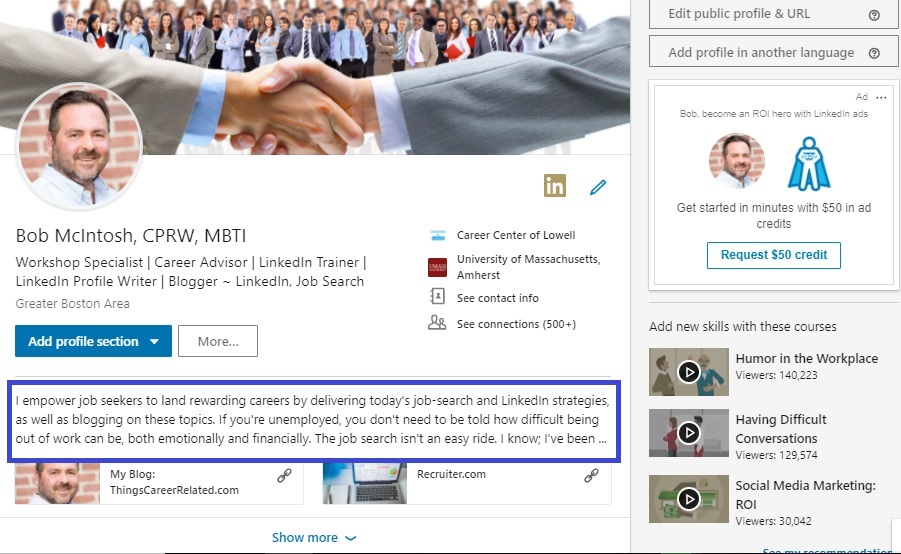
Bob McIntosh, CPRW, is a career trainer who leads more than 20 job search workshops/webinars at an urban career center, as well as critiques LinkedIn profiles and conducts mock interviews.
Job seekers and staff look to him for advice on the job search. In addition, Bob has gained a reputation as a LinkedIn authority in the community.
Recently he was awarded one of LinedIn’s Top Voices for his contributions on LinkedIn.
He started the first LinkedIn program at the Career Center of Lowell and created workshops to support the program. People from across the state attend his LinkedIn workshops.
Bob’s greatest pleasure is helping people find rewarding careers in a competitive job market. For enjoyment, he blogs at Things Career Related. Connect with Bob on LinkedInand follow him on Twitter.
Share this: Please share this post if you enjoyed it.
I estimate that I ignore 90% of invites from LinkedIn members, simply because they don’t include a personalized note. In fact, if I accepted all invites I’d probably have 10,000 connections in my LinkedIn network. This is not to brag; I’m just saying.
Why am I so adamant about people taking the time to personalize their invites? Short and simple, default invites suck.
The default invite on LinkedIn is: I’d like to add you to my professional network on LinkedIn. While it clearly states a hopeful networker’s intent, I need more. Something that tells me why we should connect.
Sending the default invite is akin to going up to someone at a networking event and saying, “Hi. What can you do for me?” It’s insincere and sends the message, “I’m inviting you to be in my network, but I could care less if you join.” Is this the type of message you want to send to a potential networker?
I believe there are three reasons why LinkedIn members don’t personalize their invites.
One, they just don’t get it. Or they haven’t been educated. I can only spread the word to the people who attend my LinkedIn workshops or read my posts. Even then some don’t get it.
Two, they’re using their phone to connect with others on LinkedIn. Although there is a way to send a personalized invite from your phone, most people don’t know how to do it. The process is very simple, so there’s no excuse.
To send an invite from your phone, go to the person’s profile, click the three vertical dots for androids or horizontal dots for iPhones, choose “Personalize invite,” write one, and hit send.
Three, they’re plain lazy. I think this is really the heart of the matter, and I hesitate to say it, especially out loud; but in essence this is what it comes down to. To me, a default invitation is a statement of want without a sign of reciprocation. And this defies the true definition of networking.
I and others, I’m sure, are more likely to accept an invite if a thoughtful note is attached to it. So what should you write if you want someone to join your network?
1. You might have something in common with whom you’re trying to connect. “Hi Susan, I’ve been following your updates and feel that we have a great deal in common. Would you accept an invitation to be in my LinkedIn network?”
2. Maybe you’re the bold type. “Hey, Bob. You and I are in career development. Ain’t that cool? Let’s link up!” I like this confidence, despite the slang.
3. You might want to take the calculated approach. “After reviewing your profile, I’m impressed with its quality and your diverse interests.” A little flattery never hurts.
4. Inviting someone to be part of your LinkedIn network is a perfect way to follow up with that person after a face-to-face meeting. “Sam, it was great meeting with you at the Friends of Kevin networking event. I looked you up on LinkedIn and thought we could stay in touch.”
5. Boost the person’s ego. “Bob, I read one of your posts and thought it was spot on. I’d like to connect with you.” Or “Jason, I saw you speak at the Tsongas Arena and what you said really resonated with me. I’d like to follow up with you.”
These are some suggestions that would entice someone like myself to accept an invite. When I’m sent an invite, I only request a personalized note—it’s not that hard, really. So rather than just hitting the Send Invitation button, take a few seconds to compose something from the heart.
Second, thank people for inviting you to their network
Is there anything worse than sending a “cold,” “lazy,” “uninviting” default message to a potential connection? Yes, it’s not thanking people who invite you to their network. Come on, this goes against what your parents taught you when you were a child.
It just makes common sense. If you receive an invitation to be part of someone’s network, reply to the sender by thanking them for being considered. It’s an honor the sender has chosen you, so show your gratitude.
In effect, this is similar to walking away from a conversation at a social gathering. Would you simply walk away from a conversation without saying, “Thank you for the conversation?” Simply do an about face and make for the door? I would hope not.
What to Write. Your note can begin with, “Thank you for the invite. And thank you for the personalized message.” And if you want to carry on the conversation, you might add, “It would be great to talk about our common interests, as we’re both in (the occupation). I’d be happy to call you at your convenience.”
Also thank your new connection for joining your network. All too often LinkedIn members invite someone to their network and then kill the momentum by not showing their gratitude.
To make professional online networking effective, you must keep the ball in play, keep the lines of communication open. Extend civility and appreciation for someone joining your network.
“Thank you for being part of my network” would suffice. Or you may add, “I invited you to be in my network because we’re both (occupation) or (interested in) and think we can be of assistance to each other.”
Personalizing your invites and saying “Thanks” are two very basic, yet important components of developing a solid relationship with your LinkedIn network. LinkedIn gives you the option to do neither. Don’t let LinkedIn let you get lazy.
It takes but a few minutes to connect with someone on LinkedIn the right way.
Have you, as a job seeker, experienced the bait and switch? Have you been called by a recruiter, invited in for an interview, only to find out that the “marketing” role was to sell Ginsu Knives?
I recall the Skype session I had with a woman like it was yesterday. I also recall how angry I was because it was your typical bait and switch. The woman, who I’ll call Joan, told me she had some referrals for me. I, not knowing better, believed her and was waiting with anticipation for the our Skype session to begin.
We arranged a time to talk. She sent me an email to put our “date” on my Google calendar. I told my wife I couldn’t pick up the kids at school. Would she mind leaving work early to get them? Yes, she reluctantly agreed.
The session began with small talk. Joan asked me what I do for work, even wanted to hear my personal commercial. Her inquiries were making this conversation sound legit. Why would she refer someone to me if I didn’t know what I do?
There were plenty of people who needed help with their resumes and LinkedIn profiles. Joan was overloaded with work and needed to know who to send to me; she would handle her core customers. Things were sounding good.
Would there be a referral fee, I asked. No, she said. There were other ways I could help her….
That’s when the conversation started to take a turn. At that point Joan told me to type in a website. What I saw in front of me was a website displaying hygienic products for men and women. My confusion lasted but a second, before I realized what was happening.
The bait and switch.
I gave Joan way too much time to explain the products to me before I told her that I was sorry; I was not interested in what she was selling, what she wanted me to sell.
She asked me why. There was soo much money to make, and all from the comfort of my own home. She could teach me. The marketing material is included, she ended.
No, sorry.
How much time had I wasted? Twenty minutes. I inconvenienced my wife, who had to leave work early to pick up the kids. I felt like I’d been had. To say I felt violated would be too strong. I’m sure, though, that many people have felt violated by the bait and switch.
Some of my clients have told me they’ve been contacted by recruiters who have asked them cursory questions until grilling them about some of their LinkedIn connections. The recruiters raised their hopes; all along they knew my clients were not a fit. The recruiters were only after my clients’ connections.
The bait and switch is evil
1. It’s dishonest. One thing I can honestly say is that I don’t go back on my promises to my kids. I believe in honesty. Ye who does the bait and switch must know there’s something inherently dishonest in promising one thing and delivering another. Think about how you didn’t renege on a promise to your kids.
Honesty is an important trait in an individual. Many employers seek honest employees, people they can trust to carry out the work required of them. When employees are dishonest, their bosses lose trust in them. The same holds true for employers; when they go back on a promise, it leaves a sour tasted in their employees’ mouth.
2. It hurts the violator’s reputation. I will never conduct business with Joan again. In fact, I’ve dropped her from my network. The taste she left in my mouth was so bitter that I can’t ever see interacting with her.
If anyone goes out of their way to ask about Joan, what choice do I have but tell the truth? None. I can only tell whomever asks to run for the hills. This woman’s reputation is definitely tarnished.
3. It gives sales a bad name. You don’t have to be a sales person to sell. We’re all salespeople because we all persuade. But once you persuade someone to listen to what you have to say and deliver another product, you give the art of selling a bad name.
Be honest. In your email, direct LinkedIn message, in an interview, or on the phone. Ask the person, in my case, “I have a pyramid scheme I’d like you to participate in. Are you interested?” This message is direct and doesn’t reek of a stereotypical used car salesman.
Recently I was shopping for cars for my daughter. We saw a Volkswagen Jetta listed on Carfax being sold at a car dealership 20 minutes from our home. My daughter was very excited. I called the dealership and specifically asked if the car was available. The woman who answered the phone told me it was.
You guessed it. When my daughter and I arrived, the sales manager met us on the lot with, “To make a long story short, the car is at a different location. But there are similar cars on our lot.”
I responded with, “To make this short, we’re leaving.” My daughter didn’t understand my abruptness and why I was mean to the sales manager. She said, “That’s so rude.” I told her that we just got a bait and switch.
“Baited and Switched? What does that mean?” she asked.
“It means someone tells you one thing and does another. Just like what happened now. It’s evil.”
“It sucks,” she said.
“Yes it does. Yes it does.”
Have you been the victim of a bait and switch? I’d love to hear your story.
I often come across job seekers who need a career change. They’ve had enough of their former career and want something more rewarding. I should know the feeling, as I have changed my career three times.
The LinkedIn profile is designed much like a chronological résumé, andthere’s nothing you can do about it. The order goes: Summary, Experience, and Education. The more extraneous sections follow.
The Experience section is typically the most important one of the big three. The Summary is also important, but LinkedIn’s recent move to truncate it, as well as remove its header, leads one to believe that LinkedIn has demoted it. Wouldn’t you agree?
1. Career changers, listen up!
If you’re changing your career, your friend is not the Experience section. Rather, your friend is the Summary section, which is now truncated in the Snapshot area. It’s in the Summary where you will express your value to potential employers, not the Experience section.
This said, it’s important that the first three lines (outlined above in my Snapshot area) of your Summary entice viewers to read the rest of it. If or when LinkedIn returns to the complete Summary, this may not be as important.
2. Career changers can’t rely on the Experience section alone
Your Experience section will consist of responsibilities and accomplishments that don’t necessarily match those of your new career. You need to showcase the skills and experience that will make your transition almost seamlessly.
A typical chronological format wouldn’t work with your résumé, so why would it work with your LinkedIn profile? Presenting a chronological document would require the employer to search for your relevant skills, like a needle in a haystack.
Therefore your message needs to be delivered before the Experience section, and it needs to be delivered clearly.
3. This is where the Summary comes to the rescue
How do you show your value on LinkedIn? The answer is quite simple; you showcase your value in the Summary section, and you focus mostly on the accomplishment statements that highlight relevant transferable skills.
Take this career-changer scenario: you’ve been a public relations manager in technology for seven years but want to change to a program coordinator in the nonprofit.
The ability to make this change might seem like a leap to some, but with strong transferable skills, e.g., program coordination, communications, leadership, and outreach, you have a great chance of making this happen.
Using this career-change scenario, your Summary will include an introduction, three or more paragraphs describing your strong transferable skills, and a conclusion stating your career goals.
Intro (with strong opening statement)
THE VALUE I DELIVER
I develop programs that consistently increase participation by 80%. My enthusiasm for working with colleagues to produce results for the organization is evident by my willingness to collaborate on multiple projects.
Learn how I’ve demonstrated skills in program coordination, communications, leadership, and outreach.
Value-added body (strong transferable skills in all CAPS)
PROGRAM COORDINATION
I’ve demonstrated strong program coordination, as demonstrated by supervising events and services, including work allocation, training, and problem resolution. Further, I’ve Increased sales leads 150% from Q1 to Q4, 2016, by creating a community outreach event.
COMMUNICATIONS
My president trusted my writing abilities to the point where she stopped proofing the ghost articles I wrote. As well, I wrote press releases and spoke at trade shows with no supervision. Currently I write a blog addressing marketing strategies.
LEADERSHIP
Within two months of becoming the MARCOM writer, I was promoted to public relations manager, where I oversaw a staff of five. I also communicated directly with the director of sales in weekly meetings. I was acknowledged by the VP of marketing as a “natural born leader.”
OUTREACH
Read what the VP of Sales at XYZ, Inc said: “Tom has opened new territories that have resulted in increased sales. He is extremely adept at creating relationships with important partners, VARs, OEMs, the Media, and most importantly our customers.” Jack Jones
Conclude with career goals
CAREER GOALS
With strong transferable skills to bring to your organization, I am excited to contribute as a versatile program coordinator. I have proven experience in program coordination, communications (both written and oral), leadership, and outreach. I can be reached at (email) and (telephone number).
As a career-changer, the Summary is the most important section of your profile. Simply writing a brief Summary and relying on your Experience section will make it more difficult to help employers understand how your previous experience can be transferable to your new career.
If you want to learn more about LinkedIn, visit this compilation of LinkedIn posts.
Share this: Please share this post if you enjoyed it.
Spending as much time on LinkedIn as I do, I notice how often my network contributes. Some are consistent and strike an even balance, others do not. In this post, I’m going to address the five types of Linked contributors.
I’ve always asserted that there are three components of your LinkedIn success:
It’s the third component that can be as important as the other two. By engaging with your connections, it keeps you top of mind. I use the familiar cliche when I explain the importance of engagement by saying, “Out of sight, out of mind.”
The five types of LinkedIn contributors
1.The non-contributor. Some of you might relate to this. You were an accountant until recently laid off. While you were working, one of your colleagues—maybe your colleague—said, “Hey, you should join LinkedIn. I hear it’s important to be on it.”
So you joined, not quite sure why, and let your profile sit. You accumulated 10 connections, because these were the 10 people you knew at work. You would get invitations, which sat in your My Network queue.
Now that you’re looking for work, you have no activity to speak of. In other words you’re nonexistent. You’re not getting any hits from recruiters, have no endorsements, not getting invites, don’t know how to share an update.
2. Enough to be dangerous. If this is you, I want to say it’s almost worse than not contributing. You’re trying to do what you’ve been told by someone who was kind enough to give you advice. Perhaps your heart just isn’t into it.
Your profile is strong. There’s no problem here. In fact, you hired someone to write it for you. You were pumped when it was done. The person who wrote your profile mentioned numerous times that you have to 1) connect with ten quality connections a week and 2) engage with them.
The problem is that you are forgetting the last piece. You’re hoping that optimizing your profile with keywords will draw recruiters to you. However, optimizing your profile with keywords only works if you’re active and well connected.
You have potential, though.
3. Busting your ass to catch up. Someone managed to get it through your head that being a contributor on LinkedIn is crucial to being found. Your profile is strong and your network in good shape.
You’ve been contributing, which includes: sharing articles, mentioning industry trends, giving sage advice, asking questions, sharing news about your colleagues. All good stuff, but it’s gonna take awhile before your getting noticed like you want.
I see you on LinkedIn contributing like a fiend. I see you six times a day. I won’t say your engagement reeks of desperation, but…. Here’s the thing, there is such thing as contributing too much.
It will take time to establish yourself, so be patient.
4. Addicted to LinkedIn. This is a bad thing, but you can’t help yourself. The worst thing you did was install the LinkedIn app on your phone. Just like people who are constantly checking their Instagram or Facebook accounts, you’re opening your LinkedIn app.
In fact, you’re posting updates and answering questions while you’re waiting for your son to get out of school, your wife to get off the train, during family gatherings. Yes, you’re concealing your phone underneath the table.
What’s alarming is the number of times you’re sharing updates. Ten times a day is a possibility. Five times a day is a definite. As well, you’re following your connections on a daily basis. You feel you know them as if you met them in person.
I tell my LinkedIn workshop that at minimum they should be on LinkedIn four days a week. Their jaws drop. After pausing, I tell them that the optimum amount should be every day; yes, this includes Sunday. And I finish by telling them not to be like me.
Perhaps you should seek professional help.
5. Strike a nice balance. I’ve seen people who’ve disappeared for months, if not years, only to return with enthusiasm. This isn’t you. You are on LinkedIn almost every day. You share posts twice or three times a day. They are relevant to your LinkedIn community.
You’re also consistent in contributing on LinkedIn. People know when you will share updates and look forward to your posts. I envy you. Yes, I envy you because I am a member of the fifth type of contributor.
Keep doing what you’re doing.
Now that you’ve learned about the five types of LinkedIn contributors, which one are you? Are you barely on LinkedIn to the point where you shouldn’t bother or are you a LinkedIn addict like me. Or, do you strike a nice balance? I would love to hear your story, and I promise not to judge.
How could I judge?
If you want to learn more about LinkedIn, visit this compilation of LinkedIn posts.
Share this: Please share this post if you enjoyed it.
On a visit to my brother’s school (he was a principal at the time), I noticed a whiteboard in his office with various notes on the school’s vision written on it. “Brainstorming session?” I asked. He nodded with a smile on his face.
I thought to myself that I wouldn’t want to have been in that room when a group of people who were throwing ideas against the wall to see which ones stick. Furthermore, there were probably others who felt the same. Brainstorming is good, right?
One of my valued connections recently alerted me to an article, Is Agile Stifiling Introverts? The article decries the concept of a system that values brainstorming sessions as part of open work environments. While extraverts may prosper in an Agile environment, introverts may find it disconcerting.
Agile is often credited with company success, but opponents have concluded that its productivity is in question. The article states: “For years Agile has been encouraging teams to work together collaboratively in open spaces and encouraging developers to pair program, but lately these types of practices have been coming under fire.”
Susan Cain, the author of Quiet: The Power of Introverts in a World that Can’t Stop Talking, explains that introverts excel in closed environments as opposed to open ones. A self-professed introvert, she supports the belief that a closed environment brings out creativity in introverts, not open environments like those depicted in the movie about Facebook, Social Network.
As an introvert I consider brainstorming sessions a waste of time if there is no semblance of order and structure. I grow weary of meetings that resemble a social gathering. However, a well-run meeting that covers all the topics in a quick manner can be extremely effective.
What has proved to be effective with introverts is paring them up with someone to solve problems, rather than chaotic brainstorming sessions, even if one works with someone who is not in total agreement. “Working alone is good for creativity – but being paired with someone who thinks differently from you can lead to more creativity yet,” states the aforementioned article.
Why introverts appreciate closed work environments with offices and cubicle supports a number of beliefs about I’s, such as they learn and gather more through independent research. They don’t want the distractions of colleagues walking into their workspace uninvited. A closed environment also gives them time to recharge their batteries if they’ve been interacting with groups or speaking in front of an audience.
Does this mean introverts are anti-social? No, but they’re not like their counterparts who seek out the company of others. Although it’s true some introverts, such as the stereotypical programmers, need almost complete privacy; many introverts can join the fracas and engage in office conversation. But, again, their preference is to be alone when it’s time to get down to work.
Cain is quoted in the article about the importance of solitude for introverts: “Solitude, as Cain says, is a key to creativity….Steve Wozniak claimed he never would have become such an expert if he left the house. Of course, collaboration is good (witness Woz and Steve Jobs), but there is a transcendent power of solitude.”
Pay attention in interviews
Job seekers can gain a lot from understanding their introversion or extraversions preference. At interviews they should make careful note of the work environment and ask questions pertaining to collaboration (brainstorming).
If introverts get the sense that it’s an Agile-type environment, it may not be the organization for them. Extraverts, on the other hand, would be happy to know that they’ll be among the social, freewheeling types.
Leaving my brother’s school, I asked him if he gained results from brainstorming. He smiled, saying that he finds it a great way to gather ideas, as well as letting people get to know each other better. Hmm, my ears were hearing “social gathering,” which to me doesn’t equal productivity.
Brian Ahearn is one of my favorite writers because his message is so clear and relevant. This guest post addresses Unity, one of Cialdini’s seven principles of influence. Read Brian’s story to the end. It’s quite moving.
My father is a Marine. He served from 1962-1967, having done a couple of tours in Vietnam. You might be thinking, “No, he was a Marine,” but you’d be wrong. If you’ve ever met anyone who served in that branch they always say, “I am,” not, “I was,” because they’re Marines for life.
Something I’ve always noticed about my father is this; when he meets another Marine, particularly one who has seen combat, you’d think he was closer to them than me, his own flesh and blood. My father wrote about his Marine experience and opened with this:
“Once while with friends, I was asked the most significant thing I had ever done in my life. My answer was quick and to the point, ‘Being a Marine and leading men in combat!’ My wife Jo, whom I dearly love, looked sad. I then said, ‘Marrying you was the second best.’”
His experience is a perfect example of Robert Cialdini’s seventh principle of influence – unity. Unity, a recent addition to Cialdini’s long-standing six principles of influence, goes well beyond the principle of liking.
Liking tells us it’s easier for us to say yes to people we know and like. One way to engage liking is by referring to what you have in common with another person. Commonalities could include having the same hobbies, growing up in the same town, attending the same college, or cheering for the same sports team to name just a few.
Unity goes beyond liking because it taps into having a shared identity with another person, which is much deeper than simply having something in common. Cialdini puts it this way, “The relationships that lead people to favor another most effectively are not those that allow them to say, ‘Oh, that person is like us.’ They are ones that allow people to say, ‘Oh, that person is of us.’”
I would imagine people who attended the same college and played the same sport, even if they played at different times, feel a very strong sense of unity too. For example, in Columbus, Ohio, there’s nothing bigger than Ohio State football. If someone played ball for the Buckeyes they’re part of a lifelong brotherhood. I’m sure former players at Notre Dame, USC, Alabama and other programs feel the same way.
Other examples might include:
Being part of a fraternity or sorority.
Connecting with distant relatives.
Growing up in the same neighborhood.
Winning the same award (Grammy, Oscar, Nobel Prize).
In a sense, each of these makes you part of a certain club or class that sets you apart. When you engage another person on the level of unity it’s as if you’ve connected on liking but on steroids. It’s much more powerful because, as Cialdini writes, “We is the shared me.”
Don’t worry, you don’t need to be a jock, Marine, frat boy or award winning actor/actress to connect on unity. In Pre-suasion Cialdini sites some activities that can lead to a sense of unity and that’s what we will explore next week.
Brian Ahearn, CMCT, is a sales trainer, coach and consultant whose specialty is applying persuasion and influence in sales and customer service situations. He is one of 20 individuals in the world who currently hold the CMCT designation. Brian’s blog, Influence PEOPLE, is followed by people in 200 countries and made the Online Psychology Degree Guide Top 30 Psychology Blogs in 2012.
Share this: Please share this post if you enjoyed it.
I began reading what started as a great blog post. The topic interested me, the writing was humorous and demonstrated expertise. I was settling in for a good read, but there was one major problem; this post was too long.*
When the scroll bar was only a third way down the page, I was wondering when this darn thing was going to end. So I scrolled down the rest of the way only to find out that, yes, my suspicion was correct, I was reading a novel on the topic of the résumé.
Sadly, I stopped reading this promising article.
My purpose today is not to write about the ideal length of a blog post. No, I’m writing about the importance of why brevity is important in your job search and at work.
Brevity in your written communications
Résumé
The debate over the one- or two-page résumé has some merit. My answer to this one has always been, it depends. If you can write a one-page résumé that covers all your relevant accomplishments, do it.
Otherwise your two-page résumé has to be compelling enough for the reviewer to read. Often we’re in love with our own words, but this doesn’t mean others will, especially if what you write is superfluous.
LinkedIn profile
Thankfully LinkedIn puts limits on characters for its profile sections. For example, you’re only allowed 2,000 characters for the About and Employment sections, 120 for your Headline, and other character limitations. This has caused me to think more carefully about what I write on my profile.
For everything you want to know about character limits, visit Andy Foote’s article which addresses this topic in great detail.
Twitter
Jack Dorsey, the creator of Twitter, had something going when he launched a social media application that allowed users to tweet only 140 characters (now 260). At first I was frustrated with the limitation—and I still think it’s too short—but I’ve since come to see the brilliance of this model.
The twesumewas created to make the hiring process quicker. One simply wrote a 140-character tweet with their résumé attached. If the recipient was drawn to the tweet, they would open the applicant’s résumé. Sadly, the twesume didn’t take hold.
Email
Don’t you hate long e-mail messages? If you’re nodding in total agreement, you and I are on board with this one. The general rule is that if your e-mail to a supervisor or colleague exceeds two paragraphs, get your butt of your chair and go to his office.
A good rule of thumb is to write your brief message in the Subject Header, e.g., Meet for a marketing meeting at 2pm in the White room on Tuesday, 11/18. The body of the e-mail can contain the topics to be discussed.
Brevity in your verbal communications
Networking
Brevity is also important when you’re networking. People generally like to be listened to, not talked at. Allow your networking partners to explain their situation and needs, and then try to come up with solutions.
Conversely, your networking partners should want to hear about you. On occasion you’ll come across people who don’t get the listening aspect and will make your networking experience painful.Do people the favor of listening to what they have to say, and give your advice with concise answers.
Interviews
While in an interview is not a time when you want to ramble on about irrelevant details. Answer the questions as concisely as possible, while still demonstrating value. If the interviewer needs to know more, he’ll ask for clarification or deliver a follow-up question.
Many people have lost the job opportunity because they talked too much. When I conduct mock interviews, I sometimes feel as though I’ll nod off and lose my concentration.
I’m not the only one who feels this way. People who’ve interviewed others will concur that long answers can be so painful that they’ll end the interview before asking the remaining questions.
At work
At work you must practice brevity when required. It’s said that extraverts tend to talk more than introverts, whereas introverts are better listeners. Try to be an ambivert—a mixture of the two dichotomies. Apply the proper amount of listening and talking.
Keep this in mind when you’re speaking with your manager, as she is extremely busy. So state your business as clearly as possible and listen carefully to her suggestions. The same applies to meetings. Don’t dominate them by interrupting and talking on too long.
I’m brought back to the blog post I couldn’t finish, which I’m sure is very good, because it was too long. It’s a shame I’ll never find out, and I wonder if those who provided comments actually read the whole post.
*Apparently the ideal length of a post is approximately 750 words. I’ve failed this rule by 52 words.





 Why am I so adamant about people taking the time to personalize their invites? Short and simple, default invites suck.
 I and others, I’m sure, are more likely to accept an invite if a thoughtful note is attached to it. So what should you write if you want someone to join your network?












 Things Career Related