Category Archives: Career Search

3 times when LinkedIn is essential for your professional career

I am fortunate to lead career-search workshops and counsel job seekers individually. While some of my clients fully embrace the power of  LinkedIn to land a job, others don’t make great use of it. Some outright reject it.

LinkedIn Flag

As an example of the latter, one of my clients came to me, with tears in her eyes, after a LinkedIn workshop telling me that she appreciated what I taught her, but that she wouldn’t use it. I told her that it is alright, LinkedIn isn’t for everyone.

I’m feeling optimistic today and am addressing LinkedIn members who embrace the power of this professional networking platform. There are three times when LinkedIn is essential for your professional development.

When you’re looking for a job

If you are a job seeker, your journey with LinkedIn will be challenging. You will have to develop a profile that, like your résumé, will express your value and brand you. Unlike your résumé, it should depict you on a more personal level.

Yes, you’ll include your accomplishments and maybe some of your outstanding duties; but you’ll also elaborate on your volunteerism, create an extensive list of your skills, ask and write recommendations, and more. This is your online brand, so put a great deal of effort into it.

You’ll also have to get to work on building your network. To many people this is a hard thing to fathom. Reach out to people I barely know, you may wonder? Absolutely…but only the people who will be of mutual benefit. This isn’t Facebook, so you need to develop a professional network.

But reaching out on LinkedIn to unknown people isn’t enough, you’ll need to “touch” them in a personal way. Call them on the phone. Meet them for coffee. At the very least, communicate via email.

The third piece of your LinkedIn campaign is engaging with your new connections. Now that you have a stellar profile and have developed a network consisting of quality connections, it’s time to engage with your first degree connections. The old saying, “Out of sight, out of mind” holds true.

Direct messages are the best way to engage with one or a few of your first degree connections, but if you want to reach more of your first degree connections (and their connections); you can share articles, ask questions, answer updates others have started, and Like and comment on shared updates.

When you’re working

ResearchMany people make the mistake of discontinuing their engagement on LinkedIn. Saying that you don’t have the time or energy is an excuse. Sparing even 10 minutes a day is better than nothing. I still encourage people who are working to use LinkedIn every day.

First, announce your new job, if you haven’t already. Let people in your network know; they will see your Happy Landing in their homepage timeline. You will be congratulated on your new employment.

As well, be willing to alert your networking buddies to available jobs at your new company. Many of my clients have alerted their buddies to positions that are opened, and not necessarily advertised. This is the true definition of “paying it forward.”

Update your profile. Whenever you achieve an accomplishment, add it to your new position. If you don’t do this shortly after you’ve achieved an accomplishment, you may forget about it. Another reason to keep your profile updated is that you’ll be more desirable to potential suitors.

My valuable LinkedIn connection, Laura Smith-Proulx warns that you may not want to be too present on LinkedIn. You’ll want to update your profile slowly, as to not draw attention from your new employer to your profile.

This doesn’t mean you can’t stop learning while you’re working. You can read posts written by your connections or your favorite online publishers. Do this during lunch, or when you get in early in the morning, or at home. This could be your 10-minutes a day of using LinkedIn.

LinkedIn is not only a great tool for finding a job, it’s highly effective for generating business. If your role is in sales, business development, or any other position which requires networking; use LinkedIn to reach out to potential business contacts. This, after all, is why LinkedIn was created in 2003.

The best of LinkedIn’s premium accounts for sales is Sales Navigator, which provides salespeople with the ability to identify potential buyers and tag them to keep their CRM manageable. As well, you get unlimited searches. This is a premium account that your company will most likely pay for if they value generating sales leads.

Read 6 reasons to use LinkedIn after you’ve landed a job.

When you’re in school/post grad

Elevator Your FutureRecently I conducted a webinar for college students and grads, addressing the importance of creating a powerful profile and connecting with LinkedIn members.

Although as a college student your profile may not be as developed and your work history not as extensive as people in the workforce for many years, you can still use LinkedIn to find employment or internships.

This is a great time for you to get on LinkedIn, while you have the opportunity to build your LinkedIn campaign. I call this getting on the elevator on the bottom floor. You have the opportunity to build up your network with quality connections.

Valuable connections can be alumni of the school you’re attending or have graduated from. These are people who have an affinity for their alma mater and, as an extension, an affinity for you. Think networking meetings when reaching out to them.

However, as someone who could provide you with great advice or even solid leads, they will only do so if you come across as a mature, dependable person. They will want to help but don’t want to waste their time.

How do you find your alumni? The answer is simple; use LinkedIn’s Find Alumni feature, which is done by typing your university in the Search feature, choosing School or Company, and then clicking See Alumni. You can search “alumni by title, keyword or company.”

One disadvantage you’ll have to deal with is the inability to rearrange your profile sections. As of now, your sections are arranged as such: Summary, Experience, Education, and others. Many students and post grads can benefit from showing their Education section below their Summary, as it is their most recent accomplishment.

The solution to showing your value is to pack your Experience section with industry-related employment or internships. The smartest students secure as many internships as possible during the school year or summers.

When describing your internship or industry-related employment, be as descriptive as possible. At your age, you may not have the outstanding accomplishments that older workers can tout. But most employers will understand your lack of work experience as long as you’re a quick learner and work hard to get up to speed.


Whether you’re a job seeker, employed, or a college student; LinkedIn can be extremely helpful for your career development. The way you use it will vary, but many of the principles are the same.

If you want to learn more about LinkedIn, visit this compilation of LinkedIn posts.

Nailing the interview process, part 3: research, research, research

You’ve heard it over and over again: you need to do your research before an interview. Why? Because:

  • When you do your research, you’re more prepared.
  • When you’re more prepared, you’ll be more confident.
  • When you’re more confident, you’ll do better.

Research

The last thing you want to do is wing it in an interview. You’ll fail, especially if the interviewer is good at their job.

What, exactly, should you research before your interview? Here are four areas the interview will likely cover:

1. The Position

This should go without saying. Most of the questions an interviewer poses will address the position, so you’d better know your stuff.

The most obvious resource here is the job description. A well-written job description should provide valuable information like the skills and experience required for the position. Descriptions will often list these things in order of priority.

Go to the “Required Experience” section of the job description first. Note the list of skills and experience and the order of priority.

You can take your research on the position further by talking with someone who works in the company to which you’re applying. Ask if there are any additional requirements not listed in the job description. You may uncover key requirements that were not mentioned in the listing.

2. The Company

One of the top pet peeves of interviewers is when candidates do not know much about the company. Interviewers want to know you’ve taken the time to research the company, and they want to know you’re truly interested in working for the organization.

The very least you can do is visit the company website. Most company websites will feature an “About Us” page. Read this first. The site will also likely have a “Products” and/or “Services” page. Read these, too. If the company is global, it may list its locations and the functions each performs.

The problem with company websites, however, is that the content they feature is all marketing content, engineered to paint the organization in the most positive light possible.

You’ll never get the whole truth about a company through its website, unless the company is publicly traded. In this case, the website will have annual reports that will reveal more objective information on financials, shareholder information, etc.

It’s a good idea to reach out to people you know in the company for more information about it, particularly the culture.

3. The Industry and Competition

Top candidates will know about the industry in which the company operates. This is information you can gather from labor market research websites, such as Glassdoor.com, Salary.com, and O*Net OnLine. You can always turn to Google, too.

With sites like these, you can gather information on occupations, salaries, the skills employers are looking for, and available positions in your area. Glassdoor is a particular favorite among job seekers, as it features employees’ reviews of their own employers.

You can also check out SpyFu to learn about how an employer advertises and its intended audience. Social media sites like LinkedIn, Facebook, and Twitter are also useful as well.

As mentioned earlier, public companies are required to share press releases and annual reports. Read the documents of your potential employer’s competitors. If you can cite your desired company’s competition’s statistics, you will impress the interviewer very much.

Once again, it’s important to reach out to people who work in the company to which you’re applying. They will probably have a good sense of who the relevant competitors are based on the department you’re targeting.

4. The Interviewers

Finally, you’ll want to research the people who will be interviewing you.

If you have the names of said people ahead of time, the best tool is LinkedIn. Even if you don’t know the names of the people who will interview you, you can use the site’s “Companies” feature to find people in various departments.

For example, if you are applying for an accountant position, search the company using the keywords “accountant, manager.” You will see the company’s accountant managers.

Read through their profiles to see what you have in common with them. It could be that you attended the same school, you enjoy the same activities, you volunteered at similar organizations, or something else. During the interview, try to talk about what you learned about the interviewers when given the opportunity.

Not to sound like a broken record, but you really should reach out to someone you might know in the company to ask about the person or people who will be interviewing you. They may be able to give you great information about your interviewer’s likes and dislikes.


Researching the mentioned areas will put you an advantage over the other candidates. to show off your research, mention it explicitly. Begin sentences by saying, “While I was researching the competition, I learned …”.

Remember, when you’re prepared, you’ll do well in the interview.

Check back next week, when I’ll be talking about the importance of practicing for your interview.

This post originally appeared in Recruiter.com
Photo: Flickr, Rahul Panja

Nailing the Interview Process, Know Thyself: Part 2

Interviewing for a job is tough, whether you’re actively or passively seeking. If it were so easy, people like me wouldn’t have to provide advice on how to interview. One of the challenges of the interview process is knowing yourself, really knowing yourself.

reflection

Before you even start the interview process, I’d like you to do a very simple exercise. Take it seriously, as it will give you a better sense of yourself and how you need to approach the interview process.

Some of you have done SWOT analysis at work, so you’re familiar with the concept. The acronym stands for strengths, weaknesses, opportunities, and threats. Below is a brief explanation of how a SWOT analysis is used in the work setting.

“SWOT analyses can serve as a precursor to any sort of company action, such as exploring new initiatives, making decisions about new policies, identifying possible areas for change, or refining and redirecting efforts midplan.” BusinessNewsDaily.com

SWOT

From the diagram above, you can see how to handle the four components of a SWOT analysis. Let’s go through all four components.

Strengths

When you analyze your strengths, think about the those that will help you for the position for which you’re applying. Try to address as many of them in the job posting you can. Further, think about how you can achieve at each one.

Here is a list of skills for a specific marketing specialist position:

1. Innovation. You have demonstrated innovative approaches to create marketing campaigns. You introduced one company for which you worked to paperless marketing, social media to another, and virtual tradeshows to your previous company.

2. Business to business marketing. You’ve done this successfully for many years. Included among many of your business partner are seven blue-chip companies.

3. Strategic Thinking. You’ve demonstrated the “ability to think strategically and analytically to ensure successful marketing campaign execution” and can come up with numerous times you’ve done this.

4. Cross-Functional Work. You’ve worked across multiple organizations, including engineering, sales, fiance, webdesign. You’ve demonstrated excellent interpersonal skills.

5. Understanding Customer Behavior. At your previous position, this was a large part of what you did. You worked with business development to determine the best way to target marketing efforts.

6. Strong written and verbal communication skills. You can prove this with the experience you’ve had communicating through written and verbal communications with the press, trade magazines, partners, and customers.

7. The Required Soft Skills. “Solid organizational and project management skills” and “attention to detail and demonstrated ability to multi-task.”

Try to think of at least 10 strengths that you can apply to this position and others.

Weaknesses

Be honest about listing your weaknesses. Determine how you can overcome these weaknesses, as it is important to demonstrate in an interview not only that you have weaknesses but also how you can overcome them.

1. Business to Customer. You have limited experience to this type of marketing, but you’ve shown the ability to interact well with consumers as a retail associate and, therefore understand their needs.

2. Working with Certain Departments. You have limited experience working closely with internal marketing analytics teams to define requirements for product test plans and campaign analysis.

Be honest with yourself and try to think of three or more weaknesses. 

Opportunities 

Opportunities can be anything that makes a job appealing, such as work-life balance, commute, increased income, opportunity for advancement, landing a job quickly.

Great Working Environment. From talking with people you know at the company, you know the company offers team unity, opportunity for advancement.

Work with Previous Colleague. Your previous boss and you got on very well when you were at Company X. You look forward to working with her again.

Your network is strong. This will provide you with many opportunities for a position like this one. You know people in management, as well as others who work there. Companies prefer to hire those they known, e.g., referrals.

The more examples of opportunities you can think of, the more positive you’ll feel about any jobs for which you apply.

Threats

Threats are factors that are difficult, if not possible, to overcome. These can be sticking points during an interview.

Education Requirement. You lack a Bachelor’s degree in what the company desires (Business, Economics, Marketing, Mathematics) and have no resources to acquire one. There is a loophole that says “or a related one.” Your degree in English has served you well in the past.

Experience. “Previous marketing internship experience” is a red flag. It appears that the company is looking for younger, less expensive candidates. Perhaps the company will consider a more experienced employee for the position, or they might develop a position more senior for you.

Some threats can be overcome with a little imagination. 


In the next post we look at the importance of research, research, research before the interview.

This post originally appeared in Recruiter.com.

Photo: Flickr, Torkel Pettersson

Nailing the interview process, Part 1: Be Mentally prepared

Succeeding at the interview begins before you sit in the hot seat. The first step is being mentally prepared. This means overcoming the negative feelings that came with losing your previous job.

Despondent

To lose a job for any reason can be a blow to your self-esteem. Even if you were let go simply because the company had to cut costs, you may feel like you’ve failed. Some of my clients feel responsible for being laid off, even though it wasn’t their fault.

It can be particularly devastating if you’re let go because of performance issues or because you didn’t see eye-to-eye with your manager. You may feel that you’re incapable of becoming again the productive employee you once were.

The same applies to having to quit under pressure. Your boss was constantly harping on you for small mistakes or accused you of missteps that you know were the correct actions. Because they’re the boss, though, they hold the power.

Many unemployed can’t let go of what went wrong. They lose sight of what they did well at work. Negative thoughts swim through their minds. What can a person do to get back on track?

1. Don’t deny your despondency

You may be experiencing feelings you’ve never had before: bouts of crying for no apparent reason, a short temper with family members and friends, a lack of motivation. These feelings are symptoms of unemployment. You’re not going crazy.

When I was out of work, I tried to recognize the feelings I was experiencing. It wasn’t always easy, but I realized my unemployment was temporary. You should also realize your situation is temporary.

2. Take a hiatus

You’ve heard the saying, “Get back on the horse.” This is always a good idea, but you don’t have to do it immediately. I’ve known job seekers who have taken a week off to regroup and get their bearings again. While some might believe that you should begin your job search the day after you lose your job, it would be better to clear your mind first.

This said, don’t take a full-on vacation, as many job seekers do. Even during the seemingly slow summer months, employers are hiring. Take a hiatus, but don’t waste long periods of time.

3. Evaluate the situation; be able to explain why you’re out of work

Given three reasons why you are unemployed – you were laid off, let go, or quit – determine which applies in your situation. To be able to explain to others why you lost your job, particularly in an interview, you must be able to explain it to yourself.

If you were at fault, own up to it. Then, determine how you will act differently next time so as not to repeat the same mistake. Most likely you’ll have to explain, albeit briefly, your situation in an interview. Show self-awareness. This is a big step that you’ll need to make.

4. Tell people you’re out of work

walkingThere’s no shame in being out of work. Whenever I say this, I’m sure many job seekers mutter under their breath, “What would you know?”

Plenty. When I was unemployed, it wasn’t easy for me to tell others I had been laid off, even though it wasn’t my fault.

In order for others to help you, they need to know you’re looking for work. The people you tell shouldn’t be limited to your former colleagues and supervisors. They should include family, friends, and acquaintances. Even your brother who lives thousands of miles away might hear or read of an opportunity local to you.

5. Be willing to ask for and accept help

I find this to be one of the most challenging roadblocks for many people; they just can’t bring themselves to ask for help.

There are two things to remember here: One, your job search will be shorter if you have help; two, most people like to help those in need.

Helping others gives people a feeling of achievement. As someone out of work, you will experience the same, so pay it forward.

This isn’t to say you should approach everyone in you community and ask, “Do you know of any jobs for me?” To tell people you’re out of work and explain the kind of job you’re seeking should be enough.

For safe measure, you may want to ping people to stay top of mind. An occasional request like “Please keep your ear to the pavement for me” should suffice.

6. Don’t sleep the day away

As difficult it may be, you need to develop a routine. You don’t have to rise at 5 a.m. so you can go to the gym before work, but getting up every morning at 6 a.m. to take a walk, eat breakfast, and get out of the house would be much more productive than sleeping until 10 every morning.

You’ll feel much better if you are productive than you would if you rose late and watched television all day. I honestly believe that developing a routine is essential to your mental health – and to finding a job.

7. Seek professional help if necessary

You’ll probably experience many feelings, such as anger, fear, and self-doubt. If you become consumed with these feelings, it might be best to seek the help of a therapist. This is not unusual – trust me. I went through a plethora of feelings and, yes, I did talk with a professional. It allowed me to clear my mind.

If it gets to the point where you can’t see the future – where all you can think about are the past and present – this may indicate you’re experiencing depression. It’s worth talking to a therapist when you reach this stage.


It’s hard for some people to understand how difficult unemployment can be. It hurts your self-esteem, destroys your familiar routine, and can even cause embarrassment. Following the above steps can help you mitigate this negative experience.

Look for part 2, Know Thyself, next week.

Photo: Flickr, Silja
Photo: Flickr, David

This post originally appeared in Recruiter.com

10 ways that test your courage in the job search

Although I understand my workshop attendees’ reluctance to speak in front of their peers, I also think when given the opportunity, they should take it. They should, for example, deliver their elevator pitch without warning. “Tell me about yourself” is a directive they will most likely get in an interview.

courage

They should also not pass on answering interview questions I spring on them. Can they take the fifth during an interview? Hell no.

“Tell me about a time when you solved a problem at work,” I’ll ask. “I’d rather not,” they say. Okay, see how well that goes over at an interview.

Some of you might disagree with my insistence that they deliver their unrehearsed commercial or answering an interview question when they least expect it.

You might think it’s putting them on the spot, making them feel uncomfortable, testing their courage. Darn tooting it’s testing their courage. Despite what anyone says, the job search requires courage.

1. Being put on the spot in front of other job seekers by having to deliver your personal commercial or answer difficult interview questions on the spot, are some ways that test your courage. There are nine other difficult ways your courage will be tested in the job search:

2. Telling people you’re out of work. I know this seems like a no-brainer, but how can people help you if they don’t know you’re out of work? People tell me they’re embarrassed because they lost their job, even if the company was suffering and had to release employees.

I encourage them to let as many people as possible know they’re looking for a job, even if it means they’ll be embarrassed. It takes courage to do this, but it’s counterproductive to try to go it alone.

3. Attending organized networking events. You’ve read that “no one likes networking events.” This may be true for you, for others, for most. But networking events offer the opportunity to engage in conversation with other job seekers who are at these events to seek leads, as well as provide leads and advice to you.

4. Having others read your résumé or cover letter. Although you think you’ve written a great cover letter, you may be surprised by what others think about it. Like the time my wife told me she thought cover letter was “verbose.”

I’m not sure she used that word, but I got the picture that someone reading it would think it intimidating or laborious. Asking her to read my cover letter took courage and prompted me to edit it.

5. Participate in mock interviews. This may be the closest you’ll get to an actual interview. Mock interviews are a valuable teaching tool and any organization that offers them is providing a great service.

But they don’t have to be conducted by a professional job coach/advisor; a friend of yours can conduct them. Having a camera to record your answers and body language is a big plus. I remember being asked to participate in a mock interview years ago. I flatly refused. I lacked courage then.

6. Reaching out to your LinkedIn connections. Introverts may understand this act of courage more than their counterpart. Your LinkedIn connections are not bona fide connections until you reach out to them in a personal way, as in a phone call or meeting them for coffee.

Some of the connections I’ve reached out to have proven to be great networking partners, while others had little in common with me. Oh well. Doing this takes courage.

7. Approaching former supervisors for LinkedIn recommendations. My workshop attendees often ask me if they should reach out to their former supervisors for a recommendation. My answer is a resounding “Yes.”

This may take courage for some, but having recommendations on your LinkedIn profile is a must. What your supervisor feels about your performance weighs heavier than how you describe yourself. What’s the worst your supervisor could say? Yep, “No.”

8. Getting off the Internet. Not completely, but use it seldom and in different ways. Instead of defaulting to your comfort zone like Monster.com and other job boards, use LinkedIn to find relevant connections through its Companies feature, and visit your target companies’ websites to conduct research on the labor market.

Contact those companies with a networking email  to ask for networking meetings. This takes courage but will yield better results than using the job boards alone.

9. Speaking of networking meetings. Otherwise known as informational interviews, networking meetings have been the reason for many of my job seekers’ success in landing jobs. But they don’t come easy, as many people are busy, so it takes courage to ask for them.

Once you’ve secured a networking meeting, remember you’re the one asking questions about a position and the company, so make the questions intelligent ones. You’re not there asking for a job; you’re there to gather information and get advice.

10. Going to the interview. You’ve prepared for the interview by doing your research and practicing the tough interview questions, both traditional- and behavioral-based. You’re prepared, but still you don’t know what to expect.

How will the interviewers react to you? Will they ask you questions you’re not prepared for, ones you didn’t predict? Job interviews will require the most courage you can muster…even you veteran interviewees.


Readers, what I’ve described as courage may seem like logical  and comfortable job search activities. You may thrive on networking, feel comfortable showing others your résumé, and, above all else, attending interviews.

To you I say “touché. Many others may understand exactly what I’m talking about. To them I say embrace the challenges presented to you in the job search. Show courage. Show courage. Show courage.

5 LinkedIn mobile app features you need to learn

In an earlier post I compared LinkedIn’s mobile app to the desktop platform. While the desktop (laptop included)  is more widely used than the app, the app is gaining ground with a little less than 50% turning to their mobile phone to connect with LinkedIn.

LinkedIn Phone

Personally I use the app the approximate amount of 50%, as I’m constantly clicking the icon on my phone throughout the day. LinkedIn’s app makes it too easy to stay connected. I’m not complaining though; I enjoy staying connected with my network, reading articles of interest, etc.

In the aforementioned post I addressed the Home functionality of the mobile app versus the desktop. Obviously the desktop offers more functionality, but the app has become more versatile. We’ll look at the following features:

  1. My Network
  2. Messaging
  3. Announcements
  4. Jobs
  5. Companies

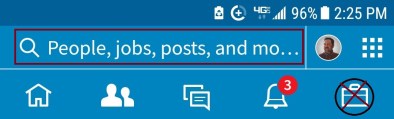
The first noticeable difference between the mobile app and the desktop is that none of the features are titled on the app. But the icons are so intuitive that there’s really no need for titles, and I imagine the desktop is going to do away with the titles in the near future.

My Network

navigation bar app My Network

My Network on the mobile app is more difficult to navigate than on the desktop. Clicking on the icon brings you to a view of the number of your connections. You’re given the option to  Add contacts, which allows you to send mass invites to your email list. Visible is recent invitations; and below it People you may know.

Note: Clicking on View of connections, you can only sort them by First name, Last name, and Recently added. However, you can’t filter your connections as well as you can with the desktop platform.

To filter your connections, you have to search for people by using the Search feature. This will bring you to a list of your first degree connections. (Inexplicably my number of connections in this view was less than the number I have upon clicking on the icon.)

Filtering connections app

The tricky part about filtering people using the mobile app is identifying the Filter icon (circled to the left).

You don’t have as much filtering capabilities with the mobile app as you do with the desktop, but you can search for:

  1. Connections (degree of connection)
  2. Location
  3. Current companies
  4. Past companies
  5. Industries
  6. Schools

Messaging

navigation bar app Messaging

The most noticeable difference between the mobile app and the desktop for messaging is that the app’s version is truncated. Only by clicking on your connection’s message can you read the stream of conversation. On the desktop you can see multiple connections. But this is expected, as the desktop has a larger surface.

Both the mobile app and the desktop allow you to search by Unread, My Connections, InMail, Archived, and Blocked, albeit in a different order. (Are you getting the sense that the desktop platform is becoming more like the mobile app?)

With both mobile app and the desktop, you can respond to Inmails by choosing Interested, Maybe later, or No thanks.

One noteworthy difference is that the mobile app has a feature that suggests an opening verbiage for messages, such as, “Hi (name), I notice you’re also connected with (name).” This feature  is akin to LinkedIn’s default invite message. No thanks.

Notification

navigation bar app AnnouncementsThis feature allows you to see what your connections have been doing:

  1. Who’s mentioned you in a post
  2. Liked your post, liked a post that mentions you
  3. Is starting a new position; and
  4. Commented on (someone’s ) post

The differences between this feature on the app and desktop are negligible and hardly worth mentioning. However, there is one major difference: the desktop seems to lag behind the mobile app. In other words, the streaming is slower on the desktop than the app.

Jobs

navigation bar app JobsPerhaps the most difficult mobile app feature to navigate is Jobs.

My suggestion is to forego the suitcase icon and simply use the Search feature.

The Search feature allows you to find jobs, say in Accounting, and then narrowing them down to Location (allow your device to identify your location, if you like), and if you want to take it further, filter by:

  1. Most relevant
  2. Most recent
  3. Determine how many miles you are willing to travel
  4. Only show jobs with which you can apply Easy Apply
  5. Date posted
  6. Company
  7. Experience level
  8. Job type
  9. Industry
  10. Job function

When you’ve chosen the job to investigate, you’ll notice—because of the limited surface—the mobile app is not as robust as the desktop version. Some similarities are:

  1. Number of first degree connections
  2. Number of alumni
  3. Job description
  4. The person who posted the job
  5. Jobs people also viewed
  6. Easy Apply

What you don’t get with the phone app are:

  1. Video of the company
  2. Meet the team

Companies

Like the desktop, you have to use the Search to access your desired companies. The most important reason to use Companies is to locate people who work for your target companies, which is a bit more cumbersome with the mobile app than the desktop.

People filter AppTo do this you must type the company name into Search and choose People, and then use the Filter tool, as shown above. You can filter by:

  1. Connections (degree)
  2. Connections of
  3. Locations
  4. Current companies
  5. Past companies (not shown)
  6. Industries (not shown)
  7. Schools (not shown)

The only benefit the desktop version offers is the ability to search by Keyword. The other filters are superfluous. Such as Profile language and Nonprofit interests.

In my opinion, this is the most important feature LinkedIn provides, whether on the desktop or mobile app. This is where real online networking happens. In fact, a blog post can be dedicated alone to using the Companies feature.


When you open the LinkedIn app on your smart phone, you’ll see the power, albeit limited, it has to offer. You’ll also see that the desktop version closely resembles the mobile app.

Next up is the differences between the LinkedIn profile on the mobile app and desktop.

If you want to learn more about LinkedIn, visit this compilation of LinkedIn posts.


How a car salesperson taught me 4 important Job-Search lessons

Like many people, I hate buying cars. But just recently I had a pleasant experience buying one. What made this transaction pleasant was the salesman, who came across as a person not concerned about meeting his quota. I got the impression that he cared about me as a person. He wasn’t pushy.

Be Safe. Girl receives the key of her new car

At one point, as I was driving the car, we were talking about our families. He told me he has a daughter who was going to meet someone from the Dominican Republic, who she met on the Internet. We both agreed this wasn’t a smart idea on her part.

I was wondering when he was going to talk about the benefits of the car, deliver his sales pitch. But he only answered questions I had about the car. And when I told him I had to bring my wife by for a test drive, he smiled and gave me his business card.

What makes a successful job seeker is similar to what makes a successful salesperson. Here’s why.

They don’t try too hard. If my car salesman had immediately delivered a diatribe on the features of the car, he would have come across as a know it all or desperate. He sensed I just wanted to drive the car.

Job seekers try too hard when they badger recruiters or potential employers before the game has begun. When a recruiter says give it three days, then give it a three days. Don’t call a day after asking about the hiring progress. Same goes for hiring managers.

On the flip-side, there are hiring authorities who aren’t as responsive as they should be. If they haven’t responded as they said they would after three days, give it two days after that to touch base.

One of my customers recently landed a job. The company said they would get back to him with a final decision in a couple of days. One week later crickets. Finally they gave him the good news. Sometimes employers get busy and can’t follow through on their promise.

Their résumé isn’t full of superfluous crap. One thing my car salesman could have done is pontificated about his sales record, which he said was quite good when I asked him. One of the biggest pet peeves of hiring managers is wading through résumés with a bunch of cliches and fluff, as well as irrelevant duty statements.

As I’ve said before, what sells are accomplishment statements. I recently read a client’s résumé and politely told her that words like “result-oriented,” “top performer,” “outstanding,” etc., added absolutely no value to her performance profile.

Further, she listed duty statements that made the résumé  look like a grocery list. I told her this and talked about how accomplishment statements can paint a picture of how well she did her job, as well as what she can offer employers.

The next time we met, she showed me her new résumé. What a difference between the former version and the new one. Sometimes job seekers try too hard to sell themselves by listing everything they’ve done. In many cases, less is better.

They don’t bombard you with their personal commercial. My car salesman merely walked up to me, extended his hand and told me his name. I told him I was only interested in driving a car. So he retrieved the key for the car I wanted to drive.

He did not jump into a sales pitch about the benefits of the car. He knew I didn’t want to hear it. Instead, he did exactly as I asked him to. One very important component of the job search is listening.

The point is that he didn’t try to sell the product from the start. Treat your personal commercial the same way; make small talk before launching into who you are and what value you deliver to employers.

They know when to stop talking. One of the largest problems job candidates have is not knowing when to put on the breaks. They don’t know when to stop talking about their greatness, or worse they go on and on about their greatest weakness.

I recall a time when my father was buying a car. A young salesman who was a wiz at knowing the cars on the lot. The problem was that he was programmed like a robot to give a dissertation on the cars. When my father told him to stop talking about the car in question, the salesman refused. My father didn’t buy the car.

What many job candidates don’t realize is that interviewers have an agenda; they have a number of questions they need to ask. By talking too much and act like you’re selling a product, you run the risk of irritating the interviewers.

Further, the people you may be working with will get the sense that you talk too much. I personally get irritated when colleagues dominate airspace and keep me from doing what needs to get done. When colleagues do this, it’s as if they are selling themselves.


The bottom line is that to be successful in your job search you need to be a salesperson like mine. He read the situation and didn’t try to push the product.

10 steps toward a successful LinkedIn strategy (Part 2)

One thing I emphasize in my LinkedIn workshops is the importance of being active on LinkedIn. My mantra is, “You can have the best profile in the world, but if you’re not active, it means nothing.” In part one of this two-part article, I listed five steps to make your LinkedIn strategy a success. The conclusion of the article addresses the remaining five steps.

Kid playing chess

6. Use the Companies feature to network. The Companies feature is one of LinkedIn’s best features, as it allows you to identify valuable people in various companies. Often LinkedIn is the only way job seekers can locate important people at their target companies.

Your goal is to connect with people at desired companies (do you have a company target list?) before a job is advertised, thereby penetrating the Hidden Job Market. Play your cards right and you can set the foundation, so when the job becomes public knowledge you’re already known by the company.

Another scenario is identifying people who work in your target companies who can provide you with additional information, or even deliver you resume to the hiring manager.

Similar to using the Companies feature to network with strategic people is Find Alumni, a feature that helps you connect with people you went to school with based on criteria, such as what they studied, where they live, where they work, etc. The benefit of connecting with your alumni is obvious; people want to help their own.

Read 6 interesting facts about your alumni on LinkedIn.

7. Use the Jobs feature. LinkedIn has made strides to make the Jobs feature a player in the job board arena. It’s not succeeding as well as LinkedIn has hoped—Indeed.com and others still draw many job seekers. But increasingly more companies are using LinkedIn to advertise their jobs.

What’s nice about Jobs is that you can apply directly to a company’s website, as well as use “Easy Apply,” which allows you to send your profile to companies trying to fill positions. As well, the poster of jobs might be listed, allowing you to send an Inmail to said person.

Before you select a job, you can see first degree connections or alumni who work for companies filling positions. This gives you the opportunity to contact said people for better networking opportunities.

Note: if you are a Career premium member, you have access to information basic members don’t. You can see who your competitors are, as well as the major skills you might lack for a particular position. LinkedIn provides you with the average salary of the job for which you’re applying.

8. Endorse your connections’ skills. I never thought I’d write this, but endorsements are here to stay. The argument against endorsement is that skills can be endorsed willy nilly, without people actually seeing a person perform said skills.

Certainly this happens, but my solution to making this more viable is outlined in an article in which I encourage LinkedIn users to rearrange their skills in order to give their connections an idea of which skills they should be endorsed.

One thing we can say about endorsements is that they encourage engagement between connections. If your goal is to accumulate endorsements, you’ll have to endorse people in your network. Do this only if you have a sense for the skills you’re endorsing. Otherwise you’re supporting the argument that endorsements are meaningless.

9. Ask for and write recommendations. Your strategy should include requesting recommendations from your former supervisors and, to some extent, your colleagues. If you find that your supervisors are slow in writing your recommendation, you may want to offer some guidance in terms of what you’d like included in your recommendation, or you may even want to write it yourself.

Write recommendations for your former employees; it’s a great way to brand yourself. This shows your authority, as well as what you value in a good employee. You don’t have to be asked to write the recommendation; simply write one and send it to your former employees. They’ll appreciate your generosity very much.

10. Follow up. Always follow up. Every networking pundit will tell you that following up with new connections can be the most important piece of networking, both after personal meetings and connecting with someone on LinkedIn. Obviously it’s difficult, if not impossible, to follow up with everyone in your LinkedIn network, particularly if you’re a LION.

Keep in constant contact with your connections by responding immediately to direct messages or even responding to their updates. There’s nothing worse than starting a relationship and then dropping it like a lead balloon.


Sometimes we loose sight of our strategy and our LinkedIn campaign becomes disorganized. At this time it’s important to reign it in and adhere to the components I’ve outlined in this two-part article.

Photo: Flickr, moradini2009 (mikeoradini.dotphoto.com)

If you enjoyed this post, please share it!

10 steps toward a successful LinkedIn strategy (Part 1)

In our neighborhood no one knows which side of the street to park on when there’s a snowstorm, which prevents the plows from clearing the street properly. The result is a cleared path the width of fish line. My wife and I have deduced that this is because there’s no strategy in place.

business strategy woman

What does the dire condition of my neighborhood during a snowstorm have to do with LinkedIn? Simply this, like a neighborhood without a strategy for a nor’easter, your LinkedIn campaign will not succeed.

Do you have a strategy for your LinkedIn campaign, or is it like the street I live on which requires a snowmobile to negotiate? If you lack a strategy you’ll spin your wheels, get frustrated, and possibly give up on a valuable tool that has the potential to create job opportunities. A plan includes the following:

1. Dedication. I’m a bit of a lunatic when it comes to LinkedIn. One of my colleagues once said I need an intervention and he wasn’t joking. I’m on LinkedIn for an average of one hour a day, 365 days a year—yes, this includes holidays. I’m not advising you to spend this much time on LinkedIn.

However, a dedicated strategy is necessary to stay on your connections’ minds. This is why I tell my LinkedIn workshop attendees to dedicate at least four days a week of activity, or for the more dedicated, everyday. Try to share at least two updates a day.

2. Know what you want to do. Are you zeroing in on a specific occupation in a specific industry, or are you willing to take anything? The former is the correct answer. With this in mind, you’ll be able to determine who to best network with. If your goal is to work in public relations at a university, you should connect with people at universities, not retail.

3. Write a great profile. This is a big order and a blog post itself, but having a profile that attracts employers and other visitors to your site will take a strategy. You’ll need a photo that brands you—the days of a suit and tie might be history. Write a branding title that immediately describes what you do, as well as your areas of strength.

Your Summary should tell a story, your Employment section describe quantified accomplishments, and don’t forget using the Media section to highlight your talents. A major part of your plan should be Search Engine Optimization (SEO) that includes the correct keywords to raise your profile to the top of the first page.

Read How to brand yourself with the new LinkedIn profile.

4. Update often. This is how you communicate with your LinkedIn community. I get looks of disbelief when I suggest to my LinkedIn workshop attendees that they update once a week. They ask me what topics they should updates about. First, I tell them, share articles they’ve found on the Internet.

Other topics can include seminars or conferences you’re attending; interviews you’ve had; advice pertinent to your industry; a great book you’re reading; a happy landing; even a good quote or two; and, of course, a reminder you’re looking for a job. Just keep it professional and refrain from negativity.

5. Connect with other LinkedIn members. No two LinkedIn members are alike; some prefer to keep their network intimate by connecting with people they know and trust, while others will connect with anyone who’s willing. My suggestion is to have a strategy and be faithful to it. Connect with those who you can help and who can help you—a lot like personal networking.

Expand your horizon. Include people in your occupation, industry, and various levels of employment. There are like-minded people in different industries, so don’t be afraid to invite them to your network. Who knows, maybe opportunities will arise from the most unlikely people.

Read How to brand yourself by connecting with others.


Read part two of this article. In it I’ll discuss five other components necessary for your LinkedIn plan. You need a plan to be successful on LinkedIn.

If you enjoyed this post, please share it!

If you want to learn more about LinkedIn, visit this compilation of LinkedIn posts.

Photo: Flickr, Sandy Huang

5 reasons job seekers dread networking events, and what to do about it

How do you react when you hear the word “networking?” Do you feel uncomfortable, roll your eyes, or even break out in a sweat? You’re not alone if the prospect of networking doesn’t make you jump for joy. Truth be known, most people don’t relish the idea of networking.

Scared Networker

Truth also be known, networking remains the most effective way to get referred for jobs that aren’t advertised. According to Jobvite.com, 40% of hires come from referrals, twice the number than the next option, the company’s website.

So why do job candidates react negatively when they hear the word “networking?”

Here are five common reasons why networking is dreaded, and what you can do about it:

1. You think it’s too late

Most job seekers have one thing – and one thing only – on their minds: landing a job. Their finances are suffering and their state of mind is in shambles. There’s no time to waste. They need to find a job now.

This sense of urgency is only heightened when you need to develop an effective network immediately – a network you should have developed while you were working.

Unfortunately, many people don’t think about networking when they’re gainfully employed. They feel secure in their positions, or they consider it to be in bad taste; both conclusions are false.

What you should do: Tell yourself that it isn’t too late. As we’ve heard many times, networking is all about building and maintaining relationships. To build relationships requires some give and take. You need to be patient, despite the urgency that is consuming you.

I tell my workshop attendees, “The next job you land, make sure you keep up with your networking – which means also letting people know about jobs that exist (unadvertised) at your company.” Think not only of yourself, but also of others who are looking for work.

2. You’re outside your comfort zone

Introverts are particularly prone to feeling uncomfortable during networking events. Many of these events consist of hoards of people huddled together in a library, church, or other free space.

These environments can be hard on an introvert – but it also makes effective networking hard for everyone. To be effective when networking, you need relaxed conversations before you can deliver your elevator pitch. Often this is not the case.

What you should do: Develop a game plan. If you’re introverted, don’t expect to “work the room.” Rather, plan to speak with a few people. Be sure to arrive with some questions for particular people, as well as a few talking points.

Put the people with whom you speak at ease. Don’t jump into your elevator speech immediately. You’ll probably flub it. Instead, talk about current events, the weather, what brought the person there, etc.

3. You have to talk about yourself

I hear it all the time. “I can talk about other people, but when it comes to me, I can’t do it.” Or, “It feels like bragging.” Look at it this way: you’re not bragging; you’re promoting yourself when the time is right.

Simply networking

For example, you wouldn’t declare during dinner that your gift to employers is that you increase productivity. However, when you’re asked during a networking event or connecting in the community, these are ideal places to let people know what you do and how well you do it.

What you should do: Talking about what you do and the value you deliver to employers should come across as normal conversation. Use your own voice and style to do this. Don’t rely on some formula you learned from career pundits. It may not work for you.

If talking about yourself or making small talk is not your thing, go to events with the purpose of listening to others. Ask questions and add your input on occasion. My warning here is that you don’t allow people to take advantage of your willingness to listen.

4. You believe you have to attend organized events

I’ve always insisted that there is no single environment that’s best for networking. Networking can happen everywhere, whether you’re at a family gathering, a sporting event, a summer BBQ, a religious meeting place, or pretty much anywhere else.

Networking is about building relationships. True. But many an opportunity has arisen when least expected. Say you’re watching your kid’s soccer game and you overhear a woman talking about how she can’t get good help in her Q.A. department.

You’re in Q.A. You politely introduce yourself and mention this bit of information. Before you know it, the woman is asking for your personal business card.

What you should do: See everywhere you go as an opportunity to network. Let me illustrate. Many years ago, my cousin Johnny attended a family gathering, at which he explained his situation and the type of work he was looking for. I considered this incredibly tacky.

Jump to five years later when there was an IT opening at the software company for which I worked. I remembered what Johnny said the day of the party and recommended him to our CFO. He was hired for the position.

5. You expect instant gratification

I’ll admit that going to networking events can be disheartening at times, especially if I don’t leave with at least two or three quality contacts. But after feeling sorry for myself, I reason that the next time will be better.

I remember running into a job seeker who attended a networking event we sponsored. I asked him if he found the event useful. His response was that he didn’t get anything out of it. No one from his industry was there.

What you should do: Do not expect great things the first or second time you attend an event. Be patient. Also, learn how to tell people in an understandable way what you do and how you can help employers. This will help you find leads or obtain great advice sooner rather than later.

The job seeker I mentioned wasn’t keeping an open mind. He should have been thinking of the bigger picture. For example, did anyone know someone at his target companies? Or better yet, how could he have helped someone? At the very least, he should have given it a couple more tries.


Networking can be uncomfortable and almost painful for some people, but it’s something we must all do. The fact remains that networking accounts for roughly 70 percent of jobs landed by job seekers. It is the most successful way of gaining employment – even if it also feels like the most difficult one.

Photo: Flickr, KELLY L