
9 facts about LinkedIn lite profile vs. the LinkedIn profile we knew

At this point I count roughly 10 posts and a few videos explaining the differences between the old (or for some, current) user interface (UI) and the new and improved one. I hope this isn’t the 11th post you’ve seen on this topic.

change2

Having played with the new UI—no I don’t have it—there are some very nice features and some disappointments. For this post, I’m going to focus on the profile.

My first thought is, be careful what you wish for. One nice thing about the new profile is it is slimmed down and more visual. However, it will take a learning curve for some to find the various sections of the new profile. Let’s start at the top.

1. The Summary
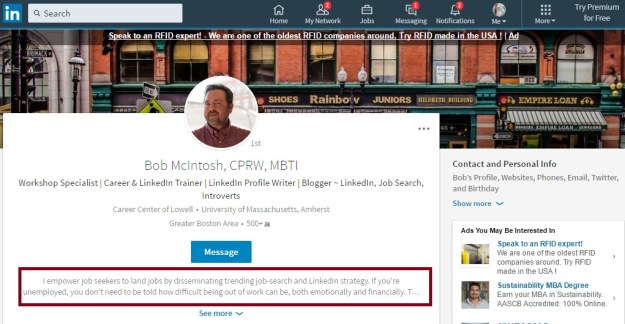
new-snapshot-areaI was warned ahead of time that the Summary section of the new profile is no longer titled Summary. In fact it’s not in the body of the profile; rather it’s in the Snapshot area (photo above, boxed in red), and…a visitor can only see the first two lines of it. Therefore, it’s important that you utilize these two lines to grab the reader’s interest.

Read The 39 most important words in your LinkedIn Summary*

My only concern here is that visitors won’t realize that they need to click “See more” in order to…see more. Get used to clicking “see more,” as LinkedIn has done its best to condense the profile as much as it could.

I heard there was talk about removing the Rich Media areas (under Summary, in Experience and Education), but LinkedIn held off on that silly idea. Rich Media is still there.

2. What About Those Three Dots and Contact and Personal Information?

new-information

The Three Dots. The placement of actions like removing connections, unfollowing, requesting and writing recommendations will take some time for recipients of the new UI to get used to, but the information is nicely placed.

Note: your profile only shows the top two commands. To remove a connection, request a recommendation, etc. you must go to that person’s profile.

The same applies to the Contact and Personal Info section which drops down to reveal the information visitors would see if they choose the Info tab on the older version. Unfortunately the public URL for someone is located in this area, instead of in plain view just below one’s photo.

3. Highlights and Posts and Activities
new-highlights-and-activities

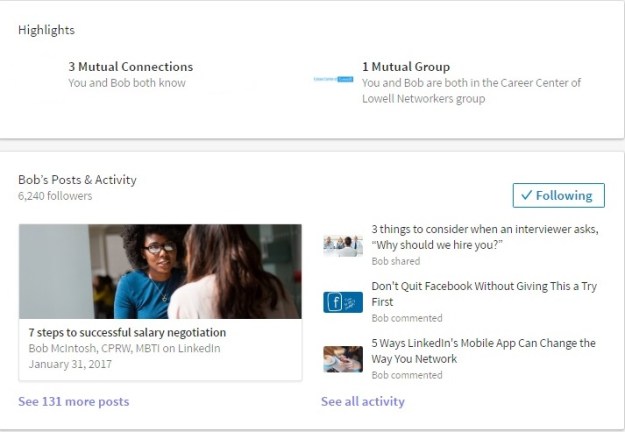
Don’t blink when you near these sections because there’s a lot of information packed into these sections. In Highlights visitors can see our mutual connections, as shown. However, in order to see all my connections, one must click on this area and choose “All.”

Bob’s Posts & Activities. This is where a great deal of information is located, including my articles, posts, and all activities. Articles are ones I’ve written on LinkedIn; this is straight forward. What is not straight forward is the difference between posts and activities. As far as I can tell, they’re one in the same.

Note: Unlike the older version, only one article is displayed. In the older version, three were displayed, which meant you had to have at least three written on order not to be embarrassed, but I’m sure LinkedIn’s motive behind this wasn’t to save you from embarrassment.

4. The Experience Section

UPDATE

How often does LinkedIn reverse its decisions? Not often is the answer.

The good news is that LinkedIn has reversed it’s decision of showing only the first position in its entirety and truncating the previous ones. On May 26th, 2017, I noticed that LinkedIn corrected this faux pad. Now we can see most of the positions expanded.

This is great news, as visitors to your profile might not have known that they had to click “See More” in order to see your other positions.

Read this article to see my approval of this “change-back.”

5. Pause

Have you noticed that I’m talking about the new profile in a specific order, e.g. Summary followed by Experience. With the new profile, you cannot move the sections around.

This is a problem for me, because I prefer to follow my Summary with my Skills and Endorsements. I also have a problem with authority, and this is a total power play by LinkedIn, in my opinion.

Note: When I asked LinkedIn why it prevents its members from moving their profile sections, they said the way it’s structured is the way recruiters prefer it.

6. Education

Not much to report here. Because this section can’t be moved, this may cause a problem for students and recent grads.

7. Volunteer Experience

What surprises me is that this section comes before Skills and Endorsements. This section hasn’t changed much, save for the fact that visitors must expand each volunteer experience. I wonder what LinkedIn was thinking when they made this decision for me.

8. Featured Skills and Endorsements & Recommendations
new-skills-and-recommendations-section

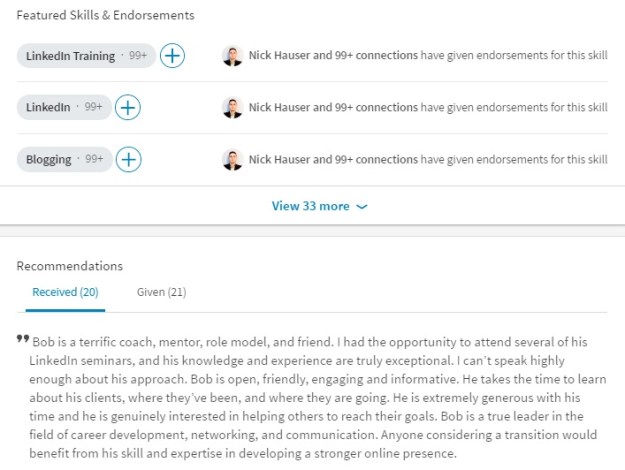
Finally we see the skills and recommendations. First, visitors notice that only the top three skills are displayed. Secondly, only one endorser is displayed, whereas with the older UI, at least ten endorsers were displayed. This is not detrimental. In fact it can be seen as a positive when we’re talking about slimming down the profile.

What I find very promising is that Recommendations are just below Featured Skills and Endorsements. This is significant because in the older version, Recommendations was anchored at the bottom of the profile, giving me and others the feeling that perhaps this section was on its way out. At the very least, it was given less prestige; much like skills are given now.

One of my valued LinkedIn connections, Rich Grant, points out that in the older UI we were able to see from which companies the recommendations came. Further, in the Experience section recommendation givers were displayed with a link to the recommendation section for said people.

9. The Rest

Certifications, Organizations, and Projects are listed under Accomplishments. Prior, they had their own real estate, but now they’re buried under this header. And yes, they must be expanded like most sections.

Do you remember painstakingly listing your professional and personal interests under Interests? Well forget it; that section has been retired, as far as I can see. Shame.

Following includes my activities and interests. This is redundant information because visitors will see the section called Bob’s Posts & Activity directly below my Highlights section.

It makes sense that LinkedIn shows the influencers, companies, groups, and schools I’m following, all of which visitors must expand in order to see more of each.


Is Less Better?

I think you’ll agree when you receive the new UI that in some cases less is better. However, the inability to move sections around as you once had the ability to do; and making you have to expand most sections, including the Summary–you might find the older version more to your liking. Or you might appreciate the lighter version of your new profile. The jury is still out for me.

If you want to learn more about LinkedIn, visit this compilation of LinkedIn posts.

Photo: Flickr, Eva Woo

3 things to consider when an interviewer asks, “Why should we hire you?”

For many job seekers, “Why should we hire you?” is one of the most difficult interview questions to answer. Don’t take it from me – take it from my clients, who list this as one of the hardest questions presented by interviewers.

group-interview-2

I understand their concerns. To answer this question, you have to articulate what the interviewer is trying to ascertain. In addition, you have to make your answer relevant to the job at hand and demonstrate the value you’ll bring to the company.

In other words, you can’t use a canned answer for every employer with whom you interview.

The secret to answering this question is that you must address the three things employers look for in their employees. The first is that you can do the job, the second is that you will do the job, and the third is that you will fit in.

1. You Can Do the Job

Having the technical know-how is essential to performing the job and advancing in your career. That includes software and hardware proficiency, specialized knowledge, etc. However, transferable skills can be just as important, if not more important.

It’s imperative that you understand the job extremely well and can address the technical and transferable skills. You do not have to address every single skill in your answer, as that will take too long. Begin your answer with something similar to the following:

“I have a thorough understanding of the role and am confident I can meet the challenges it presents. For example, you require excellent leadership abilities, which I’ve demonstrated in every position I’ve had. You also need someone who can improve the visibility of your organization …”

You can cite additional examples. Just don’t belabor the point.

2. You Will Do the Job

The interview will also want to know if you’re in love with the responsibilities of the role and the mission of the organization. Will you work until the job is finished? Will you overcome obstacles?

Why you want to work for the company is another concern they’ll have. I tell my clients that no company wants someone who’s just looking for any job they can get.

Here’s an example of how you might address your motivation to do the job:

“This position presents an exciting opportunity to take on new challenges that I will embrace. I’ve always stood up to obstacles and worked to overcome them. In addition, I’ve researched this organization and am truly impressed with the product you produce and your mission of helping special groups.”

3. You Will Fit In

Whether or not you’ll be a good fit is a major concern many employers have, and it’s also a tough thing for you to prove. It’s all about your personality. A company doesn’t want to hire someone it will have to let go because the hire couldn’t get along with their coworkers.

Of the three components employers look for in their employees, this might be the most important. There are plenty of talented people out there who can hit the ground running, but not everyone can play well with their colleagues.

Your fit is difficult to prove without data or good recommendations from your references, but try to provide as much hard proof as possible:

“In my performance reviews, I’ve always scored high on interpersonal skills. I know the clients you serve; it will require excellent teamwork in order to serve them effectively. If you ask my former colleagues and supervisors, I’m sure they’ll tell you how I’ve pitched in when needed and without being asked.”


Tying It All Together

Explain how you’ll exceed the employer’s needs based not only on being able to meet the three major components, but also by emphasizing how you will be integral to the success of the company. Going into the interview, know how important your role to the organization is:

“The next marketing specialist you hire will be crucial in creating a strong presence in the direct community and beyond. I can assure you, based on my experience with doing this, I am your person. This is ultimately why you should hire me.”

Learn how to answer other tough questions like:

“What is your greatest weakness?”
“Tell me about yourself.”

This post originally appeared in recruiter.com.

Photo: Flickr, Enri Endrian

5 ways a successful job search counts on how you treat people

I tell my daughter, who is often late for appointments, that life is about minutes. The first time I told her this was when she missed a train into Boston by a few minutes. Not just when catching a train, I went on to explain; but when you have an appointment of any kind.

SONY DSC

The message I delivered to my daughter particularly applies to the job search. Here are five notable examples of how a successful job search counts on how you treat people :

1. Be punctual. When I think about the conversation with my daughter about how minutes matter in life, I think that not only is it important to be punctual when you need to make a train. Punctuality is also important when you’ve made arrangements to meet fellow networkers or potential decision makers.

Especially when you’re scheduled for an interview that will determine whether you get the job or not. Or if you’re meeting someone at a coffee shop for a networking meeting. You don’t want to keep people waiting.

2. First impressions count. You might be rolling your eyes at this well-known fact, but I’m talking about internalizing and embracing this. Yes, you can practice how to shake hands, maintain eye contact, dress for the occasion; but this is something you must do every day.

Think beyond the interview if you want to conduct a successful job search. Your first impressions must be outstanding during networking events, while you’re connecting in your community, even at family gatherings.  If practicing your first impressions is what you have to do, then practice them every day.

3. The way you communicate matters in all forms. Of course your written and verbal communications—which includes your resume, networking, and the interview—are important. But communicating effectively also includes listening and not over-talking.

Over-talking you wonder. Is it even a word? Treating someone with respect means allowing them to do some of the talking, at least. I’ve been to too many networking events where someone feels the need to dominate the conversation. Telling me what they do doesn’t require them to talk without coming up for air.

4. Think of others in your network. One of my favorite posts I wrote is 5 ways to give when you’re networking for a job. This isn’t one of my favorite posts because it garnered many views; it’s a favorite because it talks about the importance of giving back in the job search.

True networkers don’t think only of themselves; they think of others as well. Treat others well by reciprocating when someone does a favor for you. But you don’t need to wait for someone to help you first. Turn the table by doing something helpful to other job seekers. Offer advice on their resume or LinkedIn profile or provide a lead, of offer great advice.

5. Meet your stakeholder’s expectations. This raises the question, who are your stakeholders? The most obvious one is a potential employer. Meet their expectations by networking yourself into becoming a referral. Submit a resume that speaks to the their needs and backs up your claims with accomplishment statements. Go to the interview prepared by having done your research.

Other stakeholders include your network. Related to the previous way to treat others well in your job search, consider ways to reach out to various stakeholders like the community in which you live. For example, when you have time, shovel your neighbors driveway, or help them move furniture. Help them help you by giving them a clear understanding of what you do and what your goals are.

Consider volunteering at a nonprofit that can use your talent. One example would be developing a website for your son’s preschool.Take over the bookkeeping for a start-up. Offering your marketing assistance to a restaurant that is suffering.


The success of your job search will depend on how you treat other people, whether they’re other job seekers; your neighbors; and, of course, potential employers. It comes down to more than just being punctual, you must heed your first impressions, communicate properly, treat your network well, and satisfy your stakeholders. When all of this comes into place, your chances of landing a job will be greater.

4 things to keep in mind when answering “What is your greatest weakness?”

A conversation I had in the past with my daughter aroused in me emotions of both concern and relief. Yes, two conflicting emotions, but the feeling that stays with me is the feeling of relief.

Job interview

Relief because she was truthful about her faux pas, her display of bad judgement. All was forgiven, although not forgotten.

“This is what the truth accomplishes,” I told her.

This is what you get when you ask your kids to be honest, regardless of the response. But is the truth always the best policy?

That depends.

What Is Your Greatest Weaknesses?

What interviewers get from candidates in response to this interview question aren’t always honest answers. Candidates are guarded, weighing every word they say; because they feel one wrong answer can blow the deal.

For this reason, I think this is the dumbest interview question ever. Nonetheless, I ask my workshop attendees this dumb question, because I know they will be asked it in an interview.

So when I spring the question on my workshop attendees, I often get a moment of silence. Their minds are working like crazy to come up with the correct answer. They think the best answer is one that demonstrates a strength disguised as a weakness.

So they come up with answers like, “I work too hard,” or worse yet, “I’m a perfectionist.” I tell them these answers rank high on the B.S. scale, at which they laugh. But it’s true. These answers are predictable. They’re throwaway answers, wasted breath.

Instead, I advise my workshop attendees to follow these simple steps.

1. Keep It Very Short: I can’t tell you how many people talk on and on when their answer should be no longer than 20-30 seconds.

2. State a Legitimate Weakness: Interviewers want transparency. They also want to see self-awareness – that you’re aware of your mistakes. People who think they’re flawless are unable to see their mistakes, learn from them, and correct them.

3. Be Smart, Though: I asked at the beginning if honesty is always the best policy. The real question is, how honest should you be? In other words, don’t mention a weakness that is vital to the position at hand.

For example, bringing up your fear of public speaking when you’re applying for a training position would be a major problem and probably eliminate you from consideration.

4. Talk About What You’re Doing to Address Your WeaknessThis is of great interest to the interviewer, and something people tend to leave out of their answers.

shadowReturning to the training position example: If you were to say that you tend to talk too much during your presentations, but that you have learned to ask more questions to generate engagement, that would be an answer that is honest and shows your efforts to correct your weakness.

People Make Mistakes

Smart interviewers understand that candidates make mistakes. No one is flawless. They don’t want to hear you dance around this question. It’s a waste of their time and just makes you look silly.

Furthermore, interviewers want to hear self-awareness. They want to be sure that you know what your weaknesses are and are doing something to correct them. Self-awareness speaks to your emotional intelligence (EQ), which is necessary if you want to succeed in the workplace.

Lynda Spiegel, a job coach who has interviewed hundreds of candidates, believes transparency is the best policy:

“There’s nothing to be gained by candidates trying to bluff their weaknesses. To act as though a strength is a weakness (“I can’t seem to turn off my work email when on vacation”) is disingenuous, and to claim that there are no weaknesses lacks credibility. The best way for candidates to approach questions about their weaknesses is to acknowledge one or two, explain what they’ve done to address them, and then move on to their strengths.”

The weakness question is one I consider to be … well, dumb. It lacks creativity and doesn’t address the requirements of the position. But it’s also a question everyone should be able to answer before they get to the interview.

To Review:

  1. Keep your answer short.
  2. Be honest, but not too honest.
  3. Explain what you’ve learned from your weakness and the measures you’re taking to correct it.
  4. Practice your answer before arriving at the interview.

Back to My Daughter

I appreciated my daughter’s transparency and, as a result, I now trust her more than I would have if she hadn’t told the truth. In addition, I understand she’ll make mistakes in the future.

This is not too different from the reaction an interviewer will have when a job candidate shows transparency. Interviewers trust candidates more when those candidates are honest (to a point).


Now read how to answer other tough questions:

“Why should we hire you?”
“Tell me about yourself.”

4 facts about introverts at parties

Recently I went to an acquaintance’s birthday party. When my wife and I agreed to go, I was psyched to have an evening out without kids. It would also be nice to catch up with people I hadn’t seen for a long time. This was two weeks before the night of the party.

party

But as the night approached, I became anxious, thinking about how uncomfortable it would be to be surrounded by 30 or so people, most of whom I didn’t know. This feeling persisted throughout the day and I seriously considered telling my wife I wasn’t going to attend.

But the day of the party, my wife told me she didn’t want to stay too long because she wasn’t feeling too well. Ah excellent; an exit plan. This is one fact about introverts at parties.

1. Entering a room full of strangers and having to introduce themselves to these people makes introverts uncomfortable. They would rather enter a room with people they know well.

It was no different for me when my wife and I found ourselves in a room full of strangers. So immediately I looked for people I knew. None were present for the first, long ten minutes. here did the host say the beer was we wondered out loud.

At this point If I had the option to leave, I would have. But my wife, who is an extravert, is not the leaving kind; so I scanned the room looking for a familiar face, any familiar face. Alas a good friend entered the room. We made eye contact and she headed our way.

two people talking2. Finding allies will make acclimating to the party more bearable for introverts. Once they’re comfortable, they see promise in the party.

Soon after our friend arrived and I was more relaxed, I noticed another person I recognized and someone with whom I had somethings in common. I excused myself and made my way over to this person.

I had found an ally to associate with; not a large group to join and exchange stories or one-up each other with witty remarks. We settled comfortably on a couch to talk about my trip to Wisconsin and his work.

3. Deeper conversations, is the introvert’s preference while their counterpart prefers broader, more varied discussions. It’s how we roll.

The conversation with my ally turned into something philosophical about the economical ramifications soccer has on the world. We talked on and on for what seemed like hours.

My wife freed herself to check on me (her introvert) to see if I was having a good time. The look of reflection and concentration on my face—and the fact that my ally and I weren’t talking at the moment—must have worried her, but I assured her things were great. (Introverts are comfortable with moments of silence.)

4. Leaving when it’s time is important to introverts. They don’t like to close the bar…unless they’re having a great time. Generally introverts prefer leaving earlier than others. It’s a matter of energy level.

So when my wife asked me if I was ready to leave, I feigned disappointment before telling her I was ready. At the moment I was engaged in a superficial conversation. Time had escaped me—it was now 11:30 pm—and I was happy that I didn’t get the 10:00 pm itch.

In the car my wife remarked that she and I hadn’t seen each other all night, which to me was fine. She could fill me in on all the gossip. We both agreed that the party was a success. She was able to catch up with her many friends, and I enjoyed the solitary, in-depth conversations I engaged in.


Not all parties go as smashingly as this one had. Perhaps the stars were aligned, but I was simply happy that I left the party more energized than when I had arrived. Plus, I had a few great conversations. And that’s all I really needed.

My 9 LinkedIn failures for 2017

Some of my colleagues and I are participating in The Biggest Loser contest. You know the concept; the person who loses the most weight wins. I’m gonna lose. I’m still eating cereal at night and large roast beef subs, instead of small ones.

new-year-resolutionAccording to an article in U.S. News Health, 80% of New Years resolutions will fail. So resolving to lose weight, spend less time in front of your television, giving up smoking, and other vices will most likely result in failure. Why? This is the reason the article states:

Whether you’re feeling anxious, depressed, frustrated, fatigued, weak and out of control, or simply bored, emotional friction (stress) becomes the high-octane fuel of failure.

As the posts on 2017 resolutions are starting to roll out, I have decided to be realistic and not write about my successful resolution; rather I am going to write about how I plan to fail in 2017, particularly when it comes to LinkedIn. This, I reason, will make me feel successful…by failing

So here are my 2017 LinkedIn failures.

1. Being on LinkedIn every day of the week, every week of the year. This includes holidays. At this writing  I’m already failing. I’ve failed at staying off LinkedIn every day for at least seven years. So far so good. Read my post on running the LinkedIn marathon.

2. Criticizing LinkedIn when it pulls a bonehead move. There are ass-kissers who love everything LinkedIn does.There are trolls who bash LI for every little blunder. I consider myself a realist. Nonetheless, I’ll be honest about LI’s mistakes and adequate customer relations.

3. Shamelessly sharing my posts on LinkedIn from Things Career Related, Recruiter.com, LinkedIn Publisher.  However I will try my best to share my connection’s posts more often. Read to Share is golden.

4. Letting go of one of my stringent principles of NOT accepting default invites from LinkedIn members who don’t send personal invites. I apologize, Mom, but you didn’t send a personalized invite.

5. Offering LinkedIn etiquette advice. The hypocrite I am, I’ll still tell people how to act on LinkedIn, including how often to share updates. Don’t do what I do, do what I say. Note: I’ve been called by some a “LinkedIn Etiquette Police.”

6. Staying within the limited commercial searches LinkedIn has imposed. Although I use this feature in my LinkedIn workshops at a nonprofit career center, I don’t make it to the last workshop of the month without seeing, “Bob, you’ve reached the commercial use limit on search.”

7. Participating in Groups as much as I should. I’m sorry, I can’t get excited about the changes LinkedIn made approximately a year ago to this feature. Furthermore, the people I ask if they’ve been using groups mostly respond with a negative.

8. Reaching out to more people after connecting with them on LinkedIn. If you’re supposed to reach out to every LinkedIn connection, I guess this will be an epic failure for me. I’ll try to schedule times to talk with people after I get out of work, but I don’t see this improving at a great rate. An introversion-type thing?

9. Persuading my LinkedIn clients to use the platform four days a week. They think this is overdoing it, but I tell them it will help them immensely in their job search. I also tell them being on LinkedIn once a week is even better, while also warning them against becoming obsessed like me. (Related to #1.) But LinkedIn isn’t for everyone.


If resolutions are 80% likely to fail, I’ve decided that I will not fail…at least when it comes to LinkedIn. Other resolutions I’ve made, which will fail, are to lose weight by joining the Biggest Loser competition at work, getting rid of clothes I no longer wear, and start new projects at home.

I’m interested in knowing if there are some LinkedIn resolutions you know you’ll fail. I’d like to add them to this list.

Photo, Flickr, Carrie

3 things to keep in mind when answering, “Tell me about yourself”

The directive from the interviewer, “Tell me about yourself,” strikes fear in the hearts of even the most confident job candidates. That’s because they haven’t given serious consideration to how they’ll answer this directive.

elevatorpitch

It’s also because they haven’t taken time to construct a persuasive elevator pitch, which is one of the most important tools in your job search toolbox. There are three components necessary to answer, “Tell me about yourself.”

1. Keep it relevant. You must be aware of what the employer wants from their employees, which requires from you not only researching the job but also the company.

Let’s say, as a trainer, you’re aware of the employer’s need for satisfying people of cultural differences. You’ll begin your elevator speech by addressing this need.

You’ll begin your elevator pitch with something on the lines of:

Along with my highly rated presentation skills, I’ve had particular success with designing presentations that meet the needs of diverse populations.

Then you’ll follow it with an accomplishment, as accomplishments are memorable.

For example, the company for which I last worked employed Khmer and Spanish-speaking people. I translated our presentations into both languages so that my colleagues could deliver their presentations with ease and effectiveness. This was work I did on my own time, but I realized how important it was to the company. I received accolades from the CEO of the company; and I enjoyed the process very much.

Finally, you’ll close your elevator pitch with some of the strong personality skills for which you’ve been acknowledge. In this case, your innovation, assertiveness, and commitment to the company would be appropriate to mention. But don’t simply list your personality skills. Show them.

My managers have often told me that I’m innovative, which I understand you’re looking for in your next trainer. If I’m hired for this position, I’ll be committed to helping you meet your goals, whatever they may be.

2. Be on your toes. Being prepared is essential to job seekers who need to say the right thing at the right time to a prospective employer. This is where your research on the company comes into play—the more you know about said company, the better you can recite your elevator pitch.

One way to answer, “Why should we hire you?” is by using your elevator pitch. Throughout the interview, you’ve paid careful attention to what the employer has been saying regarding the challenges the company is facing.

They need a manager who can develop excellent rapport with a younger staff, while also enforcing rules that have been broken. Based on your new-found knowledge, you realize you’ll have to answer this question with a variation on your rehearsed pitch. You’ll open instead with:

I am a manager who understands the need to maintain an easy-going, professional approach as well as to discipline my employees when necessary. As this is one of your concerns, I can assure you that I will deliver on my promise, as well as exceed other expectations you have for this position.

Then you’ll follow with an example of what you asserted.

If I may give you a specific example of my claim, on many occasions I had to apply the right amount of discipline in various ways. There was one employee who was always late for work and would often return from break or lunch late, as well.

I realized that she required a gentler touch than the others, so I called her to my office and explained the effect she had on the rest of the team when she wasn’t where she was supposed to be. I then explained to her the consequences her tardiness would have on her. (Slight smile.) I don’t think she had been spoken to in such a straightforward manner by her other managers. I treated her with respect.

From that day forward, she was never late. In fact, she earned a dependability award. There are other examples. Would you like to hear them?

3. The purpose of your elevator speech. When employers listen to your elevator pitch, they should recognize skills and accomplishments that set you apart from the rest of the candidates.

Tell your elevator pitch in a concise manner that illustrates these skills; don’t simply provide a list of skills you think are required for the position. Remember that accomplishments are memorable and show your value added, especially if they’re relevant to your audience, e.g., an employer.

Above All Else, Your Elevator Pitch Must Show Value! The value you bring to the employer. As in the example above in which the candidate understands the needs of the employer to be building rapport with young workers, while also enforcing rules; you must know the employers pain points.

Once you’ve got a full grasp on the employer’s pain points, you’ll know which content to include in your elevator pitch and how to deliver. it.

Whether you use your elevator pitch to answer the directive, “Tell me about yourself,” or the question, “Why should I hire you?” there are enough reasons to develop one that is relevant and shows you can think on your feet.


Now read how to answer other tough questions:

“Why should we hire you?”
“What is your greatest weakness?”

8 Ways to challenge yourself if you really want a job in 2017

In my workshops, I often ask the participants to deliver their elevator pitches unrehearsed. Or I’ll ask them to answer interview questions when they least expect it. Or I’ll ask them to talk about their accomplishments. In other words, I challenge them.

challenge

The job search is stressful as it is. I totally get this. But I also get that the more you challenge yourself in your job search, the easier it will become and the better you’ll do. Think of it as akin to pushing yourself to run that extra mile when you want to stop. You’ll be better for it in the end.

Here are some ways you can challenge yourself and improve your job search skills:

1. Allow Yourself to Be Put on the Spot

When someone like me asks you to deliver your elevator pitch, don’t bow out and say you’re not prepared. So what if you feel uneasy in front of the other job seekers? So what if you don’t do well at first? This is an opportunity to practice, challenge yourself.

When you’re asked to describe your biggest challenge, don’t plead the fifth. That won’t fly in an interview. You can’t say, “I’m not prepared for this question. Next.”

So what if you don’t get it right on your first try? Accept the challenge.

2. Tell People You’re Out of Work

To most people this seems like a no-brainer, but you might be surprised how embarrassed some people are about losing their jobs. They don’t realize it’s a natural part of life, especially in a bad job market.

I encourage job seekers to let as many people as possible know they’re looking for a job, even if it means they’ll be embarrassed. Take the challenge of contacting many people in person to let them know you’re in transition. In other words, network within your community.

3. Attend Organized Networking Events

You may have heard that no one likes networking events. Don’t listen to the naysayers. You’ll be passing up a great opportunity. Networking events offer the opportunity to engage in conversation with other job seekers who could provide sage advice or possible leads.

I know networking events can be uncomfortable, but I challenge myself to attend them simply to sharpen my skills. I suggest you do the same. Challenge yourself to attend at least two networking events a week.

4. Have Others Read Your Résumé

You may think you’ve written a great résumé and cover letter, but other people may not agree—like the time my wife told me she thought my résumé was “verbose.” I’m not sure if she used that word exactly, but I got the picture that someone would think it laborious to read.

Asking my wife to read my résumé took courage and prompted me to edit it. Challenge yourself to have someone else read your résumé, and then take what they say as constructive criticism.

Read my very popular post on avoiding getting too much input on your résumé.

skier5. Ask for a Mock Interview

This may be the closest you’ll get to an actual interview. Mock interviews are a valuable teaching tool, and any organization that offers them is providing a great service. But mock interviews don’t have to be conducted by a professional job coach or career advisor; a friend of yours can perform the function just as well.

When I challenge job seekers to participate in mock interviews, many pass on the opportunity. Others, though, see a mock interview as a valuable tool that will help them better understand how they answer questions, their body language, and their facial expressions. You should challenge yourself to participate in a mock interview.

6. Reach Out to Your LinkedIn Connections

Introverts may feel the severity of this challenge more than their extravert counterparts. However, your connections are not bona fide connections until you reach out to them in a personal way, as in a phone call or coffee meeting.

Some of my LinkedIn connections I’ve reached out to have proven to be great networking partners, while others turned out to have little in common with me. The point is that as challenging as this is, it’s well worth the effort. You could develop real relationships that you never would have developed otherwise.

7. Get Off the Internet

Not completely, but use it seldom and in different ways. Instead of defaulting to your comfort zone of job boards, use LinkedIn to find relevant connections through the “Companies” feature. Then connect with these people and follow my suggestion above.

Also visit your target companies’ websites to see how they’re doing in terms of growth. Contact the companies that are doing well with a job-search networking email to ask for informational meetings (or networking meetings). This takes courage, but it will yield better results than using job boards alone.

8. Participate in Informational Meetings

Informational meetings have been critical to many job seekers’ successes, but landing an informational meeting isn’t easy. Many of the people you’d want to meet with are very busy, with little time to spare. You may have to elicit help from one of your LinkedIn or personal connections in order to secure an informational meeting.

When you attend an informational meeting, remember that you’re the one asking the questions about a position and the company—so ask intelligent ones. You’re not there to beg for a job; you’re there to gather information and get advice.


Reader, taking on the challenges outlined above—having people read your resume, asking for mock interviews, etc.—are necessary if you want to land the desired interview. The interview is perhaps the biggest challenge of all when it comes to the job search, but if you prepare yourself by facing these smaller challenges first, I have no doubt you’ll land the job.

I would love to hear about your success story. Please leave a comment below!

This post originally appeared in recruiter.com.

Photo, Flickr, ANKESH KATOCH

Photo, Flickr, jirifx

LinkedIn is NOT a dating site: 3 types of inappropriate daters*.

In my LinkedIn Unleashed workshop I make an off-handed comment that LinkedIn is NOT a dating site. I get chuckles from the attendees, but I never seriously consider that some people try to use LinkedIn as a dating site, until recently.

online-dating

A female job seeker told me she was hesitant to network because it involves reaching out to strangers. I told her her reluctance was not uncommon, but then she went on to tell me about a LinkedIn member who asked her out on a date.

Shocked, I asked her to repeat her claim. Not just once, she told me, but by numerous people. How, I wondered out loud, can men take advantage of people who are unemployed and vulnerable? The unemployed are looking for a job, not a date.

I’ve read claims from other women on LinkedIn who were hit on or received sexist remarks. One person went as far as to call out a person on a Facebook group, The Un*Professional LinkedIn Network, where shameless accusations were common.

The point here is that LinkedIn is intended for professional networking, which doesn’t include using it to ask for dates. Some people, however, haven’t gotten the message.

I classify the LinkedIn daters in three groups.

1. The oblivious. Not everyone knows better. They are oblivious. They don’t know they’re crossing the line. Their initial intention is to network professionally, but their overtures become too personal.

Their purpose to connect online and meet a woman for coffee may be for professional reasons at first, but they eventually develop a personal interest that isn’t returned. Nonetheless, their overtures persist, making it uncomfortable for the recipient of their advances.

2. The stalker is the next level of LinkedIn dater. They’re showing up on a person’s profile view on a daily basis. They really don’t have anything in common with the person, yet they’re ever present.

I’ve heard from some LinkedIn users who think that anyone who looks at their profile is a stalker. This is not what I’m talking about. Imagine someone looking at your profile everyday, without contacting you to provide an explanation. Creepy.

3. The level 3 type. Their advances are outright obvious and persistent, and will prompt the recipient to block this person. My client told me the man she spoke of in no uncertain terms asked if she’d like to meet for drinks.

As a job seeker, she wanted nothing more than to connect with people—men or women—who could be of mutual assistance, not people who wanted to approach her, based on her profile photo. This is what I find disturbing, namely that job seekers’ most important objective is to land a job, not be hit on.


A reader commented that “it is such a shame that some people do use their job titles and take advantage of vulnerability of those in job transition.” I agree that to use one’s power to hire, or introduce someone who has the power, is unethical. This is the greatest injustice of all.

I’m curious to hear of anyone who has met someone on LinkedIn, which developed into a romantic relationship. Please share your story if this happened to you.

*Perhaps “stalker” or even “predators” are better word for these types of people.

Photo: Flickr, Ashley Bishop

7 steps to successful salary negotiations

The interview went extremely well. So well, in fact, that the hiring manager has offered you the position and then says, “What I need to know now is what is your salary requirement?”

negotiating-salary

Wow, you think. You were fairly sure you’d be offered the job, and that’s a good thing. However, you aren’t ready to have the salary conversation just yet. But the interviewer is looking at you with expectation. Surely you have a salary in mind.

All too often, people freeze when asked about salary expectations, or they quickly throw out a figure. This can lead to candidates asking for too much and pricing themselves out of consideration or asking for too little and settling for an unsatisfactory salarie.

If you want to ensure you get a fair salary and benefits package, follow these steps:

1. Start off on the right note

You probably think your résumé is the first contact you have with an employer, and that is usually the case. You submit a strong résumé that shows the value you’ll bring to the employer. It is loaded with relevant accomplish statements and tailored to that particular job.

But here’s a better first-contact scenario: You find a contact within the company who can lead you to a decision-maker. You and the decision-maker have a few very productive conversations during which you’re able to sell yourself face to face. Eventually, a position becomes available. By then, you are already considered a shoo-in for the role.

2. Do your homework

First, you must determine the salary you’re able to live on. Next, you determine what you’d consider your “dream salary.” For example, maybe you can live on $80,000, but you’d be ecstatic with $90,000.

It is important to be realistic about your value in the labor market. There are tools out there that can help you with this, such as Salary.com.

The second piece of your homework requires determining the employer’s budget, or what it can pay. Networking with people within the company will play a huge part in understanding what the employer can pay. However, if you can’t do this, Glassdoor can be of some assistance.

3. Sell yourself during the interview

So you’ve set the stage by networking and having a series of meetings with the hiring decision-maker, or you’ve submitted a strong, tailored resume. Congratulations – you landed an interview! It doesn’t end here, though.

You will continue to sell your value throughout the interview process. Your job of selling yourself will be easier if you understand the employer’s pain points. Are there lagging sales? Inefficient processes? Poor communication within departments? Enormous waste? Hint: during the first stage of the process, you should ask the right questions to determine their pain point.

Loaded with this information, address these pain points whenever you can during the interview, thereby showing you understand the needs of the employer and that you can meet them.

 4. Ask for the employer’s range

Now that you’ve determined your needs and the employer’s budget, you are at a stronger vantage point for the salary negotiation. But before you engage in a negotiation, it’s important to realize two things: one, employers expect you to negotiate; and two, you are the one they want – and for this reason, you have more leverage.

The first step in responding to the employer’s query regarding your salary expectations is to ask for the employer’s range. Employers will generally disclose their ranges, but keep in mind that the numbers they offer are usually within their first or second quartiles.

For example, if the employer provides a range of $80,000 to $90,000, chances are the real range is $80,000 to $100,000. Based on your research of the company, the employer’s range should be approximately the range you expected.

Your next step is to offer a range of your own. Your range should exceed the range given by the employer. You might give $92,500 to $94,500, for example. The lower figure would be your anchor. An anchor is a number that focuses the other negotiator’s attention and expectations, so make sure it’s a salary you’d be happy with.

Note: Some active job seekers might feel uncomfortable going beyond the employer’s high end, for fear of not getting the job. I still advise stating a range beginning within their range and ending beyond their highest figure. An example might be $88,000 to $92,000.

5. Back up your expectations

You aren’t justified in asking for a salary higher than the employer’s offer unless you back your request up with facts and figures. Focus on the pain points and illustrate how you can alleviate them.

You may reply with, “First, I’d like to tell you that this job interests me very much. I will be committed to it and the company, if we can be closer to the $92,500 to $94,500 range. I know your sales department needs someone to infuse motivation into it. I want to remind you that I was able to increase sales by at least 85 percent at my last three companies. Further, I will bring in four times the salary you’re offering. I’ve also contributed to my previous positions by presenting at the AA-ISP’s Inside Sales conference. I can bring more visibility to the company. Are we on the same page?”

6. Remember the Benefits Package

You may come to a standstill during salary negotiations. When this happens, the best recourse is to divert to benefits. Many people don’t realize that benefits, such as vacation, flex time, and stock options, can be negotiated. Remember, it’s not all about salary.

For example, “I understand there are budget constraints, so I’d like to talk about vacation time. Where I last worked, I accumulated five weeks of vacation. You’re offering two weeks. If we could agree on four and a half weeks of vacation, I’d be happy accepting your offer.”

7. Ask for time to consider the offer

Congratulations, you negotiated the salary you wanted, but they weren’t as generous with the vacation you wanted. Tell the employer you’re happy that you’ve come to a satisfactory figure, but would like some time to think or talk with your spouse about the whole package. Assure them that you’ll call them within 24 hours.

Perhaps the employer wouldn’t budge on the salary but can offer you the additional two and a half weeks of vacation you asked for. Again, ask for time to think about the whole package.

This is normal procedure with most job offers. Employers want you to be certain that you’ll take the job. But there are two reasons why you ask for time. First, this is a huge step; you want to make sure you’re making the right decision. Second, this will give the employer time to reconsider (it worked for me).

When you call the employer take the time to ask them how they came to their decision and ask if you can revisit the salary or benefits. Hopefully they’ll be amenable to your request, but if not, give them your answer.


Negotiating salary can be stressful. It’s important that you view it as a business transaction, not a confrontation. Always keep a level head and try to smile during the process. And if one company can’t meet you where you want to be, remember that there will be other offers from employers who will be able to accommodate your needs.

Photo, Flickr, bm_adverts