Tag Archives: Networking

The 5 ways employers prefer to fill a position

And what you should do about it.

Consider this scenario. On Friday the position of Sr. Engineer is announced internally. All employees who want to apply need to submit a résumé detailing their qualifications COB on Monday.


CEO

Three people feel they are qualified and hurry to update their résumé over the weekend, save for one who doesn’t have a résumé, has never written one. He’ll have to learn how to write one quickly.

By the end of Monday, when résumés are due, the VP of Engineering shakes the hand of the new Sr. Engineer, who is told to keep this promotion under his hat until the staff meeting on Friday.

The VP wants to receive the résumés, just to make a good show of it. She winks at the new Sr. Engineer as he leaves her office. Again, keep this under your hat, he is told.

This is not news to many people who have witnessed one of their colleagues suddenly be appointed to a coveted position in the company. The more senior employees—those who’ve been around for a while—are least surprised by this move.

Generally speaking, there are five ways employers prefer to fill a position.

One. The scenario above is the most preferred way employers fill a position; from within the company. Ideally they have someone who can fill it quickly and with little fuss. Is it fair to the unemployed outside the company? No.

Unfair to the unemployed, but companies have one thing in mind, filling the position with a safe bet; and who’s safer than someone they know?

The hiring manager is familiar with the abilities, and inabilities, of the company’s employees. As well, promoting from within builds good will in the company. An employer that promotes from within is a good employer. So this is a win-win situation.

Two. The second way employers prefer to fill a position is by taking referrals from their own employees. In some cases the employer will reward the employees with a monetary bonus for referring a person who sticks for, say, three months.

When I was in marketing, I referred my cousin to an IT position in a company for which I worked. I recalled years before how he spread the word of his unemployment at a family gathering, so I brought this up to the powers that be. The CIO read my cousin’s résumé, invited him in for an interview the next day, and offered him a job that day.

I was rewarded one thousand dollars, minus four hundred for taxes. I’ve heard of people who received as much as ten thousand dollars for making a referral. Of course the level of the position to be filled matters.

I never would have referred my cousin unless I was confident of his abilities, which is the case with most employees making a referral. People like me don’t want egg on their face if the person doesn’t work out, even if said person is family. By the way, my cousin worked out extremely well.

Three. At this point the employer has tried his best to find an internal candidate or someone recommended by his employees. Nothing has worked out and the position has to be filled yesterday.

His next move is reaching out to people he trusts outside the company. The employer may reach out to former colleagues, partners, vendors, even people who’ve left the company for greener pastures (boomerang employees).

He trusts these people because they know what he’s looking for in job-related and soft skills. They’re the best bet he has at this point.

A recent survey by Jobvite.com revealed that 40% of hires were from referrals, which made up of only 7% of sourcing efforts. This is significant, given the other methods used and makes one wonder why employers are wasting their time on, say, job boards.

Four. When requesting referrals doesn’t work, the employer’s next step is hiring a recruiter. This is less desirable than seeking referrals because recruiters are expensive (as much as 20% of a candidate’s first annual salary), but palatable because recruiters are more knowledgeable of the industry.

Forbes.com article talks about the two types of recruiters, retained and contingency. While retained recruiters work strictly for the employer and are more knowledgeable of the industry, the contingency recruiters only get paid when they find the best candidates.

The employer’s cost for hiring a recruiter can range from 15-25% of the applicant’s first year salary. A hefty chunk of change.

Either way, the employer is paying for a few candidates to be delivered to the table. It’s still a risky proposition. Referrals are still the desired source of candidates for the reasons stated above.

Five and finally last. Now it’s desperation phase, because this is when employers advertise their positions. There are two major problems with advertising a position, cost and uncertainty of hiring the right candidate.

You may think that it’s the cost of advertising online is the major concern, but it isn’t; the cost employers feel the most is the time spent reading résumés and interviewing unknown people. When I ask former HMs, who have read a great number of résumés, if they like reading those résumé, approximately 98% of them say they don’t.

With applicant tracking systems in place, you’d think the process would be more manageable and pleasant, but this isn’t the case. For some, reading 25 résumés is reading 25 resumes too many.

Even with the advancement with the ATS, poor candidates get past and make it to the interview. What many recruiters and HMs are experiencing are candidates who are not qualified and, in many cases, have embellished their accomplishments.

What do you do as a jobseeker?

The obvious answer is to become a referral by reaching out to those you know in a desired company. This sounds easier said than done, but the steps you take begin first with determining which companies you’d like to work for. And, most importantly, why? Create a list of 15 target companies.

Next identify people at said companies who can be of assistance. LinkedIn is ideal for this, as most hiring authorities are on LinkedIn. Make use of your online time by using the Companies feature and do advance searches. Work your way up by connecting to people on your level. Also, connect with people who used to work at the company; they can give you some insight.

Remember the number two way employers prefer to fill a position? When you find someone who works at a desired company, fairly late in your conversations, ask if her company offers an employee referral bonus. This would be a great incentive for said employee to refer you to a position, providing she has faith in your abilities and character.

If you were an outstanding employee where you last worked, friends of your employer will come to you. I see this often with my best customers who land jobs based on their personal branding. Former vendors, customers, partners, and colleagues reach out to them.

Attend industry groups where people who are currently employed are networking for business. You are there to offer your expertise either on a paid basis or as a volunteer. You are prepared with personal business cards and your personal commercial. It’s my opinion is that the best people to be with are those who are employed.

One of the best places to network is in your community. You never know when you could run into someone who knows someone who works at one of your target companies. Most important is that people know about your situation and that you’ve clearly explained what you’re looking for.

When you least expect it, your lead will come to you. One of my former customers was approached by his neighbor who had heard my customer was out of work. His neighbor took my customer’s résumé to the HM of the company he worked for. Days later he was interviewed for a position.

The bottom line is that you cannot rely on applying online and waiting to be brought in for an interview. You must become a referral.

Photo: Flickr, Roger Braunstein

Introvert or extravert? Maybe you’re an ambivert

And how being an ambivert can help in your job search.

I conduct a poll at the beginning of my Myers-Briggs Type Indicator workshop. I ask my attendees to write on the back of a piece of paper if they had the choice to be an introvert or extravert, what they would choose. What do you think they choose? Easily nine out of 10 would prefer to be an extravert.

ambiverts

Their reasons for preferring to be an extravert (remember, we don’t have the option) vary from: extraverts are well liked; they make better small talk; they’re not shy; they get ahead at work; and, by large consensus, their lives are easier.

There’s good news for my attendees if they’re labeled as a slight introvert, they are an ambivert. Susan Cain’s newsletter explains it this way:

Based on your responses, you’re an ambivert. That means you fall smack in the middle of the introvert-extrovert spectrum. In many ways, ambiverts have the best of both worlds, able to tap into the strengths of both introverts and extroverts as needed. See below for information on introverts and extroverts; you’ll likely see part of yourself in both.

Although the Myers-Briggs Type Indicator doesn’t recognize it as a dichotomy, author Daniel Pink writes about the ambivert in To Sell is Human.

In his book Pink claims it’s not very clear extraverts, nor very clear introverts, who make better salespeople. It’s ambiverts who are better at selling (moving). Ambiverts are more balanced and therefore make better salespeople. (Take the assessment here to see if you’re an ambivert.)

Pink writes:

“Extroverts can talk too much and listen too little, [and] overwhelm others with the force of their personalities.” On the other hand, “Introverts can be shy to initiate, too skittish to deliver unpleasant news and too timid to close the deal,” but ambiverts “know when to speak up and when to shut up, when to inspect and when to respond, when to push and when to hold back.”

According to Pink, one out of nine people are proclaimed salespeople, but in actuality nine of nine people are salespeople because they are moving others. This is especially important to job seekers who have to move others while exercising their marketing plan, e.g., their written and verbal communication skills.

When we talk about introversion and extraversion, it generally comes down to energy level or re-charging one’s battery. Extraverts are said to have abundant energy, especially around crowds. Their batteries are re-charged by being with many people.

Introverts are more reserved and prefer smaller groups, which don’t drain their batteries. They need their alone time and, because of this may be seen as reclusive. Stealing away at times recharges the introvert’s battery.

Ambiverts adopt the traits of each side of the continuum; their batteries are charged by being with many people or being alone.

How this helps in the job search

As a general rule, extraverts prefer to communicate orally with others and tend to be more comfortable with small talk. They enjoy the back-and-forth banter. Introverts would rather communicate through writing and that’s how they learn best. Small talk can be more of a challenge for them.

Ambiverts are comfortable with both

Ambiverts have the energy extraverts have to attend networking events. They don’t give into the temptation to blow off an event after a hard day of looking for work. Ambiverts are also more open to meeting with someone for an informational meeting, whereas introverts may be a bit reluctant.

Written communications is generally considered a strength of introverts. They love the time to collect their thoughts and then write them down. Generally extraverts are impatient with written words; they prefer speaking to learn. Ambiverts also excel at writing their resumes, LinkedIn profile, and other written communications.

Do ambiverts exist?

Ambiversion is widely considered to be a farce by many members of the LinkedIn group I’m a member of, Myers-Briggs Type Indicator Assessment, who claim you prefer one or the other. Yes, we have the ability to utilize all traits on the spectrum, but the consensus among the group is an ambivert doesn’t exist.

One member writes: “…I’m not offended by the word ‘ambivert’ but I do think it dismisses the idea embedded into the MBTI that we all have innate preferences and can learn to utilize skills from other parts of what are truly the spectrum, not dichotomies.”

Another member of the group explains we have a preference for introversion OR extraversion, while some are more comfortable adapting the traits of the other type. Ambiversion is merely a term to explain this: “We all have an innate preference for extraversion OR introversion. Someone with a level of type development that allows them to comfortably and adeptly execute behaviors associated with BOTH preferences is an ambivert.”


My take on all of this is that an introvert can utilize the traits of an extravert and vise versa, and should feel secure with this knowledge. However, if he/she doesn’t like to be labeled an introvert, there’s always the ambivert title to fall back on. Now, a true student of the Myers-Briggs Type Indicator would tell Mr. Pink he’s practicing poetic license.

Shut up; you’re talking too much

If that got your attention, good. I don’t know any other way to say it; I hate it when people talk too much. This is a personal issue of mine, a lack of tolerance, perhaps. But incessant talking makes my mind go numb.

Nonstop talking not only drives people like me nuts, it can have a negative effect on your job search and at work. Following are five times when you need to modify your talking.

Networking events: When you’re at a networking event and the person with whom you’re speaking talks only about himself, it goes beyond annoying. It’s downright disrespectful.

I recall once talking with a woman at a business networking event; rather she was talking at me non-stop. I eventually wondered if she needed time to breathe. Nope.

Professional meet ups: Another way talking too much can hurt you in the job search is when you’re at a meet up and you don’t allow the facilitator or the attendees to get their points across. This really inhibits the sharing of information and advice, creating a counterproductive environment.

You can see the irritation spread around the room like a black cloud. People begin to stir in their chairs, roll their eyes, and sigh. This is a clear sign that it’s time to shut up.

Interviews: Talking too much will definitely hurt you at an interview. One of my workshop attendees told the group that an interviewer told him at the conclusion of the interview that he talked too much. He admitted that he had to work on his problem because it hurt him at other interviews. I felt like giving him a hug for his revelation.

I was the victim of a woman who talked too much when I interviewed her. I think she was nervous. Nonetheless, she lost the position five minutes into the interview when she talked without pausing. She was responding to, “Tell me about yourself.”

In the workplace: People who corner you at work are a major annoyance, particularly when you’re trying to get some work done. Take a cue from someone who’s trying to complete a project at the 11th hour. Notice when their eyes drift to their computer and they repeatedly say, “Ah ha, ah ha…” It’s time to take your talkative self  somewhere else, like the water cooler.

Company meetings: The talkative types come out of the woodwork at meetings, don’t they? Their need to be heard can extend meetings way beyond their deadline. Managers notice this and resent those who disrupt the agenda, unless they’re the talkative ones.

When called on it, the offenders become belligerent; their feelings are hurt. I say, “Too bad.” Uber talkers need to know when their talking is a nuisance and curb their words.


To see if verbal verbosity is a psychological disorder, I Googled, “talking too much disorder” and came across a number of people who have various opinions, as well as those who are struggling with this problem. Some attribute it to attention deficit hyperactivity disorder (ADHD), bi-polar disorder, and even “communication disorder.”

Joseph B. Walther, Dept. of Communication, Cornell University, Presented at the annual meeting of the American Psychological Association, Boston, August, 1999.

In one paragraph he writes, “While extraversion and sociability are characteristics which, when exhibited appropriately, confer attributions of credibility and may be pro-social, personal experience, history, and literature are replete with anecdotal accounts of people who talk a great deal to negative extents. Terms such as ‘talk too much,’ verbose, long-winded, gossipy, dominating, etc., all speak to the notion that auditors devalue others who verbalize beyond normative levels, and that lay interpretations of such behavior result in negative attributions.”

Sadly, loquaciousness may be unavoidable, as the author states: “Additionally, talkaholics reported that they had been unable to curtail their talkativeness activities. When asked if they had ever tried to talk less, most indicated they had but many added comments such as ‘Yeah, but I can’t do it.’ ‘I can’t stop talking.’ ‘I am driven to talk.’”

I’m not sure after reading this if I was proud to have discovered it, or suffer from “intolerance disorder” (not a real diagnosis). One thing is for real, talking too much has a negative effect on not only me but others as well. So if you are one who can’t stop talking, the road to the job search and beyond may be a long one.

Photo: Judi May, Flickr

12 ways to get outside your comfort zone at networking events

Most of us have a comfort zone. Mine’s walking into a workshop and talking about various job search topics. I guess I’ve been leading workshops on the job search for so long–thousands over the course of eight years–that engaging with people (the more the better) is second nature to me. I’m comfortable and in my zone.

comfort-zoneThere are times when I’m not comfortable, like when I have to order a meal—I’m indecisive and usually defer to Kung Pao Chicken—or talking to complete strangers at a networking event. While I attend networking events on occasion, I still experience a bit of discomfort.

If you’re like me, and feel uncomfortable entering a large room full of strangers, you’re experiencing what it’s like to leave your comfort zone. You shouldn’t feel that it’s unusual to feel this way, but you must continue attending networking events. They are necessary in your job search.

This means you must get outside your comfort zone. So how do you get outside your comfort zone? Follow these steps:

  1. Like Nike says, “Just do it.” That’s right, tell yourself that meeting new contacts is necessary in order to shorten your job search.
  2. Think of what it really is, connecting with people who are at a networking event to help each other in the hopes of developing relationships. The emphasis is on getting to know each other and not entirely on creating business or gathering leads. You’ll meet again.
  3. Set a goal of how many people you’ll talk with. If you’re an extravert, you may prefer to work the room—the more the better. Introverts prefer fewer but deeper conversations, so set a goal of meeting two or three quality contacts.
  4. Get emotionally prepared. One way to get prepared is by choosing a nice outfit to wear, but nothing too fancy. The ones who have been attending for a while are usually nicely dressed, although not necessarily wearing a three-piece suit. Ask about the dress code if you’re not sure.
  5. Have your personal business cards ready. There’s nothing more embarrassing than being asked for your card and not having one. I personally leave a stack of business cards in the glove compartment of my car just in case.
  6. Bring a friend along or plan to meet someone at the event. I tell my workshop attendees there’s no reason why they need to do it alone. Driving together will give them time to strategize as to when it will be best to separate at the event.
  7. Approach people who are standing alone. They’re waiting for someone like you to start the conversation. They’re out of their comfort zone, too, so be humane and help someone get acclimated. It will make you feel good.
  8. Speaking of conversation, you should have your talking points ready. Current events are fine as long as you stay away from religion and politics. No sense in starting an argument. If conversation isn’t going well, break away very politely. No hard feelings.
  9. Don’t come on too strong. I still remember a public relations coordinator who approached me at a trade show; hand outstretched, he launched into his memorized 30-second commercial. Although his commercial was excellent, he sounded stiff an unnatural.
  10. Speaking to #9, you’ll need an elevator speech, but ease into it with a little small talk, or wait until you’re asked about yourself.
  11. Listen to others. This will help you get outside your comfort zone because it will allow you time to think about what you want to say–especially helpful for those who dislike making small talk.
  12. Take a breather if you need to. Walk outside and take in some fresh air. Just remember to return.

Bonus. Once you’ve accomplished getting outside your comfort zone and feel great about “Just doing it,” you will need to followup with the people you’ve met. Take the attitude that if you don’t initiate the follow-up it won’t happen, even if this means getting outside your comfort zone.

12 egregious mistakes you don’t want to make with your LinkedIn profile

linkedin-sumary1

I’ve reviewed many profiles as a workshop facilitator and LinkedIn trainer. Many profiles are well constructed, while others are not indicative of future success.

Is it easy to create a compelling profile that gets noticed in a positive way? Not for all LinkedIn users. It takes hard work  and commitment.

The mistakes I’ve seen on LinkedIn profiles range from a poorly done photo to typos and spelling mistakes. However, when I think about 12 egregious mistakes you don’t want to make, the following ones for jobseekers come to mind.

  1. Posting a poor photo. The advice to post a great photo hasn’t reached enough ears, as there are still those who have inappropriate photos. Think about what a photo of you skiing on the slopes of Killington says about your value as an employee? It says you’re a helluva skier but not much about your brand.
  2. Writing, “Unemployed” in the headline. Even, “Looking for next great opportunity” doesn’t say much about your talent and potential to help future employers. This is prime real estate for branding yourself and including some keywords. (As far as I know, not many employers consider seeking unemployment as a key selling point.)
  3. Bragging in your Summary statement that you’re the solution to every problem will get you nowhere, save for an immediate click on the back arrow. Though you may think bragging is acceptable because you’re supposed to “sell” yourself, it comes across as dishonest. Proof, such as quantified results, goes a lot further than words like, “outstanding,” “excellent,” “awesome”….
  4. Being dishonest. Forbes advises against lying and 9 other mistakes. Don’t be dishonest in your Employment section. Employers can smell a liar like a bloodhound can smell a man on the run. Don’t write that you achieved 100% customer satisfaction because it sounds good. A “near perfect” rating is more acceptable and easier to defend at an interview.
  5. Not elaborating on your experience and accomplishments. Some people will write a stunning Summary but only provide the bare minimum in their Experience section. This is a crime. Visitors, especially employers, want to know about your most relevant duties and accomplishments—the more quantified accomplishments the better. A poll was taken on LinkedIn awhile ago (but it’s still relevant) asking which section people thought was most important. Can you guess what the majority chose?
  6. Copying and pasting your résumé to your profile and leaving it at that. I advise those starting out to make this first step, but then you have to modify it to fit its purpose, which is a vehicle for networking. A professional photo and personal Summary that tells your story are a must for networking. A good thought to keep in mind is that your profile  is an extension of your résumé; employers aren’t expecting to see an exact copy of it.
  7. Neglecting LinkedIn’s tools which are meant to enhance your networking. Use the tools LinkedIn gives you, such as the Skills and Endorsements section, Additional Information, Publish a Post, Media capabilities, Certifications, and Awards are just a few of the tools that can give employers and networkers a sense of your accomplishments.
  8. Not letting people in your network know about significant changes. You should update your connections when you’ve made major changes, e.g., a career change, a new photo, etc. Of course your network doesn’t want to know when you added a comma to your Summary.
  9. Love it and leave it. Although your profile is fairly static—you don’t change it often—revisit it from time to time to make sure all the information is current. The other day I sat with a customer who told me he hadn’t touched his profile in over a year—didn’t even know his password.
  10. Failing to ask for and write Recommendations. Even though I think this feature is growing out of favor—due to the increase in the popularity of Endorsements—Recommendations are a great way to increase your branding by describing you as a great worker (receiving them) and as an authority (writing them).
  11. Not customizing your LinkedIn profile’s URL. This advice comes from Joseph Catrino, who wouldn’t appreciate me plagiarizing him, so I give him credit. Yes, often we see business cards, résumés, and other marketing documents with the default URL listed on them. This shows a lack of savvy; whereas the contrary shows awareness of LinkedIn.
  12. Neglecting to include keywords. To be found on LinkedIn, your profile must include the skills and areas of expertise employers are looking for. If you’re not sure which keywords to include, take a sample of six or so job descriptions and identify the common keywords for your occupation. Hint: use http://www.wordle.net to accumulate them into a word cloud.

Your profile is your online presence. Potential employers might judge you based on what you say and show on your profile. If they like what they see, your chances of success will be greater. If they don’t like what they see, it’s on to the next profile. So be sure not to make the six mistakes listed above.

10 things to consider about your attitude when looking for work

I posted this article almost two years ago on this site but it’s timeless advice. If you haven’t read it, perhaps you should. I’ve also added two examples of behavior that contribute to a poor attitude.

angry-woman

No one will argue that being unemployed isn’t a traumatic experience, especially me. I was on the receiving end approximately 14 years ago and now I serve people in the same situation. Being unemployed isn’t what I’d wish on anyone.

Your negative attitude shows itself in how you appear and the way you communicate. Demonstrations of your mannerisms precedes any opportunity to appear before an employer. Failing to control your mannerisms can prevent you from getting to the interview.

Below are some signs of a negative attitude. These are things you should keep in mind when going out in public.

1. Arrogance impresses no one. You may have been outstanding at what you did, and you may be outstanding in the future, but keep in mind that diplomacy is your best card at this time. You will be relying on many people to help you in your job search, and most people don’t appreciate being looked down upon.

2. Apparel is one of the most obvious aspects of your attitude. This it’s second on the list. During the summer, when it’s hot, please refrain from wearing gym shorts and tee-shirts with Budweiser advertisements. At all times make sure you are well-groomed and presentable—you never know when a potential employer might be just around the corner.

3. Your countenance is more noticeable than you think. I’ve witnessed people who walk into the career center looking as if they’d like to strike anyone in their path. Their mouth looks like it was chiseled into a constant frown. There seems to be hatred in their eyes. This can be intimidating, if not off-putting.

4. And your posture. How you enter a room says a great deal about your attitude. Walking in with an erect posture says you’re confident. On the flip side, slouching as you enter a room indicates lack of confidence and in some cases hopelessness. You may be tired, worn out; but try to project the confidence people are drawn to.

5. Be outgoing…or at least fake it. For you introverts (I can relate), try to use every opportunity to network. Your most vital job search technique must include networking. Networking doesn’t necessarily mean going to large arranged events—maybe your thing is small get-together. Real networking is a daily thing and that’s why you have to be on your game every day. Always think of helping others in whichever way you can. The help you need will come around.

6. Mind your manners. “Thank you,” “It was great seeing you,” “Hope your day is wonderful,” etc., go a long way. These are things we learned in Kindergarten, yet not all of us practice the niceties as much as we should. I am often thanked by customers after a workshop. It’s nice to be appreciated, to know I play a small part in their finding a job.

7. Be prepared to talk about yourself. I’m not talking about a contrived elevator pitch which can be more irritating than impressive. Talk about your passion and how it’s led to your success. Explain your situation—you’re in transition but see hope—and your needs. Also listen to what others have to say; no one appreciates someone who does all the talking.

8. Don’t appear desperate and despondent. Most people want to help you, but if you seem like you are giving up the battle—your peers, career advisors, and people employed in your industry—will doubt your ability to succeed at your next job. “Don’t let ‘em see you sweat.”

9. Hide your anger. Some of the people I help don’t hide their anger. I tell them their anger comes across loud and clear and…it impresses no one. Yes, you were unfairly let go; but people are not drawn to anger. They’re pushed away.

Read this post on A little advice for my angry LinkedIn connection.

10. Think about the endgame. This means following-up. Have the attitude that follow-up is essential in the job search. Tell someone you’ll call them, call them. Tell someone you’ll meed them for coffee, meet them for coffee. Don’t drop the ball. When you don’t follow up,  you lose possible opportunities.

Why does this matter?

Simply put, your job search is ongoing. You are being judged wherever you go. The man or woman who has the authority to hire you, may be standing behind you in the checkout line. Those who try to help you take into account the aforementioned aspects of your overall attitude. If given the choice to recommend someone for a position, anyone is likely to back the person who has their attitude in check.

As I’ve said, maintaining a pleasant demeanor and appearing positive is difficult under an extremely stressful situation like being unemployed; but I’ll guarantee you that a negative approach to conquering unemployment will not lead to quick employment. Be mindful at all times how you appear to others.


Top photo courteous of Flickr, Laura Vanzo

10 tips job seekers must heed for a successful job search

And a short story about how my son didn’t listen.

The other day, my son and I were shooting hoops. He was loving it. I was hating it, for the mere fact that my fingers were numb from the cold. To add to my frustration, I was telling him to layup the ball with his opposite hand, but he wasn’t listening. “Why do I need to do layups with my left hand?” he asked me.

basketball

“Because you need to be multi-talented,” I told him. “You need to be able to layup the ball with your opposite hand when you’re forced to the left side.” I’ve never played organized basketball, so I’m not sure my advice was sound; but it sounded good.

While I was “coaching” my 14-year-old kid, I got to thinking about the advice I give job seekers, most of whom listen and others (like my son) who don’t. The ones who listen are those who send me e-mails or even stop by the career center to tell me about their upcoming interviews or, best of all, their new jobs. It’s all about the effort they put into their job search that makes the difference. They do the hard work, while I simply provide the theory. Such as:

1. Begin with a proper attitude. All too often I hear negativity from my job seekers. “I’ll never get hired because I’m overqualified.” Or, “There are no jobs out there.” Talk like this will get you nowhere, as I tell my customers.

People are more likely to help people who appear positive, as opposed to negative. I’m not saying you must feel positive; I’m just saying appear positive. As the saying goes, “Fake it till you make it.”

2. Your first impressions matter more than you think. First of all, are you dressed for the job search? What do you mean, you wonder. I mean you’re on stage every time you leave the house, so don’t walk around in clothes you’d wear while cutting the lawn. Always look people in the eyes while delivering a firm handshake that doesn’t crush their hand.

3. Network, network, network. Tell everyone you know that you’re looking for work. Be clear as to what you want to do and where you want to do it. Clearly explain your occupation (human resources vs. human services is a big difference), your greatest attributes, and your extensive experience.

Whenever you talk with someone in your community and the opportunity arises, mention you’re between jobs. Attend job seeker networking events to gain leads and provide leads; remember, networking is a two-way street.

4. Penetrate the Hidden Job Market. Which coincidentally has a great deal to do with networking. Look for jobs where most people aren’t. “Why?” as my son would ask me. Simple, employers gain a lot more from not advertising their positions than they do if they advertise. They prefer to promote from within or get referrals from trusted sources.

Advertising comes with a slew of problems–tons of résumés to read and interviewing strangers. What really frustrates me is when I ask my customers how they’re looking for work, and they list a slew of job boards…and that’s it.

5. Approach growing companies. This will require gathering your Labor Market Information, which can be done in a number of ways. I suggest developing a list of companies for which you’d like to work and visit their websites to see if there’s growth.

Growth equals possibly hiring in the future. Sources like business journals, the stock market, networking in the community and at organized events, are all viable options. Once you know which companies are growing, send them an approach letter or call them to get a networking meeting.

6. When applying for jobs: research, research, research. Always know the requirements for the jobs for which you apply. Which major skills are most important, and do you have relevant accomplishments to tout.

Know about the companies in terms of their products, services, mission statement, etc. This will come in handy when you write your résumé and other written marketing material, as well as when you interview.

7. Market yourself with professional targeted résumés. DO NOT send a one-fits-all résumé that fails to show the love; rather tailor your résumés for each job. Your résumés should include relevant quantified accomplishments and a strong Performance Profile that makes the employer want to read on.

Don’t limit accomplishments to the Work History; include some accomplishment statements in the Performance Profile…the better to get employers’ attention.

8. Send a cover letter with each résumé, unless instructed not to. True, some recruiters do not read cover letters, but many do. And if your job will involve writing, you must send a well-written targeted cover letter.

A cover letter does a great job of demonstrating your enthusiasm for the job and company to which you’re applying. It also points the reader to the relevant accomplishments on your résumé.

9. Start a LinkedIn, FaceBook, or Twitter networking campaign. Online networking should not replace face-to-face networking; rather it should supplement your networking efforts.

I lean more toward LinkedIn as an online networking and branding site. It is for professionals looking for jobs and advancing their business. Your LinkedIn profile should be outstanding like your résumé. If not, don’t advertise it.

10. Dribble with your left hand. Yesterday I had our networking group do an exercise that was intended to have them think of other ways to look for work, as most of them were probably using the same methods without success.

If looking for jobs six hours a day on the Internet isn’t working, try networking, or contacting a recruiter, or reaching out to your alumni, or retraining, etc.


My son didn’t listen to me when I told him to layup with his opposite hand, despite my constant harping. But he’ll soon learn his lesson when it comes game time and defenders will force him to his left. And my customers will hopefully follow these ten tips in order to make their job search shorter.

If you enjoyed this post, please share it with others.

Don’t disappear from LinkedIn, my valued connections

disappering

How to stay in touch with your LinkedIn connections.

I connected with a childhood friend on LinkedIn about a month ago. It was like a reunion where we caught up on good times, exchanged professional information, and were happy to reconnect. For the last two weeks, though, I haven’t seen hide nor hair of him.

What’s funny is that his profile was respectable; nay strong. He even used the media feature in his Experience section. He put real work into it and wrote to me, “I don’t know why people think building a profile is so difficult. All you have to do is play with it.”

But this post isn’t about the best way to build a profile; there have been many posts on this topic. What I’m constantly wondering is where are the people? The people who seem to be going strong, like my childhood friend, but suddenly disappear as if they’ve gone on an extended vacation.

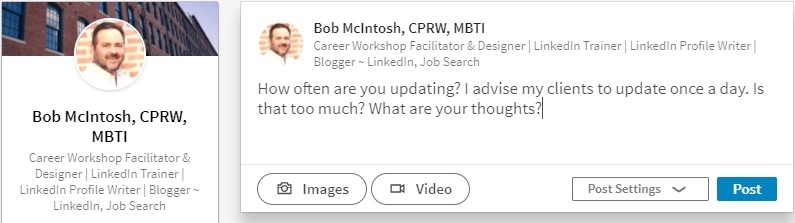
One of the most important aspects of networking—online or personal—is maintaining a presence. I tell my LinkedIn workshop attendees to update at least once a day. That’s correct, once a day. This is how you communicate with your connections and…stay on their minds.

Of course there have to be viable reasons for updating daily. It’s not like you can write, “I’m off to the beach; let’s meet up,” like you might on Twitter. No there must be intelligent and professional topics on which to update.

Let’s start with the most common:

  • Sharing articles—One of my favorites, especially articles from which people will learn. A good source for articles is Pulse.
  • Writing articles—I know, scary. But if you like writing, LinkedIn makes it possible to share your writing via Long Posts with your connections…and their connections.
  • Posting quotes—Some enjoy doing this. I’m not a big fan.
  • Writing about skills you’re developing—Great for jobseekers to show their value.
  • Letting people know what classes or conferences you’re attending—Perhaps you can meet up with people while you’re in DC.
  • Hosting an event—One of my connections hosts business networking events and uses LinkedIn to announce his events.
  • Provide tips—This demonstrates your expertise.
  • Ask questions—Ask illuminating questions that generate replies.
  • Are you leading workshops—Updating is a great way to promote them, as well as strengthen your brand as a workshop facilitator.
  • A great book you’re reading—Keep it professional. Because LinkedIn eliminated its Reading List feature, you might want to let people know you’re reading Twitter 2.0, for example.

Maybe updating on a regular basis is not your thing. You might simply want to:

  • “Like” what others update.
  • Write a short comment to someone’s post.
  • Thank people for visiting your profile.

The point is to be active and maintain your presence. It’s really not that hard, my valued connections.

I guess what I’m saying is I miss you. You are part of my network, so don’t disappear like a poof of dirt. Are you getting tired of LinkedIn? Are you spreading yourself too thin? Did you feel forced to join? Be persistent because, as you know, success only comes to those who work hard.


Photo: Danielle Nelson, Flickr

10 signs your job search resembles The Middle

The middleOne of my favorite TV shows is ABC’s The Middle. You know, the show about a family struggling just to get by. The character I like best is Brick, the youngest of the Hecks who is a genius yet oddly strange. (“Oddly Strange,” he whispers to his chest.) I also like Mike who my kids say I resemble, until I threaten to cut off their food supply.

Watching The Middle reminds me that some people conduct their job search as if it’s…The Middle. How, you may wonder? Think about the way the family never seems to get ahead, how their lives remain the same; and despite the fact that the show makes us laugh, we find it somewhat depressing. This is my point. There are 10 signs of your job search that resembles The Middle.

  1. No game plan. Does this not describe the Heck family to a T? Having a plan and goals also means you need to know what job you want to pursue, which can be the most difficult part of the job search for some. Without a plan, you’ll have no direction, which is essential if you don’t want to be stuck in The Middle land.
  2. A résumé that fails to brand you. Most important is writing a résumé that is tailored to each job, showing employers you can meet their specific needs. A Summary that fails to attract the attention of the reader, lacking a Core Competency section. no accomplishments to mention; are all signs of a The Middle job search.
  3. No online presence, namely LinkedIn, the premier social media application for the job search. At least 87% of recruiters/employers use LinkedIn to find talent, so if you’re not on LinkedIn you’re definitely hurting your chances of advancing in the job search.
  4. cover letter that doesn’t excite. You’re writing cover letters that fail to express your personality and are, well, boring. Worse yet, you’re sending form cover letters that don’t show you meet the specific requirements of the job. Further, you’re a believer of not sending cover letters. The Middle material for sure.
  5. Only applying online for positions. I’m not saying not to use job boards, but don’t use them as the foundation of your job search; networking still is, and will be, the most successful way to find employment. Don’t be fooled into thinking that sending out hundreds of applications will advance your job search…definitely reminiscent of The Middle.
  6. Networking isn’t part of your vocabulary. If you’re not going to networking events, meet-ups, or connecting with everyone you know, you’re missing the boat. Networking is proactive and a great way to uncover hidden opportunities at companies/organizations that may be hiring.
  7. Informational interviews are alien to you. The goal behind information interview is networking with people who are in your desired industry and selected companies. Impressing the people with whom you speak can create opportunities that might include being recommended for a job developing in the company, or may lead to speaking with other quality connections.
  8. Following up with potential connections is missing from the equation. You’re great at meeting people at networking events or other places to connect. You promise to e-mail or call your connections. But you don’t. This is a sure way to be stuck in The Middle, where nothing seems to change.
  9. Preparing for interviews as an afterthought. Oops, you go to interviews without having done your research on the position and company. You think you can wing it because you know your business like no one does. You’ve heard of behavioral-based questions but aren’t too concerned. You don’t get the job because of your lack of preparation.
  10. Not sending a follow-up note clearly says you don’t care. And simply thanking the interviewer/s isn’t enough; show the interviewers you were listening and engaged by mentioning some points of interest or revisiting a question you didn’t elaborate on. If you want to remain in The Middle, don’t send a follow-up note. But if you want the job, show the love. And no form thanks-yous please.

The Middle teaches a good lesson about how we need to put more effort into the job search. Doing a few of these activities does not make a successful job search; they must all be done to shorten the search. Can you think of other components of the job search that are necessary to make it a success?

If you enjoyed this post, please share it on LinkedIn and Twitter.

11 ways to communicate with your LinkedIn connections

A blast from the past, but well worth repeating. I’ve added one more way to communicate with your connections.

Having a strong LinkedIn profile is essential to being found by other LinkedIn members and employers, but you’re job isn’t complete unless you’re communicating with your connections and the LinkedIn community as a whole.

business_communication

I tell my LinkedIn workshop attendees that I spend approximately an hour a day (it’s probably more) on LinkedIn. Their faces register surprise; and I’m sure some of them are thinking, “Does this person have a life.”

Part of the workshop is about explaining the need to communicate with their connections because networking is about communication.

1. The most obvious way to communicate with your connections is to message them directly. Awhile back LinkedIn changed the way we message our connections. Now, our messages are a running stream beginning when we first started a message.

It took a while to get used to, for me, but now it’s nice to have a history of a conversation I have with one of my connections. In addition, the ability to begin a message is available on every page you’re on. This is an obvious sign that LinkedIn wants you to communicate with your connections.

2. Another great way to communicate with your connections is by is posting Updates. How many you post is up to you, but I suggest at least one a day. This is when I get remarks from my attendees about not having time to make an update a week.

Update oftenYou’ll notice that LinkedIn has given its members the ability to create and post videos. Although a nice feature, not many people are using it. This feature is similar to what Facebook has offered for many years.

3. Another way to communicate with your connections is to “Like” their updates. Liking their updates is great, but it takes very little effort to simply click the link. Like, Like, Like. Be more creative and add a comment which can generate discussion, or reply to your connections privately.

4. I’ll visit my connection’s profiles—with full disclosure—many times a day. My connections will visit my profile many times, as well.

When they “drop in” and have disclosed themselves (not Anonymous LinkedIn User or Someone from the Entertainment Industry), I’ll show my appreciation by writing, “Thanks for visiting my profile.” This will also lead to a discussion.

5. You’ve probably read many opinions from people on the topic of Endorsementshere we go again. Add me to the list of people who prefer thoughtful recommendations, both receiving and writing them, as opposed to simply clicking a button.

But, in fairness, Endorsements have a purpose greater than showing appreciation for someone’s Skills and Expertise; they act as a way to touch base. In other words, they’re another way to communicate with your connections.

6. Participating in discussions regularly is a great way to share ideas with established and potential connections. Yes, I’ve gained connections because of the values we shared as revealed by discussions.

Just today I connected with a great resume writer who impressed me with comments she made regarding a question I asked from my homepage.

7. If your connections blog, take the effort to read their posts and comment on their writing. This is an effective way of creating synergy in the blogging community, but blog posts have made their way into the Updating scene, as well.

The majority of my Updates are posts that I’ve read and commented on.

8. I turned 50 yesterday. Not surprisingly I received happy wishes from some of my connections. When your connections have an anniversary (work, that is) or have accepted a new job, you’ll be alerted and be given the opportunity to communicate with them.

A small gesture but nice to recognize your connections and generate some discussion.

Take it a step further

So far I’ve written about how you can communicate with your online connections. You can’t lose sight of the fact that an online relationship will not come to fruition until you’ve reached out and communicated with your connections in a more personal way.

9. A very simple way to extend your communications is by e-mailing them. I know, it doesn’t require a lot of effort, but it’s another step toward developing a more personal relationship.

Because you are connected by first degree, you have access to their e-mail address, access which can come in handy at times. Note: LinkedIn users can disclose their email to anyone on LinkedIn, not just their first degrees.

10. Naturally the second act toward strengthening your relationships is to make that daunting phone call (for some it is a big step), Let your connections know, through e-mail, that you’ll be calling them.

Write the reason for the call, such as explaining who you are and what goals you have in your professional life. Nothing is as awkward as dead air and running out of things to say, because the recipient of the call is caught off guard.

11. Finally comes the face-to-face meeting at a place that is convenient for both of you. If your connection lives in a distant location, you may suggest getting together when you’ll be in their city or town. Plan to meet at a coffee shop or a personal networking event if your connection lives close by.

When you meet in person with a connection, he/she becomes a bona fide connection. This is the ultimate way to communicate with a LinkedIn connection. It may not happen often, particularly if he/she lives a great distance from you, but when it does possibilities may present themselves.


Having a great profile is not enough. It’s a start but only the beginning of communicating with your connections. I’ll write LinkedIn profiles for people, and they might have questions about what to do next. Sometimes it’s your activity on LinkedIn that really makes the difference between standing still and realizing success.

Did you like this post? Please share it if that’s the case.