Tag Archives: job search

The sport of the job search: 3 types of job seekers

This past summer I saw my son’s basketball team lose a close playoff game. I noticed a mixture of emotions. Some of the players, including my son, played hard until the final whistle blew. Others gave up the game when the other team began to dominate. And some demonstrated a downright negative attitude, including fouling out of frustration.

basketball hoop

The team could have won if they had more confidence and stayed the course. But they didn’t stay the course and unite as one. It was interesting to see the clear distinction of attitudes between the players. I witness the same attitudes in some job seekers.

Some job seekers don’t give up

These are the people who are a pleasure to assist. They wear a smile on their face, despite how they’re feeling inside. They don’t hear back from employers after working hours on their résumé and cover letter. They make it through three rounds of interviews only to lose out in the end to someone who was a “better fit.” Despite this, they trudge on.

One job seeker I helped, when I started delivering workshops, would ping me on his progress. “Bob, I had a great interview today. I have a few coming up this week. Ciao.” Then, “Hola, didn’t make the final cut. Better luck with the next interviews.”

When he finally landed, I asked him how he felt during his job search. Not surprisingly he told me there were times when he felt despair and wondered if he would ever land a job.

He was so grateful for the services I and others offered him at the career center that he speaks to our networking group when I ask him. He also let’s us know when there are openings at the company for which he works. This is the true nature of networking.

Some job seekers throw in the towel

It shows on their face. They say they’ll never land a position. They lose sight of the bigger picture. Like my son’s teammates during the game, they walk through their job search rather than run. Their despondency is understandable, but they don’t see it hurting their chances of landing.

They lose confidence. They make excuses like, “It’s my age.” I’m not naive enough to believe that ageism doesn’t exist; however, I believe if you adopt that attitude immediately, you’ve already lost the game. Hopelessness settles in.

When employers see your lack of confidence, they wonder if you’ll demonstrate confidence on the job. Similarly when people with whom you network see your lack of confidence, they’ll wonder if they should back you as a reference.

This was not the case when I recently acted as a reference for a woman who had been out of work for more than two years. I loved her “can do” attitude so was glad to speak to her personality. She landed a job based on her rich experience and, I’m sure, her attitude.

Some job seekers let their anger show

As soon as I saw my son’s teammates get angry, I knew “that’s all she wrote.” There was no chance they could regain their composure. The other team noticed this, and I’m sure it boosted their confidence. I wondered if I were coaching if I could reign them in. I concluded I couldn’t. It was in their personality makeup.

I see anger in few of my clients. It may be a workshop or during a one-on-one appointment. When I see their anger, I’ll tell them their anger is written on their face. They’ll deny being angry, but it’s so apparent that there’s no denying it.

I understand they are angry; I was angry at times during my job search. However, I tried hard not to let it show in public. Public anger might be witnessed by people who have the authority to hire you or know someone who has the authority to hire you.

Job seekers who let their anger show don’t think others notice it. After one workshop a recruiter who was between jobs approached me and said, “You know, I’ll eventually find a job in recruiting, and I’m going to remember the people in this workshop who are angry. They’re not the ones I’d present to my client.”


The job search is like sports. Moreover, how you handle yourself during this time of transition can be more important than your technical expertise. Don’t give up and don’t show your anger; your job search will be longer if you do either or both.

This post originally appeared in Recruiter.com.

Photo: Flickr, Sar_Proc_

Apply for some jobs already! 5 reasons why you’re not applying.

And what you should do about it!

It’s called paralysis by analysis. I’m sure you’ve heard of it, or even suffered from it. I have. Suffered from it, that is. This is when you’re caught up more in the process than achieving the goal. No, this is different than procrastination. This is the inability to act.

Man from recruiter

I see it in the resource room of the career center for which I work. A person sits down in the morning; opens their résumé on a computer to revise it; and when I walk by at the end of the day they’re still revising the same résumé, their eyes bloodshot. I ask nicely, “Are you applying for jobs?”

“Not yet,” he replies. “I’m waiting until my résumé is perfect.”

“You’ve been here all day working on the same résumé.”

“I want it to be perfect.”

One time I must have been heard throughout the career center as I raised my voice at one person, “Apply for some jobs already.” I was being playful, but I also meant it.

Another person is doing such a great job of networking. He is meeting people for coffee or lunch, going to networking events and buddy groups. This has been going on for weeks. I ask him where he’s applied.

“I want to make sure I apply to the right companies,” he says. “I’m trying to get a sense of their culture.”

“Great,” I reply. “But you need to start applying. Apply on line.” And I hate saying this, because to me applying online is equivalent to throwing chumline in the ocean and waiting for fish to surface.

These are but a few examples. It could be trying to make their LinkedIn profile perfect before sending invites to people, asking for recommendations, or engaging with their network. Anything less than perfect is unacceptable.

Are you suffering from paralysis by analysis? Here are a few reasons why you might be, as well as some advice on how to move forward:

You’re shell shocked

Losing a job is a terrible blow to your psyche, even if you weren’t to blame. Additionally you’re wondering how you’re going to pay the bills. What will working again be like, you wonder? It might be 15 years since you last engaged in the job search. A lot has changed since then. This is a scary prospect.

What to do

I’m not going to say, “Get over it.” But I am going to say, “Take some time—a week or two—to realize that the more you’re out of work, the longer it will take to find employment. Understand that:

  • this is temporary,
  • it happens to many people,
  • it’s natural to feel despondent,
  • there is help from your One-Stop career center and a therapist, if necessary.

Writing résumés has changed over the past 15 years

The way résumés are written has changed. Recruiters want to see accomplishment statements, with quantified results. The applicant tracking  system might not have been used by organizations, as well.

What to do

Don’t be obsessed with writing your résumé; however, make sure it meets the following criteria:

  • shows value with accomplishments,
  • is tailored to each position,
  • is readable with short paragraphs and plenty of white space,
  • doesn’t exceed 15 years of work history,
  • finds itself in the hands of the hiring manager, as much as possible.

Networking is key

Most companies want you to apply online or go through recruiters and staffing agencies, but you’re more likely to get better results by getting your resume in the hands of the hiring manager directly. Most companies prefer to hire job seekers through referrals from people they know and trust.

What to do

Despite what most people think, networking events aren’t the only activities that constitute networking. Look at networking as connecting with people everywhere. Your neighbors, relatives, friends, store owners, dentists — essentially everyone can be a valuable networking connection. Make sure to reach out to former colleagues and supervisors who can act as references. Don’t be afraid to ask for help.

Social media plays a large role in the hiring process

In today’s job market, you have to be cognizant of your social media image. According to a 2014 survey, 94 percent recruiters look for and vet talent on LinkedIn. Four years later, the number may be even higher. Employers are also checking you out on Facebook and Twitter to dig up any dirt that may disqualify you from the running.

What to do

First of all, LinkedIn will not land you a job by itself. It is a supplement to your face-to-face networking events. However, it can be very helpful if used properly. Like your résumé, don’t dwell on trying to make it perfect. There are two other components that make your LinkedIn campaign a success—growing your network and engaging with your connections.

The interview process is longer

You might have to endure as many as five telephone interviews before multiple face-to-face interviews. The types of interviews you will participate in could vary, including Skype, Zoom, group, and, of course, one-on-one.

What to do

Go with the flow. It’s a known fact that employers dread hiring the wrong person because it’s costly and embarrassing. It may seem like they’re looking for the purple squirrel, so be patient and persistent. Most importantly, don’t put all your eggs in one basket. Some job seeker tell me they’re only applying to a couple of companies, because they’re the ones. Apply to the right companies, but have a list of at least 10 companies for which you’d like to work.


If my clients think I want them to scatter their résumés around the state, they’re wrong. All I’m asking is that they don’t spend more time doing nothing than doing something. Yes, they should recover from their trauma…or fake it til they make it. They need to connect with people in their community. The interview process, and the methods employers are using, is taking longer.

One thing we all an say for certain is paralysis by analysis is real and detrimental to your job search.

Photo: recruiter.com

__________________________________________________________________________

Bob McIntosh, CPRW, is a career trainer who leads more than 17 job search workshops at an urban career center, as well as critiques LinkedIn profiles and conducts mock interviews. Job seekers and staff look to him for advice on the job search. In addition, Bob has gained a reputation as a LinkedIn authority in the community. Bob’s greatest pleasure is helping people find rewarding careers in a competitive job market. For enjoyment, he blogs at Things Career Related. Follow Bob on Twitter and connect with him on LinkedIn.


2 areas where self-promotion is important for introverts

As my wife and I were driving our daughter home from a summer camp in Maine, where she was employed as a counselor, my daughter brought up a topic that is familiar with those who prefer introversion. The topic was self-promotion, which many introverts struggle with.

work

She began be telling us that she worked harder than some of the counselors, but didn’t get recognized for it. In fact, those very counselors who weren’t as effective were given praise in moments when she should have. I asked her why, and she told me that they were constantly in the ear of the supervisors, being their friend and talking about the great things they did.

I couldn’t resist the temptation to put on my Myers-Briggs Type Indicator hat and give her some advice. I told her that in the future she’ll need to promote herself better. That self-promotion comes harder to introverts because they’re not as outspoken about it.

It’s not that introverts don’t want to be recognized, it’s just that they find it awkward doing what my daughter had described about the other counselors who were getting the recognition. I emphasized to my daughter that she has to be more proactive about promoting herself in the two most important areas in her life, the job search and then work.

So how can she and other introverts promote themselves in important areas of their lives?

Job search

Writing is something with which introverts are comfortable. It allows them to process their thoughts and speak (through writing) intelligently. Therefore, their written communications will in all likelihood outshine extraverts, who are more prone to talking. Introverts are stronger when it comes to writing resumes, cover letters, and their LinkedIn profiles.

Although introverts are not as comfortable with networking as extraverts, they possess the strength of listening and asking relevant questions. Introverts also prefer smaller groups, so a buddy group might be more to their liking. When it comes to conversation, introverts would rather talk in depth than have longer more shallow conversations. It’s not that extraverts are better networkers; they don’t get overwhelmed by people as much as introverts do.

In interviews introverts tend not to be as animated and spontaneous as their counterpart. They don’t display the bravado extraverts do. However, what they lack in display of enthusiasm, they bring more preparation to the table. I recently conducted a mock interview with a client who rates 20 out of 21 points as an introvert. She defied everything I’ve just written. She came across as confident, at sometimes animated, smiled and laughed on key. Through her answers I got the sense she had researched the company and position and, as a result, was well prepared. This can be a strength of introverts.

At work

As I state in my story about my daughter, introverts need to be more “friendly” with their direct supervisors. I’m not suggesting they appear in their supervisor’s office three times a day. It’s only natural for supervisors and managers to feel well liked, so visiting them or catching them in the hallway just to talk is a good thing. The seldom encounter is not kissing up to the supervisor; it’s building and nurturing a relationship.

As mentioned earlier, introverts’ strengths lie mostly in writing. In my opinion if extraverts are going to promote themselves through oral communications, why shouldn’t introverts promote themselves through written communications. I’m speaking of email. When I accomplish something at work, I send an email about my accomplishment to my manager. Sometimes I’ll cc the director of the organization.

If introverts take this approach, they must be sure to include anyone who helped them with a project, solved a problem, provided excellent customer service. In other words, not come across as self-serving.

The direct approach is sometimes best. Introverts must also be willing to knock on their manager’s door and talk about the accomplishment they’ve achieved. They shouldn’t come across as boastful, but they should show pride in their accomplishment.

The other day I went to my manager and told her I needed more clients to counsel (showing initiative). Before she could ask why, I told her that many of my clients were landing jobs. This made me feel somewhat awkward, but I knew it was a time when I had to point out my accomplishments…in a “by-the-way manner.” It was well taken by my manager.

One bit of advice I have for introverts, as well as exraverts, is not to use meetings as a way to blatantly tout their successes. If the timing is right, introverts should mention their accomplishments, while also acknowledging a team effort. Anyone who talks in “I” terms only comes across as self-centered. Eyes will start to roll when this happens.


Perhaps it’s the awkwardness of self-promotion that prevents introverts from getting promoted more often than extraverts. Introverts make excellent workers, as my daughter illustrates; but they don’t get the recognition, again as my daughter illustrates. I hope in the future she learns how to be more forthcoming with her accomplishments.

Photo: recruiter.com


3 more reasons why job seekers should blog

Part two of a two-part series.

I wrote, in an earlier blog, three reason why job seekers should blog. They are: it demonstrates their ability to write, it helps brand them, and it’s a great way to network.

blogging3

My idea for writing part one of this series came from my recollection of my two daughters’ penchant for writing; the older one preferred academic essays and the youngest preferred fiction.

Here are three more reasons why you as a job seeker should blog.

1. You’ll feel more productive and learn from writing

Writing about what you know requires processing your knowledge to put it to paper—or in most cases your computer screen. When I write about the job search, it makes me think about what is important to my audience, as well as how to express it.

You will learn more about your industry by blogging, as you’ll have to conduct research in order for your posts to be accurate. One benefit of blogging for me is that I often use what I write as fodder for my career-search workshops. Essentially, I leverage my writing.

It’s believed that one must blog on a consistent basis. You may want to start by blogging once a month, then twice a month, and maybe weekly. Hitting these goals will further give you a sense of productivity. I generally try to blog once a week.

2. More people will witness your expertise

Whether you’re blogging about your industry or job search, you can publish it on your own blog or a third-party blog. LinkedIn is a common third-party platform for blogging. The expertise you share with your audience will be there for as long as the blog sites exist. Personally, I use WordPress, Recruiter.Com, and LinkedIn. I don’t foresee either of them disappearing soon.

There are many platforms on which you can publish your posts. The top three are LinkedIn, Twitter, and Facebook. Others include Tumblr, Google+, Reddit, and many more. Your audience can then share what you’ve written with their connections, followers, friends, etc. The information you share can go viral, as they say.

Hopefully you’ll continue to blog after you land your next job. I know people who begin writing great content but then suddenly stop. Documenting your expertise is great, but doing it on a regular basis keeps it topical.

3. It educates your readers

Related to number one, you can help other job seekers learn more about your and their industry. I educate my readers on the job search and LinkedIn. I’ve been contacted by people who are in the job search, as well as job-search educators, who tell me that they’ve learned a great deal from me. This is a good feeling.

One of the goals of networking is sharing what you know with other job seekers. Your shared knowledge can be a gift; it might be the reason why job seekers land their next gig.

One reason I gave for blogging in the previous post is branding yourself. If you blog consistently and for a long period of time, you could become known as an authority on your industry, whether it’s High Tech, Social Media, Finance, Medical, etc.


This post, along with the first one I wrote, marks six reasons why job seekers should blog while searching for a job. It’s not only important to keep the momentum going while you’re hunting for work; it’s also important to continue sharing your knowledge while you’re working.

6 Areas on your LinkedIn profile you should optimize in 2019

If you’re wondering how an optimized LinkedIn profile will help you in your job search, the answer is simple: Your profile needs to be found by hiring authorities (recruiters, hiring managers, and human resources reps). These people can’t find your profile unless you utilize search engine optimization.

linkedin-alone

Hiring authorities approach LinkedIn similarly to the way they approach their applicant tracking systems (ATSs). They search the site for certain keywords denoting titles and areas of expertise. To be found, you must show up in the first 4-6 pages of search results, lest you be overlooked.

Let’s consider the following scenario: A hiring authority is searching for a finance manager with expertise in data analysis; advising senior managers on how to maximize profits; business analysis; forecasting; supervising employees responsible for financial reporting; and legal compliance. A Masters of Business Administration (MBA) is preferred, although not required.

If a given finance manager wants to be found by the hiring authority in this scenario, their LinkedIn profile must contain their title and area of expertise. Furthermore, this information must be listed in all areas of the finance manager’s profile in order to maximize their chance of being found. This information can be worked into the finance manager’s profile through the use of keywords.

Areas on Your Profile Where Keywords Count

1. Your Name

This area is valuable real estate, as it is weighed heavily in searches. Any certifications or degrees you hold should be included alongside your name, as they will indicate your experience and expertise. So, our finance manager would list their education, “MBA,” after their name.

2. The Headline

This area should be rich with keywords, and it should brand you for your occupation and industry.

Using our financial manager as an example, their headline would read as:

Finance Manager ~ Data Analysis | Business Analysis | Forecasting | Legal Compliance | Maximizing Profits | MBA

Note that you only have 120 characters – including spaces – to work with in your headline. The above example uses 113 characters.

3. The Summary

Your summary should not be brief. Writing a brief summary prevents you from including all the important keywords we’ve identified. In the case of our finance manager, they would want to repeat “finance manager” and the areas of expertise mentioned in the headline above as often as possible.

Note that you have 2,000 characters with which to work in your summary. Something to keep in mind is that visitors only see the first two lines of your summary, unless they select “See more. Read: The 39 most important in your LinkedIn profile summary

4. Experience

The experience section is often overlooked, which is a huge mistake. Each entry in the experience section contains two factors that need to be considered: the job title and the position description.

Our finance manager’s official title is “finance manager” at ABC Company. While this is an accurate title, it doesn’t show their full value. The finance manager should instead list a title similar to their headline. However, you only have 100 characters here, so you have to be more selective. Our finance manager’s title might read:

Finance Manager ~ Data Analysis | Business Analysis | Forecasting | Legal Compliance | MBA

Here, the phrase, “maximizing profits” was removed. “MBA” could be removed instead, but the designation is more important for our finance manager’s purposes.

While the position description must above all else show the candidate’s value by listing accomplishment statements with quantified results, it is also an area on your LinkedIn profile where you can utilize a great deal of space. You have 2,000 characters here to repeat your title and areas of expertise. Don’t squander them.

5. Education / other sections

The education and other sections are also in play. What many people fail to realize is that they can add narratives to their education section. Yes, you’ll list your institution of learning and location (no dates of graduation), but you can also provide some background information.

Our finance manager might tell a story like this: “I fell in love with accounting and other areas of finance on my way to earning my MBA. Of particular interest to me were data and business analysis. I was given the opportunity to learn these skills during an internship at ABC company, which is where I am now employed.” Notice how this narrative employs the right keywords!

You can also benefit from keywords in the featured skills and endorsements sections. Your skills are counted, and some say the number of times you’re endorsed for them increases your ability to be found.

Other considerations when optimizing your LinkedIn profile

Loading your profile with keywords isn’t going to be enough on its own. Being found by hiring authorities also depends on how many people you’re connected with, as well as who your connections are. In addition, engaging with your connections will increase your chances of being found. Read 3 reasons for your LinkedIn success.

Outside your LinkedIn profile

Highlighting your LinkedIn profile on business cards, resumes, links from other social media can further optimize your profile.


Next week, we’ll explore LinkedIn profile optimization further by looking at how to properly connect with other LinkedIn members.

This post originally appeared on recruiter.com.

If you want to learn more about LinkedIn, visit this compilation of LinkedIn posts.

6 reasons keeping you from asking for help during your job search

And what to do about it.

You know the “Golden Rule” of networking: offer help before asking for help. This is good in theory. When you give first, others will return the favor. It may not be the person to whom you gave a slam-dunk lead, but the favor will eventually be returned.

Professional man

Many take this golden rule to heart, almost to the point where they don’t ask for help. It’s as if they don’t believe they deserve being helped with their job search, which to me is a huge shame. Here are some reasons why you might not ask for help and what to do about it.

1. You feel shame

I understand the feeling of the shame and embarrassment of being unemployed, because I’ve been there. Even though I was laid off when the company for which I worked was acquired, I felt like I had let myself and my family down. I know now that the shame I felt was irrational.

What do. What’s rational is realizing that your friends, relatives, neighbors, former colleagues understand that people lose their jobs. It’s part of human nature to, at one point or another, be unemployed. In fact, some of these people were probably unemployed. So, put your shame aside and ask them for help.

2. You don’t think you need help

Many people who haven’t had to look for work for  many years don’t anticipate how difficult the job search can be. Take an executive who’s risen to the top of her career. She’s was in the position of hiring candidates. Now the roles are reversed, and the way employers are hiring have changed.

What to do: Like the executive, you need to understand the job search has changed and be willing to accept help from those who are trained to help you, as well as from other job seekers who have been in the job search more recently. Even executive-level job seekers struggle in the job search.

3. You’re too proud

Some people who are unemployed are too proud to ask for help, because to ask for help is a sign of weakness. From an early age we grew up believing independence is admired and a sign of strength. Helping others is what we should do.

What to do: Now is the time to swallow your pride. If you’ve been helping others throughout your life, or even more recently, accept help from others. Believe it or not, people are willing to help. Social psychologist point out that helping others gives us a sense of pride and happiness, so make other people happy by asking for help.

Being Polite

4. You don’t know who to ask

Knowing who to ask is difficult for some job seekers. They ask me who to approach. My answer to them is “everyone.” As absurd as it may seem, anyone can be of assistance. These are what we call the superficial connections.

What to do: Certainly you will ask your former colleagues and supervisors, as they are you top tier. Beyond that look to your community, including friends, relatives, neighbors, etc. Organized networking groups, buddy groups, and professional associations are also a great source of help.

5. You don’t know how to ask

“Excuse me, do you know of any jobs available?” This is what you wonder, and this is what you want to ask someone who might know this answer. But it is wrong, because it puts people on the spot and makes you appear desperate.

What to do: Simply by letting people know that you’re out of work will put them on notice. They’ll keep you in mind when they hear of openings. Ping people occasionally is what I tell job seekers. Send an email to them to let them know about your search, but don’t always make your pings about your job search.

6. You don’t know when to ask

There are the premature askers–such as a person who asks for help immediately upon sending a LinkedIn invite—and the Johnny come lately askers—the person who summons up the courage after a positions been filled.

What to do: You’re at a professional association event speaking to an insider at a company for which you want to work? Now is  the time to ask for help. Remember reason number 5; don’t ask for a job. Rather, ask if you could connect on LinkedIn or if the person would have time to give you advice on your job search.


Asking for help can be difficult at times; it can even take courage. However, during the job search it’s a necessity. As I tell job seekers, “Going it alone will make your job search longer…much longer.”

Photo: Flickr, Дŋøŋ ДђḾęĐ

One major turnoff for interviewers: lack of transparency from candidates

Three questions that snag job candidates.

A conversation with my daughter in the past aroused in me emotions of both concern and relief. Two conflicting emotions you’re thinking. Yes, two conflicting emotions, but the feeling that stays with me is the feeling of relief.

Honest Abe

The feeling of relief because she was truthful about her faux pas, her display of bad judgement. All was forgiven, although not forgotten. “This is what the truth accomplishes,” I told her.

This is what you get when you ask your kids to be honest. This is what you get when you ask for honesty, regardless of the response.

What interviewers get from their job candidates at an interview aren’t always honest responses. Candidates are guarded, weighing every word they say, because they feel one wrong answer can blow the deal. They don’t have faith in the interviewers being understanding of mistakes made in the past.

Questions addressing candidates weaknesses

When I spring the question, “What is your greatest weakness?” on my workshop attendees, I often get a moment of silence. Their minds are working like crazy to come up with the correct answer. They think the best answer is one which demonstrates a strength, not a weakness.

No job candidate wants to disclose a real weakness. They don’t want to kill their chances of getting the job, so they creatively elude the question, or even lie.

What I impress upon my workshop attendees is that interviewers want transparency, not a coy answer they’ve heard countless times. The “weakness” question is the one that gives them the most trouble.

So they come up with answers like, “I work too hard,” or, worse yet, “I’m a perfectionist.” I tell them these questions rank high on the bullshit scale, to which they laugh. But it’s true. These answers are predictable. They’re throwaway answers, wasted breath.

Be smart, though. Don’t mention a skill as a weakness that is vital to the position at hand. Talking about your fear of  public speaking, when it’s a major component of a position requiring public speaking skills, would be a major problem and probably eliminate you from consideration.

Another question job candidates struggle with is, “Why did you leave your last job?” For those who’ve been let go this can be a struggle. Transparency is required here just like the weakness question.

Unfortunately you may have been let go from your previous position, which means you may have done something wrong; or maybe it was just a conflict in personality with your manager. Whichever the case may be, be transparent, rather than trying to make up a phony story.

For example, “My first manager worked well together because he was clear about his deadlines. However, with my recent manager, I didn’t get a clear sense of when financial reports were due.

This became a problem on a few occasions, which I take responsibility for. Because of this, I’ve learned to ask about strict deadlines.”

Note the person explained the situation succinctly (this answer must be short) and explained how she learned from the experience. This demonstrates transparency and self-awareness.

A final difficult directive might be, “Tell me about a mistake you made and how you dealt with it.” This directive is one that many people are not prepared to answer. When I ask my clients this question, they pause, or might say, “I never thought of this question.”

Like the weakness question, you don’t want to choose the most detrimental mistake you’ve made. The time you cost the organization a $3 million account due to poor follow-through with a huge client is not the example you want to bring up.

However, interviewers want an honest answer. They also want you to tell as story about this mistake. This is where a brief STAR story comes in handy. Read this post to learn how to use the four components necessary to answer this directive.

make mistake

People make mistakes, they do

Smart interviewers understand that just as job candidates make mistakes, managers also make mistakes. No one is flawless in the interview process. Nonetheless, they don’t want to hear candidates dancing around their questions. It’s a waste of time and just makes the job candidate look silly.

Furthermore, interviewers want to hear self-awareness, meaning that you know your weaknesses, and are doing something to correct them. If your greatest weakness is a fear of public speaking (this is not a major requirement of the job), maybe you’ve been attending Toastmasters to get over that fear.

If you can’t admit that you slip every once in awhile, you lack not only self-awareness, but also emotional intelligence, which is a key component of your personality. Not all interviewers want the purple squirrel, the candidate that is perfect and elusive.

Employers want people who can do the job—have most of the required skills—and the motivation to take on challenges. So if candidates don’t have some  non-consequential skills, they need to own up to it. Their understanding of self and limitations is part of their EQ, which is not a given in everyone.


Back to my daughter

It’s tough as a parent to realize your daughter, or son, is not perfect and makes poor judgement calls. Life would be easier if you didn’t have to deal with these minor issues, but they are part of life.

I appreciated her transparency and, as a result, trust her more than if she hadn’t told the truth. In addition, I understand she’ll make mistakes in the future. This is not too different than a conversation that an interviewer and job candidate have. Interviewers will trust candidates more when the candidate is honest….to a point.

I’m sure there was more to the story than my daughter wanted to disclose.

Photo: Flickr, Limmel Robinson

4 reasons why the applicant tracking system is ineffective

My wife has an ongoing argument with Amazon’s Alexa. “Alexa, play WBUR.”

“I don’t understand your question.”

“No, Alexa….Play WBUR….Alexa, play WBUR.”

“Playing a station from Boise Idaho.”

“Argh.”

alexa

As I watch this interaction, it demonstrates how technology and humans don’t always jive. This transaction between my wife reminds me of how the applicant tracking system (ATS)—of which there are hundreds—doesn’t work for the following reasons.

People are only human

No matter how hard I try, some job seekers don’t send résumés tailored to specific jobs. Instead they send generic résumés to every job, exclaiming in aspiration, “Why don’t I get interviews? I’ve sent hundreds of résumés and gotten no interviews; not even a phone interview.”

For years I’ve been preaching to job seekers that keywords are the trick with the ATS. I tell them that they can identify keywords from the job postings by using software as simple as http://www.tagxedo.com or http://www.wordle.net to create word clouds, and then do the same to compare their résumés to job postings. Or they can use a more scientific method using http://www.jobscan.com.

Take the time to dissect the job post to understand the required major requirements and skills. Modify your Branding Headline, Performance Profile, Experience section, essentially everything to fit the job post.

The ATS is not human

The ATS can’t do human; it doesn’t know you as a person who has so much more to offer than the requirements for the job at hand. It is designed to do one thing: parse résumés for keywords. Only if your résumé contains the keywords—and density of them—will it be delivered to the hiring authorities who will read it.

Learn more about the ATS by reading 8 things you need to know about applicant tracking systems.

The ATS is so exact in the keywords for which it searches; there is no room for error. It doesn’t  digest the following words (in bold) in this sentence written by a job seeker: “Demonstrate organizational skills by coordinating events that garnered 98% participation from municipality constituents.

It recognizes the following words (in bold) from a job posting: “Must coordinate events for functions that attract an extremely high percent of participants. Candidates must be extremely organized

Here is where the job candidate fails in matching the three keywords.

  1. coordinating doesn’t equal coordinate.
  2. participation doesn’t equal participants.
  3. Organizational doesn’t equal organized.

The ATS promotes a failing system

The ATS is brilliant because it eliminates as many as 75% of hundreds of résumés submitted for one job. This makes hiring authorities’ lives more manageable and keeps them sane. Most large, and many midsize, companies use applicant tracking systems. One source rates the top 99 applicant tracking systems.

For years we’ve realized that the hiring process is deficient in various ways. When human meets machine, the process fails. You submit your application through an ATS, which does a great job of rating your résumé among others (remember keywords).

However, if your résumé doesn’t meet the ATS’s criteria, you’re out of luck for that job. What the ATS can’t determine is perhaps the most important aspect of a candidate’s potential, emotional intelligence (EQ). The ATS focuses strictly on the skills stated on your résumé; it does not sit across from you in an interview.

The ATS also delivers unqualified people to interviews. This might be attributed to career developers, such as myself, who advise job seekers on how to get by the ATS. (Surely not all people who can play the ATS game are unqualified.) The ones who are unaware of mechanics of the ATS, are being passed by for less qualified people.

The ATS perpetuates job boards

Job boards are chum line. If you’ve ever gone deep-sea fishing, you know what it means to use chum line. Scraps like squid, clams, fish parts, and basically anything that would attract large fish are thrown overboard. The bait attracts any fish who happen to be near the surface.

Hiring authorities reason that they might not get the perfect candidate, but there are job seekers out there who are qualified enough. In other words, what they don’t see, they won’t miss. This thinking is human nature, but it is also faulty.

The ATS allows employers to accept more résumés, convinced the most qualified candidates will be presented to them. Further, the résumés that don’t pass the ATS the first time will be stored for future perusal. Hiring authorities will have a trove a future candidates to look at. This is of no solace to job seekers who need a job now.

The job board’s success rate ranges from 2%-10%. The marriage between it and the ATS is a perfect union.


Friend or foe, the ATS is no better than Alexa. My wife eventually taught the machine to find the radio station she desired, but it took some teaching and frustration. Will the ATS be smarter? Will it be more human? More intuitive? If Alexa is any indication, there might be hope.

Photo: Flickr.com, Victor Gonzalez Couso

6 interesting ways you can find your alumni using LinkedIn’s “See Alumni”

I’ve been working with a gentleman who is interested in enhancing his LinkedIn strategy. One questions he had for me was with whom should he connect.  I suggested that he connect with those in his occupation and industry, as well as people in companies for which he’d like to work, and then I pointed him to See Alumni.

Home_UMassAlumniInAction_1400_636505033912274809


Alumni? you may wonder. Yes, alumni. It makes perfect sense. Think about the bond you have with the people you went to school with, even if you never met them. There are things you probably experienced during the four years of your education, such as frequenting the same sports bar, getting chased by the white swans from the campus pond, cheering for your school’s basketball team, surviving the blizzard of ’87.

If you haven’t taken a look at See Alumni, which you accesse by typing your school’s name in the Search field, you should see what kind of information you can gather and the potential of connecting with your alumni. I’ve gathered some telling information about my alumni. I’m focusing on my 2nd degree connections.

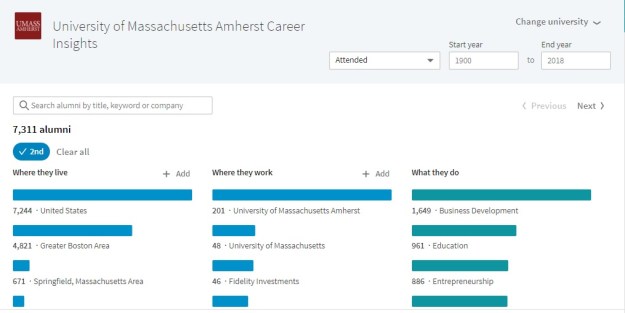
LinkedIn allows me to filter my alumni by six categories. Below is the first of two pages of See Alumni:

See Alumni 1

1. Where they live

In the United States the majority of my alumni live in the Greater Boston area (4,821), which makes sense. I also live in the Greater Boston area and choose to connect with people who are local. Only 671 of my alumni live in the Springfield, Massachusetts area. This also tells me there’s more industry in eastern Massachusetts.

2. Where they work

If I’m wondering where my alumni work, I see that 201 of them haven’t strayed far from home. Most of them work at my alma mater, while the 46 work at Fidelity. I pointed out to my client that if he clicks “See More,” he’ll see many more companies, along with other filters.

I also tell him that this filter is a great source of information, especially if he has some companies in mind. His alumni can be allies in his job search.   

3. What they do

Of my alumni connections 1,649 are in business development. And at the bottom of the truncated view are 886 people in Entrepreneurship. I recall looking through my See Alumni feature and noticing that I’m connected to many engineers, even if they’re 2nd degrees. This filter can be a good indication of the relevance of your network.

The second page of See Alumni provides the following information.

See Alumni 2

4. What they studied

Economics, Psychology, and Business Administration seem to be the choices of majors of my 2nd degree connections at my alma mater. My discipline, English Languages, is seventh on the list. Mechanical Engineering is seventh. Dad always told me not to be an engineer. Not because it’s a lousy occupation; but because I’d make a lousy engineer.

5. What they’re skilled at

My alumni are more skilled at leadership (2,831) than business development, which is hidden, (1,342). If I fashion myself skilled at public speaking, I’m in the company of 2,194 others who share this skill.  Social Media stands at 1,902. Four years ago it was at the bottom at the list at 556. This is an indicator that social media is exploding.

6. How you’re connected

Four years ago my 1st degree connections stood at a mere 32. Now I have 159. My second degrees have grown from 4,521 to 7,311 in that time frame.

What does this all mean?

This has been a fun exercise for me in terms of discovering where my alma mater live and work, what they do, etc; but the power of this feature lies in identifying specific people with whom you’d like to connect. No matter what your age is, this is a feature you should be using.

If you enjoyed this post, please share it.

Photo: UMass.edu Almuni

How to answer “Tell me about a time you made a mistake” in 4 easy steps

No one likes to talk about the mistakes they’ve made. However, interviewers want to know about more than just your successes. They want to hear it all — the good, the bad, and the ugly. This includes your mistakes.

Attention

This is why I’m surprised when I conduct mock interviews and my participants aren’t prepared for the common directive, “Tell me about a time when you made a mistake.” I explain to my participants that good interviewers will challenge them with questions like this. The best interviewers want to get a full sense of their applicants.

When a candidate can answer these challenging questions about their negative experiences, they demonstrate their self-awareness and emotional intelligence.

Does that mean you have to share the story of your most egregious failure? Of course not — and I don’t think interviewers want you to. However, telling them about a time when you handed in a report two days late is disingenuous. You have to strike a balance.

Here are four steps to take when answering interview questions about your mistakes and failures:

1. Prepare for Them

Always try to anticipate these questions. For example, let’s say you’re a project manager. You know conflict resolution is a key component to your job success. Moreover, you noticed that the posting for the job for which you are preparing to interview specifically calls for someone with experience in running teams and handling conflict.

In this situation, you would reflect on some times when there were internal conflicts among team members. Choose a story that demonstrates some error in your judgment — but not too much error. Similarly, you don’t want to share a story centered on someone else’s mistake. Remember, you want to show self-awareness by admitting to a time when you made a mistake.

2. Keep Your Example Short

I recommend you keep your answer to 30 seconds. Some people talk much longer than that. In doing so, they provide too much background information, and they often make their mistakes sound worse than they are.

Keep your answer brief by sticking to the problem, action, result (PAR) format. For example:

Problem: I recall a time when one member of our team wasn’t pulling his weight and another member confronted this person.

Action: I didn’t act soon enough. As a result, there was a standoff that lasted for many weeks.

Result: We were able to meet the deadline for the project we were tasked with, and I was praised by management for delivering a quality product on time and under budget.

3. Explain What You Learned From Your Mistake

Even if your example has a happy ending, your story isn’t complete until you’ve demonstrated your understanding of what you could have done differently.

In the above example, you might say something like:

Even though the team I led successfully delivered the project, it didn’t sit well with me that two of my teammates were at odds with each other. I met with them after the project concluded and helped resolve the conflict, but I now know I should have addressed it earlier.

This example accomplishes three objectives. First, it explains the problem and what you did to address the problem. Second, it shows how you achieved success despite the problem. Third, it demonstrates your self-awareness by outlining what you learned from the experience.

4. Be Ready for Follow-Up Questions

Interviewers will often want to know more about the situation, such as: How serious was the conflict? Did it threaten to disrupt the team’s activities? Why didn’t you act sooner? When you finally met with the two members, how did you handle it?

Don’t be surprised if an interviewer tries to dig a little deeper. This is just a sign that they want to know more. Answer any follow-up questions calmly. As always, you want to be honest, but you don’t want to overemphasize the magnitude of your mistake.


While many job seekers take steps to prepare for interviews, few ever think about how they will present their negative workplace experiences. However, it’s likely the interviewer will want to know about your failures. Don’t take it personally. They just want to know more about you. That’s a good thing.