20 steps to take during your job search

How should the job search be conducted? Everyone has their own idea. In this article, I present my idea of the steps job seekers should take to secure a rewarding job. Hint, I don’t feel that writing/updating your résumé is the first step. I think there are variables to consider. 

job seeker balck and white

One thing for sure is that no two job seekers are alike; thus, no two job searches are alike. How you conduct your search is going to be different than the next person, so you might skip some of these steps or embrace all of them.

1. Forgive yourself

If you haven’t already forgiven yourself for being laid off, let go, or forced to quit, it’s not too late. You may be experiencing guilt, self-doubt, anger, and despondency to name a few. When I was laid off from marketing, I remember going through all of the aforementioned feelings. Now I think it was all wasted energy.

If you are having a difficult time forgiving yourself, considering seeing a therapist, especially if these destructive feelings are hindering your job search. Most health insurance policies cover mental health. Look into the health insurance you or your spouse is purchasing.

2. Take a short break

I advise a few days off after you’ve lost your job. You need time to get your head straight. Your emotions will be frazzled. There’s also taking care of your finances, e.g., applying for unemployment. You may want to catch up on medical appointments that you’ve put off because your were too busy while working.

However, if you’re newly unemployed, now is not the time to take a three-month vacation with severance your company gave you or vacation time you’ve accumulated. This will put you behind the eight-ball in terms of getting into the job search and showing a gap on your résumé.

3. Dive into your job search with gusto

Now that your break is over, it’s time to put a concerted effort into your job search. Determine how you’re going to conduct your job search. Make a plan or have someone help you create a sound plan for your search. Many job seekers make the mistake of searching for work online as their only means.

I advise my clients that the methods of searching for work that are most successful from best to worst are: face-to-face networking, attending professional affiliations, utilizing a recruiter or staffing agency, combining LinkedIn with face-to-face networking, and using job boards. You don’t have to use all of these methods, as you don’t want to spread yourself thin.

4. Let others know you’re out of work

As simple as this sounds, plenty of job seekers are reluctant to tell their friends, neighbors, relative, former colleagues, etc., that they’re out of work. Not only should you not feel embarrassed, you are missing opportunities to network.

Most people understand that people sometimes lose their job. It’s likely they have also lost their job. It’s a known fact that people want to help you, so let them. Give them the opportunity to feel good about themselves for helping you. Look at it this way.

5. Be good to yourself

You’ve heard of work/life balance. I believe there’s also job-search/life balance. In other words, don’t burn out during your job search. In a recent job club meeting, I asked the members what they did during the Christmas holiday. Many of them talked about making connections with valuable recruiters.

But the ones who also impressed me were the ones who said they took some time off to decompress, sprinkled in with some job searching activities. You must remember that there are other important aspects of your life, such as family, friends, and events that you otherwise would have put off.

6. Don’t play the numbers game

At times I have to remind job seekers of this destructive practice, where they will say, “In a month I’ll have been out of work for more than a year.” Obsessing over the time you’ve been out of work will hurt your morale and, therefore, your job search.

Everyone’s situation is different. Your friend who is searching for an entry-level position will most likely land a job faster than you, if you’re looking for executive-level roles. In general, the average time it takes to find a job is 26 days, but again this depends on level of position and demand for your position.

7Know thyself

It’s important to possess self-awareness, if you want to conduct your job search effectively. This means thinking about your strengths, weaknesses, opportunities, and threats. What does this spell? SWOT. That’s right, do a SWOT analysis on yourself.

I have my attendees do a partial SWOT analysis in some of my workshops. I tell them to do a complete one on their own. You should write down 10 or more strengths, five weaknesses, three opportunities, and three threats. This will give you a better sense of what you can capitalize on and areas you need to overcome.

8. Take time to think about what you really want to do

All too often job seekers will settle for the next job that comes along. Sometimes it works out, other times it doesn’t. This stage in your life is a great time to reflect on what will make you happy.

If it’s a career change, think about how your transferable skills can make the transition easier, despite not having all the job-related skills. One woman I worked with had previously worked for Hewlett Packard in marketing. She joined our career center as a grant writer. Eventually she became the director of our Workforce Investment Board.

This article points out various self-assessments you can take to determine your interest.

9. Conduct some labor market research (LMR)

Now, you need to gather LMI on job availability, determining which skills are in high demand, and what salaries employers are offering.  One site that gives you a broad sense of your value in the labor market is Salary.com.

But the best way to gather LMI is by speaking with people in the know, who might include other job seekers or people who will grant you networking meetings, better known as informational interviews.

10. Create a list of companies for which you’d like to work

This is difficult for many people. The sharp job seekers understand the value of keeping a going list of 10 to 15 companies they research. This is also part of your LMR. Your research can tell you which companies are in growth or decline.

You also should identify important players in the companies, hiring managers, directors, VP, CEOs, etc. LinkedIn is ideal for identifying key players in your target companies. Networking is even better, providing you have the right connections.

11. Write your résumé and LinkedIn profile

Now it’s time to write your résumé. When others jump immediately to their résumé and LinkedIn profile, they’re flying blindly. They haven’t self-reflected, thought about what they want to do, and conducted their LMR.

To write your résumé right, you’ll write a tailored résumé for each job you can. A one-fits-all résumé won’t do it; it certainly won’t pass the applicant tracking system (ATS). Employers don’t want to see a grocery list of duties; they want to see relevant, quantified accomplishments.

Read this article to learn more about how to write your LinkedIn profile.

12. Networking is still your best method of looking for work

Approach connections who work for your target companies or people who know people who work for your target companies. Many job seekers have great success using LinkedIn to make connections at desired companies.

I strongly encourage my clients to attend professional association events, where they can network with people who are currently working. Those who are working might know of opportunities for you, or at the very least provide you with some sage advice. To find an association, Google your industry/occupation and your location. Here’s one I found for marketing.

15. Research, research, research

This part of your job search can’t be emphasized enough. One complaint I hear from hiring authorities is the lack of research candidates do. One hiring manager told me a person came to an interview and told the group that he was happy to be invited to (Company X), but he mistakenly called their company by the wrong name. Oops.

Be sure to research the position, company, industry, and even the people conducting the interview. Going to the company’s website is fine, but dig a little deeper. Read press releases and talk with people who work for the company at hand. One figure said 40% of candidates do one to five minutes of research before the interview.

14. Be prepared for tools employers are using, such as Applicant tracking systems (ATS)

The ATS eliminates approximately 75 percent of the applicants for a single job. It is a godsend for recruiters and HR, who are overburdened with résumés to read. However, for job seekers, it’s an impediment.

To be among the 25 percent that pass the ATS, you’ll have to write a résumé that is keyword rich. Unfortunately many candidates don’t know about the ATS and don’t optimize their résumés. Your best bet is to write keyword-rich résumés that are tailored to each job.

Jon Shields of www.jobscan.co explains the ATS in great detail in this post.

15. Pre-employment aptitude and personality tests

Employers have come to rely on aptitude and personality tests that can determine the candidates who’ll advance in the hiring process. Some employers will swear by them, believing that the software can do a better job of screening individuals than their own HR and recruiter.

Employers use pre-employment tests because they are objective and fair across the board—each candidate answers the same questions—and they’re a good indicator of job-related skills. These tests also measure character traits like integrity, cognitive abilities, emotional intelligence, etc.

This article talks about the most common types of pre-employment tests.

16. Telephone Interviews

Hardly new, the telephone interview is typically the first type of interview you will encounter to get to the face-to-face interview. The interviewer has two main objectives: getting your salary requirement and determining if you have the job-related skills to do the job.

However, you need to expect not only the aforementioned questions, but more difficult questions, such as situational and behavioral-based. Telephone interviews have also become more numerous. It’s not uncommon for someone to participate in three or more telephone interviews before getting to an in-person interview.

17. Skype interviews

Skype interviews are common these days. Employers use them to save time and, ultimately, money. As well, interviewers get to see your facial expressions and body language. They are akin to in-person interviews, save for the fact that candidates aren’t invited to the company. This means candidates must nail the following areas:

  1. Stellar content and demonstrated enthusiasm through your answers and body language.
  2. Professional attire. Dress as though you’re going to a face-to-face interview.
  3. All the mechanics are in check, such as lighting, sound, and background.
  4. Look at the webcam, not at the interviewer/s. Looking at them will make it seem like you’re not making eye contact.

Skype interviews may, in fact, be the final interview, which makes it even more dire for job candidates to be prepared for them. This is particularly true if interviewers are situated all over the world.

18. Video interviews

Job candidates are given a number of questions to answer and are timed during the session. At no point do they see the interviewer/s, unlike a Skype interview. My clients who have participated in video interviews say it’s like talking to a wall.

This might be a bit unnerving, but don’t let it rattle you. Have you ever answered interview questions while looking in the mirror? Think of it this way and you’ll be fine. One more thing, look at your computer’s webcam while answering the questions, just as you would for a Skype interview.

Matthew Kosinski from www.recruiter.com. rates the top five video interview platforms in this post.

19. Finally you make it to the big ball, the interview

Chances are you will have to interview in person with companies multiple times. Employers are being very selective because hiring the wrong person can lead to loss in money, time, and possibly customers. For this reason, you need to present your best self. First impressions do matter.

More to the point, the content of your answers need to answer one question, “What value can you bring to the employer?” Your experience and accomplishments have been stated in your written communications and during pre-interviews, but all needs to be reiterated while talking with interviewers.

Read this seven-part series on Nailing the interview process.

20. It’s not over until you follow up

All your good work goes to waste if you don’t follow up after a networking event; informational meeting; being invited to join someone’s LinkedIn network; and, of course an interview.

A thank you note is required after an interview. Not just a form note, but a unique note for each person with whom you interviewed. You had a group interview with four people, you send four separate notes. Try to make each special by mentioning a point of interest discussed during the interview. Yes, email is preferred.


One more: it’s never too late to volunteer

Look, I’m not trying to sell you out. It’s a proven fact that volunteering is an effective way to land a job. Consider these four reasons:

  1. You improve your skills or gain new ones. For example, you’re a webmaster and volunteer to revamp an organization’s website to learn ColdFusion.
  2. It is a great way to network. If you volunteer in the proper organization, you can make connections with vendors, partners, customers, and others in your industry.
  3. You’ll feel more productive. It’s far better than sitting at your computer for six hours a day applying online. As I tell my clients, get out of your house!
  4. It’s a great way to pad your résumé. Volunteerism is work, so why not include it in your Experience section.

Photo: Flickr, worldentertainments center

Keep 8 rules in mind when answering why you were fired

And five possible reasons why you were fired, plus how to explain why.

Interviews are not something most people relish, especially if they have to address the fact that they were fired. (I prefer the term, let go.) The fact is that people are let go, good people. So the revelation will come when an interviewer asks, “Why did you leave your last job?”

why fired

The reason interviewers ask this question is obvious; they want to know what caused you to leave your previous position. It’s only natural that they’re curious. Wouldn’t you be curious if you were trying to decide whether to hire someone?

Of the three possible scenarios for leaving your previous company, the toughest one to explain, by far, is why you were let go. But you can answer this with more success if you keep eight important rules in mind.

Eight rules to follow when answering this question

Rule 1: Know your story. Because this question will be asked every time, you shouldn’t be caught off guard when it is. My experience interviewing people has shown me that many people haven’t thought of how to answer it.

Rule 2: Keep it short. Whereas a typical question can be answered within 90 seconds, this question should be brief. Think 20-30 seconds at most; hopefully shorter.

Rule 3: Be calm when delivering your answer. Don’t show emotion and body language that shows you’re uncomfortable. The old saying, “Don’t let them see you sweat” applies here.

Rule 4: Don’t bash your former employer. The reason for this is simple; most likely you’re talking with a potential manager who is trying to see if you’re going to be a fit.

Rule 5: Show self-awareness. Interviewers find it refreshing when candidates tell the truth, rather then lying about why they left their last position. For example, “I was looking for a better opportunity” doesn’t make sense if you have no job in hand.

Rule 6: Own it. Don’t place blame on others. Some of my clients tell stories about how the team failed to complete a project on time, but don’t explain their fault in the process.

Rule 7: Prove what you’ve learned from the situation. If the reason why you had to leave was due to your downfall, be honest about it while also demonstrating remorse without being emotional.

Rule 8: Have an ally on your side. If possible, let someone in the company speak to your excellence. My esteemed colleagues, Virginia Franco and Sarah Johnston, advise that you don’t go it alone.

Five common reasons why you were let go

There are various reasons why you may have been fired, but here are five common reasons why people must leave their previous company against their free will. Keep in mind that the following reasons will not keep you from getting hired.

You were not qualified for the job

In this case, it’s not your fault you were let go, unless you lied about your abilities. Assuming you were completely truthful, the fault lies on the employer. The interviewers didn’t do their homework or didn’t know what projects were coming down the road.

“When I was hired for the position, my employer realized six months later they needed someone who knows Pivot Tables in Excel and could use them without any training. To my manager’s credit, she apologized for not knowing this. There were no hard feelings. From now on, I’ll make sure I’m not getting into a similar situation.”

You under-performed

You may have been given goals that were unrealistic, goals most people couldn’t meet. In some cases upper management doesn’t understand what happens on the front lines. Here’s where you need to refrain from bashing your past employer.

On the other hand, the goals set forth may have been doable, but you “fell down on the job.” Here is an example of this scenario:

“I had to sell a product that was struggling against another top paint brand. For three years, I was doing well, but sales began to slip from seven percent growth year after year to slightly under zero percent growth. My VP told me I was no longer meeting expectations. We left on good terms, and he’ll be happy to be a reference for me.”

You made a mistake

Mistakes happen. Some environments are prone to mistakes; they’re part of occupation. However, some mistakes are more detrimental than others, and an employer may not see them as forgivable. Here’s were self-awareness (rule 5) is important to demonstrate. As well, explain what you’ve learned from your mistake. Here’s an example of an assignment completed late:

“As the senior software engineer in the team, I failed to realize how long this one would take and didn’t put enough time into it. This was a high exposure product, so the VP wanted this data storage software shipped on time. Unfortunately, it shipped two weeks late and wasn’t featured in a top trade magazine. I learned a valuable lesson from this: not to take deadlines lightly. In fact deadlines are 10 yards beyond the finish line, not the finish line.

Your boss was a tyrant

This is a very hard one to explain. You don’t want to bash your prior boss (rule 4), but you also don’t want to take full responsibility for this terrible situation. I can’t tell you how many people have confided in me about their difficult bosses; their stories so vivid that I believed them.

How do you explain this without going into vivid detail? How do you refrain from getting emotional (rule 3)? It’s a tough one I have a hard time explaining to my clients. I’ve had one terrible boss in my career, yet he wasn’t bad enough that I was let go or wanted to quit. Without going into too much detail, you could explain this reason like this:

“Prior to my most recent boss joining the company, I had a boss who I worked well with. My new boss had a different style of leadership (meaning he was a bastard), which I was unaccustomed to. Suffice to say I learned a great deal from both managers and am prepared to work with bosses of various styles.”


When answering this question, remember to keep the eight rules in mind:

  • Rule 1: Know your story.
  • Rule 2: Keep it short.
  • Rule 3: Be calm when delivering your answer.
  • Rule 4: Don’t bash your former employer.
  • Rule 5: Show self-awareness.
  • Rule 6: Own it.
  • Rule 7: Prove what you’ve learned from the situation.
  • Rule 8. Have an ally on your side.

The reason you were let go may be one of the five I mentioned above. Keep in mind that many people get let go from their job; you’re not unique. So don’t lose confidence in yourself.

Photo: Flickr, Patricia Adam

Be ready to prove that you can do what you’ve written on your résumé

Even though I had delivered hundreds of workshops, where I currently work, I still had to deliver one when applying for the workshop facilitator position. Sound confusing? You see, prior to applying for the role, I was delivering workshops as a disability navigator.

Teaching

I was in essence grooming myself for the role I now hold. Strike that. Now I also meet one-on-one with clients, as well as conduct workshops. I love the diversity, so the extra work is no problem.

In my interview workshop one attendee asked if having to perform a skill, such as what I described, for an interview is normal. I told her that it might not be commonplace, but it’s a great way to find the right candidate, along with asking behavioral-based questions and tough technical questions.

Situational interviews are smart

When you think about it, would a company hiring a truck driver without making a candidate actually drive a truck? Of course not. Why would it be any different for a software engineer to program in Java Script in an interview? Or a teacher lead a lesson on earth science to high school students?

Many articles have been written on how to answer tough interview questions. But let’s consider putting a day of questions away and instead having candidates perform in certain situations. There is more value in this for the mere fact that candidates must prove they can do what they’ve written on their résumé.

For a lack of a better cliche, “The proof is in the pudding.” The candidate delivers on his promise. He wrote on his resume that he can write compelling copy. A situational interview makes him prove it. A product or service is described; now he needs to write compelling copy for the website. This can be done at home or on the spot.

More than a few employers have discovered days after hiring an administrative assistant that he can’t, in fact, perform a task like creating pivot tables in Excel. Had the employer conduced a situational interview, they wouldn’t have come across this problem.

The circumstance would be more dire if a company hired a project manager without having said person present a 30, 60, 90 day plan of how she would oversee the implementation and follow-through of a testing software and hardware product.

Preparing for a situational interview

I’m sure you’ve heard about preparing for an interview—I mean really preparing—a bazillion times. You’ve been told you need to research the position, company, and industry. And if you’re really on top of it, you’ll research the people whom are interviewing you.

I asked one of my former clients how he would prepare for a situational interview. The surprise on his face was evident. Would he actually have to do that? He might. As a social media manager, he might have to write a 30, 60, 90 day plan on how he would develop a social media campaign.

The best case scenario and fairest of all is being told before an interview of the project a person has to complete, but this isn’t always the case. Like a truck driver who has to drive a dump truck, you might have to deliver a technical training class.

Ideally you know someone who works in the company for which you’re interviewing. You could ask that person if he knows how the interview process will  go. Your mole tells you the last person had to write a 30, 60, 90 day plan on the spot. Having a mole in the company who can provide you with this information is ideal, but often not possible.

You might reach out to the hiring team and ask if you’ll be participating in a situational interview, stating that you want to be as prepared as possible. Sound desperate? Perhaps. Maybe they’ll tell you; maybe they’ll leave you in the dark.

If you have no inside information, carefully comb through the job description to determine which of the requirements are most important. For example: top of the list is, “Analyze and track operational and financial metrics.” You might predict that you’ll have to perform part of this task, either before, during, or after the interview.

Preparation might not be an option

At the very least, you need to know that these types of interviews exist. They’ve been around forever, it seems. I had to create a flyer for a workshop program when I applied for a job in career development. Of course I busted my ass doing it. In the end, I didn’t get the job, and the organization had the results of my hard work. Hmm.

One of my clients was told specifically by HR that he wouldn’t have to solve a software problem in an interview. However, the hiring manager had different ideas. In the interview, he was told to go to the whiteboard and solve a problem.


One of the secrets of doing well in an interview, any type of interview, is expecting anything. Don’t be surprised by the types of questions asked, and don’t be surprised if you have to prove what you assert on your résumé.

Photo: Flickr, Marilyn Kaggen


5 times when TMI hurts your job search

When my wife and daughters talk about bras and other female accessories in my presence, that’s too much information (TMI) for me. Or when they reveal certain information on the relationship of one of my girl’s boyfriend, that’s also TMI.

tmiWhen my older customers introduce themselves during our networking events, they may reveal TMI. Such as how they were let go from their previous employer or how they have been out of work for a certain number of months.

What these folks fail to realize is that there are situations when disclosing your deepest and darkest secrets is not a wise move. And a networking event is one of them. So when is it harmful to your job search to disclose TMI?

The answer I’d like to give is always, but that’s unrealistic and a very cold statement. There should be times when you can voice your frustrations, such as with close friends, job-search buddy groups, etc. There should be times when you can let your guard down.

But let’s look at times when you shouldn’t.

Networking Events

I’ve already mentioned networking events. But this deserves more discussion because this is a time when you have a large number of people listening to you deliver your elevator pitch, or simply talking with you one-on-one.

This is a time when most people are listening for confidence, not defeatism; when they want to hear a positive tone, despite your feeling of despondency. After all, the purpose of networking is to create relationships that are beneficial to you and your networking partners.

Community Networking

Many people don’t realize that whenever they talk with someone in their community, there’s a chance, slight as it might be, that they might know of someone with whom you can speak, heard about a job opening, or even know the hiring manager of the department in which you’d like to work.

Therefore, it’s wise to not disclose TMI to anyone with whom you speak outside the home. Sometimes in my workshops I’ll listen to people as they talk about how they were unjustly let go. Workshops are part of your community and not where you should share this information unless asked.

I reiterate, if you want assistance from people, you need to come across as calm, friendly, and even confident. If you appear confident, others will be confident in your abilities.

Online Networking

Often I’ll see TMI shared on LinkedIn. What people need to realize is that recruiters, hiring managers, and HR are trolling LinkedIn for talent and that they read what people write. So if you come across as angry or you share inappropriate posts, you’re hurting your cause.

The same applies to Facebook and Twitter. I am acutely aware of the content people share on Facebook, content that would severely hurt people’s chances of getting a job. (Have you seen the F bomb thrown around on Facebook? I have.)

Many people reason that because they’re working, they don’t need to be concerned about sharing TMI. To them I say, “Nothing lasts forever, including your job.”

Family gatherings

Family member would love to help you find your next job and get out of unemployment. They really would. However, many of them are not in a position to help you. Sure, they may hear about an opportunity that seems right for you…85 miles from your home.

Am I saying you shouldn’t let family know you’re out of work? No, not at all. Just be selective as to which family members you share a great deal of information with. Cousin John, for example, is in your industry and understands the job of an accountant. Therefore, he is an ideal person to talk to at length.

The others. They’re the ones who you mention in passing that you are in transition. Explain what type of job you’re looking for and some of your best strengths. Going into a long drawn-out story about your unfortunate situation will probably garner some sympathy, but will not instill confidence in you.

Interviews

There are questions that are meant to determine if you raise any read flags. The most obvious are the weakness question, why you left your last job, and even tell me about yourself. Be aware of questions like this. Don’t disclose too much information that can hurt you.

Rather share information that shows the value you bring to an organization. Your answers to questions that ask for a negative result should be brief; no longer than 30 seconds. And they should always circle back to what you’ve learned from the experience.

Ironically my clients tend to describe every nuance of their weakness. At times I need to put up my hand and loudly say, “Stop.” Then they ask me if they’ve gone too far. TMI. Interviewers do want to hear self-awareness, but enough is enough. TMI.


As career consultants, we always stress telling the truth. But there is such thing as too much information (TMI). Know when you need to speak in a positive manner, as when you’re out and about; and know when you should avoid disclosing TIM at interviews.

5 Elements Necessary to Answer In an Interview the Failure Question

Tough interview questions can raise the hair on the back of your neck, and behavioral-based job questions usually fall into that category. One behavioral-based question my clients say catches them off guard is, “Tell me about a time when you failed in your job.”

Failure

This question is general, and a good interviewer will give the candidate some guidance by adding, “What did you learn from it? How did you make a change/changes to correct your mistake.”

The employer’s goal with behavioral interview questions is to understand how you have responded to certain situations in the past to predict how you would act in similar situation if you worked for them.

How to answer the failed-in-your-job question

There are four thoughts you need to keep in mind when answering this question and questions like it:

  1. Interviewers want to see how you’re going to respond to this difficult question.
  2. They want to see self-awareness/honesty.
  3. Understand why they’re asking the question.
  4. Have your story (short) ready.

 Stay calm

You must understand a good interviewer will not ask you questions that only call for a positive result. She will also want to hear answers where you talk about possible failures.

  • Don’t be offended.
  • Don’t show discomfort.
  • Don’t squirm in your seat.

Most importantly, don’t avoid answering the question.

Show self-awareness and honesty

If you believe you’ve never failed, you lack self-awareness. Everyone has failed at least once — albeit some failures are less detrimental than others.

Don’t talk about a time your failure was so drastic that it cost the organization tens of thousands of dollars or was the cause of your dismissal (some of my clients admit to this). But do be honest.

Understand their reason for the question

There may be a number of reasons why interviewers ask this particular question.

One reason they ask may be that they are looking for someone who can bounce back from failure. Your predecessor may have failed and was unable to handle his failure. Failure is part of life and can be a learning experience. Smart interviewers realize this.

Have your example ready

The story told well is essential to answering the question. Often the interviewer hears other skills in your story than the one he inquired about.

The story is the most important part of answering this question. It should be shorter than 90 seconds, but more importantly it should give the interviewer a sense of the situation (S), the task (T), the actions you took (A), and the final result (R). The acronym is STAR.

Sample answer

The situation: 

We had a new client, a start-up that wanted us to create, launch, and manage their website for them. I spent a solid week working on the plan for the content and the design of the web pages, presented it with confidence to the client, and was told by them it needed significant work.

 The task

Although I was initially very disappointed, I knew I had to please the client by coming up with a new website.

 The actions 

When I shared the news with my manager, I could tell she was unhappy. I told her I would see the project through to the end and not disappoint her or the client.

So, I asked the client if I could meet with them a second time to get a better idea of what exactly what they were looking for. This meeting required me to drive 75 miles to the company and back.

In the meeting they told me that they wanted to emphasize the story of their company more than the services they were offering. In addition, they weren’t happy with the color scheme; they wanted more pastels. Finally, they wanted graphics that were more colorful.

I set to work on the website the following day. I wrote content that was more aligned with their mission and services offered. I adjusted the color scheme as they suggested. The only thing I was unsure of was how to create the graphics they wanted. But, I knew who could.

Once again I approached my boss. This time I had to persuade her to hire a graphic designer who could produce the graphics our client demanded. I told her that my friend’s son had graduated from a local college with a degree in graphic design. He was having a tough time finding work. She said she’d rather hire someone reputable.

I wasn’t going to argue the case with her. Instead, I asked my friend’s son to point me to his online portfolio, and I showed it to my boss. She was convinced, and agreed to hire him for this one project.

My friend’s son and I spent many hours together coming up with the graphics. He was phenomenal and took my instructions extremely well. With the graphics designed, I put the finishing touches on the website.

 The result

Originally, the client gave me two weeks to develop a new plan for the website. But within a week I completed the plan with the new design and graphics. The client liked the plan which we implemented quickly, and the client was completely satisfied with the website. In fact, they remain a client of the company to this day. I’d also like to add that my son’s friend landed a permanent job shortly after the work he did with me.

 Bonus – the learning 

I learned that I should have gotten a full understanding of what my client needed before jumping into the project. Listening is extremely important, so I always make it a habit to listen carefully to what my clients need.

Note that after the STAR was shared, the candidate shared what he learned from the experience, a very positive way to end his answer..

The bottom line

Anticipate that you will be asked behavioral questions in interviews. As usual, the best defense is a good offense — have examples of how you have handled difficult situations, structured as STARs so you clearly present both the situation and the positive result.

This post originally appeared in www.job-hunt.org

Photo: Flickr, Mike Cohen

One area on your LinkedIn profile you may not be not aware of

And probably should.

While doing a LinkedIn critique with a client, I asked him if he’s taking advantage of his See contact info area. His reaction was typical. He didn’t know it existed. Sadly, he’s not atypical of most LinkedIn users.

Hiding Place

My reason for this assertion is because when I ask my workshop attendees if they know about their See contact info area is, their reaction is the same as my client’s. They have no clue.

If you aren’t aware of See contact info, you’re missing out on information you can provide for your visitors.

Where is See contact info?

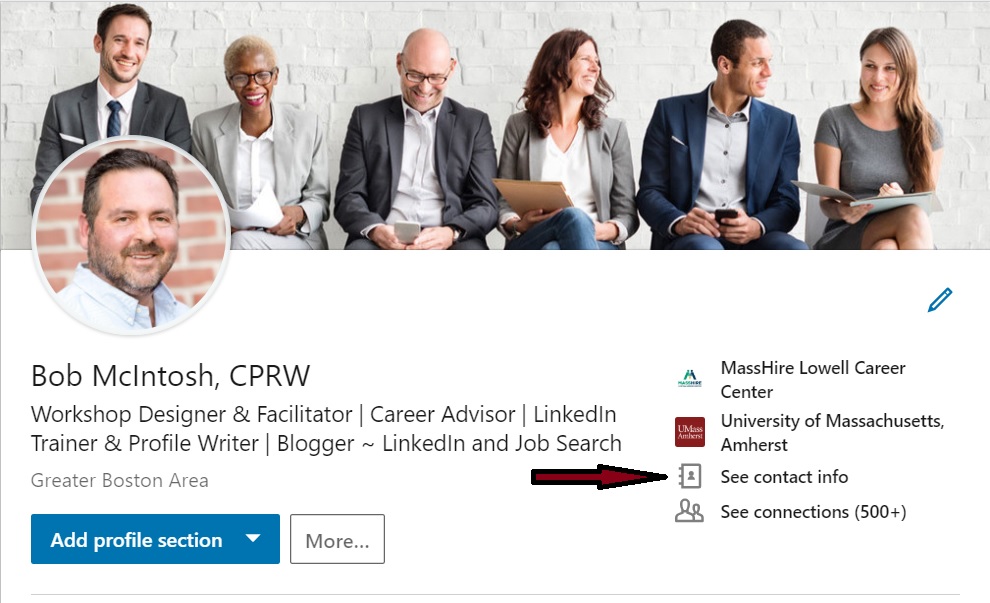
Herein lies the problem; many LinkedIn users don’t know where this area on the LinkedIn profile is. Perhaps this is because of the location, where it’s mixed in with current employment, most recent education, and number of connections. (See below for where it’s located in the Snapshot area.)

See contact info

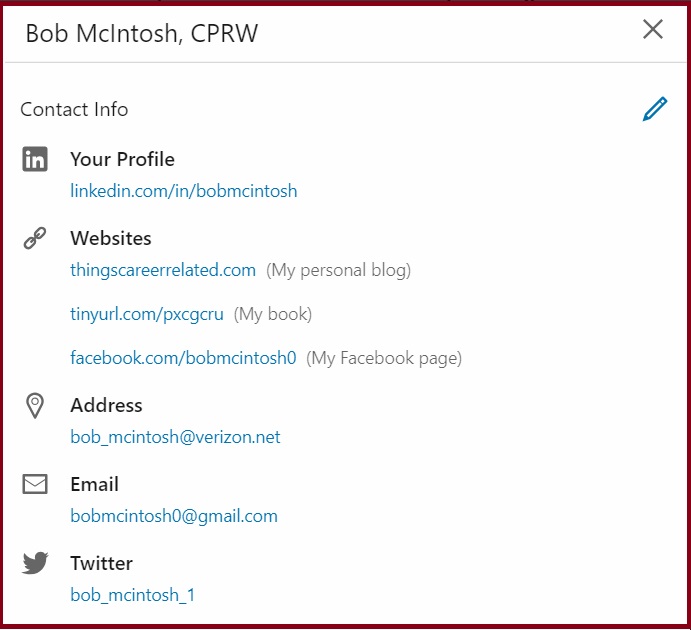
It’s unfortunate that many LinkedIn users don’t know where See contact info is located, as there is important information that can be discovered in this area, not least of which is a user’s email address. To add value to this area on your profile, read below.

Information you can provide in See contact info?

LinkedIn profile URL

At the bare minimum your LinkedIn public profile URL is revealed. Here’s where visitors can see if your URL has been customized (there are no numbers or letters after your name). Make sure it’s customized by going to Edit public profile & URL (top right-hand corner of your profile) select Public URL and type only your name into the field.

When I see a public profile URL that is customized, I know the LinkedIn user understands it makes them look more savvy with LinkedIn. Only when it’s customized should it be included on your resume, personal business cards, professional networking profile, and other job-search documents.

Email address

You have the option of allowing all LinkedIn users to see your email address, first degree connections, first and second degree connections, or only you. If you want recruiters and other hiring authorities to contact you, allow everyone to see your email address.

To set your email view, go to Settings & Privacy and select Who can see your email address.

Websites (three)

I provide websites for my blog; book; and since there’s no designated space for Facebook, my Facebook page. If you have a company website, a website for your job search, or want to draw visitors to a page on your former/ current employer’s site, this is a great place to do it.

Links to websites can go a long way toward branding you, especially if you’re in an artistic industry and want recruiters to see your online portfolio. You can also provide links in your rich media areas, but why not cover all your bases?

See contact info Bob

Phone

Not many job seekers list their telephone number, but the smart ones do because it’s easier for recruiters to call or text them. I tell my clients it’s their prerogative, and secretly think I wouldn’t do it. However, if I were job searching, I’d follow my own advice.

If you own a business or have a side hustle, you should list your phone number. Some people prefer immediate satisfaction. You don’t want to miss that phone call that could be a potential client.

Address

Do not. I repeat, do not list your home address. I don’t know what LinkedIn was thinking when it created this field. I, for one, don’t want people to know where I live, but that’s just me.

This is where you should list a second email address. Perhaps you want only your first degree connections to be privy to your primary email address, but will allow everyone to see a different email address. It could be a business email address, separating pleasure from business.

Twitter

Some of my connections have a larger presence on Twitter. It’s their platform of choice. While others are more present on Facebook, Instagram, etc. If you’re on Twitter, you should include your handle. I’m on Twitter but don’t use it as effectively as I do LinkedIn. I guess I could say, “I don’t get it.”

An important reason for including your Twitter handle would be if you want what you post on LinkedIn to also be tweeted on Twitter. Another reason for including your handle is so visitors to your profile can follow you on Twitter.

You have the ability to include more than one Twitter handle. To set your Twitter accounts, you’ll need to do this in Privacy & Settings.

Not enough

As I say, many LinkedIn members are not aware of the See contact info area. How then do you make sure they see your contact information, or at least some of it? One of my valued colleagues and executive resume writer, Laura Smith-Proulx, says it nicely:

“The See contact Info area does seem neglected by many people who might otherwise welcome a recruiter’s call. I hope your post convinces them to include more information. I also advocate putting at least an email address in the Summary at the end, which is designed to make the recruiter’s job easier and build more Connections.”

Yes, include your call to action in your Summary. I often see my clients fail to do this. Often many of them didn’t think of it, or in some rare instances they don’t want to reveal this personal information. This, according to Laura, makes it more difficult for recruiters to find you. Perhaps they’ll simply give up.


As you can see, there’s a great deal of information in See contact info. At the very least LinkedIn users should include a customized LinkedIn public profile URL and an email address visible to everyone. Going beyond this with websites and a Twitter handle helps in your branding.

Two sources of information I didn’t mention above are Instant messenger (three) and Birthday. The reason for this is IM is not used often, and I’m not a fan of giving out my birthday.

Photo: Flickr, irving robledo

3 reasons to properly endorse someone for the skills on their LinkedIn profile

How do most LinkedIn members endorse others for their skills? They click on the visible top three (like below) and leave it at that. Don’t be that person! Instead, click Show More, which expands a user’s skills list, so you can endorse them for other skills.

Kevins Skills

LinkedIn is trying to make endorsing skills more valid by asking you to choose how strong the the people you’re endorsing are with their skills (seen below). The choices are Good, Very Good, or Highly Skilled. Further, LinkedIn tells you that your choice won’t be made public to who you endorse. How much this will effect LinkedIn users SEO isn’t known for sure.

KevinsEndorsements

Then LinkedIn asks you to select a relationship you and the endorser shared (seen above). You worked directly on the same team or project with the person, managed him, reported directly to him…none of the above. Actually, you don’t have to choose any of these.

Of course there ways to truthfully answer LinkedIn’s inquiries.

You have witnessed the person perform her skills

In this case you can honestly answer the questions LinkedIn asks you in terms of someone’s level of expertise and, of course, your relationship. This is the most valid way to endorse someone for her skills.

For example, I would have no problem endorsing my colleagues for their skills. Not necessarily all skills, but many that I’ve seen them perform. And when I connected with them, the first thing I did was endorse their skills.

Maybe you’ve spoken with her over the phone or met for coffee, and by talking with her you get the impressions she’s the real deal. This isn’t as solid as witnessing her perform, but it comes close, particularly if you’re good at judging character.

His profile clearly demonstrates expertise in his skills

Some profiles are written so well that you feel you know the person as if you met them in person. He promotes himself well in his Summary, demonstrating passion, listing poignant accomplishments, and closes the loop with a call to action.

In his Experience area he hits you over your head with more accomplishments that don’t seem embellished. You dig a little deeper and find that most of his skills have received 99+ endorsements. I know someone in the 99+ club who has almost 900 endorsements for one skill.

Caveat: endorsements can, and often are, tit for tat. I spoke to the person who accumulated 99+ endorsements for each skill–rightfully so–who told me he just has a lot of friends. Which is true, he runs a networking group for business people.

Someone has referred you to the person or spoken very highly of her

Generally people won’t refer you to a person unless they know her well and can vouch for her skills. The risk of doing this is tarnishing their reputation, something no one  wants to do.

Similar to the reason number two, you read the recommendations on her profile and get the sense that those who wrote the recommendations were sincere and truthful. There is no fluff in them and the accomplishments are precise.

Caveat: recommendations can also be tit for tat. In the day when only recommendations existed as a way to award LinkedIn users for their greatness, we often saw someone write a recommendation for someone, which was immediately reciprocated.


In order to give endorsements credence, You should use these three ways of endorsing someone. It is safe to say that endorsing someone who lives across the world, if not the country is contributing to Endorsements’ poor reputation.

How to answer, “Tell us about a time when you had to deal with pressure” in 5 easy steps

You’re in a group interview and it’s been going smoothly. You’ve answered the questions you prepared for. To your credit, you read the job description and identified the most important requirements for the job, Marketing Manager.

Mock Interview

The interview is going so well that you’re wondering when the hammer will fall. When will the killer question be asked? That question would be, “Tell us about a time when you had to deal with pressure.”

In the job description, one sentence read, “You will be working in a fun, fast-paced, pressure packed environments. If you like challenges, this is the job for you.”

Sure enough one of the interviewers asks the question you were dreading. “Jane, tell us about a time when you had to deal with pressure. How did you approach it, and what was the result?”

Great, a behavioral-based question. You never considered what you did at your last job as having to deal with pressure. Pressure wasn’t in your vocabulary. Coming to the interview, you ran a scenario over and over in your mind.

The interviewer is waiting for your answer. How are you going to respond? You decide that you’ll ask for some clarification first. “This is a great question but one I’m having trouble with,” you say. “Would you give me an example?”

“I’m referring to a time when you had to meet a deadline as a Marketing Manager. There will be deadlines to meet here,” one of the interviewer says calmly.

All of the sudden it occurs to you that you had many deadlines to meet, and that you met almost all of them, 95% at least. You will have no problem answering the question honestly. It’s just a matter of recalling the specifics of a story that comes to mind.

“Thank you Ms. Jones. This helps a lot.”

Remembering the S.T.A.R formula a career coach told you to use, you begin your story.

Situation

Three years ago I was hired by my previous organization to manage the marketing department. One major problem the company had was a lack of social media presence. I mentioned this in my interview with them.

Task

Shortly after I was hired, I was given the task of creating a more robust social media presence. The VP of the organization came into my office and gave me the exciting news; and as he was leaving, he told me I had a month to pull it off.

Actions

  • The first thing I did after hearing the news was evaluate the situation. We had a Facebook page that was barely getting hits. Some of our employees had LinkedIn accounts, and that was about it.
  • I approached one of my employees whose LinkedIn profile was strong and asked if she would be willing to create a LinkedIn company page. I was strong with LinkedIn, but knew very little about a company page. She was excited to take this on.
  • As I left her cubicle, she told me she would also take on the Facebook page. I joked with her about taking on Twitter. She told me it would be too much work, in addition to her other responsibilities. I agreed.
  • From looking at our competitors’ social media campaigns, I realized our strongest competitor had the top three I mentioned, as well as Instagram and Pinterest. I didn’t have the staff to implement these two platforms. I would need to hire a person to take these on.
  • My VP agreed to letting me hire a person to take on Instagram and Pinterest, but told me I had a budget of 20K. I was able to negotiate 5K more, plus an additional month on the deadline.
  • The person I hired was looking for part-time work, 25 hours a week, and knew Instagram and Pinterest very well, having taught it at a local community college. He agreed upon 22K for salary.
  • The last step was letting our clients and partners know about our new campaign. Once the campaign was a few weeks off the ground, I had one of the staff send out a mass mailing through ConstantContact, letting them know about our campaign.

Result

At first the reaction I was hoping for from our audience was sluggish, but after a month our visits to Facebook increased by 300%. LinkedIn visits increased by 50%, and Twitter gained 50% more followers. Instagram also did well with 4 visits a day. It was agreed that Pinterest would be dropped after a month since its inception.

Even with the extended due date I negotiated, my staff were able to complete the task by a month and a half. In addition, my VP decided that our new hire would be offered a full-time position monitoring all of the platforms.


There’s one more component of your story to make it complete: what you learned. This will close the loop.

Learn

What I took away from this experience is that when the pressure’s on, I react with decisiveness. I’m more than confident I will do the same for you.


This behavioral-based question is a common one asked in interviews. Be prepared to answer it and make sure you use the S.T.A.R formula. This is the best way to tell your story.

Reflect before slapping your LinkedIn profile together

I’m sure you’ve read many articles on writing your LinkedIn profile. And I’m sure you know how important your profile is to your LinkedIn campaign. This is why it’s important to not simply slap our profile together and hope for the best.

linkedin-alone

Your profile is important but it’s not the only piece of the proverbial puzzle. Read the series beginning with The ultimate LinkedIn guide, part 1: how to optimize your LinkedIn profile to learn how to create and effective LinkedIn campaign.

This post focuses on the profile alone, and more specifically how you need to reflect before you begin writing it, or even if you’ve already written it. Here are some important considerations:

How do you want to brand yourself?

The first consideration, how you want to brand yourself, requires a great deal of reflection in itself. First you have to decide if what you’re doing is what you want to continue doing, or if you want to go in a different direction.

If you want to continue on the same path, you’ll have to think about how you can strengthen your message. While it may be strong on your résumé, the LinkedIn profile gives you more leeway for expressing the value you will provide to the employer. Think Headline and Summary as the most obvious places where you can accomplish this.

But also consider other sections on your profile that aren’t typically on your résumé, namely Skills & Endorsements, Volunteer, expanded Experience, and Recommendations.

Some of my clients want to change their career and ask me if they should create two profiles. First of all, I tell them, this violates LinkedIn’s policy. But more to the point, it would be a royal pain in the ass.

My advice is to express their transferable areas of expertise in their Headline, tell their story in the Summary, and prioritize statements throughout their profile.

reflecting

Your LinkedIn profile is not your résumé

I tell my clients that initially they can copy and paste their résumé content to their profile, but then they need to personalize their profile. Make it a personal résumé, an online marketing document. This will take a great deal of reflection.

However, your profile shouldn’t confuse hiring authorities as to what you do. For example, you don’t want to brand yourself—on your résumé—as a marketing specialist, but emphasize to a greater extent—on your profile—your expertise as a web designer. This will definitely confuse hiring authorities.

If you’re in job-search mode, you want the two to be similar, yet not identical. In other words don’t regurgitate what you have on your résumé. However, if you’re gainfully employed and want to convey the message that you are promoting a side hustle, you have more flexibility.

Which parts of your profile will brand you?

The answer is every part of your LinkedIn profile brands you, beginning with your background image and ending with your interests. Yes, even your background image can brand you. Didn’t think about this, did you? Again, this will require reflection.

Here are some of the profile sections that you also need to reflect upon:

  1. Headline
  2. Photo
  3. Summary
  4. Articles/activities
  5. Experience
  6. Education
  7. Volunteer experience
  8. Skills & endorsements

Speaking to your Summary, reflect on how you want to tell your story. Of all the major sections on your profile, this is blatantly different from your résumé. You’ll write it in first-person point of view, talk about your passion or knowledge of your industry, include some accomplishments, and a call to action, e.g., your email address.

Who is your audience?

Your audience is your intended industry. You will deliver a different message if you’re changing careers; but if you want to continue doing what you’ve done, you’re speaking to the same audience. Therefore, you must optimize your profile with industry keywords.

The narrative you use to address your audience will take some reflection. I’ve mentioned your Summary as a great section to speak to your audience, to tell your story. Your job scope in your Experience section is another area where you can express your message. Here’s how I talk to my audience:

I’m more than a workshop facilitator & designer; I’m a career and LinkedIn strategist who constantly thinks of ways to better market my customers in their job search. Through disseminating trending job-search strategies, I increase our customers’ chances of finding jobs.

Knowing your audience takes a great deal of reflection. Obviously, from my example, I’m addressing job seekers in a personal manner.


Reflecting on your LinkedIn profile is no easy task. I see the cogs working in my clients head when I ask them to consider the aforementioned aspect of their LinkedIn profile. Whether you are starting your LinkedIn profile or revising an existing one, it definitely will require reflection.

Photo: Flickr, daysmoveeasy

4 ways to learn about workplace values before you’re hired

Think about the job you disliked the most. Perhaps it was because the work environment was toxic. Maybe you weren’t able to see your children’s events because of the commute home. You weren’t given the autonomy you craved. Or you were working at a dead-end position. The company for which you worked lacked integrity. There are many reasons why employees are dissatisfied with companies for which they work.

Stressed young businessman

The above are examples of how workplace core values are not met. How important are workplace core values? Statistics show that work values are more important than salary, unless earning a high salary is your main core value.

A Harvard Business Review article supports this statement:

“One of the most striking results we’ve found is that, across all income levels, the top predictor of workplace satisfaction is not pay: It is the culture and values of the organization, followed closely by the quality of senior leadership and the career opportunities at the company. Among the six workplace factors we examined, compensation and benefits were consistently rated among the least important factors of workplace happiness.”

This brings to question how you ensure that you take a job which meets your core values. Here are four ways to discover the core values employers support, from worse to best.

4. Ask in the interview

This is the worst way to determine the company’s core values, as it may be too late. (It’s always best going into an interview with your eyes wide open.) You can ask the recruiter during the telephone interview.

However, he might not know much about the company’s values, especially if he’s an agency recruiter (not on site). A corporate recruiter would have a better idea of the company’s values; although, not as accurate as a hiring manager’s.

You may be able to ask the question, “Can you tell me a little bit about the company’s core values?” during the interview. But more likely you’d ask this question at the last phase of the interview when they ask if you have any questions for them.

If this is your only opportunity, ask the questions as such: “What are (Company X’s) top three core values?” This is a question that will challenge the interviewers and indicate that you’re serious about working for the company.

3. Comb through company reviews on a site like glassdoor.com

I’m skeptical of a site like Glassdoor. My thought is that disgruntled current or former employees won’t speak objectively about their present or past companies. And, reportedly, some employers have launched paid campaigns to encourage positive reviews.

However, there could be value in this site’s reviews if the they are consistent; if most of them are positive or negative. I looked at two companies, one a nationally known monolith and the other a largish company local to Boston. They were consistently positive in their reviews.

Dell EMC had a whopping 4.3K reviews and a 76% “Recommend to a friend” rating. In terms of pros and cons, work-life balance was the top value mentioned: 507 applauded the work-life balance, whereas 107 trashed the work/life balance.

The other company, Kronos, also did consistently well. Of the 1.3K employees who posted a review, 81% would recommend this company to a friend. Not surprisingly work-life balance was the number one value: 239 favored it; 45 employees saw it as a con.

2. Find someone on LinkedIn who can speak about the company

LinkedIn can be a great tool for finding people who work for your target companies; or better yet, worked for your target companies. It’s important to know how to locate people at said companies. You’re going to get very familiar with LinkedIn’s All Filters feature.

How to use LinkedIn’s All Filters

  1. First click in the Search bar at the top of most pages.
  2. Choose People.
  3. Click on All Filters.
  4. Type in the company name.
  5. Select second degree connection.
  6. Select Current or Past companies.
  7. Choose location.
  8. Scroll down to enter the title of the person you would like to approach.

Second degree connection who works for your target company

If you are a Premium account member (most likely Career), use one of your five Inmails to message someone who shares a common connection with you. You may mention in the first line:

“Hello Susan, you and I are connected with John Schmidt, who encouraged me to reach out to you….”

What if you don’t have a premium account? Go to the person’s Contact Info box on her profile and send her an email. Or, send an invite for quick action. My suggestion is to proceed like you would if you have a premium account in terms of the message you send. Indicate you share a common connection who will vouch for you.

Read this post to learn more about how to properly communicate with a possible connection.

Second degree connection who USED to work for your target company

Job seekers often don’t think of reaching out to someone on LinkedIn who used to work for their target companies. I tell my workshop attendees that these people can be their best online source of information, as they will most likely provide the truth. They have nothing to lose.

Again, if you don’t have a premium account and have to send an invite, it’s best to mention a common connection. Be sure the common connection you mention is amenable to vouching for you. There are many connections who will vouch for me, but there are some who (I hate to admit) I hardly know.

1. Have a mole in the company who will tell you about the company’s values

This is the best way to discover the values your potential employer supports. The person/people you ask, via LinkedIn or in person, are onsite and experience the company’s core values on a daily basis. They can provide intricate details, whereas glassdoor.com and current and former employees on LinkedIn might not be as willing to go into details.

I recall applying for a job that was posted by an employer I was considering working for. I knew someone within the organization who was very open about the company’s culture. She described an environment where management was so abusive toward their employees that people were quitting. Needless to say, I didn’t apply for the job.


Your workplace core values are not to be ignored when applying for positions. They can make the difference between being happy or unhappy. An exercise I have my workshop attendees do is write down their top five values, not an easy task for many. Then I have them narrow it down to three and finally one. Can you identify your top value? I bet it’s not salary.

This post originally appeared in www.job-hunt.org

Photo: Flickr, Reputation Tempe