Category Archives: LinkedIn

2 important rules for connecting on LinkedIn the right way

First, never send default invites

I estimate that I ignore 90% of invites from LinkedIn members, simply because they don’t include a personalized note. In fact, if I accepted all invites I’d probably have 10,000 connections in my LinkedIn network. This is not to brag; I’m just saying.
li-logoWhy am I so adamant about people taking the time to personalize their invites? Short and simple, default invites suck.

The default invite on LinkedIn is: I’d like to add you to my professional network on LinkedIn. While it clearly states a hopeful networker’s intent, I need more. Something that tells me why we should connect.

Sending the default invite is akin to going up to someone at a networking event and saying, “Hi. What can you do for me?” It’s insincere and sends the message, “I’m inviting you to be in my network, but I could care less if you join.” Is this the type of message you want to send to a potential networker?

I believe there are three reasons why LinkedIn members don’t personalize their invites.

One, they just don’t get it. Or they haven’t been educated. I can only spread the word to the people who attend my LinkedIn workshops or read my posts. Even then some don’t get it.

Two, they’re using their phone to connect with others on LinkedIn. Although there is a way to send a personalized invite from your phone, most people don’t know how to do it. The process is very simple, so there’s no excuse.

To send an invite from your phone, go to the person’s profile, click the three vertical dots for androids or horizontal dots for iPhones, choose “Personalize invite,” write one, and hit send.

Three, they’re plain lazy. I think this is really the heart of the matter, and I hesitate to say it, especially out loud; but in essence this is what it comes down to. To me, a default invitation is a statement of want without a sign of reciprocation. And this defies the true definition of networking.

lazyI and others, I’m sure, are more likely to accept an invite if a thoughtful note is attached to it. So what should you write if you want someone to join your network?

1. You might have something in common with whom you’re trying to connect. “Hi Susan, I’ve been following your updates and feel that we have a great deal in common. Would you accept an invitation to be in my LinkedIn network?”

2. Maybe you’re the bold type. “Hey, Bob. You and I are in career development. Ain’t that cool? Let’s link up!” I like this confidence, despite the slang.

3. You might want to take the calculated approach. “After reviewing your profile, I’m impressed with its quality and your diverse interests.” A little flattery never hurts.

4. Inviting someone to be part of your LinkedIn network is a perfect way to follow up with that person after a face-to-face meeting. “Sam, it was great meeting with you at the Friends of Kevin networking event. I looked you up on LinkedIn and thought we could stay in touch.”

5. Boost the person’s ego. “Bob, I read one of your posts and thought it was spot on. I’d like to connect with you.” Or “Jason, I saw you speak at the Tsongas Arena and what you said really resonated with me. I’d like to follow up with you.”

These are some suggestions that would entice someone like myself to accept an invite. When I’m sent an invite, I only request a personalized note—it’s not that hard, really. So rather than just hitting the Send Invitation button, take a few seconds to compose something from the heart.


Second, thank people for inviting you to their network

Is there anything worse than sending a “cold,” “lazy,” “uninviting” default message to a potential connection? Yes, it’s not thanking people who invite you to their network. Come on, this goes against what your parents taught you when you were a child.
636072212661198938-231321585_3D-Thank-You-HD-Wallpapers

It just makes common sense. If you receive an invitation to be part of someone’s network, reply to the sender by thanking them for being considered. It’s an honor the sender has chosen you, so show your gratitude.

In effect, this is similar to walking away from a conversation at a social gathering. Would you simply walk away from a conversation without saying, “Thank you for the conversation?” Simply do an about face and make for the door? I would hope not.

What to Write. Your note can begin with, “Thank you for the invite. And thank you for the personalized message.” And if you want to carry on the conversation, you might add, “It would be great to talk about our common interests, as we’re both in (the occupation). I’d be happy to call you at your convenience.”

Also thank your new connection for joining your network. All too often LinkedIn members invite someone to their network and then kill the momentum by not showing their gratitude.

To make professional online networking effective, you must keep the ball in play, keep the lines of communication open. Extend civility and appreciation for someone joining your network.

“Thank you for being part of my network” would suffice. Or you may add, “I invited you to be in my network because we’re both (occupation) or (interested in) and think we can be of assistance to each other.”


Personalizing your invites and saying “Thanks” are two very basic, yet important components of developing a solid relationship with your LinkedIn network.  LinkedIn gives you the option to do neither. Don’t let LinkedIn let you get lazy.

It takes but a few minutes to connect with someone on LinkedIn the right way.

Photo: Flickr, ruijiaoli

Photo: Flickr, Retroeric

3 reasons why the LinkedIn Summary is key for career changers

I often come across job seekers who need a career change. They’ve had enough of their former career and want something more rewarding. I should know the feeling, as I have changed my career three times.

LinkedIn Flag

The LinkedIn profile is designed much like a chronological résumé, and there’s nothing you can do about it. The order goes: Summary, Experience, and Education. The more extraneous sections follow.

The Experience section is typically the most important one of the big three. The Summary is also important, but LinkedIn’s recent move to truncate it, as well as remove its header, leads one to believe that LinkedIn has demoted it. Wouldn’t you agree?

1. Career changers, listen up!

If you’re changing your career, your friend is not the Experience section. Rather, your friend is the Summary section, which is now truncated in the Snapshot area. It’s in the Summary where you will express your value to potential employers, not the Experience section.

New Snapshot3

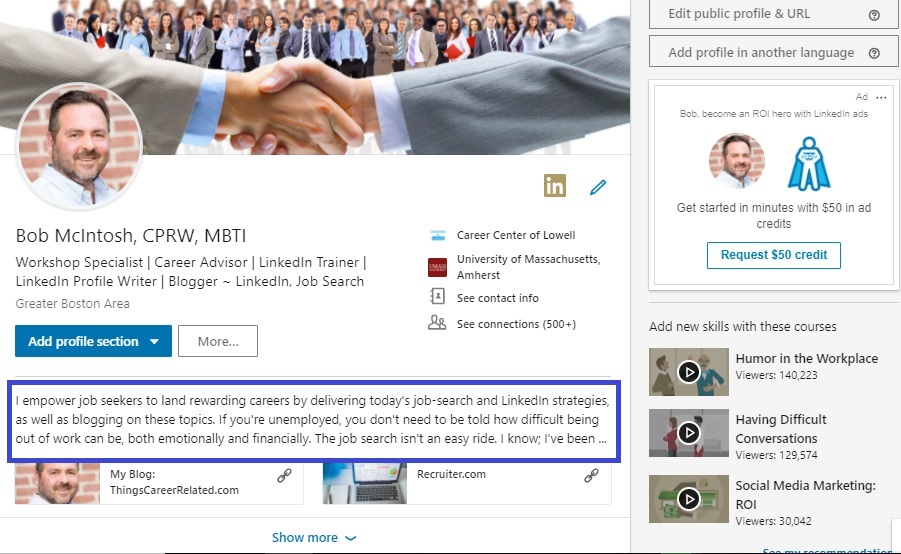
This said, it’s important that the first three lines (outlined above in my Snapshot area) of your Summary entice viewers to read the rest of it. If or when LinkedIn returns to the complete Summary, this may not be as important.

2. Career changers can’t rely on the Experience section alone

Your Experience section will consist of responsibilities and accomplishments that don’t necessarily match those of your new career. You need to showcase the skills and experience that will make your transition almost seamlessly.

A typical chronological format wouldn’t work with your résumé, so why would it work with your LinkedIn profile? Presenting a chronological document would require the employer to search for your relevant skills, like a needle in a haystack.

Therefore your message needs to be delivered before the Experience section, and it needs to be delivered clearly.

3. This is where the Summary comes to the rescue

How do you show your value on LinkedIn? The answer is quite simple; you showcase your value in the Summary section, and you focus mostly on the accomplishment statements that highlight relevant transferable skills.

Take this career-changer scenario: you’ve been a public relations manager in technology for seven years but want to change to a program coordinator in the nonprofit.

The ability to make this change might seem like a leap to some, but with strong transferable skills, e.g., program coordination, communications, leadership, and outreach, you have a great chance of making this happen.

Using this career-change scenario, your Summary will include an introduction, three or more paragraphs describing your strong transferable skills, and a conclusion stating your career goals.

Intro (with strong opening statement)

THE VALUE I DELIVER

I develop programs that consistently increase participation by 80%. My enthusiasm for working with colleagues to produce results for the organization is evident by my willingness to collaborate on multiple projects. 

Learn how I’ve demonstrated skills in program coordination, communications, leadership, and outreach.

Value-added body (strong transferable skills in all CAPS)

PROGRAM COORDINATION

I’ve demonstrated strong program coordination, as demonstrated by supervising events and services, including work allocation, training, and problem resolution. Further, I’ve Increased sales leads 150% from Q1 to Q4, 2016, by creating a community outreach event.

COMMUNICATIONS

My president trusted my writing abilities to the point where she stopped proofing the ghost articles I wrote. As well, I wrote press releases and spoke at trade shows with no supervision. Currently I write a blog addressing marketing strategies.

LEADERSHIP

Within two months of becoming the MARCOM writer, I was promoted to public relations manager, where I oversaw a staff of five. I also communicated directly with the director of sales in weekly meetings. I was acknowledged by the VP of marketing as a “natural born leader.”

OUTREACH

Read what the VP of Sales at XYZ, Inc said: “Tom has opened new territories that have resulted in increased sales. He is extremely adept at creating relationships with important partners, VARs, OEMs, the Media, and most importantly our customers.” Jack Jones

Conclude with career goals

CAREER GOALS

With strong transferable skills to bring to your organization, I am excited to contribute as a versatile program coordinator. I have proven experience in program coordination, communications (both written and oral), leadership, and outreach. I can be reached at (email) and (telephone number).


As a career-changer, the Summary is the most important section of your profile. Simply writing a brief Summary and relying on your Experience section will make it more difficult to help employers understand how your previous experience can be transferable to your new career.

If you want to learn more about LinkedIn, visit this compilation of LinkedIn posts.

There are 5 LinkedIn contributors; which one are you?

Spending as much time on LinkedIn as I do, I notice how often my network contributes. Some are consistent and strike an even balance, others do not. In this post, I’m going to address the five types of Linked contributors.

Man on phone 2

I’ve always asserted that there are three components of your LinkedIn success:

Creating a profile;

connecting with LI members; and

engaging with your connections.

It’s the third component that can be as important as the other two. By engaging with your connections, it keeps you top of mind. I use the familiar cliche when I explain the importance of engagement by saying, “Out of sight, out of mind.”

The five types of LinkedIn contributors

1. The non-contributor. Some of you might relate to this. You were an accountant until recently laid off. While you were working, one of your colleagues—maybe your colleague—said, “Hey, you should join LinkedIn. I hear it’s important to be on it.”

So you joined, not quite sure why, and let your profile sit. You accumulated 10 connections, because these were the 10 people you knew at work. You would get invitations, which sat in your My Network queue.

Now that you’re looking for work, you have no activity to speak of. In other words you’re nonexistent. You’re not getting any hits from recruiters, have no endorsements, not getting invites, don’t know how to share an update.

There’s a lot of work ahead for you.

Read why LinkedIn might not be for you.

2. Enough to be dangerous. If this is you, I want to say it’s almost worse than not contributing. You’re trying to do what you’ve been told by someone who was kind enough to give you advice. Perhaps your heart just isn’t into it.

Your profile is strong. There’s no problem here. In fact, you hired someone to write it for you. You were pumped when it was done. The person who wrote your profile mentioned numerous times that you have to 1) connect with ten quality connections a week and 2) engage with them.

The problem is that you are forgetting the last piece. You’re hoping that optimizing your profile with keywords will draw recruiters to you. However, optimizing your profile with keywords only works if you’re active and well connected.

You have potential, though.

3. Busting your ass to catch up. Someone managed to get it through your head that being a contributor on LinkedIn is crucial to being found. Your profile is strong and your network in good shape.

You’ve been contributing, which includes: sharing articles, mentioning industry trends, giving sage advice, asking questions, sharing news about your colleagues. All good stuff, but it’s gonna take awhile before your getting noticed like you want.

I see you on LinkedIn contributing like a fiend. I see you six times a day. I won’t say your engagement reeks of desperation, but…. Here’s the thing, there is such thing as contributing too much.

It will take time to establish yourself, so be patient.

4. Addicted to LinkedIn. This is a bad thing, but you can’t help yourself. The worst thing you did was install the LinkedIn app on your phone. Just like people who are constantly checking their Instagram or Facebook accounts, you’re opening your LinkedIn app.

In fact, you’re posting updates and answering questions while you’re waiting for your son to get out of school, your wife to get off the train, during family gatherings. Yes, you’re concealing your phone underneath the table.

What’s alarming is the number of times you’re sharing updates. Ten times a day is a possibility. Five times a day is a definite. As well, you’re following your connections on a daily basis. You feel you know them as if you met them in person.

I tell my LinkedIn workshop that at minimum they should be on LinkedIn four days a week. Their jaws drop. After pausing, I tell them that the optimum amount should be every day; yes, this includes Sunday. And I finish by telling them not to be like me.

Perhaps you should seek professional help.

5. Strike a nice balance. I’ve seen people who’ve disappeared for months, if not years, only to return with enthusiasm. This isn’t you. You are on LinkedIn almost every day. You share posts twice or three times a day. They are relevant to your LinkedIn community.

You’re also consistent in contributing on LinkedIn. People know when you will share updates and look forward to your posts. I envy you. Yes, I envy you because I am a member of the fifth type of contributor.

Keep doing what you’re doing.


Now that you’ve learned about the five types of LinkedIn contributors, which one are you? Are you barely on LinkedIn to the point where you shouldn’t bother or are you a LinkedIn addict like me. Or, do you strike a nice balance? I would love to hear your story, and I promise not to judge.

How could I judge?

If you want to learn more about LinkedIn, visit this compilation of LinkedIn posts.

Great news! LinkedIn returns the expanded Experience section

LinkedIn has done it again; it’s made a change to our profiles. This is a welcome change and hopefully a return to the old LinkedIn profile. Get ready for this—we can now see most of our positions expanded. 

LinkedIn Flag

I noticed this change when I was working with a client. Pleasantly surprised, I expressed my glee. My client, though, didn’t make the connection. He didn’t realize that only the first position used to be expanded; the others were truncated.

Immediately I reached out to my network to ask them if they noticed the change. “Do my eyes deceive me or has LinkedIn expanded the positions in the Experience section?” With, the blink of an eye, some of my connections responded with affirmation.

Others were unaware of what I was speaking of. They hadn’t received the update yet. With LinkedIn, changes aren’t made across the board at the same time. One of my connections wrote back a few days later when she received the expanded Experience section.

What was wrong with the truncated Experience section?

In a previous popular post, I complained:

Again the new model of less is more is in play in the Experience section. One is able to see the entire first job listed but must click to see more for each of the remaining jobs.

My concern here is that a person with a feeble current or most recent job will not show as much value as someone who has a more extensive and accomplish-laden job to show. Also, people who have two jobs must choose which one to demonstrate first.

Or, we can simply rely on visitors to click on every job to see their descriptions.

The answer to the final sentence in my post is, no. We couldn’t always expect people to click on the previous positions; thereby raising the possibility of your visitors missing some very important information, including your rich media.

For example, under my second position I have links to two podcasts in which I was interviewed for my knowledge on LinkedIn. Previously, this was not immediately visible without expanding my second position.

You might have been frustrated because you don’t have rich media examples under your first position, but have plenty of it under your previous positions. Now you don’t have to worry about people not seeing your rich media under your second or third positions.

LinkedIn hasn’t expanded all position, however. This might be a good thing, as it cuts down the verbiage seen on users’ profiles. And this was LinkedIn’s intention—to streamline and make the profiles more readable. In order to see all of a person’s Experience section, one must click See more positions.

LinkedIn hasn’t expanded the Summary section. Perhaps this is a good thing. While some don’t read the Summary, many do. I personally think this section is important in telling one’s story.

Just make sure your first 235 or so characters count, as they’re the only ones immediately available. I suggest using a branding statement that expresses your value to recruiters and other visitors.

LinkedIn, take it a step further

To make my LinkedIn experience complete, I’d like to see the return of the photos of the people who’ve written me recommendations. If you don’t remember said photos, they resided under each position showing who wrote recommendations for LinkedIn members. A nice touch.

What’s more, I’d like to see a link between the positions/companies and the Recommendations section. Currently, recommendations are arranged in the order of when they were written. This gives visitors no sense of the companies from which the recommendations came.

I’m sure recruiters don’t appreciate not being able to link recommendations to the respective positions.


When teaching LinkedIn, I’m never surprised when I come across a change made over night. In this case it is a pleasant change, and I am glad that I don’t have a reason to complain. I don’t like to come across as a downer, I really don’t.

If you want to learn more about LinkedIn, visit this compilation of LinkedIn posts.

Photo from Coletivo Mambembe, Flickr.com

5 LinkedIn Profile Sections That Are Anchored and How This Is Hurting Its Members

The inability to move LinkedIn profile sections around may cause consternation for some members. Although the new LinkedIn profile is condensed, slim, and uncluttered; members are prohibited from strategically rearranging sections to highlight what’s most important.

Read How to brand yourself with the new LinkedIn profile: part 1.

anchor2

Did LinkedIn have its members’ best interest in mind when they made this decision? Will the profile revert to the former version when one could move sections about the better brand them? Below are reasons why LinkedIn members are hurt by the sections being anchored.

Education first comes to mind 

One night I volunteered to critique current students’ and recent grads’ LinkedIn profiles for my alumni association. One thing that’s become clear from critiquing their profiles is how the inability to rearrange the profile’s section is a disadvantage to them.

One recent grad, with whom I spoke, had virtually no work experience or internships to tout. She had focused on completing her double major in business management and mathematics. She did extremely well, earning above a 3.5/4.0. However, her dual major put a toll on her, making it virtually impossible for her to secure internships.

Because LinkedIn has arranged the profile in the following order: Summary, Experience, Education, and less significant sections; this woman could not highlight her greatest accomplishment, her education.

What about teachers? The anchored sections isn’t a problem only for the recent grad; it also affects teachers, who benefit from placing their Education section below the About section, rather than below the Experience section of their profile.

Generally speaking, teachers must immediately show their teaching certification, school transcript, and GPA. School systems would like to see this early on. Like their resumes, teachers should be allowed to highlight this information.

Even IT job candidates might want their Educations section near the top. Not only teachers place their Education at the top of their profile; other job seekers have been known to do this.

When I asked one of my workshop attendees—an IT specialist—why he placed his education at the top of his profile, he said it was a major requirement for a job he last applied for. He was going to keep it near the top for future jobs.

Other sections could be moved to strengthen a profile

Volunteer Experience

LinkedIn members who want to display their Volunteerism near the top of their profile will be frustrated. I had a private client who wanted to highlight his volunteer experience over his employment. With the old LinkedIn, this was an easy fix.

Some pundits believe volunteerism can be listed under Experience. I feel that if it is related to your work, or you perform extensive volunteerism (20 hours a week), go for it. Keep in mind that everything you write on your profile needs to brand you.

Skills (and Endorsements)

I had this section placed under my About section (which was expanded in the old LinkedIn), because this format closely matched a resume.

As an added insult, this section has been truncated to show only the top three skills. If visitors want to see additional skills, they must click “View more.” I fear people will only endorse their connections’ top three skills, because they will not think to…view more.

Recommendations

This section was anchored at the bottom of the old LinkedIn profile, which caused consternation for some business owners, I’m sure. Recommendations are testimonials for members who rely on them to grow their business. To me this was a lack of respect for this section.

Now Recommendations are given the same amount of respect as Skills…well, almost. Let’s say they’re given more respect now, prompting me to request and write them more than before.

Note: recommendations are listed in order in which they’re written. As well, the people who write your recommendations are not shown in the Experience or Education sections.

Accomplishments

LinkedIn has done such a great job of truncating the profile that sections some would like to relocated are hidden from the common observer. Within Accomplishments are subsections that used to be separate and rearrange-able:

  1. Certifications
  2. Projects
  3. Organizations
  4. Patents
  5. Publications
  6. Courses
  7. Honors
  8. Awards
  9. Test Scores

I know a LinkedIn member who uses Projects for highlighting a mini documentary filmed by Aljazeera America. In the video he is depicted as a New York City photographer who films models and the homeless. He used to have this section at the top of his profile; now it’s buried in Accomplishments.

Patents might be another section members would like to rearrange. Maybe not closest to the top, but within the first three-quarters. Engineers, scientists, and inventors could see these as some of their greatest accomplishment, and therefore place them below their Summary.

Courses, Honors, Test Scores all might benefit college students or recent grads. Yet, like all the sections contained withing Accomplishments, they must be discovered and chosen in order to view.

The goal of your LinkedIn profile is to highlight the most important aspects of your career. If you can’t rearrange your sections to do this, what’s the solution?

Two ways to solve the anchored section’s conundrum 

The fist solution would be making better use of your Branding Headline. Let’s return to Education. Begin by showing your value in the Branding Headline by stating that you’re a student from your university, include your major, and what you’ll offer employers.

Wrong: many college students will simply write in their Branding Headline, as an example, Student at the University of Connecticut. This uses 40 of the 120 characters you’re allowed in your Branding Headline.

Better, show your accomplishments and goals: High Honors Student at UConn | Major: Business Management | Minor: Mathematics | Aspiring Business Analyst

The second way to mitigate the problem of anchored sections is directing visitors to areas of your profile in the About section. Despite the Summary section being condensed and showing only the first three lines, it’s more important than ever to tell your story. Moreover, it’s essential that you use those two lines to highlight your greatest accomplishment.

You might indicate within the two opening lines that you worked extremely hard completing a Chemistry major while also completing four internships.

While at Tufts, I majored in Biology and completed internships in all four semesters. As a testament to my time management skills and ability to stay focused, I maintained a 3.8/4.0 GPA.

This falls well within the characters allotted for the opening two lines of your Summary statement. You will continue to tell your outstanding story about your college years, including participating in extra curriculum activities.

For professionals, you can add a line at the bottom of your About section that effectively directs visitors to a section that you want them to see. For example, I have a line in my About that reads:
⬇️ 𝗜𝗻𝘁𝗲𝗿𝗲𝘀𝘁𝗲𝗱 𝗶𝗻 𝘀𝗲𝗲𝗶𝗻𝗴 𝗺𝘆 𝗿𝗲𝗰𝗼𝗺𝗺𝗲𝗻𝗱𝗮𝘁𝗶𝗼𝗻𝘀? 𝗦𝗰𝗿𝗼𝗹𝗹 𝘁𝗼 𝗺𝘆 𝗥𝗲𝗰𝗼𝗺𝗺𝗲𝗻𝗱𝗮𝘁𝗶𝗼𝗻𝘀 𝘀𝗲𝗰𝘁𝗶𝗼𝗻 ⬇️


While the anchored sections might be a deterrent to showing the skills and accomplishments you want to closest to the top of your profile, LinkedIn has done a fine job of streamlining the profile.

No longer do we have people abusing the ability to overload their profiles with pages upon pages of extraneous information. Touche for that, LinkedIn.

If you want to learn more about LinkedIn, visit this compilation of LinkedIn posts.

What fun is that? 5 reason why you should contribute on LinkedIn

thinking

Recently I spoke to a person who uses LinkedIn on a fairly regular basis, at least four times a week he said.

When I asked him how often he updates, contributes to discussions in groups, or shares his thoughts in general; he told me never.

So naturally I asked him what he does on LinkedIn, to which he said he reads what others have to say.

So I’m trying to figure out why someone would just read what others write or would share articles written by others. What fun is that?

I’ll be the first to admit that I over contribute. I joke with my workshop attendees that I am probably the most hidden person on LinkedIn. In fact, I probably am.

Which isn’t to say I don’t read other’s updates and share articles written by others. A great deal of what I know comes from reading articles about the job search, LinkedIn, and introversion.

I am constantly trying to increase my knowledge so I can share it with my customers and colleagues. Call me an equal opportunity contributor.

Back to the person who told me he doesn’t update, contribute to groups, or share his thoughts in general. Here’s the thing: LinkedIn is a platform that encourages its members to share information.

Thus its creation of the publishing feature—yes, I’ve contributed posts on LinkedIn—which gives anyone the ability to share their words of wisdom and thoughts.

For those of you who are on the verge of contributing to LinkedIn but can’t take the plunge, here are five reasons I hope will urge you to make that leap.

It gives us a voice. Whereas some people are verbal communicators, others prefer to communicate via writing. They find comfort in being able to express their thoughts without interruption.

Updating and contributing to discussions in groups follows Parliamentary Procedure which allows one to speak, receive feedback, respond to feedback, and so forth.

LinkedIn is educational. When you write an update, contribute to a discussion, or post an article; you challenge yourself to present viable information, which means it’s best if you do a little research to back up your assertions.

Similarly you can be assured that what others write is well thought out and educational. Challenge yourself to produce updates, contribute to group discussions, and post on LinkedIn information that others will find interesting.

What you contribute isn’t done with impunity, though. On occasion I’ve been told my blog posts are utter shite, so I have to brace myself for this possibility.

When this happens my first instinct is to feel hurt, but then I think, “Hey, people are paying attention.” And that’s a good feeling.

You may want to be fairly conservative if you don’t want to be criticized harshly for your thoughts.

Contributing to LinkedIn can brand you as a thought leader. Not everything one writes is worthy of a Pulitzer. But when you contribute to a group discussion with well thought out content, or write a post that adds value; you’re positioning yourself as a thought leader.

I encourage job seekers to write articles on their area of expertise, even if they feel deflated from being out of work. They are, after all, professionals in their field.

Even asking an interesting question can demonstrate your expertise. Some of my most viewed writing are questions I pose to my connections. Make it simple, yet relative.

It’s fun. This is a matter of opinion. I find writing on LinkedIn extremely fun. For the four reasons listed above, plus an escape from the demands of daily life, as well as not having to watch mindless television.

My family doesn’t understand it until I ask my girls why they spend endless hours taking photos for Instagram. Enough said.


These are my five reasons for contributing to LinkedIn. To simply read what others write and not write stuff of my own is not my idea of fun.

I guess if I were a more understanding of people who feel shy about writing, I’d come up with five reasons why it’s cool not to update and contribute to discussions. Hey, there’s a topic for my next post.

7 ways to brand yourself on LinkedIn by being active: part 3

Now that you have a profile that brands you and you’ve started connecting with the right people, you’re two-thirds of the way to your LinkedIn goal. To wrap up your LinkedIn campaign and solidify your powerful brand, all you need to do is engage with your connections.

linkedin-alone

In this three-part series we have been looking at the components of a LinkedIn campaign that will brand you, which include:

  1. Creating a powerful profile
  2. Connecting with the right people
  3. Engaging with your connections

I’m often asked by my clients how regularly they should use LinkedIn. My inclination is to tell them, like me, use it at least two hours every day—but I know that is unreasonable for them. In fact, it borders on insanity.

So I suggest at least half an hour, four days a week. Still, their eyes glaze over and I hear some groans of protests. But I stay firm on this requirement.

Why is it important to be on LinkedIn often? Because if you want to be top of mind, you need to be present. In other words, you must consistently communicate with your connections to brand yourself successfully.

Here are six very simple ways to communicate with your connections.

1. Share Updates

Sharing Updates

This is the easiest way to communicate with your connections and brand yourself as a thought leader in the LinkedIn community. However, what you write must be carefully thought out and must add value to people’s lives.

I’m not talking about tweet-like updates (although you can share updates to Twitter) every day stating you’re looking for work. I’m talking about illuminating updates that prompt participation.

I recently shared an update about how nine out of 10 people prefer extraversion over introversion. The response was tremendous, and I continued to brand myself as an authority on introverts.

Your updates might be about what’s going on in your industry. You can provide important tips (remember, you’re still an expert in your occupation). Maybe inspirational quotes are your thing.

The new LinkedIn profile combines articles, photos, and updates into one field (see below). This is in line with LinkedIn efforts to streamline its user interface (UI) as much as possible.

2. Publish Posts (Write an article)

Writing an article

By using LinkedIn’s “Write an article” feature to share your writing with the appropriate audience, you are gaining visibility and, therefore, enhancing your brand.

Again, it’s important that your writing adds value to your connections. If it doesn’t, you’re wasting your connections’ time.

Another great way to educate your connections is by acting as a curator. A curator is a selfless LinkedIn member who shares the writing of other LinkedIn members. In addition to educating others, you are building strong relationships with your fellow writers by sharing their work.

Don’t forget to “like,” “comment,” or “share” your connections’ updates. This shows you appreciate the efforts they’ve made to contribute on LinkedIn. In my mind, it is far better to provide an intelligent comment; rather than only “liking” an article.

Even if you’re unemployed, you should take advantage of this feature. You can demonstrate your expertise of your occupation/industry, thus strengthening your brand.

3. Participate in Groups

Groups went through an overhaul more than a year ago. Some believe that this feature may have suffered from LinkedIn’s attempts to enhance it. (Not sure what I’m talking about? Read this article for an explanation of the enhancements.)

Nonetheless, it’s important to participate in conversations that are going on in your particular groups. When you participate in a group discussion, your connections will see your input streaming on their home pages.

To brand yourself effectively, be certain that the conversations you start or contribute to add value. Don’t indulge in the silly arguments that can pop up in groups.

Many recruiters are members of groups that you may also be in. They may read your contributions to the group, so make certain you write intelligent, non-negative comments. Remember, it’s about branding yourself as a capable, positive job candidate.

4. Send Direct Messages to Your Connections

LinkedIn recently made another change in the way you communicate with your connections. Now, instead of sending individual InMails, all your correspondences are grouped together in an endless stream. It takes some getting used to, but it has proven to be an effective change.

Every once in a while, you should ping your connections, letting them know how you’re doing in your job search. This is another way to stay top of mind.

Keep in mind that your messages don’t have to always be about the job search. Sometimes, it’s nice to send an informal message, commenting on something like your connection’s daughter’s soccer game, or sending a link to an article you think your connection might appreciate.

Doing the aforementioned  will brand you as a concerned connection, not one who thinks only of themselves.

5. Endorse Your Connections for Their Skills

endorsements (1)

You’ve probably read many opinions from people on the topic of endorsements – here we go again! Add me to the list of people who prefer receiving or writing thoughtful recommendations to simply clicking a button. And I’m not alone.

But in all fairness, endorsements have a purpose greater than simply showing appreciation for someone’s skills; they act as a way to touch base. In other words, they’re another way to communicate with your connections.

Don’t get click-happy when endorsing your connections. This will make you appear disingenuous and damage your brand.

6. Use the ‘Companies’ Feature

Search Groups

I saved one of the best features for last. The “companies” feature epitomizes networking on LinkedIn. It allows you to find people who are in a position to help you. It encourages you to be proactive.

In my LinkedIn, workshop I explain that the attendees should have a list of companies for which they’d like to work. It’s important to set foundations before applying for jobs at these companies. This means building a network of valuable people.

Once you’ve located the person with whom you’d like to connect, you manually connect with said person by going to their profile, clicking “connect,” and writing a personalized invite. Failing to send a personalized invite will hurt your brand; you’ll be seen as lazy.

7. Use the Jobs feature to network

Using LinkedIn’s Jobs feature to apply for jobs exclusively is not your best way to land a job because, after all, it’s a job board. (A very low percentage of job seekers are successful using job boards.) But I wouldn’t discount LinkedIn Jobs. Use it in conjunction with your networking efforts.

In many cases the person who posted the position is revealed, providing you with the option of contacting said person. You can also “meet the team,” whom you might want to reach out to. Perhaps my favorite feature of Jobs is the ability to see which of your alumni work at the companies of interest.


Engaging with your connections is the only way to stay top of mind on LinkedIn. You may have the best profile ever and 5,000 connections, but if you are not active on LinkedIn, your results will not be rewarding.

If you want to learn more about LinkedIn, visit this compilation of LinkedIn posts.

How to brand yourself by connecting with others on LinkedIn: part 2

So you have a great LinkedIn profile that supports your personal brand. You have a great photo, a keyword-packed descriptive Headline, and Summary and Experience sections that really sell your talents. You’re golden.

linkedin-alone

In this three-part series we will look at the components of a LinkedIn campaign that will brand you, which include:

  1. Creating a powerful profile
  2. Connecting with the right people
  3. Engaging with your connections

Unfortunately, you only have 70 connections. This is not good because first, a paltry number of connections limits your reach and second, your small network is telling hiring authorities that you’re not embracing the purpose of LinkedIn.

In short, your low number of connections is harmful to your personal brand. You come across to others as a nonparticipant on LinkedIn. Equally important, your reach to other LinkedIn members is extremely limited. You’re essentially a nonentity.

In my workshops and during individual counseling sessions, many people ask me with whom they should connect, how they should connect with people they don’t know, and with how many people they should connect.

With Whom to Connect

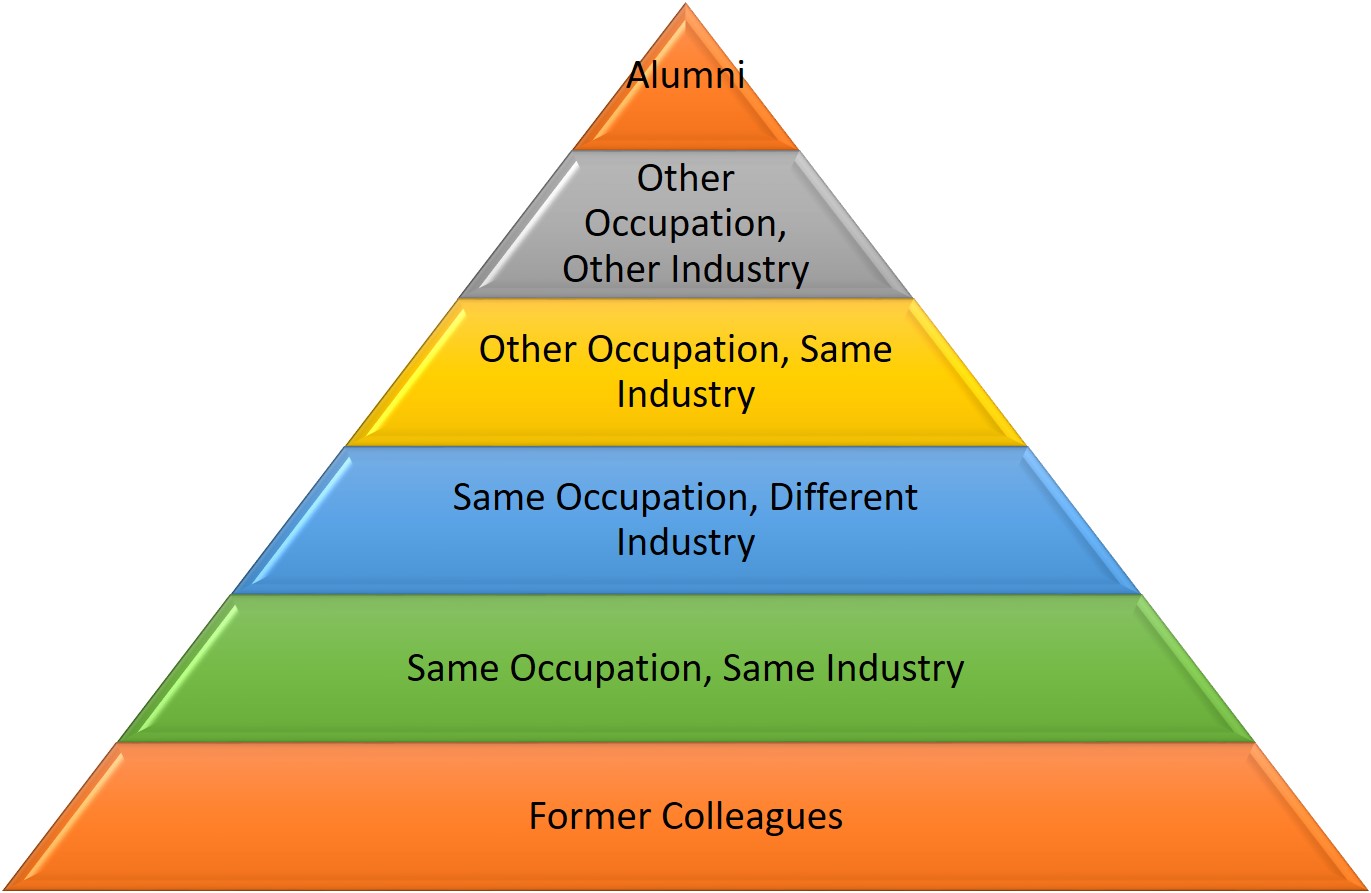
When people ask this, I explain that they should look at their potential connections as a pyramid. The goal is to connect with as many second- and third-degree connections as you see fit—although third-degree connections should be the last ones with whom you connect.

Picture1

On the bottom level—the most important tier of the pyramid—are people with whom you worked, e.g., former colleagues and supervisors. I say most important because they know you and are entrenched in the industry in which you’ve worked.

The second level contains people who share the same occupation and same industry. These people are like-minded and have similar aspirations to yours.

The third level is people who share the same occupation but in different industries. So, if you’re a marketing specialist, you want to look for other marketing specialists in industries outside of your own.

The fourth level is people in other occupations but the same industry. Connecting with these people will provide you with possible entries into your target companies. Connecting with an accountant, for instance, may give you access to the hiring manager of marketing at a desired company.

The fifth level includes people in other occupations and other industries. This may seem counter-intuitive to some, but consider that the V.P. of a manufacturing company that is on your target employers list may need an accountant. You’re not a V.P., and you don’t work in manufacturing, but you are an accountant.

The last level consists of your alumni, people who are likely to connect with you because you attended the same schools at some point.

How to Connect With LinkedIn Members

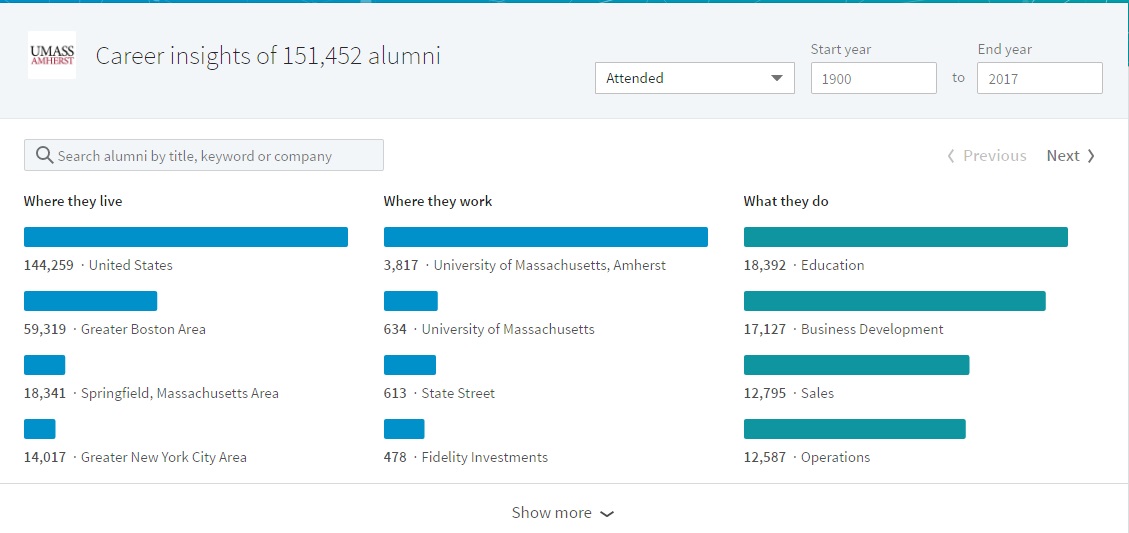
There are three ways to connect with LinkedIn members. The first, and simplest way, is to use the search field. Second, you can search companies with the Companies feature. And third, search by your alumni by typing in your alma mater as a company and selecting “See Alumni.”

1. Search by title. In my LinkedIn workshop, I tell my attendees that typing an occupation title in the search field is one step toward finding people. (For example, if you’re looking for marketing specialists, you type: “marketing specialists.”)

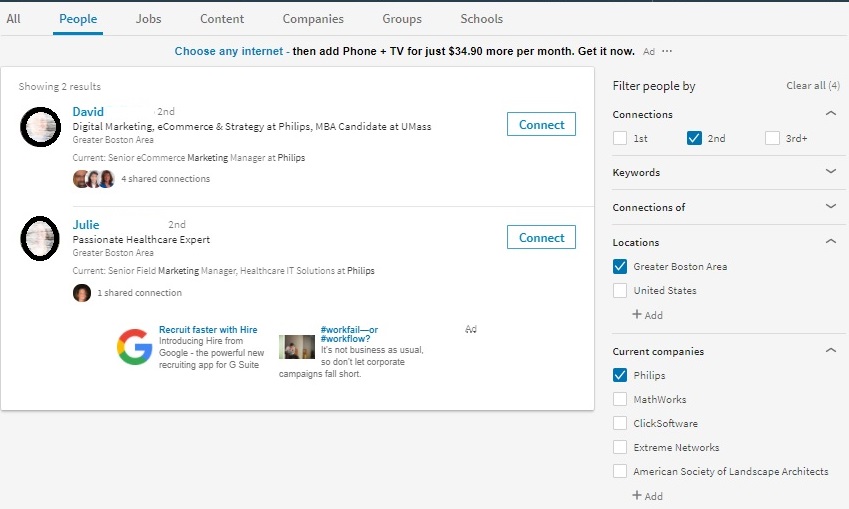
In “Filter people by” on the right, you can select second-degree connections; location; and other criteria, such as company. (See below.)

People Search, 2nd, location, company

2. See who you have in common. These are people that are first degree connections of your desired connections. You’ll see their headshots below the people who show up on your search. Click on “(number) shared connections” to see who they are.

Select one of the share connections to either write an introduction for you or mention in a “cold” invite. Read 5 Steps to connecting with LinkedIn connections for more detail.

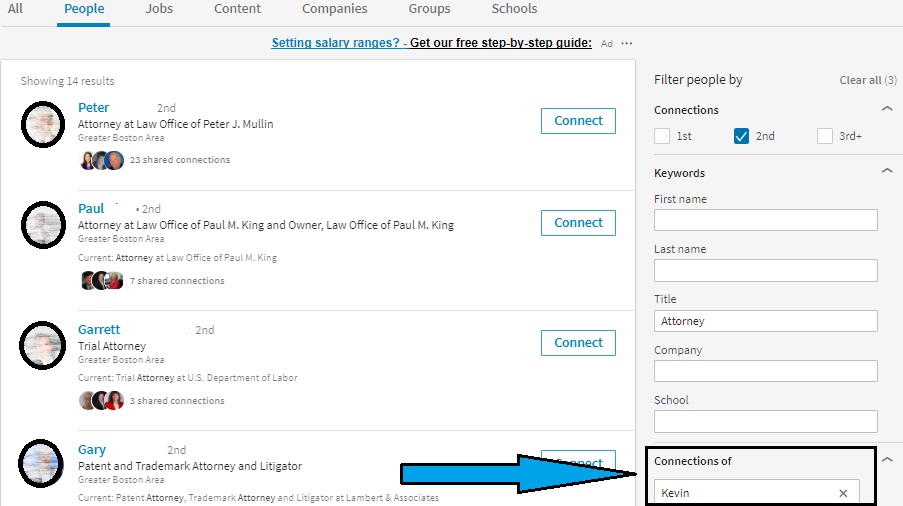
3. Use Filter people by. LinkedIn has added a great feature since I first wrote this post, called Connections of. In this field you type in a person who has shared connections with your desired occupation. This person is someone who you feel can best provide you with an introduction or a reference in a cold invite. (See below.)

Connections of Kevin

Use See Alumni

Another way to look for valuable connections is by using the “See alumni‘ feature, which is a great way to connect with LinkedIn members who are more likely to accept your requests than mere strangers. After all, you attended the same university or high school.

find-alumni-new-linkedin

Connect with people at companies

One the best way to connect with someone is by selecting a company that you’re targeting and finding an employee at said company. This is a great way to get your foot in the door for an open position – or, better yet, to start building your networks at target companies before jobs are even advertised.

(Search for 2nd degree employees at Tufts University below.)

Company Search

Here’s where Connections of can come into play. If you have a trusted connection who is a first degree of someone with whom you’d like to connect, or send a message, you can rely on your trusted shared connection.

Note: When asking someone to connect with you, make sure your note is personal – not the default message that LinkedIn provides. That said, I’m not a fan of connecting with people by using your smartphone or trolling your email contacts and sending mass invites. I see this as lazy.

How Many People with Whom to Connect 

The answer to the age-old question – quality or quantity? – comes down to personal preference.

I personally aim for a combination of both – that is, 300 or so quality connects with people who share your interests and or goals. If you look back at the “pyramid” above, you’ll see that focusing on connections in the first three levels is a good way to achieve the quality + quantity goal.

When you build connections in this way, you solidify your brand as someone who is focused on a specific audience. You have the chance to build a tight-knit network of individuals.

On the other hand, focusing too much on quality does limit your number of connections, which means you’re limiting your access to other LinkedIn users who could be of assistance.

If you focus on quantity, you’re less selective. You may come across as having little direction and less focus on an audience. In my mind, this is not the best way to brand oneself.

Quantity does have its benefits, though – particularly if you are a business owner and want to advertise your products or services.

Finally there is the extreme strategy: the LinkedIn Open Networker (LION) strategy. LIONs are LinkedIn members who are interested in collecting as many connections as possible. They believe that more people create opportunities.


Recruiters and hiring managers will take notice of your number of connections on LinkedIn, and they’ll look to see what kinds of people you connect with.

They may even go to your connections’ profiles and by chance notice some not-so-savory things. In other words, you could be found guilty by association. Let’s say, for example, one of your connections is affiliated with someone in a controversial group. This could look bad for you.

Because you are responsible for choosing connections that support your image, you must also consider how each and every connection may affect your personal brand.

Next in this three-part series is branding yourself by engaging with your connections. Stay tuned.

If you want to learn more about LinkedIn, visit this compilation of LinkedIn posts.

How to brand yourself with the new LinkedIn profile: part 1

LinkedIn has gone through some recent changes, some of which are welcome, other that are not. Regardless of how you feel about these changes, you will have to adapt in order to be successful in your LinkedIn campaign.

linkedin-alone

In this three-part series I will talk about the components of a LinkedIn campaign that will brand you, which include:

  1. Creating a powerful profile
  2. Connecting with the right people
  3. Engaging with your connections

I will also point out the changes to the former LinkedIn that have led to the new LinkedIn Lite.

In an Entrepreneur article, author Thomas Smale stresses the importance of having an online presence: “Do you have social media profiles? If so, are they fully fleshed out with all of your information? Do they present you in the best light possible, and make you look professional? Are you using high-quality professional photography? Are you interacting with others and sharing their content?”

Change: By now most of you have the new LinkedIn user interface (UI) and have noticed that you cannot move your sections about as you were able to do with the older version. This change is disconcerting because LinkedIn has unilaterally decided how your profile is structured.

Read 5 ways LinkedIn Lite’s anchored sections are hurting its members.

As a professional, your LinkedIn profile is a critical component of your online personal brand. Let’s look at the major sections of your LinkedIn profile and how they can contribute to your brand:

Background Image

The background image is what visitors will see first. It can serve to brand you, let people know about your personality, what type of work you do, and that you actually care about your profile. The option would be using LinkedIn’s default image which is light blue and has dots connected by lines.

Change: LinkedIn used to provide its members with a selection of stock images, albeit a small selection.

Snapshot Area

I call this section the Snapshot because that’s exactly what it is: a snapshot of who you are. The Snapshot section of your LinkedIn profile includes your photo and your Headline. Failure to impress viewers in these areas will hurt your brand.

A photo that is unprofessional is an immediate turnoff. Perhaps more damaging is a non-photo. It’s believed that a profile with a photo is 14 times more likely to be read than one without a photo. Your photo is the first area of your profile that brands you.

Headlines that say things like “Seeking Employment” or “Finance Manager at Company X” are ineffective, as they fail to show value.

Rather, your Headline should be something like this: “Finance Manager at Company X | Financial Planning and Analysis | Auditing | Saving Organizations Millions.” This headline shows your value and brands you. It also adds to your keyword count.

Changes: The photo is no longer square and situated to the right; it is in the center and smaller. Therefore you need to make sure your face and shoulders are captured in your photo.

We only see a person’s current place of employment, instead of current and previous. The relationship section has been taken away; there is no longer the ability to tag your connections, among other features. 

Most notably is that the Summary section is located at the bottom of the Snapshot. More on that below.

Summary

Support your brand with a kick-ass Summary. This is where you tell your story, which can include the passion you have for your occupation, a statement about your expertise, or some talk about how you’re changing your career.

You’ll want to use close to the 2,000 characters allowed in the Summary in order to include the keywords your profile needs to boost your visibility. But your Summary must also be compelling. It should mention accomplishments that will capture the reader’s attention.

Common mistake. Failure to show creativity or your personality are huge mistakes. You should write your Summary in either first or third person point of view. Don’t simply copy the Summary from your resume for this section.

Change: As mentioned above, the Summary is now located in the Snapshot area; it no longer has its own section. Also, only the first two lines (approximately 50 words are revealed); visitors must click See more to see the full-blown Summary. Therefore, these lines must immediately sell you. I suggest a branding statement.

Read The 50 most important words in your LinkedIn Summary.

Your Articles and Activities

Don’t blink when your looking at these sections, because there’s a lot of information packed in. In “Highlights,” visitors can see mutual connections, as shown above. However, in order to see all my connections, one must click on this area and choose “All.”

A great deal of information is located under the “Posts & Activity” heading, including my articles, posts, and all activities. Articles are the ones I’ve written on LinkedIn; this is straightforward. What is not straightforward is the difference between posts and activities. As far as I can tell, they’re one and the same.

Change: Unlike in the older version, only one article is displayed. In the older version, three were displayed, which meant you had to have written at least three articles if you didn’t want to be embarrassed, but I’m sure LinkedIn’s motive here wasn’t to save you from being embarrassed.

Experience


New Expericne section2

I’m often asked by job seekers how they should address the experience section of their profile. I tell them they have two options: They can either write a section that resembles the work history found on their resume, or they can use their experience section to highlight only their most important accomplishments.

I favor the latter approach, but some think their profile might be the only document an employer sees, so they believe showing all is the way to go. What’s most important in building your brand is listing accomplishments with quantified results.

Good: Increased productivity by implementing a customer relations management (CRM) system.

Better: Initiated and implemented – before deadline – a customer relations management (CRM) system that increased productivity by 58%.

It’s a good idea to use bullets to highlight your accomplishments. One of my LinkedIn connections, Donna Serdula, has created a handy list of bullets and symbols you can copy and paste for use on your own profile.

Change: In its effort to truncate the profile, LinkedIn expands only a few of the positions. For the others, visitors must click See More. This is great news, as previously the Experience section showed in full detail only the current or most recent position.

Education

Many people neglect this section, choosing to simply list the institution they attended, the degree they received, and their date of graduation. This might be the norm for resumes, but LinkedIn gives you the opportunity to further support your brand by telling the story of your education.

Take Mary who completed her bachelor’s degree while working full-time – a major accomplishment in itself. If she wants to show off her work ethic and time management skills, she might write a description like this:

University of Massachusetts, Lowell
Mechanical Engineering, Magna Cum Laude

While working full time at Company A, I attended accelerated classes at night for six years (two years less than typically expected). I also participated as an instructor in an online tutoring program, helping first-year students with their engineering classes. I found this to be extremely rewarding.

Volunteer

Build your brand by showing visitors that you are utilizing your skills and developing new ones. It’s fine to volunteer for what I call “a good cause,” but to show people you’re serious about your occupation, you’ll volunteer at a host agency that requires your expertise.

(If you volunteer for a significant amount of time, I feel it’s fine to list this experience in your Experience section, as long as you write “Volunteer Experience” beside your job title.)

What surprises me is that this section comes before Skills and Endorsements. This section hasn’t changed much, save for the fact that visitors must expand each volunteer experience. I wonder what LinkedIn was thinking when they made this decision for me.

Featured Skills and Endorsements

A healthy Skills section consisting of 30-50 skills is another way to strengthen your brand. The skills you decide to list should demonstrate your expertise. Do not list skills you are simply familiar with.

To further enhance your brand, the skills may be endorsed by your first-degree LinkedIn connections. If you’re unsure as to which skills to endorse, here is a previous article of mine that can help you.

Change: Now the Skills section shows only your three top skills and one person who’s endorsed you. Previously it showed your 10 top skills and more than 10 people who endorsed you. Visitors need to click View (the number) more in order to see all yours skills.

endorsements

Recommendations

This is a section I talk about in my LinkedIn workshops, and I always stress how valuable it is to receive recommendations from and write them for others. By receiving recommendations, you show the value you bring to employers. Meanwhile, writing recommendations shows your authority and what you value in workers.

Change: This has to do more with your Experience section, where previously visitors could see two people who endorsed you for a particular job. Now there are no nice miniature photos of the people who endorsed you. There is also no link that brings you directly to your Recommendations section. Oh, this also applies to Education. Bummer.

Accomplishments

Certifications, Organizations, and Projects are listed under Accomplishments. Prior, they had their own real estate, but now they’re buried under this header. And yes, they must be expanded like most sections.

Change: Do you remember painstakingly listing your professional and personal interests under Interests? Well forget it; that section has been retired, as far as I can see. Shame.

Following

This section includes your Influencers, Companies, Groups, and Schools you’re following. These used to be their own sections but have been truncated to save space.

Change: In order to see the above sections, you must click (you guessed it) See more. Unless visitors are aware of where these sections are, they will go missed. 


These are just some sections on your LinkedIn profile that contribute to supporting your strong personal brand. In the next post, I will talk about maintaining strong personal brand via connecting with others on LinkedIn. Stay tuned!

If you want to learn more about LinkedIn, visit this compilation of LinkedIn posts.

My love/hate relationship with LinkedIn endorsments

Lovehaterelationship

Perceived value or real?

Ask anyone who knows me how I feel about LinkedIn endorsements and they’ll tell you I love them also hate them. My ambivalent feelings have something to do with their value, which other LinkedIn members also question. Are endorsements perceived value or real? This is the question.

Perceived value. I love that term and it has stuck with me. It’s like buying a grapefruit at an expensive grocery store believing it has more value than a grapefruit at a less expensive grocery store.

In the end, the grapefruit from the less expensive store is tastier, juicier, and more delectable. Still the more expensive grapefruit’s perceived value tricks our minds into thinking it tastes better.

LinkedIn endorsements’ perceived value

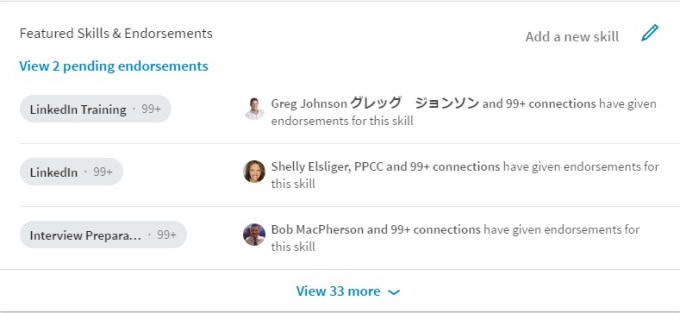
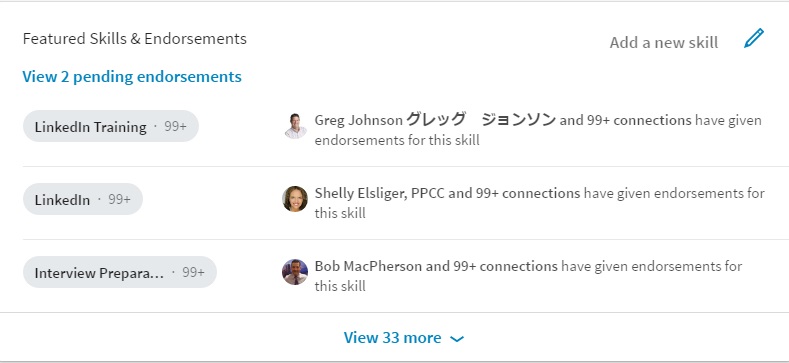
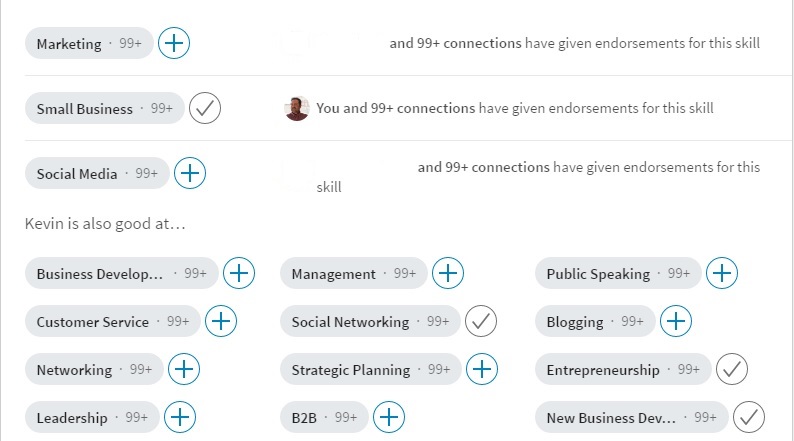
Someone who has many endorsements is perceived as being strong in those skills. For example, I visit one of my valued connection’s profile during my LinkedIn workshop and show the attendees that every bleeping skill he has has 99+ endorsements. (Partial list below.)

kevins-endorsements


I asked him one day how he had accumulated so many endorsements. With a smirk on his face he told me it was because he has a lot of friends. He also said that he hates endorsements. “Bro,” I told him, “give me some of your endorsements.”

Endorsements were introduced by LinkedIn to increase engagement, plain and simple. With a click of the mouse you can endorse someone for a skill you’ve never witnessed them perform.

While some argue that what their connections write on their profile is proof enough, you and I both know that words can be embellished all for the sake of marketing oneself. So this reasoning for me is faulty.

LinkedIn is screwing with people’s minds by suggesting which of your connections’ skills you should endorse. LinkedIn does this occasionally when you visit someone’s profile and also offers suggestions of skills to endorse on your profile.

I once asked one of my colleagues why he endorsed me for some skills I didn’t want endorsed, and he told me, “Because LinkedIn told me to.” This is LinkedIn screwing with people’s minds. LinkedIn is turning us into lemmings who are running off the proverbial cliff.

LinkedIn endorsements’ real value

But wait, you’re thinking, if you’re opposed to endorsements, why are you making such a fuss over them? This is a fair question. It’s because endorsements can have real value if they’re awarded the proper ways.

The first of two ways is by seeing your connections actually perform the skills they have listed on their profile. Remember my valued connection who joked that he was endorsed for his skills because he has a lot of friends? Truth be told, I’ve seen him perform a number of those skills and he deserves to be endorsed for them.

The second proper way to endorse someone is by trusting them. Based on how the recipient lists their skills, this is giving you a clue as how to proceed. The skills I have listed on my profile, for instance, have been carefully selected to reflect my value, not perceived value. (Read my post on how to help people endorse you.)


In closing, LinkedIn endorsements will only provide value when they are dealt out accurately. This can be accomplished if visitors have seen recipients demonstrate the skills for which they’re endorsed or, as I’ve said, trust them to arrange their skills to truly represent their strengths.

When this happens, I will have faith in LinkedIn endorsements. But if endorsers continue to follow LinkedIn’s suggestions, or endorse people by the highest number of endorsements, I see them as perceived value.

Photo: Flickr, Mauricio Sarfati