2 great reasons why introverted job seekers should walk

Introverts find various ways to carve out the time to reflect. Mine is walking. Yours may be hiking, yoga, going to the gym, taking a ride, etc. The nice thing about walking is that it’s free. Yes, you don’t need to pay a monthly $15 gym membership fee to walk on a treadmill. But I’m not judging.

Walking shoes

As often as I can I lace up my sneakers, set my phone to NPR or my music play list, and set out for my 45-minute walk…alone. Always alone. If you’re thinking that only a loner would walk alone, let me assure you that, as an introvert, this time is golden.

I usually walk the same route; although, I might get a little crazy and reverse the route. I joke that if someone wanted to assassinate me, they’d know where to find me based on my routine.

Why do I walk alone? I walk alone because it’s my time to relax after a long day of work. It’s my time to get out of the house and be in nature. It’s my time to reflect.

Despite wearing earbuds and listening to “On Point” or Taylor Swift (don’t judge), I am alone, and I do think of whatever comes to mind. At times I’ll formulate ideas for a new workshop. I’ll figure out a way to solve a pressing problem.

Introverts need time to reflect

I tell my job seekers that when I was out of work I extended my walking from 45 minutes a day to 90 minutes. That’s right; I doubled my distance. I walked around the city of Lowell strategizing on the job search and clearing my head.

I suggest they do the same and the reactions are mixed; some nod with approval, others give it a thought and then dismiss it. Maybe to some walking is boring. I admit if it weren’t for my NPR and music playlist I wouldn’t enjoy walking as much.

Extraverts, on the other hand, generally require a walking buddy who they can talk with, because they need to be around people. In fact the more the better. Occasionally I’ll see groups of walkers talking with each other a mile a minute.

If I notice someone in the group just listening and seldom contributing, I think that must be the introvert in the group. Introverts welcome conversation but don’t engage in exhaustive group discussion, where the goal is to win the battle of “Conversation Master.”

One of my valued connections, Edythe Richards, asserts that as an ISTP I’m extremely independent, which makes perfect sense given the fact that I love my alone time. I’m surrounded by people during the day, but after work I like to walk alone.

(I suggest you listen to Edythe’s awesome podcast on my type: ISTP. She’s recorded many more, with her goal to create podcasts on all sixteen types.)

Edythe also says ISTPs can appear aloof. I don’t consider myself aloof, but maybe that’s what makes people aloof—they don’t know they’re exhibiting such behaviors. To me, walking alone is natural and often enjoyable.

In place of human interaction, I have my NRP or music playlist. Oh, of course, I have my variety of thoughts, some of which are productive (as in a new idea for a workshop) others are regarding kids’ issues, and others just thoughts. Regardless, they’re thoughts.

How introverted job seekers can benefit from walking

If you’re currently without a job, walking can be especially beneficial to your state of mind. Those who haven’t suffered the loss of a job may think that the loss of income is the most devastating part of being unemployed. This is not necessarily true.

20200328_095015

With the loss of employment comes the blow to your emotions, which in turn can affect your motivation. A routine of walking early in the morning can replenish the motivation by giving you routine similar to what you had when working.

Getting up at the same time every morning and leaving the same time. It’s a routine and all good. You lose your routine, you lose your mojo. And you don’t want that.

Walking is also a great way to strategize about your job search, devise your day’s activities. There is a networking event coming up. Are you prepared for it? Are your personal business cards in order? Check. What are some of your talking points if you have to make small talk.

Maybe your résumé needs updating. Walking gives you the time to think about some of the accomplishments you achieved in your most recent position. They have to be included on your résumé. You have to enhance your LinkedIn profile, including adding a photo, beefing up the Summary and Experience sections.

I used to walk before an interview. It gave me time to go over my elevator pitch and answer the difficult questions I expected. So when the interview arrived, I was prepared to answer the questions. I must have confused people who saw me talking to myself. Oh well.

The time to reflect eliminates the things in your house that distract you from the job search. I’m always telling job seekers to get out of their house. Walking is a perfect way to do this.

I’m not saying walking is going to be your thing. I’m also not saying that introverts are the only ones who should walk. Give it a shot whether you’re out of work or just need some time to reflect.

Photo: Flickr, sabrina amico

14 tips to connect in your community for your job search

Some job seekers see attending organized networking events as akin to meeting their future in-laws for the first time. For some it’s downright frightening; one job seeker told me she hyperventilates before she goes to an event. Wow.

small meetingPerhaps you feel similar symptoms, dreading the times you have to attend organized networking events.

You’re expected to engage in conversation about you and the strangers you meet, deliver your elevator pitch, maintain proper posture, exchange business cards, refrain from eating messy food, etc.

Take away the expectations that come with attending a networking event, and you’re left with simply connecting with people in your community. You’re more relaxed. There’s no pressure to perform like you would at a networking event.

Community includes the people with whom you interact: former colleagues, small meet-ups, friends, family, neighbors, soccer parents, PTA members, your hair stylist, the folks with whom you volunteer, your career center staff—essentially everyone in your life.

Am I suggesting that you avoid networking events? Certainly not. There are opportunities these events provide, but by connecting with people in your community valuable opportunities also exist. Some important points to consider when connecting in the community include:

  1. Get the word out. As simple as this sounds, I know people who don’t tell family or friends they’re out of work because of shame and embarrassment. Regardless of how you departed your company/organization, your community has to know you’re no longer employed. There is no shame in being unemployed, as thousands of others like you are in the same situation.
  2. Don’t come across as desperate. One thing employers look for in a candidate is confidence. The same applies to your community. Someone who appears confident and not phased by their situation is someone your community members will be willing to back.
  3. Make a good first impression. Along with projecting a positive attitude, dressing well at all times, being considerate of people’s time, going out of your way to help others, and of course smiling all count. The saying that your first impression is your last impression holds true.
  4. Resist the urge to bash. Regardless of how your employment ended, don’t rant about how unfairly you were treated and the circumstances of why you were let go or laid off. If asked about your departure, explain how it happened, but don’t come across as angry. If you’re not past the anger stage, avoid talking about the situation.
  5. Know what you want to do. Your community can only help you if you are able to explain very clearly what occupation you’re pursuing, the industry in which you’d like to work, even the location you prefer. To say, “I’ll do anything; I just need a job” is not helpful to people in your community, and will make you appear desperate.
  6. Clearly explain what you do. To say, “I’m in customer service” is not enough.Telling your community that you “answer customers’ questions regarding their cable, telephone, and Internet issues” paints a better picture and provokes follow-up questions.
  7. Do your researchWhat type of companies do you want to work for? What are the names of those companies? This is all important information, especially if you know of someone in your community who has a contact or two at those companies. Casually connecting with these people by making a phone call or meeting them for coffee can lead to results.
  8. No events are off limits. Bar-b-ques, holiday parties, baby showers, your nephew’s birthday party, are appropriate places to connect to explain your status. Just be tactful and don’t dominate conversations with your job search woes. Instead briefly explain what you do and ask people to keep their ears to the pavement.
  9. Start small. An alternative to an organized networking event is a meet-up. This is a small group consisting of 4 or 5  people who get together to discuss their job-search situation, hold each other accountable, offer job-search advice, and provide moral support.
  10. Carry personal business cards with you. That’s right; even when you connect with your community in a casual way you’ll want to show how serious you are about finding a job. It shows professionalism and helps people to remember what you do and the type of job you’re seeking (related to numbers 4 and 5). Unlike your resume, they are easy to carry.
  11. Never outright ask if they know of a job. If you want your community to help you, don’t ask if they know of any jobs that would suit you. This only puts pressure on them. One phrase I used when I was out of work was, “If you come across anything, please let me know.”
  12. Stay top of mind. Ping the people in your community with updates on your job search or just to keep in touch by sending them e-mails or cards on special occasions. It doesn’t always have to be about your job search; asking a contact how their child’s play went is a good break from business. Doing this will keep you top of mind.
  13. Follow up. Perhaps the most important part of you job search is following up on the people with whom you’ve spoken. Chances are they for got your conversation a couple of days ago. Kindly tell them, “I’m following up on our conversation. When you get the chance to send me Bob McIntosh’s contact information, I would appreciate it very much.” Always follow with asking them how you can be of assistance.
  14. Reciprocate. When you finally get your job, be sure to show your gratitude by offering to help those who assisted you with your job search. This means everyone. You may not be able to provide the same kind of help, but maybe you could help someone with her small business, for instance. Keep the good will in your community going.

Connecting with people in your community should feel natural and relaxed, not stiff and laborious. Connecting at networking events can have great benefits, and over time you’ll learn to network better; but begin by establishing relationships with the people in your community and build your way up to attending the events.

If you enjoyed this post, please share it.

Photo: Flickr, Ormiston Sudbury Academy

5 steps to take when you can’t tailor your résumé to a particular position

ResumeWhen I tell job seekers they should tailor their résumés to every position, their eyes widen. Some protest that this is too much work and one or two even become angry and profusely refuse to put in this hard work.

The reason I tell my customers to make the effort is because they need to speak to the needs of the employer. Further, this will impress the employer with their research of the position and demonstrate how they can solve problems the company is facing.

But let’s be realistic; this is not possible for every résumé you write, particularly if:

  • you’re posting your résumé on a job board where it will be stored in a résumé bank among millions of other résumés;
  • you don’t have a descriptive job ad and/or;
  • there’s no one to network with to find the real deal about the job for which you’re applying.

So what’s the solution?

In his Knock ‘Em Dead series, Knock ‘Em DeadSecrets & Strategies for Success in an Uncertain World, Martin Yate offers his Target Job Deconstruction (TJD) method as the next best thing to a tailor-made résumé. His method makes sense to me, so I teach it in my workshops.

“Your résumé,” he writes, “will obviously be most effective when it starts with a clear focus and understanding of a specific job target. TJD allows you to analyze exactly how employers prioritize their needs for your target job and the words used to express those needs, resulting in a detailed template for the story your résumé needs to tell.”

There are eight steps Martin describes when writing your TJD (they can be found in his book), but I’ll talk about the most immediate steps for creating your résumé template.

1. The first task in creating your résumé template is to collect approximately six job ads for a position you’re seeking. Use websites like Indeed.com. They use spider technology pulling from other job boards and deliver a plethora of positions from which to choose. The locations of the jobs matter not.

2. From there, you’ll note a requirement (skill, deliverable) most common for all six positions. Next, identify a common requirement for five of the six positions, a common requirement for four of the six positions, and so on, until you have a list of the most common requirements in descending order.

This will give you a good understanding of how employers think when they determine who they’d like to hire. It will also give you a foundation to write a résumé template, which you can modify whenever you send your résumé to a particular company.

Let’s look at a Marketing Specialist position in the Boston area. I managed to find six job descriptions by using Indeed.com. Listed below are the six most common requirements for this position.

  1. Common to all six companies is writing copy for web content, as well as creating a social media campaign.
  2. Common to five of the companies is managing relations with appropriate departments.
  3. Common to four of the companies is coordinating projects with outside vendors.
  4. Common to three of the companies is researching competitors’ websites and reporting activity.
  5. Common to two of the companies is coordinating trade shows.
  6. Another notable duty is Photo shoots/animation development, which drew my attention, as I enjoy, but have limited experience in photography.

3. Now write your résumé. Given the above information, your new résumé should first verify in the Professional Profile your qualifications for the most common requirements listed. Your Performance Profile could read as follows based on the general requirements:

Produced compelling content for website and social media distribution ~ Manage communications between engineering, production, and sales ~ Develop and nurture vendor relationships ~ Direct trade shows from planning to completion ~ Acknowledged by CEO for cost reduction.

4. You will next extract all the key words that apply to you and create a Competencies section including those key words, as your résumé might be scanned by large and even midsize companies. Don’t forget the strong transferable skills you possess.

5. Finally, you will prove in your Employment History what you have asserted in your Professional profile. Try to prove your assertions with accomplishment statements that are quantified. For example, the following accomplishment addresses the first statement from the Performance Profile above:

Produced persuasive content which was distributed via the company’s website and major social media platforms. During this time, revenue increased by 56%.

Final Note: I continue to insist that, when at all possible, my customers tailor their résumés to each job they apply, as it demonstrates their knowledge of the position and effectively demonstrates their qualifications to meet the position’s requirements. This is ideal when you have a list of your top 20-30 companies, the companies for which you want to show your love.

11 job-search blunders I find hard to believe

o-SCALE-facebook

Some things I find hard to believe; like I stepped on my scale this morning expecting to be two pounds heavier due to weekend of overeating, but I was actually two pounds lighter.

Or I deliver the best workshop of my life and receive less than stellar evaluations. What about my wife still talking to me after I haven’t installed a new screen door on our house three weeks after she’d asked me to?

Other things I find hard to believe are things that job seekers do in their job search. For example:

  1. After getting laid off, they think it’s a great time for a three-month summer vacation. Take a week off and then start your job search is my advice. Some downtime is healthy, but the longer you’re out, the harder it will be to get a job.
  2. They tell me they have no accomplishments to list on their résumé, so they have a résumé that looks like a grocery list of duty statements. One job seeker told me that in five years of working at a company he hadn’t achieved anything great. Come on, try, guy.
  3. They send the same résumé to employers thinking targeted cover letters will address how they meet the requirements of a job. One customer admitted he sends out the same résumé but makes sure to tailor the cover letter to meet the employers’ needs. Half way there.
  4. Related to #3: They don’t send cover letters with their résumés. Come on, it only takes an hour at most to write a cover letter that elaborates more on your qualifications and accomplishments. Unless specifically told not to send a cover letter, send one.
  5. They think it’s acceptable to dress like they’re going to the gym while they’re in public. You’re always in the hunt and you never know when someone who has the authority to hire you—or knows someone who has the authority to hire you—will bump into you in the grocery store.
  6. Speaking of networking…they think going to networking events are the only places networking is allowed. Newsflash, networking is ongoing and happens wherever, whenever someone is willing to listen. Next time you’re getting your hair styled or cut, put a bug in the ear of your hairstylist.
  7. They start a LinkedIn profile and just leave it there like a wilting plant. Do you think doing this will create a positive impression on recruiters and employers? No, it will do more harm than good. Having a profile is one part of the equation; being active is another part. Be active on LinkedIn.
  8. They spend the majority of their time on the computer, posting résumés to Monster, SimplyHired, the Ladders, etc. Richard Bolles, What Color is Your Parachute, says your chance of success is between 5%-10% when using this method alone. To me this is not a great use of job seeking time.
  9. They spend mere minutes researching companies and the jobs for which they apply before an interview. Really now, don’t you owe employers the respect of being able to articulate why you want to work at their company and do the job they’re advertising? Do your research.
  10. They expect recruiters to work for them. Who pays the recruiters’ bills? Recruiters work for employers, and any optimism you hear in their voice is to give you confidence when vying for the position, not to indicate you have the job. They’re busy people who don’t always have time to answer your phone calls or e-mails, so don’t feel slighted.
  11. They don’t send a thank you note to employers after an interview. I know, people say it’s a waste of time; but don’t go about your job search in a half-ass way. Thank you notes are an extension of the interview and could make you or…break you.

If you’re committing all of these blunders, or even some of them, consider correcting these aspects of your job search. I’m curious to know of any blunders that come to your mind. Let’s add them to the list.

5 ways to avoid a bad experience at networking events

two people talkingRecently I attended a networking event which left me with the feeling that I must have had the words, “Talk at me” written on my forehead. Not, “Listen to what I have to say. You may actually be interested.”

In other words, I didn’t get a word in edgewise. It got to the point where the words spewing out of peoples’ mouths were simply noise that I had to block out, lest I ran from the room screaming.

It’s not like wanted to be the one who did all the talking–I didn’t–or that I expected people to abide by Robert’s Rules of Order–that’s a bit extreme. I just didn’t want to feel like I was a sounding board.

I’m being a bit dramatic. I had great conversations with a photographer who explained how he programs meta tags into people’s LinkedIn photos to optimize their profile—I still don’t understand that.

Another person I spoke to talked about the  networking groups she started, demonstrating her concern for job seekers.

A third person I spoke with is someone for whom I wrote a LinkedIn profile, someone I met at this group years ago.

No, it was just one person who chewed my ear off and made the whole night a lousy experience. Complaining about people who talk too much is becoming a common theme with me.

As I think about the night and how I could have participated more and not simply been a sounding board, I’ve come to realize five things I need to do better to prepare for networking events.

1. Have exit phrases. I don’t have any “exit” phrases to use when people want to hear themselves talk and could care less about what I have to contribute. This doesn’t only apply to people who attend networking events; I run across this in my daily life.

I realize I need phrases that will release me from their grip of constant verbiage that makes my eyes turn to stone. I know I can’t say, “Please, for the love of God, stop talking.” No, that wouldn’t work. The following would be better:

“Please forgive me, I was heading for the bar to get a drink for myself and a friend of mine.” 

“A person I’ve been meaning to speak to has arrived. Would you excuse me?”

“It just occurred to me that I have to remind the host of an idea I have for her.”

“I’d like to hear more about your product/situation. Let me take your business card and I’ll follow up.”

Of course, none of these came to mind.

2. Get the message across. I have to get my messages across. I have to remember that feeling of anger I had and, in the future, be bent on doing most of the talking, almost to the point where I’m the one dominating the conversation….

Naw, that’s not good networking, and that’s not me. I believe in equal time. I believe in courteousness, where everyone gets heard. But some people could care less about others’ right to talk, which seems disrespectful to me. I’ve noticed that some people converse as if its a dueling match, but that’s not me. “As I was saying,” often works for me when I want the floor.

3. Ask questions. If I don’t understand what the person is talking about, instead of nodding as though I understand what she’s saying. This slows the gushing of words pouring from her mouth and helps me contribute to the discussion.

“So are you saying you’re looking for a job in marketing, more specifically social media? That’s interesting. I teach courses on LinkedIn, Twitter, and blogging. Social media is dominating the landscape in some marketing departments. Would you like to take my business card and follow up with me?”

4. Be mentally prepared. I have to prepare myself. Some pundits believe that introverts may be slower on the uptake when it comes to small talk or self-promotion.

Marti Olsen Laney, author of The Introvert Advantage: How to Thrive in an Extroverted World, claims that introverts are physiologically slower than extraverts when expressing themselves. They need to formulate their thoughts before speaking, lest they say something unintelligible.

I notice that I’m at my best against loquacious types when my adrenaline is higher than usual. I’m more animated and expressive. This can take some preparation before going to a networking event by getting in the mood to attend, somewhat difficult for introverts.

5. Leave. That’s right. If the event isn’t meeting your expectations, or you’re being talked at with no ability to retreat; simply say adieu to the host and anyone with whom you made a connection.

There’s no sense in drawing out a bad experience. Call it a loss, but by no means consider all networking events are the same. At this particular event I had the misfortune to be assaulted by the wrong person. Many other events have turned out very well for me.


I enjoy attending networking events but what I experienced that night is what gives networking a bad name. Connecting at these events should be a natural process, one of give and take; not one where you leave with your head spinning.

If you enjoyed this post, please share it.

5 ways you’re killing your job search

angry eye

This post was originally published on recruiter.com. I have added an additional job search killer, though. 

I talk with my workshop attendees about some variables in the job search that are very important to their success. These variables are not their résumé, cover letter, LinkedIn profile, or interview techniques. It’s their attitude.

I’ve written about the importance of demonstrating a positive attitude, but this concept is hard for some to embrace. Let me be clear that I’m not implying that people in crappy situations have to feel positive; they just need to fake it till they make it.

Lately I’ve read more than enough responses to posts or updates on LinkedIn to prompt me to speak up. As well, I see a few people who attend the career center for which I work who look like they have hatred in their eyes; enough, in fact to be scary.

To these people I offer a warning; your chances of getting help are minimal at best. All would agree that people are more willing to help those who are positive than those who are negative. This I also point out to my workshop attendees.

Displaying a negative attitude may make people, such as networkers who can be of assistance and potential employers, refrain from helping because of the following reasons:

You come across as a difficult person with whom to work

That sneer on your face serves no other purpose than to drive people away. It makes people wonder why they would want to spend time talking with you. You come across as angry and mean.

When potential employers see your rants on LinkedIn, they wonder if the negativism will carry over to work. And since they have people beating down their doors for jobs, you’ll get passed over as one of hundreds applying for their job/s.

One trait of someone who has emotional intelligence (EQ), is someone who can control their emotions. With a nasty attitude displayed in public or online, you come across as someone who lacks this important element.

You aren’t confident

Whether we like it or not, employers want to hire someone who shows confidence. Confidence implies the ability to perform well on the job. I think particularly of salespeople who need to close a deal, showing confidence in their product and in themselves.

But this also applies to the job search. If you want someone to refer you to a position, you need to demonstrate confidence. You need to show you have the skills to do the job for which they’re referring you.

And at the interview when only your appearance and verbal communication skills are what count, a lack of confidence can kill the deal. Interviewers are wondering if you can handle the responsibilities required of this position when your body language and verbiage say otherwise.

Now here’s the rub: after losing a job for any reason, your confidence may be shot. You may doubt yourself. As someone who essentially goes on stage every workday, I have to act enthusiastic, even if I’m not in the mood. The same applies to you…but at a greater level.

(Gulp) there was a reason why you were terminated

Many people who were terminated will say it was their bosses’ fault. They will cast blame. But as you listen to their story, it becomes clear that the boss was not at fault. It was the employee’s poor attitude that caused friction.

The first part of self-awareness is realizing this in yourself, and the second part is doing something about it. Assess when you were difficult to work with and come up with a way to correct it.

Lastly, don’t talk about these instances in public. Listeners will not want to hear about them, especially if you go into elaborate stories about how unfairly you were treated. You will essentially come across as a complainer.

You’re not ready to work

Until you have your poor attitude in check, you are not ready to enter the job search. You’ll need to come to peace with your situation. Perhaps there was a reason why you were let go, and it was justified.

In this case, you should (figuratively speaking) count to ten. Take more than a week off, as I suggest to my customers, before you begin your job search. It may take longer. And you may have to seek professional help.

Employers want steady, confident employees; they shy away from candidates who are unstable. I’ve heard reports from recruiters and hiring managers who wouldn’t consider recommending someone for a job because the person was too emotional during the interview.

You’re just plain ole nasty

I once saw a bumper sticker that read, “Mean People Suck.” This bumper sticker spoke to people who are angry at themselves, at others, essentially at the world. Anger comes through in a person’s face-to-face interactions, as well as their online presence.

I wrote a blog awhile back about a person who was eyeballing me during a workshop, and how my objective during the workshop was to give it back. He ended up giving me the highest rating I could receive, to my surprise. Nonetheless, I prefer a happy, head-nodding person over this gentleman any day.

My only hope for people like this is that they find an employer and environment where they can flourish. Maybe it’s a position where human interaction is unnecessary, or where nastiness is required for the position–none comes to mind. I refuse to say there is no hope for someone like this, but I’m inclined to think it.


I don’t have any illusions of all readers to agree with what I’ve written. I imagine there will be some who downright hate it. Some people will complain that I could never understand what they’re going through, that it’s hard not to scowl or gather up the confidence.

Here’s a secret. I wasn’t the best unemployed person on the face of this earth. I’ve run into people far better than me. But I’ve learned from my mistakes, and I can only say, “Try. Try real hard to act civilized. It’s the only way you’ll receive help from those in the position to help you.”

Photo: Flickr, adriana chira


5 very good reasons to volunteer to find employment

Before the words leave my mouth, I can hear my workshop attendees thinking, “Why should I work for free?” I hear you. It sucks working hard and not getting paid for it; but read what I’ve got to say before you condemn volunteering to find work.

office worker

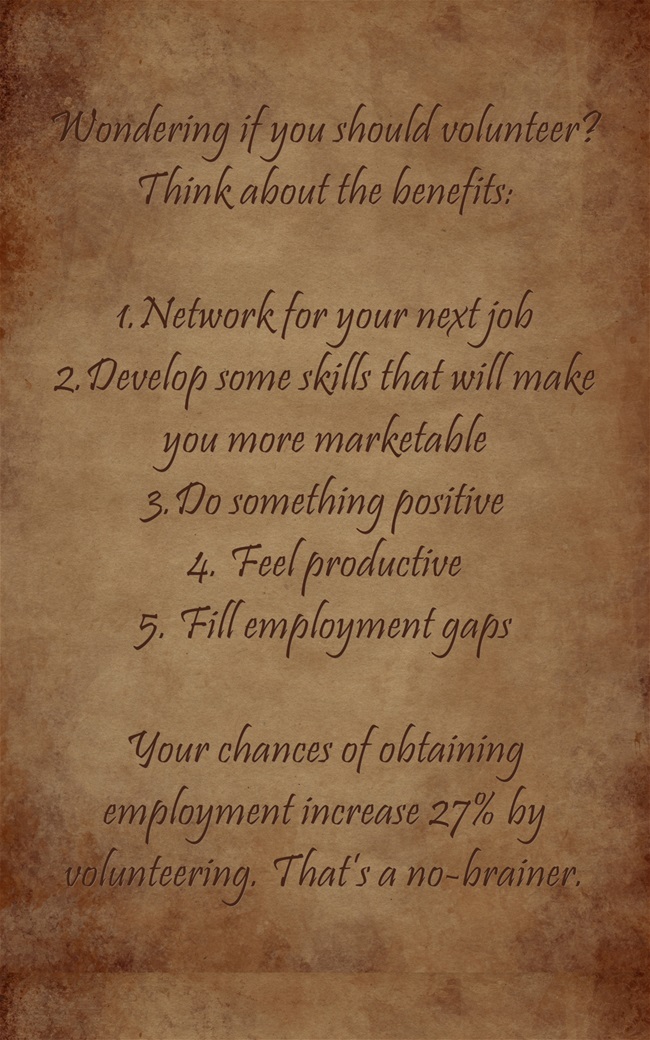
An articleVolunteering as a Pathway to Employment Report, praises the act of volunteering, claiming that one’s chance of obtaining employment is 27% higher than by not volunteering. The article points out Social and Human Capital—strengthening relationships and building skills—as two major outcomes of networking.

I elaborate on these assertions and offer three additional outcomes of volunteering: it creates a positive outlook, makes one feel productive, and closes gaps in employment on your résumé. So you naysayers, read on.

1. Volunteer to network for your next job. It opens potential doors because you’re in a place where you can do some real-time networking. Choose an organization or business in the industry in which you’d like to work.

If marketing is your forté, for example, approach an organization that needs a graphic artist or publicist to design some art for their website or write a press release or two.

This organization where you’ve managed to get your foot in the door can help you with leads at other companies, especially if you do a smashing job. The president or owner will want to help you because you’ve come across as competent and likeable. Who knows, you could possibly join the company if a position opens up…or is created.

2. Develop or enhance skills that will make you more marketable. You’ve had it in your head to start blogging but haven’t had the time to dedicate to it. The company who took you on as a volunteer in their marketing department not only can help you network; it can give you the opportunity to enhance your diverse writing skills.

Your approach to management might be to offer starting a blog for them, as the rest of the marketing department is up to their elbows in alligators. They gain a talented writer to write entries, and you learn the fine art of blogging.

Volunteer3

3. Volunteering is a great way to do a positive thing. You may consider choosing an organization where your efforts are meaningful in a big way.

A customer of mine said she volunteers at a soup kitchen because she has a soft spot in her heart for the less fortunate.

She’s a bookkeeper, so I suggested that she also offer to do the books for her church. While she’s helping the less fortunate at the soup kitchen, she could also keep her skills sharp through volunteering at her church.

4. Feel productive. Instead of sitting at home and watching The View, you can get back into work mode.

Do you remember work mode? It begins with getting up at 6:00 am, doing some exercise, leaving for a job from 8:00 am to 5:00 pm, all the while feeling productive. When you get home from volunteering, you can watch those episodes of The View on DVR.

I tell my workshop attendees that one of the ways to stay sane during unemployment is by getting out of the house, and I repeat this three or four times until I know it’s embedded in their brains. As simple as it sounds, volunteering gets you out of the house.

5. Volunteering will pad your résumé and LinkedIn profile. Yes, employers look at gaps in your work history. When an employer asks about your three months of unemployment, you can proudly say you’ve been volunteering at Company A in their marketing division.

There you authored press releases, created their newest website designs, and started them on your way to a new blogging campaign. Of course you’ll indicate on your résumé, in parenthesis, that this experience was (Volunteer) work. Nonetheless, it was work.

There is concern among LinkedIn users about how to indicate they’re looking for work. Of four possible ways, I list volunteering as my preferred way to indicate you’re in the job hunt. Read the article if this is one of your concerns.


Any time you feel slighted for working without pay, remember why you’re doing it; to  network, develop or enhance new skills, do something positive, feel useful, and pad your résumé. If these five reasons aren’t enough, then by all means stay home and watch The View.

Photo: Flickr, Technical Resources

Clichés on your résumé: damned if you do, damned if you don’t

SONY DSC


The summary statement began with: “Results-oriented Marketing Professional…” As if my hand had a mind of its own, I circled Results-oriented and wrote “Ugh” next to it.

I thought twice of erasing my first comment but in the end left it there. My customer did a double-take and pouted, hurt by my crudeness.

With all the negative press about using clichés or outdated words and phrases on your résumé and LinkedIn profile, there’s now a push to show how you possess important adaptive skills rather than to simply tell employers you have them.

Résumé experts say words like creative, team-player (ouch), innovative, hardworking, diligent, conscientious, and more are being thrown out the window. They’re seen as fluffy words with no substance.

Words like designed, initiated, directed, authored are more of what employers want to see on a résumé and LinkedIn profile. The big difference is obviously the “bad” words are adjectives and the “good” words are action verbs.

To complicate matters more; even some of the verbs have fallen in the cliché category, like led, managed, facilitated, etc.

From a reader’s point of view, this makes sense. Someone who claims he’s outgoinghighly experiencedseasonedresult-driven, etc., seems to…lack creativity.

Someone who can assert that he is results-oriented by showing he began and finished multiple projects in a timely manner, while also consistently saving the company costs by an average of 40% will win over the minds of employers. Showing is always better than telling.

Keywords and phrases: Here’s the rub—many job ads contains clichés; and if you’re going to load your résumé with as many keywords/phrases as possible, you’re almost inclined to use these outdated and useless words.

If you know your résumé is going to be scanned by an applicant tracking system (ATS), it may be imperative that you use clichés, especially if you want to pass the ATS and be one of the 25% of résumés read.

I performed a quick experiment where I looked at three job ads and attempted to find some of the overused words.

Sure enough words and phrases like team player, hard worker, ability to work independently and as part of a teamdetail-oriented, to name a few,  showed up in many of the ads.

Why do companies write job ads that contain words that are almost comical? Part of the reason is because the fine folks who write these ads don’t know any other way to phrase effective ads; and partly because these are qualities they’re looking for.

Almost every company is looking for a team player who can work independently as well. Every company desires people who are results-oriented, innovative, hardworking, etc.

This leads us back to our conundrum. What to do if you’re trying to write a résumé or Linked profile that includes the keywords and phrases? Not only to game the ATS but also to appease the eyes who’ll be reading your written communications?

The answer is: you’re damned if you do, you’re damned if you don’t. You can write your résumé and LinkedIn profile employing clichés, or you can avoid the them on your marketing documents, documents that are, after all, examples of your written communications. I say take the high road and don’t sell yourself out.

Photo: Flickr, Tom Newby

Try these 5 activities before giving up on your job search

despondantThis post originally appeared in recruiter.com.

I’ve seen it all too often: people losing their motivation to find employment. They resign themselves to the fact that they’ll never obtain their ideal job. Instead, they’ll wait for it to come to them—if it ever does.

In short, they’ve given up.

Is this you? Have you given up hope? When I was out of work, I was on the precipice of losing hope, but I was very lucky to land a job weeks before my unemployment benefits expired. Thanks to a surge of energy, reaching out to the right people, and a little luck, I landed the job.

Are you conducting your job search the way you should? Are you doing all you can? If not, it’s time to get back to the basics.

Reach Out for Help

This is perhaps one of the hardest things a job seeker can do. They feel that asking for help is a sign of weakness, or that no one wants to help them. First of all, asking for help is not a sign of weakness. Not asking for help is a sign of weakness. Let go of your pride.

Here’s the thing; people like helping others. Psychologists say that helping others gives people a sense of accomplishment and makes them feel empowered. Have you helped someone find a job? If you did, I bet it felt good.

How you ask for help makes a difference, so keep that in mind when reaching out. Don’t simply approach people if they know of any jobs for you. This puts them into an awkward situation.

Instead, work into the conversation that you’re out of work, what you do (be exact), and the type of work you’re looking for.

Listen to Those You Trust

You worked with some great colleagues and maybe some “not so great” colleagues. Recall the ones who were trustworthy, the ones who you could trust with confidential information. These are the people you want to connect with if you haven’t already.

Listen to their advice and determine whether it makes sense for you. If it doesn’t—for example, if they tell you to spend your entire search on the Internet—then listen politely, but disregard it.

You’re fortunate if you find a “wingman.” They’re people who offer sound advice and stick with you throughout your job search.

Don’t forget the people in your community. They can also be great sources help. They may hear of opportunities that you otherwise wouldn’t. For example, your neighbor might work at one of your desired companies, and he might be willing to deliver you resume to the hiring manager in the software engineering department.

Shuck Off the Negative Nellies

It’s nice to have someone to occasionally commiserate with – someone with whom you can curse your former employer, talk about being bored, share your financial woes, etc.

A former colleague of mine and I did exactly this. We met once a week, maybe twice, at a local bar where we would “cry in our beer.”

This was great at first, but soon it got old and made me more depressed as time went on. So I broke ties with him. I was determined to surround myself with people who were positive, hoping their positivity would wear off on me.

Try Something Different

1. Develop a Plan: Now it’s time to develop a career action plan. The plan I’m speaking of should, ideally, cover your day-to-day – maybe even your hour-to-hour. Record it all on a spreadsheet. Without a solid plan, you’ll end up spinning your wheels.

2. Use Different Methods to Look for WorkNetworking has always proved to be the best way to look for work. Supplement that with LinkedIn. Make follow-up calls. Even knock on companies’ doors, if possible. You’ll feel more productive if you employ a variety of methods – just don’t spread yourself thin. Four methods should be fine.

3. Take a Break: You are most likely riding a roller coaster ride of emotions. You need to take occasional breaks to regroup. Not too long, mind you – but long enough to regain your energy. Go on walks or to the gym. If the weather’s, nice sit on a bench and reflect on your plan.

4. Volunteer in Your Area of Work: Volunteering is a good idea for a number of reasons. One, you put yourself in a position to network with people who are currently working and may have ideas or contacts who can be of use. Two, it keeps you active; you’re not spending all your time sitting at home behind your computer. Finally, you can enhance the skills you have or develop new ones.

5. Get Job Search Assistance: Your local one-stop career center, an outplacement agency (if you were granted one by your employer), or an alumni association can all be sources of job search advice.

6. Join a Networking Group: Or, if you were networking and stopped, try it again. I’ve spoken with job seekers who have had unlucky experience with networking groups. Perhaps joining a smaller group of networkers who will offer support and job search advice is the way to go.

7. Seek Professional Help If Needed: Sometimes, the stress of being out of work is too much to handle on your own. You may feel anxious and even depressed. It’s important to realize this. Take advice from family and friends when applicable, and seek help from a therapist if need be. You may find talking with a non-judgmental third party refreshing.

Getting Back on Your Bicycle

You’ve fallen off your bicycle, figuratively speaking, so now it’s time for a surge of energy. Try as best you can to put the facts and figures behind you. Remember that you were and will continue to be a productive employee.

Photo: Flickr, Václav Soyka


5 tips for promoting yourself in the job search

baseball

When I made our town’s Little League All-Star team, I ran to my neighbor’s house where my father was helping him fix a lawnmower. I burst into the garage and told my father with pride that I’d made the team. Instead of sharing my excitement, he told me not to brag and turned to finish working on our neighbor’s lawnmower.

I’ve thought for a long time that that day my father taught me an important lesson about humility. Now I’m not so sure it was such an important lesson. Some believe that our inability to promote ourselves is due to being told as children not to brag. To brag is inappropriate; to be humble is honorable.

This inability to self-promote often rears its ugly head in my workshops when my customers declare they cannot “brag.” I assume, like me, they were told not to brag as children.

I also understand that their confidence is shattered; and when you’ve been kicked in the gut, it’s hard to muster up the ability to talk about yourself in a positive, yet objective way—which is to say, not brag. Here are five tips on how to promote yourself during the job search.

  • Understand your audience. Know what interests potential networkers and employers. If you have the “stage,” this makes self-promotion all that much easier. This gives you free reign to highlight your accomplishments and related experience, as long as they apply to the job search and eventually the position for which you’re applying. If, however, you’re in the company of people who have no interest in what you’ve achieved, save touting your accomplishments for the proper audience.
  • Back up your accomplishments. As a jobseeker, your accomplishments will seem more authentic if you have evidence to back them up, perhaps in the form of recommendations, awards, or outstanding references. As well, if you can quantify your accomplishments with percentages and dollars, they will carry more weight. What others say about you, I tell my customers, carries more weight then what you say about yourself. And always be truthful; never lie about your achievements. Lies will come back to bite you in the ass.
  • Be relevant. Any self-promotion has to have relevance. If the employer is looking for someone who has demonstrated superb written communications, you should not talk about the numerous presentations you gave before packed houses; you will come across as a round peg for the employer’s square whole. Think back to the times when you wrote the company newsletter and got published in trade magazines.
  • Don’t overdo it. Avoid using words like “great,” “outstanding,” “the best,” etc. It is far better to provide facts than conjecture. For example, “I was the best counselor on the staff“comes across as bragging without any substance. Better put would be, “Among my colleagues, I was given the highest-level customers on a regular basis. I was trusted by management to give them the service they needed.” Yes, you were the best.
  • Give credit where credit is due. I often tell my customers that they should talk about their accomplishments, because that’s what employers want to know; what they’ve accomplished. But when they’ve worked with a team that achieved a common goal, this needs to be expressed. No one likes a smoking gun who takes all the credit.

The simple fact is that you as a jobseeker must promote yourself, because you can’t rely on others to be there by your side in your job search. We’ve been taught not to brag, like the time I rushed to my father proud of making the town’s Little League All-Star team, but we have to realize that promoting ourselves at the right moment isn’t bragging.

Photo, Flickr, Roiz, Roiz, Play Baseball