Category Archives: Career Search

So you didn’t get the job; ask yourself 3 questions

So you didn’t get the job you wanted. You nailed the phone interview, had great rapport with the recruiter, he loved you and said you’re in consideration for the face-to-face. But you don’t hear back from him. Crickets.

Rejection2

In my Interview workshops I ask people if they’ve had a telephone interview lately. Some raise their hand, so I ask them how the interviews went. Their typical response, “Not so well. I didn’t get to the next step.”

They were probably right for the job but didn’t have one of the three components employers’ look for—they didn’t meet the technical requirements for the job. Having the other two components, willing to do the job and being a good fit, just didn’t cut it.

Let’s face it, recruiters, are foremost concerned about your ability to handle the task assigned to you. The other two components are important, but the first priority is meeting the job specifics. Their job is to determine if you have the technical skills.

This is wrong according to Mike Michalowicz ‘s article in WSJ.com called The Best Recruits May Not Be Who You Think, but many employers don’t realize the value of the variable. He writes:

“When hiring new employees, most recruiters consider qualifications first – and last. They’re looking for someone with the best education, the most experience and the most impressive skills. This is a mistake because you can teach employees what you want them to know, you can give them the experience you want them to have, but you can’t change who they are on a fundamental level. Their attitude, values, willingness and work ethic are all ingrained in them.”

Let’s take a marketing specialist position that lists the following requirements:

  1. Familiarity with data storage software.
  2. Write copy for direct mail and electronic distribution, including web content.
  3. Manage relations with appropriate departments.
  4. Coordinate projects with outside vendors.
  5. Speaking with media, partners, and customers.
  6. Research competitors’ websites and reporting activity.
  7. Coordinate trade shows.
  8. Photo shoots/animation development, webinars, product launch planning.
  9. Willingness to travel 25%.
  10. Plus a Master’s Degree in Marketing preferred.

Now, if the other candidates have all the technical ingredients for the job, and you’re lacking webinar production experience and coordinating projects with outside vendors, have limited experience speaking with the media; the decision of whether you advance to the next round may be based on your lack of experience.

You may be perceived as someone who is motivated to work at the company, because you express enthusiasm for the duties and challenges presented; and come across as a great personality fit, because you demonstrate adaptability to any environment and management style. But these components usually aren’t weighed as heavily by recruiters.

The fact is that most recruiters must be assured that you can hit the ground running. They want to hire someone who has 80%-100% of the requirements under their belt. You can’t beat yourself up for not getting the job, despite shining in every other way.

CareerCenterToolBox.com published an article called 5 Things You Need to do After the Interview, in which one of the things suggested was to evaluate your performance. It says: “Right after the interview, recall what happened. You need to start by asking yourself these three vital questions:

  1. What went wrong?
  2. What went right?
  3. What can be improved?

As I tell my workshop attendees, “What went wrong?” was probably the fact that another candidate presented herself as more qualified for the position based on her experience. Or there are other reasons that were out of your control.

Read about 10 reasons you’re not a fit for the job.

What went right? You stood up to the pressure of an interview and presented an articulate, thoughtful, and personable candidate. You answered all their questions with confidence and poise, maintained eye contact.

When asked about direct experience, you highlighted transferable skills that would make the transition seamless. You learned more about what is expected at an interview.

What can improve? Ideally you’ll apply for jobs where you have 80%-100% of the job-related requirements; but don’t shy away from jobs where you only meet 75% of the requirements, because occasionally employers see other qualities in you other than the alphabet soup. Please don’t throw in the towel yet. Keep fighting the good fight!

Photo: Flickr, Sheila Janssen

4 qualifications job candidates must demonstrate during the interview

It’s no secret that job seekers must satisfy three requirements to land a job:

  1. They can do the job.
  2. They will do the job.
  3. They will fit in.

motivated-girl

These three requirements are the foundation of a complete candidate.

There’s also a fourth piece to the puzzle. It is often overlooked, but some companies place more importance on it than any of the other requirements. This fourth requirement is the cause of much consternation for many a job seeker. Can you guess what it is?

Let’s take a look at these three requirements every candidate must satisfy – and the mysterious fourth one as well:

1. Can You Do the Job?

Of course interviewers won’t ask the question so directly. Rather, they’ll pose more indirect questions, like:

“What skills and experience do you see being necessary to do the job?”

“Tell me about a time when you handled problem X.”

“What kind of experience do you have in the area of Y?”

And you should always be prepared to answer the “Tell me about yourself” question.

For many employers, this is the most important requirement for any potential employee to meet – but the following three cannot be overlooked.

2. Will You Do the job?

Employers want to know how motivated you are. They’ll want to know if you’ll enjoy the responsibilities and support the mission of the organization. Will you work until the job is finished?

You may have to field a question like, “Why do you want to work for this company?” Think about it: Would you, as an employer, want to hire someone who isn’t totally into working for your company? Probably not.

Or, “Tell us which responsibilities of the job you will enjoy taking on. And why?”

“Tell us about a time when you took on a challenge you thought was insurmountable.”

How can you prove your desire to take on the responsibilities of the position or work for the company? Stories using the situation-task-action-result (STAR) formula are a great way to demonstrate your motivation and passion for the job.

3. Will You Fit?

Showing that you’ll be a good fit is tough to do, but it’s a concern many employers have. It’s all about your personality. They don’t want to hire someone who won’t get along with coworkers.

In this area, you’re likely to face behavioral questions, such as, “Tell me about a time when you had to deal with an irate colleague.”

Or, “What’s your definition of a team, and how have you been a team player in the past?”

To some employers, your cultural fit will be even more important than your technical skills. Technical skills can be learned, but it can be difficult – if not impossible – to learn new personality traits.

Can you train someone to become more sensitive? What about teaching a talkative person to become a listener? Can you improve the attitude of someone who has difficulty interacting with other departments? The answer to all these questions is probably “no.”

4. The Final Requirement: Are You Affordable?

dollar-signAs stated above, some employers stress this requirement even more than the others – especially when landing a candidate who costs less is a priority. Sure, a candidate who meets the other three requirements would be ideal, but not always necessary.

During an interview, the first question out of the recruiter’s mouth might be related to salary: “What do you expect for salary?” or “What did you make at your last company?” These salary questions could come during the phone or in-person interview, so make sure you’re prepared to answer in a way that doesn’t cause you to lose out on the salary you deserve.

Don’t be surprised if you’re out of this employer’s price range – it can happen.

Salary negotiation makes some people’s skin crawl because they see it as a confrontation. In fact, it’s a straightforward affair. Companies don’t want to pay you too little because it can lead to resentment. However, this is business, so employers aren’t going to give away the farm, either.


Being able to address the three most obvious concerns employers have is what gets you to the fourth concern – can they afford you? If you do a great job meeting the first three requirements, the last one should go smoothly – as long as you’re reasonable.

This article appeared in Recruiter.com.


Being selfish and 3 other tips for your job search

For job seekers who are being held back in their search for employment, understand that nothing should hold you back from doing what’s necessary.

Selfish job search

After sitting with a client to talk about her job search and realizing she wasn’t allowed to conduct it the way she had to, I lectured her on how nothing should impede her progress. She was surprised by my stern voice, but I think she got the message.

We often think of the job search as consisting of writing our marketing documents, preparing for interviews, networking, and using LinkedIn. But there are intangible factors that need to be considered by the job seeker; the first of which is being selfish. Maybe this isn’t the optimal word, but it comes down to demanding the time you need to conduct a successful job search.

Being selfish (demand the time you need)

This is one of the messages I impart to my Introduction to the Job Search workshop attendees. I tell them, “OK, I need to tell you something; and I want you to listen.”  And for effect I pause to make sure all eyes are on me. They must think I’m going to say something brilliant, but what I tell them is:

In your job search, you can’t let anyone get in your way of looking for a job. You can’t let anyone tell you to watch the kids or grandchildren. You can’t let anyone tell you to do some errands that will take up your whole day. No home projects, unless the pipes have burst. Do you get what I mean?

Almost everyone of my attendees nod in agreement; some lower their head and look at the desk. After another moment of pause, I tell them that there are other things to consider when they’re conducting their job search. Things other than their résumé and interviewing skills.  

Show a positive attitude

Throughout your job search, it’s important to display a positive attitude. The operative word is “display.” I’m not going to preach the importance of feeling positive and all happy inside. I’ve been unemployed and know how it sucks, so how you feel is really a personal matter.

I am, however, advising you to appear positive. This begins with the way you dress for the day. Because it is entirely possible that you may run into someone who may have the authority to hire you or know someone who has the authority to hire you, it’s important that you are dressed well. Not to the 9’s mind you, but certainly not in sweat pants and a Tee-shirt.

Other ways to show a positive attitude have more to do with your behavior, such as suppressing anger, wearing a friendlier countenance, making an attempt to be more outgoing, and (this is tough) not showing your desperation.

One of my customers comes across as angry. He always mentions how long he’s been out of work when asked to talk about himself, a no-no when asked to explain the value you present to employers. (This also applies to your presence on LinkedIn.)

Be dedicated to your job search, but don’t burn out

If you’re going to demand the time it takes to conduct your job search, you have to show your loved ones that you are serious about your job search; not rising late, lounging in you pajamas, watching Ellen, going out with the buds at night, etc.

How can you rightfully deny those around you who need your assistance when they don’t see any effort from you? You can’t. They don’t see any dedication in the job search from you, so naturally they’ll want you to pull your weight in other ways.

I ask my customers how many hours they worked a week when employed. Most of them report more than 40 hours. I then ask them if they need to dedicate this much time to their job search–to which they say yes.

To their surprise, I disagree with them. Twenty-five to 30 hours a week is plenty, I tell them. Any more than this may lead to burn out. I say look smarter, not harder. But looking smarter requires a well thought-out plan.

Have a plan 

The best way to strive toward a goal is by creating a Career Action Plan (CAP) and following it as closely as you can. Sure there will be times when you slip and miss a date or change your plan around. This should not discourage you and cause you to abandon your plan. Your plan may look similar to this:

  1. Early-morning: take a walk or go to the gym, then eat breakfast.
  2. Mid-morning: attend a networking group, or go to workshops at your local career center.
  3. Noon: gather with some networking buddies for lunch (you can write these lunches off).
  4. Mid-afternoon: Volunteer at an organization where you’re utilizing your skills and learning new ones.
  5. Evening: eat dinner with family or friends.
  6. Early-evening: use LinkedIn to connect with more people.

Note: Your activities will vary from day to day, and you may include other activities, such as meeting with recruiters or using job boards or going door-to-door and dropping off a résumé (yes, this works); but the outline is similar.

When you show those around you your CAP they’ll realize you’re serious about your job search and will most likely encourage you to follow through with your objectives. Keep them updated during your week to show them your progress, or post it on the refrigerator. Most importantly you’ll feel better about your job search, especially if you’re meeting the majority of your objectives.

Back to my client

Being selfish…I mean demanding time for their job search…is difficult for some folks, who feel the need to be of help to others before helping themselves. But it’s a necessary component of a successful job search . Of course I stress to my workshop attendees the importance of supporting those around them when they have spare time…but only when they have spare time.

Photo: Flickr, bm_adverts

5 ways for job seekers to discover their greatness

“Greatness” I call it, because you have demonstrated it in your career in the form of accomplishments. It has set you apart from your colleagues and competitors. You’ve achieved accomplishments, whether you realize or not.

business lunch

Unfortunately you might be someone who thinks of what you did at work as something…you simply did?

I was talking with a colleague and dwelling on the fact that I felt I haven’t accomplished as much as I would have liked. “What do you mean,” she said. “You’ve developed tons of workshops and get great reviews. You started a LinkedIn group and developed three workshops on LinkedIn. That shows innovation, initiative, and knowledge….”

Enough already I thought; I get the point. I’m simply too close to…me…I guess. I need to step back and hear from others what I’ve accomplished.

One of my valued connections and an executive résumé writer, Laura-Smith Proulx, explained this quandary of not recognizing one’s accomplishments.

“Most executive leaders and skilled professionals are subject matter experts in all types of leadership competencies, from strategic planning to team delegation. However, when asked to describe their strengths, most of them will resort to tactical or skills-based descriptions, rather than illustrating the ways in which they add strategic value.”

Plainly speaking, even high-performing job seekers have a hard time seeing what they’ve accomplished, who they are. While important in writing a powerful résumé, there are other aspects of your job search that require self-awareness.

Here’s what you do to gain the self-awareness to see what you’ve accomplished at work.

1. First  and most importantly, ask others you work with (or worked with) about what you’ve accomplished. Invite them to have coffee with you or simply talk with them on the phone.

Others (we’ll call them allies) can see the greatness in you because they have different perspectives. At this point you only have one…yours. But they’re not as close to what you’ve done as you are. I bet, like me, you’ll be pleasantly surprised.

2. After you’ve listen to what your allies say, write a list of 10-15 accomplishments, maybe double this amount if you’re an executive level job seeker. Writing your list will etch your accomplishments in your mind. Review this list over and over until you can remember the details.

Don’t confine yourself to work-related accomplishments, although they are of more interest to employers. Next to each duty statement, write the word “Result” or “And.” Sometimes there isn’t a positive result. Leave them off your list.

3. Devise or revise a résumé that clearly reflects your accomplishments. Don’t be concerned about length; you’ll modify your résumé for each job, removing the accomplishments that aren’t pertinent as you send your résumé to A-list companies.

Show your new résumé to your allies and ask for their opinions, focusing on the positives. Keep in mind that some of your allies may be busy and won’t be able to get back to you immediately. Don’t push.

Read this popular post on receiving opinions on your résumé.

4. Write seven or so unique stories that tell about your major accomplishments. If you want more guidance on this, read Katharine Hansen’s book, Tell Me About Yourself, Chapter 2: How to Develop Career-Propelling Stories.

Katharine talks about loads of important skills employers are looking for that are ideal for your stories. You’ll want to modify your stories for different situations, and this will further help you in gaining self-knowledge. Again, show your stories to your allies.

5. Rehearse your stories. Recite them to friends, family, networking partners, to anyone who will listen. Relating your stories to others will give you a sense of pride and increase your self-esteem. This is a key component in understanding who you are.

As well, your allies will get a better sense of who you are, what  you’ve done, and, most importantly, what you’ve accomplished. By writing and rehearsing your stories, you will better prepare for answering behavioral-based questions.


You know what you’ve done, but how can you tell effective stories that illustrate your worth to your current/past employers? How can you show your worth to prospective employers if you’re having a hard time seeing them?

It’s as if your accomplishments might be hidden in a bush, always there but unseen by you. To uncover your greatness, rely on your allies and ask them for help.

Photo: Flickr, Baden-Wuerttemberg

4 steps necessary to prepare for behavioral-based questions

During our career center orientation, I ask the participants if they’ve been asked behavioral-based questions. Then I say, “If you find this type of question difficult to answer, keep your hands up.” Almost all hands are still raised.

Future2

I’m not surprised when job seekers in my orientation admit that behavioral-based questions are difficult to answer, given the fact that this type of question is meant to get to the core of the applicant.

Surprisingly, not enough interviewers ask behavioral-based questions. Instead they fall back on traditional questions that lack creativity and can be answered with rehearsed replies. “What are your two greatest weaknesses?” or “Why should I hire you?” are two examples of predictable traditional questions that are easy to prepare for.

In addition, traditional questions  can be answered theoretically—in other words, the candidate hasn’t performed, or failed to perform, the desired competencies successfully. The candidate can essentially tell the interviewer whatever he/she wants to hear.

What is difficult about answering behavioral-based questions is that they demand the candidates to address specific times when they’ve performed certain skills and then tell stories about those times. To be successful, candidates need to do the following:

1. Understand the requirements of the job

In order to prepare for a behavioral interview, it requires acute knowledge of the position’s requirements. If you are able to identify eight or more competencies required for the position, you can predict, within reason, the types of questions that will be asked.

For example, if the job ad calls for someone who is organized, demonstrates excellent verbal and written communications, is a leader, etc., you can expect questions such as:

“Tell us about a time when your organization skills resulted in a smooth delivery of services.”

“Give me an example of when your verbal communications skills made it possible for you to solve a conflict between colleagues.”

“Tell me about a time when your leadership faltered and resulted in a conflict between a subordinate and you. What did you learn from your error?”

2. Write the stories for each question

Questions like these will require you to tell a compelling story for each of these skills. How you tell your stories is important. They will consist of a beginning, middle, and end. You should write your stories because you will remember what we’ve written better than by simply trying to remember them.

When you write the stories, use the S.T.A.R. formula. The beginning is the Situation and (your) Task, the middle consist the Actions taken to meet the situation, and the end is the positive, or negative, Result.

Following is an example of an answer for a behavioral-based question. The question is, “Tell me about a time when you collaborated on a successful project.”


Situation: As part of a three-member team, we were charged with writing a report necessary to continue operating an outside program funded by the Department of Labor.

Task: I was given the task writing a detailed report of our participants’ training experience and the jobs they secured with the assistance of a dedicated job placement specialist.

Actions: I started with noting how I recruited 80 participants for the training program, a number I’m happy to say exceeded previous expectations of 50 participants. This required outreach to junior colleges, vocational schools, and career centers.

Step two involved writing detailed descriptions of their training, which included Lean Six Sigma, Project Management, and Agile. Then explaining how this training would help the participants secure employment in their targeted careers.

Next, I interviewed each participant to determine their learning level and satisfaction with the program. All but one was extremely satisfied. The person who was not satisfied felt the training was too difficult but wanted to repeat the training.

As well, I tracked each participant over a period of four months to determine their job placement. Jobs were hard to come by, so at times I took it upon myself to approach various manufacturing companies in the area in order to place 40 of our participants.

Finally I took the lead on writing a five-page report on what the members of the team and I had accomplished in the course of  three months. Other members of the team were of great help in editing the report and making sure it was delivered on time to Boston.

The result: The result was that we delivered the report with time to spare and were able to keep funding for the project for three more years. In addition, the DoL told our director that our report was the best one they’ve received.


3. Rehearse your stories

The story above, as written, takes approximately two minutes to read. This is stretching it in terms of time, so you’ll want to rehearse your stories to the point where they’re more concise, yet maintain their value.

You can talk about them in front of a mirror or deliver them to a live audience, like your friend, neighbor, or family member. The latter is probably the best method to use, as you will not only speak them aloud; you’ll speak them aloud to someone who may make you a tad bit nervous.

Do not try to memorize every little detail of each story. You may fumble with your stories during an interview. Also, you will forget some of the smaller details, but don’t get down on yourself when this happens. Just make sure you hit the major points.

4. Be prepared for zingers

In the interview, you may face questions that take you off guard. Perhaps the stories for which you prepared and rehearsed only end with positive results.

Keep in mind that not all questions will call for a positive results; some interviewers will ask about a time when you failed. Obviously you don’t want to elaborate on these situations.

And don’t answer negative questions with stories that describe the downfall of your company. Therefore, it’s important to write brief stories that end with negative results. A popular question is: “Tell us about a mistake you made and how you rebounded from the mistake.

Interviewers who ask negative questions are smart. Would it make sense to you to learn only about the positive side of the candidates? No. Smart interviewers need to know the good, bad, and  ugly.


How many stories are necessary?

One wonderful thing about stories is that they often reveal more skills than the interviewer originally asked for. For example, the story I provided above reveals the following skills: coordination, outreach, interviewing, interpersonal, initiative, writing, and more.

Photo: Flickr, cthoma27

3 vital areas where extraverts can improve their job search

With the plethora of job-search advice for introverts (Is) and approximately zero for extraverts (Es), it must make the Es feel…unloved. I’d like to give some love to the Es, because that’s the kind of nice guy I am. In this post I’ll advise the Es on mistakes they can avoid.

woman-at-computer

There are three components of a job seeker’s marketing campaign, written documents, networking, and interviews, where Es can use some help.

1. Written communications. For most, the job search begins with submitting a résumé and posting a LinkedIn profile. The act of writing their marketing documents can sometimes be problematic for the Es, who prefer speaking over writing.

Is, on the other hand, prefer writing than conversing and, as a rule, excel in this area. The Is are more reflective and take their time to write their marketing materials. They prepare by researching the position and company—almost to a fault.

Es must resist the urge to hastily write a résumé and LinkedIn profile that fails to accomplish: addressing the job requirements in order of priority, highlighting relevant accomplishments, and promoting branding.

One excuse I hear from my extraverted customers for faltering in this area is that they’ll nail the interview. At this point I tell them they “ain’t” getting to the interview without a powerful résumé.

Where the Es can shine in this area of the job search is the distribution of their written material. They are natural networkers who understand the importance of getting the résumé into the hands of decision makers and, as such, should resist simply posting their résumé to every job board out there.

This is where the Is can take a lesson from their counterpart, the ability to network with ease.

2. Speaking of networking; Es are generally more comfortable than Is when it comes to attending formal networking events. But not all Es are master networkers.

The main faux pas of poor networkers is loquaciousness, which is a fancy word for talking too much. While Is are often accused of not talking enough, Es have to know when to shut the motor—a tall order for some Es.

Networking isn’t about who can say the most in a three-hour time period. Proper networking requires a give and take mentality. Take a lesson from the Is who listen to what others have to say, as well as ask probing questions. People appreciate being listened to.

Many of my extraverted customers tell me they talk too much, and some have admitted they annoy people. These folks feel the need to explain every little detail or their search or their past work. Others might just like the sound of their voice.

I would be remiss in not stating that I know plenty Es who are great listeners and are truly interested in what others have to say.

3. Es are known to be very confident at interviews, which is a good thing. But they can also be over confident which leads them to ignore the tenets of good interviewing. That’s a bad thing.

At interviews the Es must keep in mind that it’s not a time to control the conversation. The interviewer/s have a certain number of questions they need to ask the candidates, so it’s best to answer them succinctly while also supplying the proper amount of information.

Lou Adler writes in an article about answers that are too long:

The best answers are 1-2 minutes long….Interviewees who talk too much are considered self-absorbed, boring and imprecise. Worse, after two minutes the interviewer tunes you out and doesn’t hear a thing you’ve said.

One more area the Es must work on is conducting the proper research before an interview. They are confident oral communicators and may see no need to research the job, company, and competition; thus going in unprepared. Winging it is not going to win the job; the person with the right answers will.

The Is, on the hand, could take a lesson from the Es’ playbook in terms of confidence during the interview. They need to speak more freely and quicker; rather then reflecting and appearing to reflect too much. This is where the Is preparation comes in handy.

There has to be a middle ground, referred to by folks like Daniel Pink as ambiverts, when it comes to reaching the right amount of talking and listening at networking events and interviews. Accordingly, the Es who “score” slight in clarity on the continuum (11-13) are more likely to be better listeners, as well as comfortable with small talk. This is likely true for Is who also score in the slight range.

When it comes to written and oral communications in the job search, Es have to be cognizant of taking their time constructing their résumés and knowing when it’s time to listen as opposed to talking too much. Without understanding the importance of effective written and verbal communications, the job search for the Es can be a long haul.

Photo, Flickr, Source One Network Solutions

6 reasons why you must be persistent in your job search

I recently received an email from a former job seeker who said she landed a job after three years. I’ve also heard from other job seekers who landed jobs after more than a year into their job search. What was the secret to their success? In one word, persistence.

Biking

One definition of persistence is a “firm or obstinate continuance in a course of action in spite of difficulty or opposition.” A simple definition would be, “not giving up.”

What we know about the job search is that there are new obstacles that make it difficult. I say this based on my experience in the job search when certain requirements were not expected of me.

Having witnessed many job seekers struggle with their job search, I can say it is harder now than when I was unemployed. Here are six reasons why:

1. The applicant tracking system (ATS) is more prevalent. One source says 127 people apply for entry-level positions and 89 apply for professional level positions. What this means is employers would have to read many résumés without the aid of an ATS. Instead, they rely on a “robot” that reads resumes and chooses the ones that are, theoretically, the best ones.

The ATS relieves employers from reading more than 75% of résumés for a position. That’s the good news. The bad news is that job candidates must write keyword-rich résumés that get them past the ATS. And many qualified job seekers are unaware of this requirement.

Writing tailored résumés for each job requires persistence. It’s easy to put together a generic résumé and send it to every position for which you apply. To modify your Summary, or re-write it entirely, and prioritize relevant accomplishments is entirely different. Only by doing this will you get past the ATS.

Read 10 tips for writing a professional resume.

2. Employers rely heavily on social media. Two years after I had to look for work LinkedIn came on the scene, and a year later Facebook arrived. I didn’t have to contend with either. LinkedIn, originally developed for business but largely used by job seekers for their search, takes diligence, knowledge of the platform, and realizing its significance.

Jobvite.com recently revealed that 87 percent of hiring authorities use LinkedIn to cull talent, so it makes common sense to be on LinkedIn. Job seekers are using LI to find people at companies they’re targeting, networking with people who might provide opportunities, and using the Jobs feature. To be effective, job seekers must use LinkedIn daily. This takes persistence.

Read If you join LinkedIn be prepared to work hard.

Although not used as much as LinkedIn, Facebook has a job-search purpose. Recruiters are on Facebook, and they’re reaching out to job seekers. Jobvite.com also revealed that more job seekers are using Facebook (67 percent) for their search than LinkedIn.

A serious consideration is keeping your Facebook account professional, because hiring authorities are looking on Facebook to see if you’re behaving. I was asked by one of my managers to look at job candidates on Facebook. One particular candidate didn’t come across as a girl scout. Enough said.

3. Employers are pickier. The average time to find employment is approximately 26 weeks, based on a position paying $60,000. In addition, many employers have extended the number of interviews from two to four, or even five. And given that they’re busy, the time between interviews can be as long as two weeks.

Why are employers pickier than they were when I was looking for work? The simple answer is to reduce mistakes. Besides getting egg on their face, hiring the wrong person can be extremely expensive. (A Forbes.com article states a “bad” hire can cost more than 30 percent of a person’s first year salary.)

You must be persistent when the job search is taking so long. Don’t give up on employers who are taking their time. Understand that they want to avoid mistakes. Stay in contact with your recruiters to see how the process is going (believe me, they’re just as anxious).

Read 7 thoughts on the mind of a recruiter.

4. Ageism is a reality. Unfortunately, employers discriminate against age. I tell my workshop attendees that a few employers, not all, will practice ageism. Nonetheless, it’s wrong and can’t be defeated easily.

Older workers must be especially persistent and think about ways to get to the interview, one of which is writing résumés that don’t reveal their age. Then during the interview sell themselves as a benefit to the employer, not a disadvantage.

Smart employers will see that older workers want to work as much, or more, than people younger than them. Employers will realize that older workers are more mature and dependable, have extensive job experience, as well as life experience.

Your job is to dispel the stereotypes that exist for older workers, such as they expect too much money, are not as quick to learn, are set in their ways, will be sick more often, and will leave sooner than younger workers. These are all untrue.

Read 5 strength of the older worker.

5. Networking is necessary more than ever. Regardless of age, networking will be the key to your success. The old saying, “It’s not what you know or who you know, it’s who knows you” is truer than ever.

One of my favorite job seekers wrote to me about another job seeker’s Happy Landing. She wrote: “[Landing her job] was completely through networking; she has not even met her hiring manager yet. One person’s word and recommendation was enough!

Of course networking involves more than relying on your reputation to land a job. You need to be more persistent than I was during my unemployment. To say networking is the name of the game is an understatement.

It’s believed that your chances of landing a job are 60%-80% by employing networking. Of course other methods of job seeking must be used to supplement your networking. And networking doesn’t have to be confined to networking events; you must persistently network on a daily basis, throughout the community.

Read 5 steps to uncovering career opportunities.

6. Don’t forget to following up. Perhaps the biggest failure in the job search is not following up with potential valuable contacts. I hear it all the time; someone meets a potential contact at a networking event, or in the community, and doesn’t follow-up; thereby loosing out on a huge opportunity.

You must be persistent in following up. I say to my workshop attendees, “Why waste all the hard work you do while networking, submitting your written communications, and networking by not following up?” It doesn’t make sense.

Remember that your job isn’t done after the first or even second contact. It’s done when you get a number of yeses. Yes, the person you met at a networking event will meet you for coffee. Yes, after coffee they will agree to deliver your résumé to the hiring manager. Yes, it leads to an interview. And yes, you’ve been accepted for the position after five interviews. These yeses only come by following up.

If this isn’t persistence, what is?


The saying that anything worth having takes hard work is about being persistent. It’s about not giving up. It’s about getting to yes. I can think of other words which begin with “P” that are important to the job search, but persistence always comes to mind.

It goes without saying that in 2020 the economy has taken a huge whack with more than 16 million workers losing their jobs, according to the Department of Labor. This has become the number one reason for persistence in the job search. This article was written three years ago when there were 7.2 million US people out of work, so the economy wasn’t a huge consideration. Now it is.

5 LinkedIn Profile Sections That Are Anchored and How This Is Hurting Its Members

The inability to move LinkedIn profile sections around may cause consternation for some members. Although the new LinkedIn profile is condensed, slim, and uncluttered; members are prohibited from strategically rearranging sections to highlight what’s most important.

Read How to brand yourself with the new LinkedIn profile: part 1.

anchor2

Did LinkedIn have its members’ best interest in mind when they made this decision? Will the profile revert to the former version when one could move sections about the better brand them? Below are reasons why LinkedIn members are hurt by the sections being anchored.

Education first comes to mind 

One night I volunteered to critique current students’ and recent grads’ LinkedIn profiles for my alumni association. One thing that’s become clear from critiquing their profiles is how the inability to rearrange the profile’s section is a disadvantage to them.

One recent grad, with whom I spoke, had virtually no work experience or internships to tout. She had focused on completing her double major in business management and mathematics. She did extremely well, earning above a 3.5/4.0. However, her dual major put a toll on her, making it virtually impossible for her to secure internships.

Because LinkedIn has arranged the profile in the following order: Summary, Experience, Education, and less significant sections; this woman could not highlight her greatest accomplishment, her education.

What about teachers? The anchored sections isn’t a problem only for the recent grad; it also affects teachers, who benefit from placing their Education section below the About section, rather than below the Experience section of their profile.

Generally speaking, teachers must immediately show their teaching certification, school transcript, and GPA. School systems would like to see this early on. Like their resumes, teachers should be allowed to highlight this information.

Even IT job candidates might want their Educations section near the top. Not only teachers place their Education at the top of their profile; other job seekers have been known to do this.

When I asked one of my workshop attendees—an IT specialist—why he placed his education at the top of his profile, he said it was a major requirement for a job he last applied for. He was going to keep it near the top for future jobs.

Other sections could be moved to strengthen a profile

Volunteer Experience

LinkedIn members who want to display their Volunteerism near the top of their profile will be frustrated. I had a private client who wanted to highlight his volunteer experience over his employment. With the old LinkedIn, this was an easy fix.

Some pundits believe volunteerism can be listed under Experience. I feel that if it is related to your work, or you perform extensive volunteerism (20 hours a week), go for it. Keep in mind that everything you write on your profile needs to brand you.

Skills (and Endorsements)

I had this section placed under my About section (which was expanded in the old LinkedIn), because this format closely matched a resume.

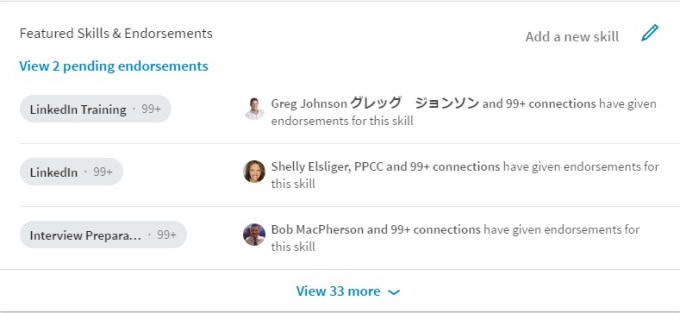
As an added insult, this section has been truncated to show only the top three skills. If visitors want to see additional skills, they must click “View more.” I fear people will only endorse their connections’ top three skills, because they will not think to…view more.

Recommendations

This section was anchored at the bottom of the old LinkedIn profile, which caused consternation for some business owners, I’m sure. Recommendations are testimonials for members who rely on them to grow their business. To me this was a lack of respect for this section.

Now Recommendations are given the same amount of respect as Skills…well, almost. Let’s say they’re given more respect now, prompting me to request and write them more than before.

Note: recommendations are listed in order in which they’re written. As well, the people who write your recommendations are not shown in the Experience or Education sections.

Accomplishments

LinkedIn has done such a great job of truncating the profile that sections some would like to relocated are hidden from the common observer. Within Accomplishments are subsections that used to be separate and rearrange-able:

  1. Certifications
  2. Projects
  3. Organizations
  4. Patents
  5. Publications
  6. Courses
  7. Honors
  8. Awards
  9. Test Scores

I know a LinkedIn member who uses Projects for highlighting a mini documentary filmed by Aljazeera America. In the video he is depicted as a New York City photographer who films models and the homeless. He used to have this section at the top of his profile; now it’s buried in Accomplishments.

Patents might be another section members would like to rearrange. Maybe not closest to the top, but within the first three-quarters. Engineers, scientists, and inventors could see these as some of their greatest accomplishment, and therefore place them below their Summary.

Courses, Honors, Test Scores all might benefit college students or recent grads. Yet, like all the sections contained withing Accomplishments, they must be discovered and chosen in order to view.

The goal of your LinkedIn profile is to highlight the most important aspects of your career. If you can’t rearrange your sections to do this, what’s the solution?

Two ways to solve the anchored section’s conundrum 

The fist solution would be making better use of your Branding Headline. Let’s return to Education. Begin by showing your value in the Branding Headline by stating that you’re a student from your university, include your major, and what you’ll offer employers.

Wrong: many college students will simply write in their Branding Headline, as an example, Student at the University of Connecticut. This uses 40 of the 120 characters you’re allowed in your Branding Headline.

Better, show your accomplishments and goals: High Honors Student at UConn | Major: Business Management | Minor: Mathematics | Aspiring Business Analyst

The second way to mitigate the problem of anchored sections is directing visitors to areas of your profile in the About section. Despite the Summary section being condensed and showing only the first three lines, it’s more important than ever to tell your story. Moreover, it’s essential that you use those two lines to highlight your greatest accomplishment.

You might indicate within the two opening lines that you worked extremely hard completing a Chemistry major while also completing four internships.

While at Tufts, I majored in Biology and completed internships in all four semesters. As a testament to my time management skills and ability to stay focused, I maintained a 3.8/4.0 GPA.

This falls well within the characters allotted for the opening two lines of your Summary statement. You will continue to tell your outstanding story about your college years, including participating in extra curriculum activities.

For professionals, you can add a line at the bottom of your About section that effectively directs visitors to a section that you want them to see. For example, I have a line in my About that reads:
⬇️ 𝗜𝗻𝘁𝗲𝗿𝗲𝘀𝘁𝗲𝗱 𝗶𝗻 𝘀𝗲𝗲𝗶𝗻𝗴 𝗺𝘆 𝗿𝗲𝗰𝗼𝗺𝗺𝗲𝗻𝗱𝗮𝘁𝗶𝗼𝗻𝘀? 𝗦𝗰𝗿𝗼𝗹𝗹 𝘁𝗼 𝗺𝘆 𝗥𝗲𝗰𝗼𝗺𝗺𝗲𝗻𝗱𝗮𝘁𝗶𝗼𝗻𝘀 𝘀𝗲𝗰𝘁𝗶𝗼𝗻 ⬇️


While the anchored sections might be a deterrent to showing the skills and accomplishments you want to closest to the top of your profile, LinkedIn has done a fine job of streamlining the profile.

No longer do we have people abusing the ability to overload their profiles with pages upon pages of extraneous information. Touche for that, LinkedIn.

If you want to learn more about LinkedIn, visit this compilation of LinkedIn posts.

What fun is that? 5 reason why you should contribute on LinkedIn

thinking

Recently I spoke to a person who uses LinkedIn on a fairly regular basis, at least four times a week he said.

When I asked him how often he updates, contributes to discussions in groups, or shares his thoughts in general; he told me never.

So naturally I asked him what he does on LinkedIn, to which he said he reads what others have to say.

So I’m trying to figure out why someone would just read what others write or would share articles written by others. What fun is that?

I’ll be the first to admit that I over contribute. I joke with my workshop attendees that I am probably the most hidden person on LinkedIn. In fact, I probably am.

Which isn’t to say I don’t read other’s updates and share articles written by others. A great deal of what I know comes from reading articles about the job search, LinkedIn, and introversion.

I am constantly trying to increase my knowledge so I can share it with my customers and colleagues. Call me an equal opportunity contributor.

Back to the person who told me he doesn’t update, contribute to groups, or share his thoughts in general. Here’s the thing: LinkedIn is a platform that encourages its members to share information.

Thus its creation of the publishing feature—yes, I’ve contributed posts on LinkedIn—which gives anyone the ability to share their words of wisdom and thoughts.

For those of you who are on the verge of contributing to LinkedIn but can’t take the plunge, here are five reasons I hope will urge you to make that leap.

It gives us a voice. Whereas some people are verbal communicators, others prefer to communicate via writing. They find comfort in being able to express their thoughts without interruption.

Updating and contributing to discussions in groups follows Parliamentary Procedure which allows one to speak, receive feedback, respond to feedback, and so forth.

LinkedIn is educational. When you write an update, contribute to a discussion, or post an article; you challenge yourself to present viable information, which means it’s best if you do a little research to back up your assertions.

Similarly you can be assured that what others write is well thought out and educational. Challenge yourself to produce updates, contribute to group discussions, and post on LinkedIn information that others will find interesting.

What you contribute isn’t done with impunity, though. On occasion I’ve been told my blog posts are utter shite, so I have to brace myself for this possibility.

When this happens my first instinct is to feel hurt, but then I think, “Hey, people are paying attention.” And that’s a good feeling.

You may want to be fairly conservative if you don’t want to be criticized harshly for your thoughts.

Contributing to LinkedIn can brand you as a thought leader. Not everything one writes is worthy of a Pulitzer. But when you contribute to a group discussion with well thought out content, or write a post that adds value; you’re positioning yourself as a thought leader.

I encourage job seekers to write articles on their area of expertise, even if they feel deflated from being out of work. They are, after all, professionals in their field.

Even asking an interesting question can demonstrate your expertise. Some of my most viewed writing are questions I pose to my connections. Make it simple, yet relative.

It’s fun. This is a matter of opinion. I find writing on LinkedIn extremely fun. For the four reasons listed above, plus an escape from the demands of daily life, as well as not having to watch mindless television.

My family doesn’t understand it until I ask my girls why they spend endless hours taking photos for Instagram. Enough said.


These are my five reasons for contributing to LinkedIn. To simply read what others write and not write stuff of my own is not my idea of fun.

I guess if I were a more understanding of people who feel shy about writing, I’d come up with five reasons why it’s cool not to update and contribute to discussions. Hey, there’s a topic for my next post.

7 ways to brand yourself on LinkedIn by being active: part 3

Now that you have a profile that brands you and you’ve started connecting with the right people, you’re two-thirds of the way to your LinkedIn goal. To wrap up your LinkedIn campaign and solidify your powerful brand, all you need to do is engage with your connections.

linkedin-alone

In this three-part series we have been looking at the components of a LinkedIn campaign that will brand you, which include:

  1. Creating a powerful profile
  2. Connecting with the right people
  3. Engaging with your connections

I’m often asked by my clients how regularly they should use LinkedIn. My inclination is to tell them, like me, use it at least two hours every day—but I know that is unreasonable for them. In fact, it borders on insanity.

So I suggest at least half an hour, four days a week. Still, their eyes glaze over and I hear some groans of protests. But I stay firm on this requirement.

Why is it important to be on LinkedIn often? Because if you want to be top of mind, you need to be present. In other words, you must consistently communicate with your connections to brand yourself successfully.

Here are six very simple ways to communicate with your connections.

1. Share Updates

Sharing Updates

This is the easiest way to communicate with your connections and brand yourself as a thought leader in the LinkedIn community. However, what you write must be carefully thought out and must add value to people’s lives.

I’m not talking about tweet-like updates (although you can share updates to Twitter) every day stating you’re looking for work. I’m talking about illuminating updates that prompt participation.

I recently shared an update about how nine out of 10 people prefer extraversion over introversion. The response was tremendous, and I continued to brand myself as an authority on introverts.

Your updates might be about what’s going on in your industry. You can provide important tips (remember, you’re still an expert in your occupation). Maybe inspirational quotes are your thing.

The new LinkedIn profile combines articles, photos, and updates into one field (see below). This is in line with LinkedIn efforts to streamline its user interface (UI) as much as possible.

2. Publish Posts (Write an article)

Writing an article

By using LinkedIn’s “Write an article” feature to share your writing with the appropriate audience, you are gaining visibility and, therefore, enhancing your brand.

Again, it’s important that your writing adds value to your connections. If it doesn’t, you’re wasting your connections’ time.

Another great way to educate your connections is by acting as a curator. A curator is a selfless LinkedIn member who shares the writing of other LinkedIn members. In addition to educating others, you are building strong relationships with your fellow writers by sharing their work.

Don’t forget to “like,” “comment,” or “share” your connections’ updates. This shows you appreciate the efforts they’ve made to contribute on LinkedIn. In my mind, it is far better to provide an intelligent comment; rather than only “liking” an article.

Even if you’re unemployed, you should take advantage of this feature. You can demonstrate your expertise of your occupation/industry, thus strengthening your brand.

3. Participate in Groups

Groups went through an overhaul more than a year ago. Some believe that this feature may have suffered from LinkedIn’s attempts to enhance it. (Not sure what I’m talking about? Read this article for an explanation of the enhancements.)

Nonetheless, it’s important to participate in conversations that are going on in your particular groups. When you participate in a group discussion, your connections will see your input streaming on their home pages.

To brand yourself effectively, be certain that the conversations you start or contribute to add value. Don’t indulge in the silly arguments that can pop up in groups.

Many recruiters are members of groups that you may also be in. They may read your contributions to the group, so make certain you write intelligent, non-negative comments. Remember, it’s about branding yourself as a capable, positive job candidate.

4. Send Direct Messages to Your Connections

LinkedIn recently made another change in the way you communicate with your connections. Now, instead of sending individual InMails, all your correspondences are grouped together in an endless stream. It takes some getting used to, but it has proven to be an effective change.

Every once in a while, you should ping your connections, letting them know how you’re doing in your job search. This is another way to stay top of mind.

Keep in mind that your messages don’t have to always be about the job search. Sometimes, it’s nice to send an informal message, commenting on something like your connection’s daughter’s soccer game, or sending a link to an article you think your connection might appreciate.

Doing the aforementioned  will brand you as a concerned connection, not one who thinks only of themselves.

5. Endorse Your Connections for Their Skills

endorsements (1)

You’ve probably read many opinions from people on the topic of endorsements – here we go again! Add me to the list of people who prefer receiving or writing thoughtful recommendations to simply clicking a button. And I’m not alone.

But in all fairness, endorsements have a purpose greater than simply showing appreciation for someone’s skills; they act as a way to touch base. In other words, they’re another way to communicate with your connections.

Don’t get click-happy when endorsing your connections. This will make you appear disingenuous and damage your brand.

6. Use the ‘Companies’ Feature

Search Groups

I saved one of the best features for last. The “companies” feature epitomizes networking on LinkedIn. It allows you to find people who are in a position to help you. It encourages you to be proactive.

In my LinkedIn, workshop I explain that the attendees should have a list of companies for which they’d like to work. It’s important to set foundations before applying for jobs at these companies. This means building a network of valuable people.

Once you’ve located the person with whom you’d like to connect, you manually connect with said person by going to their profile, clicking “connect,” and writing a personalized invite. Failing to send a personalized invite will hurt your brand; you’ll be seen as lazy.

7. Use the Jobs feature to network

Using LinkedIn’s Jobs feature to apply for jobs exclusively is not your best way to land a job because, after all, it’s a job board. (A very low percentage of job seekers are successful using job boards.) But I wouldn’t discount LinkedIn Jobs. Use it in conjunction with your networking efforts.

In many cases the person who posted the position is revealed, providing you with the option of contacting said person. You can also “meet the team,” whom you might want to reach out to. Perhaps my favorite feature of Jobs is the ability to see which of your alumni work at the companies of interest.


Engaging with your connections is the only way to stay top of mind on LinkedIn. You may have the best profile ever and 5,000 connections, but if you are not active on LinkedIn, your results will not be rewarding.

If you want to learn more about LinkedIn, visit this compilation of LinkedIn posts.