Category Archives: Career Search

3 reasons why your Articles & Activity section is important

When reviewing a client’s LinkedIn profile, I look at the typical sections: Summary, Experience, Educations, Skills, Volunteer, etc. I also look at one section of their profile that is very telling. Can you guess?
linkedin-alone

To stop the suspense, I’ll tell you. I look at their Articles & Activity section. I can tell from looking at this section whether they’ve been good or bad. More to the point, whether they’ve been engaging with their network, or simply spending very little time on LinkedIn. Below is an image of a profile of that has no Article & Activities section.

No Activity

This section lies between the Summary and Experience sections. What you see above tells you that this person has been dormant on LinkedIn. Here is a look at my Articles & Activity section.
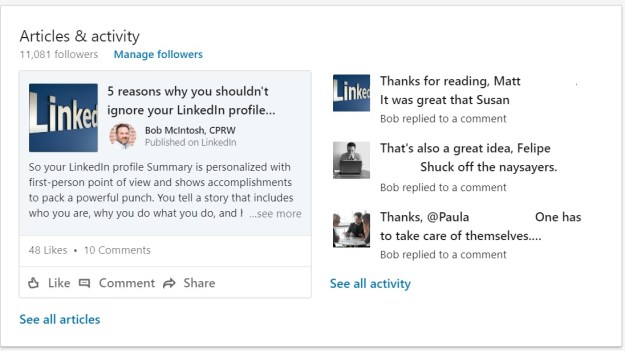
Articles and activities

Showing engagement on LinkedIn will 1) encourage potential connections to invite you to their network, 2) impress recruiters with your knowledge and expertise, and 3) show you’re better than the average LinkedIn user.

Keep visitors on your site

I am reluctant to visit and continue to read someone’s profile if I see no pulse. Am I necessarily concerned if the person doesn’t have any of their own articles to share? Not really. I realize some, or most, people don’t want to publish their original ideas.

According to one source, “only 1 million professionals have published post on LinkedIn.”

However, if I don’t at least see engagement, I know the person is not serious about LinkedIn. I’m not the only person who spends attention to my clients’ Articles & Activity section. Hiring authorities are also paying attention.

Impress recruiters with your knowledge

Close to 94% of recruiters use LinkedIn to find talent, so the more time they spend on your profile, the better. True they want to see your titles, employment history, years of employment, and education. This said, recruiters also want to see your activity because it tells them if you:

  • like or comment on articles you find of value to your network;
  • write original thoughts or ask illuminating questions;
  • share a insightful, tasteful quotes;
  • announce certifications you earned;
  • contribute to a growing discussion; or
  • post videos that are relevant to you occupation and industry.

These are merely a few examples of what a potential candidate could show as activities. I go into greater detail in a post on how to optimize your engagement on LinkedIn. I discuss the difference between being active and engaging.

For example, when you comment on someone’s post, it’s not enough to write, “Great post, Sarah. Thanks for sharing.” Instead explain why you enjoyed the post and, perhaps, politely write about what you disagreed with. In other words, put real thought into comments you share.

I strongly suggest that you write articles to share on LinkedIn, as this will show recruiters your expertise in your industry. I tell my clients that they’re still “experts” in their field. Being out of work doesn’t change that.

However, I understand the time, effort, and courage it takes to put yourself out there.

Show you’re better than most LinkedIn users

The source I cited above also claims that “an average user spends 17 minutes monthly on LinkedIn.” That’s pitiful. LinkedIn has the potential to increase your chances of getting a job significantly, but only if you put effort into your LinkedIn campaign.

This means more than optimizing your profile by filling out all selections and employing keywords. You also have to develop a focused network and engage with your connections, which will be apparent by looking at your Articles & Activity section.

You should be using LinkedIn at least four days a week, half an hour a day. Does this sound like a lot of time? Divide your day in two; spend 15 minutes in the morning and 15 minutes at night. But don’t just go to LinkedIn’s Jobs feature and look for jobs; practice some of the ways you can engage mentioned above.


Four days is the minimum amount of time I recommend to my clients. Ideally you should be using LinkedIn daily, maybe taking a day off during the week. What’s important is that your Articles & Activity section shows quality engagement, and hopefully articles that demonstrate your area of expertise.

The plight of the long-term unemployed; how to overcome it: part 2

In part one of this article, we looked at the plight of the long-term unemployed (LTU). Part two will look at five solutions for the LTU for finding work.

unemployed

Find a support system

Isolation is a symptom of long-term unemployment which is hard to overcome. One of the people who contributed to this article, Doug, described the support he received from family and friends, some friends he developed during his job search:

I am fortunate in that way. I also have a strong base of family and friends that kept me motivated. Many of these friends I never knew until I got laid off. I met them through job clubs and networking groups and consider myself lucky to have found them. They truly understood what I was going through.”

Ofer Sharone, a professor at the University of Massachusetts, created a program at MIT, which matches volunteer coaches with the LTU to provide them support and advice. One of the many benefits the members of the group receive is being with other LTU who are in the same situation.

Bob, interviewed by Sharone, stated, “When you’re let go, you get discouraged, frustrated, disappointed, feel like a failure,” but Bob explained that the support he received helped him recognize “the positive things that I’ve done in my career and has helped me see that focus, keeping me aligned with what I can offer an organization, rather than what it was that I wasn’t able to offer.”

Network

Most people understand the importance of networking, but many people are reluctant, if not terrified of doing it. For the LTU, networking outlets can lose their appeal, as the forums are attended by the same people. I’ve attended networking events as a visitor or presenter, where I’ve seen people who seem to have been there a year ago. This is not due to a lack of effort on their part. They may have been victims of the LTU stigma.

The quickest way to earn a job is by being referred to a position by someone who is known and trusted by the employer. This is easier said than done; and for someone who has been out of work for more than 27 weeks, finding people to refer them can be a tall order. It is, therefore, essential that the LTU are able to promote themselves to people who are in a position to recommend them.

David never gave up on networking the two years he was out of work. “My landing was through networking,” he said. “Someone knew someone looking for my skill set – more importantly, that someone specifically recommended me. That built up, eventually, to a full-time position that, alas, was a finite one.”

Create a powerful résumé and LinkedIn profile

While the aforementioned solutions are important, a well-crafted résumé and LinkedIn profile are paramount to avoiding the “black hole” syndrome. Foremost a résumé needs to be tailored to each position for which one applies.

Secondly, the résumé and LinkedIn profile have to express one’s value through measurable accomplishments. All too many LTU insist on listing duty statements that lack quantified results. They’re very proud of what they’ve done, but neglect to demonstrate how well they’ve performed their duties.

It’s important that the older (50 and over) LTU do not exceed 15 years of work experience on their resume for the mere fact that it ages them. The goal of the resume is to get them to the interview. Once there, they can sell the benefits they offer as older workers.

Lastly, the résumé must get past applicant tracking systems (ATS), which approximately 98% of large-sized companies are using, more than 60% of mid-sized companies employ, and some small companies are outsourcing.

Having a strong LinkedIn campaign is also a key requirement for the LTU. Some sources state that between 87-94% of recruiters use LinkedIn to find talent. Further, Approximately 40% of employers will immediately reject candidates if they don’t have a LinkedIn presence.

Perform well in interviews

As stated earlier, there is a bias against the long-term unemployed. Interviewers might be wondering why one has been out of work for six months. What’s wrong with them? Sharone acknowledges that in an interview this bias exists:

“We have age discrimination laws that reflect our belief that it is not okay for an employer to assume that just because you are 50-years-old, you’re not qualified or skilled anymore. I think the same thinking should drive policies that say we don’t think it’s a good idea for employers to make an assumption that just because you’ve been unemployed for six months, you’re not good or skilled.”

In all likelihood the LTU will be asked why they’ve been out of work for so long—many of my clients are asked this. A successful response to this question will rely on their honesty and conviction in their ability to succeed in the role they’ll be assuming. One of my clients, who had been out of work for more than two years, decided that saying she had retired was the best route to go.

Read this compilation of the stages of a successful interview.

Volunteer

As difficult as it may be to work for free, volunteering can be the best way to land a job. The reasons are simple: LTU are in a better place to network, they develop new skills, and it’s great fodder for their résumé.

What’s important when volunteering is to choose the right situation. Sure, volunteering at an animal shelter is great for the soul, but it isn’t the best place for a software engineer. A software engineer would be better off volunteering at an organization—most likely a nonprofit—where she can use and sharpen the skills she has. The best case scenario is finding a gig where one can learn new skills.

Treat yourself well

The final suggestion I have for the LTU is taking a break. Whereas some might think putting their job search in overdrive is the way to success, taking their foot of the gas pedal every once in awhile will help them maintain their sanity. My contributor, Doug, told me once when I asked how his week had gone that he took it off. My initial thought was, “The whole week?”

But it dawned on me that it was a good move on his part. The LTU can not underestimate the importance of physical and emotional wellness. Perhaps they should look at the job search more like a marathon than sprint. In the end, Doug landed a job. When it comes down to it, that’s the endgame.

This post originally appeared in Jobscan.co.

The plight of the long-term unemployed; how to overcome it: part 1

Most of the people I know have been unemployed at one point in their life. There’s a sense of despair that comes with losing one’s source of income. Perhaps more devastating is the emotional turmoil that comes with unemployment, which can include a combination of feelings, such as sadness, anger, self-doubt, fear, isolation, hopelessness, even depression.

unemployed

A special category of unemployment identifies people who’ve been out of work for 27 weeks or more. They’re referred to as long-term unemployed (LTU). The LTU experience the aforementioned symptoms at a more heightened level. I know this, because many of my clients are at this stage, some for a year or more.

According to the latest Labor of Bureau of Statistics (LBS) report, the unemployment rate in October, 2018, for individuals out of work 15-26 weeks was 14 percent of all people out of work. For individuals unemployed 27 weeks and more it was almost doubled at 22.5 percent.

But this doesn’t tell the whole story. The “real unemployment rate” or U-6 is a more accurate assessment of people who are out of work. It says that if the employment rate is 4%, for instance, the accurate amount of people out of work is more than double that. People who are no longer receiving unemployment benefits are counted among the U-6 rate, among others.

Struggles of the long-term unemployed

Ofer Sharone is a professor at the University of Massachusetts, Amherst. His research focuses on career transitions, work and unemployment. He is also the founder of the Institute of Career Transition (ICT) at the Sloan School of Management, MIT, which focuses on helping individuals traverse the road of long-term unemployment.

Sharone conducted interviews of the LTU. Following are the concerns of the people Sharone interviewed.

One person Sharone interviewed, Arnold, described the job search as a black hole, where he would send his applications to employers and never hear from them. This is not uncommon with the LTU who want to hear something from employers, even if it’s a rejection.

Sharone explains, “This void leaves it up to job seekers to interpret the reasons for their labor market difficulties, which frequently results in highly individualized accounts.”

Deborah talked about the loss of identity: “. . . This is a fairly major yardstick that we all put against ourselves, our employment. We define ourselves partly by what we do. Right now I’ve had the rug pulled out from under me in terms of how I identify myself…”

Most people who lose their job feel embarrassed, humiliated, and ashamed as Ruth, stated: “I don’t want to contact people, my friends. I’m embarrassed. I’m humiliated. I feel like a loser. And I don’t want to call anyone, I just don’t want to talk to anybody.”

In writing this post, I reached out to six people, asking them to describe their experience of being unemployed for longer than a year. Two people responded. I imagined the other four people didn’t respond because they didn’t want to relive their experience, not because they didn’t have the time.

One person who contributed, Doug, expressed: “I get my strength and rejuvenation from helping others. During this period [of unemployment], I was the one that needed help and support.  It was new to me and hard to accept. I would be lying if I said I never got down or discouraged. You don’t necessarily want a ‘pity party,’ but sometimes you just want to be left alone to let your thoughts and emotions marinate.”

Another person, David, wrote: If I can capture my feelings in simple words they would be despair, desperation, and disbelief. Despair at having to draw down savings and even my 401K to survive. Desperation at watching my retirement vanish. And disbelief that a skilled person with years of experience and strong accomplishments was passed over time and again.”

Many believe there is a correlation between age and long-term unemployment. David wrote: “I suspect ageism played a role, as did the bias many hiring managers have for people who are out of work. Despite the deep crash starting in 2007, too many employers still believe that if you have no job, especially if you’ve not had one for a while, there must be something wrong with you.” I believe David is correct on all counts.


Next read about solutions on how to overcome long-term unemployment.

This post originally appeared on Jobscan’s blog.

5 ways on LinkedIn to let employers know you’re unemployed

This post is written in response to a growing discussion on LinkedIn. 

I get the question all the time in my LinkedIn workshops: “What’s the best way to let employers know I’m looking for work?” My answer has been somewhat noncommittal, but some of my clients want potential employer to know their status.

question-mark-jpg3

Here are five options, none of which are entirely optimal.

  • Leave your most recent employer as current for a short period of time.
  • Create your own “company.”
  • End the tenure at your previous employer and address this in your Headline.
  • End the tenure at your previous employer and explain your story in your Summary.
  • List volunteer experience in the experience section.

There are problems with each tactic. After all, being out of work is … being out of work. And some ignorant employers still prefer to hire passive job seekers over job seekers who are actively looking for employment.

No matter how you spin it, employers will know the story. Let’s look at the potential solutions from worse to best:


Leave the employment date or…

5. Leave your previous position open

Of course, indicating you’re still employed when you’ve been laid off, let go, or have quit is dishonest. When job seekers ask me if they should do this, I tell them that, ideally, they should end their employment at a company a day after they lose their job.

That being said, pretending you’re still working for no more than three months is somewhat acceptable. Herein lies the problem: when a recruiter asks if you’re still at the company, you have to make up some story about how you haven’t gotten around to closing out the job. You’ll have to do some fancy dancing, and this may end the conversation immediately.

One could argue that at least you’ll have the opportunity to have a conversation with a recruiter or hiring manager. And that recruiter or manager might buy your tale.

4. Create your own ‘company’

While it is important to maintain All Star status and, thus, get more visits to your profile, you need to do so with style and a value add. I’ve seen profiles with “Unemployed” as the company name. How much value does this add to a person’s profile? None.

My colleague, Laura-Smith Proulx describes a solution in a post she wrote for www.job-hunt.org that let’s employers know you’re unemployed, while also demonstrating your value to employers. As she explains, “no current experience is a competitive disadvantage.”

A company name for Plant Engineer Supervisor would simply be: Plant Engineer Supervisor. This would show as current experience. The job title would be: Plant Engineer Supervisor Pursuing Opportunities in Manufacturing.

The description of said job needs to show your value. Laura provides a great description for the Plant Engineer Supervisor: “I offer a broad operations background, including Lean Six Sigma, team management, production supervision, and plant engineering skills.” You might also include a quote from a supervisor to demonstrate your expertise.


End the employment date

3. Tell employers in your Headline

Obviously, the worst thing you can write in your Headline is only “Unemployed,” “Seeking Next Opportunity,” or “Actively Looking for a Project Manager Position.” Any of these statements alone fail to express your value. Sure, they tell employers about your situation, but that’s about it.

Instead, show your value to the employer right out of the box: I will increase your production flow 85% by utilizing Lean Six Sigma, Manufacturing experience, and proven leadership” 

Keep in mind that space in your Headline is limited.  You’re allowed 120 characters, so make the best use of it. The example above is 119 characters. Whew.

2. Tell your story in your Summary

Whether you want to inform people of your situation immediately, in the middle, or at the end, you need to be positive about your situation. Potential employers won’t be concerned about how you lost your job as much as they will about what you can do for them.

Writing the following sets a positive tone, “After three years of an exciting stint in IT in my previous company, I’m ready to take on new challenges. Read my profile on how I can help your company’s IT needs….” Of course your LinkedIn profile must be strong and support your desired occupation.


Doing actual work: volunteering, that is

1. The best way to cover the employment gap – volunteering in your field

A Forbes article suggests including volunteer work in the Experience section. I tend to agree. I can hear the critics bemoaning this practice—after all, it’s not paid employment! While this is true, volunteer work is exactly that—work. In some cases, you may even work harder than you would in paid employment.

If you are going to include volunteer work in your LinkedIn Experience section, be sure to make a note of it by writing “Volunteer Work” next to the position. Do not mislead potential employers into thinking it is paid employment. (Some pundits don’t believe indicating that it’s volunteer experience is necessary.)

The volunteer work you list should be substantial and relevant. For example, if you’re a web developer, spending 20 hours a week developing a nonprofit’s website is a great way to showcase your existing skills and the new ones you may be learning.

Another thing to note: You can include recommendations with your volunteer experience, but only if you list it in the Experience section of the profile. If you leave your volunteer work in the volunteer section, people will be precluded from sharing recommendations.


Then there’s LinkedIn’s Career Interests feature

For job seekers who are being pursued by recruiters who have access to LinkedIn’s recruiter premium account, this features allows them to see who is currently looking for work, whether employed or unemployed.


So, is it necessary to point out your unemployment status or falsify information on LinkedIn? Probably not. Covering an employment gap with volunteer experience is the best method, in my mind.

Which brings us to the topic of volunteering. I’ll save that for another post.

A version of this post originally appeared in recruiter.com.

Photo: Flickr, Tom Waterhouse

It’s okay to connect with strangers on LinkedIn

“That’s weird. I can’t connect with strangers,” my daughter said. “Look, I’m at a coffee shop. I gotta go.” And then there was phone silence.

Networking2

This is three days after she made me proud by joining LinkedIn; I imagine because her career advisor suggested she should. So, more than a post addressed at my daughter; I’m reaching out to the college career advisor who suggested my daughter join LinkedIn.

First, I need to say, “Thank you very much.” And, second, you also should tell my daughter that it’s okay to connect with strangers on LinkedIn. It’s not “weird.”

Let me amend this statement. It’s okay to connect with the right strangers.

I get the same skepticism—which my daughter conveyed—from my older clients, but in different words. They tell me they feel “uncomfortable” asking people to join their paltry network of 80 LinkedIn members.

The short answer I give them is the idea of being on LinkedIn is to develop a network and to use it to gain assistance, as well as help others.

Then they’ll ask me, in effect, why anyone would want to connect with them. To answer their question, I explain that the power of LinkedIn is joining like-minded people. Regardless of the employment situation, my clients are still part of the workforce.

Still reluctant to connect with LinkedIn members?

I tell my clients that they should imagine themselves at an in-person networking event. They’re there because they want to meet people who can provide advice and, perhaps, information that could lead to their next gig.

Then I say there are two scenarios. The first is that they speak to as many people they feel comfortable with. They have a great time getting to know these people; it’s liberating. They’ll develop relationships with some of them; with others they won’t.

The second scenario is somewhat different. Instead of deciding to meet new people, they stand in a corner of the room and wait for people to approach them. As well, they put their heads down avoiding making eye contact. They will not develop relationships with any of them.

There are rules, though

1. Chose the right people to connect with

This is one of the rules I preach often. Know who your students will benefit from, and how they can help their new connections. Stress it’s a two-way street.

The first people your students should invite to their network are their classmates, people who are studying the same major. Engineering majors connect with engineering majors, English Lit. majors connect with English Lit. majors and so on.

Next they should connect with other majors. Bio Chemistry majors can connect with Physic majors. Psychology majors may want to be really crazy and connect with Math majors.

Next connect with students at other schools. Tell them to send invites to students at local schools, at first. There are many schools in the Boston area, so an Early Childhood Education major could connect with the like at other universities in the area.

The huge victories are connecting with the alumni of their school. These are the people who are able to help your students when they graduate from university. A business major needs to reach out to higher level employed alumni, announcing themselves as college students who would like to join their network. The best LinkedIn tool for finding alumni is “See Alumni.

This tool allows students to search for their classmates and alumni by these classifications:

  • What they are skilled at
  • What they studied
  • What they do
  • Where they work
  • Where they live

2. Know how invite LinkedIn users to their network

Students can’t just click the connect button on the profile of the intended connection, and then hit “Send Now.” Instead they must send a personalized invite. Many students probably wonder what they should write in their invite.

Have them write a generic message or two or three that fit the situation. Here are a few they can store on their desktop and modify to fit the situation.


To classmates

Hi (name). I’ve just joined LinkedIn and because we’re in the same major, would like to add you to my network. Perhaps we can learn from each other how to navigate this valuable platform.

(Student’s name)


To professors

Dear (Professor’s name)

I enjoy/ed your class and learned a great deal about (topic). I hope you don’t find this too bold, but I would like to connect with you on LinkedIn so we can stay in touch with each other. By the way, I encourage my classmates to take your class. That’s how much I enjoy/ed it.

(Student’s name)


To alumni

Dear (Name)

I’m a student at (school) and am starting to build my network. I see that you studied the same topic that I did. One of my objectives is to create focused online relationships. I understand how busy you must be. It would be great to connect and help each other when the time arises.

By the way, you and my mother worked at Dell at the same time. She’s working at IBM now.

(Student name)

3. Follow up with their new connections

What separates people who know how to use LinkedIn and those who don’t is following up with their connections. Students can’t simply invite someone to their network and leave it at that. After sending the proper invite, and being accepted, students should send a short note thanking their new connection for accepting their invite. This can facilitate more conversation.

I warn against accepting any invitation. If a student gets the “weird” feeling, it is not an invite to accept. I haven’t discussed this step with my daughter yet, but I’ll make sure that the stranger and she have a commonality, such as they are studying the same major, or have the same career goal, or simply attend the same school.


Really our jobs are not much different, dear college career advisor. We both have to help our clients get over the “weird” feeling of connecting with strangers. Tell them that other LinkedIn members are on the platform to meet people like our clients. Also tell them they should reach out to like-minded people, and that there are rules. College students understand rules.

Is the résumé Summary statement dead? What experts say

Once a staple of the job search, the résumé Summary statement may be on its way out — or perhaps it’s already dead. There are two camps; one that believes the Summary is alive and kicking, another that feels it’s run its course.

tombsones

I’ve read many résumés that contain a Summarys that is full of fluff and, in effect, says nothing at all. I’ve spoken to many recruiters and hiring managers who have told me they don’t even read Summaries when they come across them.

Recently, I posed a question about résumé Summaries to my LinkedIn followers—and I received a lot of responses.

Executive resume writer Adrienne Tom is one of the respondents—the others are listed below. Adrienne said she often considers leaving the Summaries off the résumés she writes.

“I think a lot of professionals feel compelled to share a Summary which then comes out forced, with generic word choices,” Tom wrote. “Instead, a better strategy is to focus on value points. Share with the reader the ‘hows and whys’ (provide the proof), and word selection won’t matter as much.”

So, is the Summary just wasted real estate now? Once a vital résumé component, I fear is gradually losing the foothold it once held. It may soon be excluded from résumés altogether, simply because the people who read résumés don’t have the time for Summaries.

I hope I’m wrong, because I do think Summaries can be quite powerful. Consider this summary statement:

Information Systems Department Director specializing in new project planning and achieving business objectives. Budget hundreds of thousands of dollars in project resources. Lead efforts that consistently generate sales exceeding $15K in a competitive pharmaceutical market.

Does this Summary say enough? It illustrates the candidate’s value with quantified results and should generate interest in the reader. It’s brief, and there’s no fluff.

But not all of my esteemed colleagues agree that Summaries add value. As mentioned above, I recently asked professional résumé writers and recruiters whether they thought the Summary is dead. Here’s what a few of them wrote:

“I have my candidates compose what I like to call a ‘career highlights’ section: just a bullet-pointed section of some actual career accomplishments. It catches the potential employer’s attention immediately. I feel objectives/summaries are just antiquated in a job market that is currently flooded with candidates.” — Adrienne Roberts, Branch Manager, Robert Half

“Are they on their way out? No — they have already left. Most hiring professionals will tell you that the summary, at least in the US, is an ignored piece of fluff, better left off to make room for the information they need/want to know.” — Sarah Douglas, G.C.D.F

“I feel that summary statements are still an essential component of a résumé. However, I am looking for qualifications and hard data, not fluff about perceived skills. If you can quickly read about relevant experience, results achieved, number of direct reports, and so on, then the soft skills can be explored further in the interview.” — Judy Hojel, CEO, People and Performance Training Pty, LTD.

“No, a well-written summary statement is a must on any resume. It brings together the many details of your achievements and education to focus the employer on exactly how you fit the job position. It gives one a big-picture view, with the detail to follow [in the rest of the resume].” —  Jay Barrett, Human Resources Executive

“A poorly written, anemic summary section (especially one that is basically just a string of keywords) does nothing to differentiate the job seeker. Such prime real estate gives a candidate the opportunity to concisely lay out their good-fit qualities, qualifications, and ability to meet specific needs of that specific employer. A well-written, targeted summary will stand on its own on the résumé. As well, it piques interest, and compels the reader to continue reading down the page.” — Meg Guiseppi, Executive Resume Master

As you can see, opinions vary on whether the summary statement is on its way out. I, for one, hope it remains a vital resume component — but I also agree with Adrienne Tom. The summary must provide proof of one’s greatness. Otherwise, there’s no use in having one.

What do you think? I’d love to read your comments.

This post originally appeared in Recruiter.com.

Photo: Flickr, aninwardspiral

The sport of the job search: 3 types of job seekers

This past summer I saw my son’s basketball team lose a close playoff game. I noticed a mixture of emotions. Some of the players, including my son, played hard until the final whistle blew. Others gave up the game when the other team began to dominate. And some demonstrated a downright negative attitude, including fouling out of frustration.

basketball hoop

The team could have won if they had more confidence and stayed the course. But they didn’t stay the course and unite as one. It was interesting to see the clear distinction of attitudes between the players. I witness the same attitudes in some job seekers.

Some job seekers don’t give up

These are the people who are a pleasure to assist. They wear a smile on their face, despite how they’re feeling inside. They don’t hear back from employers after working hours on their résumé and cover letter. They make it through three rounds of interviews only to lose out in the end to someone who was a “better fit.” Despite this, they trudge on.

One job seeker I helped, when I started delivering workshops, would ping me on his progress. “Bob, I had a great interview today. I have a few coming up this week. Ciao.” Then, “Hola, didn’t make the final cut. Better luck with the next interviews.”

When he finally landed, I asked him how he felt during his job search. Not surprisingly he told me there were times when he felt despair and wondered if he would ever land a job.

He was so grateful for the services I and others offered him at the career center that he speaks to our networking group when I ask him. He also let’s us know when there are openings at the company for which he works. This is the true nature of networking.

Some job seekers throw in the towel

It shows on their face. They say they’ll never land a position. They lose sight of the bigger picture. Like my son’s teammates during the game, they walk through their job search rather than run. Their despondency is understandable, but they don’t see it hurting their chances of landing.

They lose confidence. They make excuses like, “It’s my age.” I’m not naive enough to believe that ageism doesn’t exist; however, I believe if you adopt that attitude immediately, you’ve already lost the game. Hopelessness settles in.

When employers see your lack of confidence, they wonder if you’ll demonstrate confidence on the job. Similarly when people with whom you network see your lack of confidence, they’ll wonder if they should back you as a reference.

This was not the case when I recently acted as a reference for a woman who had been out of work for more than two years. I loved her “can do” attitude so was glad to speak to her personality. She landed a job based on her rich experience and, I’m sure, her attitude.

Some job seekers let their anger show

As soon as I saw my son’s teammates get angry, I knew “that’s all she wrote.” There was no chance they could regain their composure. The other team noticed this, and I’m sure it boosted their confidence. I wondered if I were coaching if I could reign them in. I concluded I couldn’t. It was in their personality makeup.

I see anger in few of my clients. It may be a workshop or during a one-on-one appointment. When I see their anger, I’ll tell them their anger is written on their face. They’ll deny being angry, but it’s so apparent that there’s no denying it.

I understand they are angry; I was angry at times during my job search. However, I tried hard not to let it show in public. Public anger might be witnessed by people who have the authority to hire you or know someone who has the authority to hire you.

Job seekers who let their anger show don’t think others notice it. After one workshop a recruiter who was between jobs approached me and said, “You know, I’ll eventually find a job in recruiting, and I’m going to remember the people in this workshop who are angry. They’re not the ones I’d present to my client.”


The job search is like sports. Moreover, how you handle yourself during this time of transition can be more important than your technical expertise. Don’t give up and don’t show your anger; your job search will be longer if you do either or both.

This post originally appeared in Recruiter.com.

Photo: Flickr, Sar_Proc_

Apply for some jobs already! 5 reasons why you’re not applying.

And what you should do about it!

It’s called paralysis by analysis. I’m sure you’ve heard of it, or even suffered from it. I have. Suffered from it, that is. This is when you’re caught up more in the process than achieving the goal. No, this is different than procrastination. This is the inability to act.

Man from recruiter

I see it in the resource room of the career center for which I work. A person sits down in the morning; opens their résumé on a computer to revise it; and when I walk by at the end of the day they’re still revising the same résumé, their eyes bloodshot. I ask nicely, “Are you applying for jobs?”

“Not yet,” he replies. “I’m waiting until my résumé is perfect.”

“You’ve been here all day working on the same résumé.”

“I want it to be perfect.”

One time I must have been heard throughout the career center as I raised my voice at one person, “Apply for some jobs already.” I was being playful, but I also meant it.

Another person is doing such a great job of networking. He is meeting people for coffee or lunch, going to networking events and buddy groups. This has been going on for weeks. I ask him where he’s applied.

“I want to make sure I apply to the right companies,” he says. “I’m trying to get a sense of their culture.”

“Great,” I reply. “But you need to start applying. Apply on line.” And I hate saying this, because to me applying online is equivalent to throwing chumline in the ocean and waiting for fish to surface.

These are but a few examples. It could be trying to make their LinkedIn profile perfect before sending invites to people, asking for recommendations, or engaging with their network. Anything less than perfect is unacceptable.

Are you suffering from paralysis by analysis? Here are a few reasons why you might be, as well as some advice on how to move forward:

You’re shell shocked

Losing a job is a terrible blow to your psyche, even if you weren’t to blame. Additionally you’re wondering how you’re going to pay the bills. What will working again be like, you wonder? It might be 15 years since you last engaged in the job search. A lot has changed since then. This is a scary prospect.

What to do

I’m not going to say, “Get over it.” But I am going to say, “Take some time—a week or two—to realize that the more you’re out of work, the longer it will take to find employment. Understand that:

  • this is temporary,
  • it happens to many people,
  • it’s natural to feel despondent,
  • there is help from your One-Stop career center and a therapist, if necessary.

Writing résumés has changed over the past 15 years

The way résumés are written has changed. Recruiters want to see accomplishment statements, with quantified results. The applicant tracking  system might not have been used by organizations, as well.

What to do

Don’t be obsessed with writing your résumé; however, make sure it meets the following criteria:

  • shows value with accomplishments,
  • is tailored to each position,
  • is readable with short paragraphs and plenty of white space,
  • doesn’t exceed 15 years of work history,
  • finds itself in the hands of the hiring manager, as much as possible.

Networking is key

Most companies want you to apply online or go through recruiters and staffing agencies, but you’re more likely to get better results by getting your resume in the hands of the hiring manager directly. Most companies prefer to hire job seekers through referrals from people they know and trust.

What to do

Despite what most people think, networking events aren’t the only activities that constitute networking. Look at networking as connecting with people everywhere. Your neighbors, relatives, friends, store owners, dentists — essentially everyone can be a valuable networking connection. Make sure to reach out to former colleagues and supervisors who can act as references. Don’t be afraid to ask for help.

Social media plays a large role in the hiring process

In today’s job market, you have to be cognizant of your social media image. According to a 2014 survey, 94 percent recruiters look for and vet talent on LinkedIn. Four years later, the number may be even higher. Employers are also checking you out on Facebook and Twitter to dig up any dirt that may disqualify you from the running.

What to do

First of all, LinkedIn will not land you a job by itself. It is a supplement to your face-to-face networking events. However, it can be very helpful if used properly. Like your résumé, don’t dwell on trying to make it perfect. There are two other components that make your LinkedIn campaign a success—growing your network and engaging with your connections.

The interview process is longer

You might have to endure as many as five telephone interviews before multiple face-to-face interviews. The types of interviews you will participate in could vary, including Skype, Zoom, group, and, of course, one-on-one.

What to do

Go with the flow. It’s a known fact that employers dread hiring the wrong person because it’s costly and embarrassing. It may seem like they’re looking for the purple squirrel, so be patient and persistent. Most importantly, don’t put all your eggs in one basket. Some job seeker tell me they’re only applying to a couple of companies, because they’re the ones. Apply to the right companies, but have a list of at least 10 companies for which you’d like to work.


If my clients think I want them to scatter their résumés around the state, they’re wrong. All I’m asking is that they don’t spend more time doing nothing than doing something. Yes, they should recover from their trauma…or fake it til they make it. They need to connect with people in their community. The interview process, and the methods employers are using, is taking longer.

One thing we all an say for certain is paralysis by analysis is real and detrimental to your job search.

Photo: recruiter.com

__________________________________________________________________________

Bob McIntosh, CPRW, is a career trainer who leads more than 17 job search workshops at an urban career center, as well as critiques LinkedIn profiles and conducts mock interviews. Job seekers and staff look to him for advice on the job search. In addition, Bob has gained a reputation as a LinkedIn authority in the community. Bob’s greatest pleasure is helping people find rewarding careers in a competitive job market. For enjoyment, he blogs at Things Career Related. Follow Bob on Twitter and connect with him on LinkedIn.


45 Résumé words that need to be made extinct

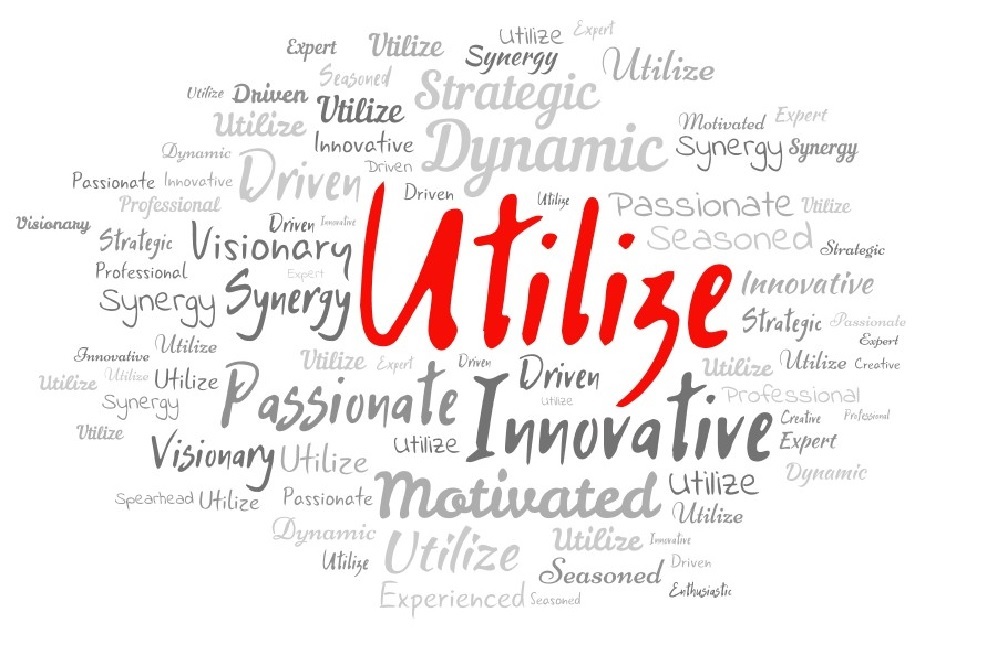
Attention job seekers: there are some words you should not include on your résumé. They are overused, clichés, plain ole fluff. One of the biggest offenders in my mind is “dynamic.” Before you type such words, ask yourself, “Does ‘dynamic’ show what I’ve accomplished, or does it simply say I’m dynamic, without proving it?” See what I mean?

Wordcloud

What’s the big deal with fluff words, you might ask? To illustrate, read this sentence: “Dynamic, results-oriented, innovative professional with vision and leadership abilities required to deliver projects on time and under budget.” Five words (one hyphenated) and a phrase that are considered fluff.

I’m not the only one who cringes at fluff words. The belief among most executive résumé writers I know is that job seekers need to eliminate overused adjectives and replace them with strong action verbs. (However, there are even action verbs out there that are considered fluff, such as “spearhead.”)

The problem with fluff words is that they’re meaningless; employers are tired of seeing them on the hundreds or thousands of résumés they read. Job seekers who write them on their résumés might believe they possess these traits or skills, but what they must do is show, rather than tell.

It all began with “utilize”

What prompted this post? Donna Svei, Executive Résumé Writer started a major discussion with a post she wrote on LinkedIn. She asked, “What’s your least favorite RESUME WORD or PHRASE? The one you’d like to see made extinct?” The driving force behind her LinkedIn post was her disdain for the word “utilize.”

At this writing there are 206 comments. Which means résumé pundits and people who happened across this post feel very strongly about this red-hot topic. From Donna’s LinkedIn post, many fluff words emerged. Here they are in alphabetical order, as well as the number of times they were listed in the post.

Best of Breed

Bottom Line

Capable

Catalysis

Championed

Change agent

Creative (3)

Dedicated

Detail oriented (3)

Driven (2)

Duties included

Dynamic (3)

Enthusiastic

Excellent communication skills

Experienced

Expert (3)

Extensive experience (2)

Go-Getter (2)

Think Outside of the Box (2)

Go-To Person (3)

Hard Worker (3)

Innovative

Motivated (2)

Organizational (2)

Out of the box thinker

Passionate (3)

Professional

Proven track record

Responsible (3)

Result driven (3)

Seasoned

Self-Motivated (2)

Spearhead

Strategic (3)

Strategic Thinker (2)

Superior

Synergy (3)

Talented

Team player (4)

Thought leader

Thought Leadership

Track record (2)

Utilize

Value Add (2)

Visionary (2)

World class

LinkedIn and resume yield similar results

Awhile back in 2015, LinkedIn came out with 10 of its outlawed words. All the words it listed are included in the list above. Alison Doyle wrote an article that includes some of the fluff words in Donna’s list.

This is a hot topic. Glassdoor.com, BusinessInsider.com, TheMuse.com, Monster.com, CareerBuilder.com and a whole slew of other blogs have weighed in on words that should not be included on a résumé.

When using fluff words is unavoidable

If you’ve had the pleasure of applying for positions which were advertised with poorly written job descriptions, you noticed some of the aforementioned words in those descriptions. You’ve probably been warned by professional résumé writers to avoid using such words on your résumé.

Therein lies the rub. If you are applying to companies that use an application tracking system (ATS). One of the golden rules of writing an ATS-friendly résumé is including keywords found in job descriptions.

The question I ask my clients is, “Do you want to take the high road and write a great résumé, or do you want to play the ATS game?” Their response is somewhat ambivalent.

Jon Shields, a content manager and writer for Jobscan.co, states in an article that most job descriptions are poorly written:

The people tasked with writing job listings aren’t typically experts in the field. It’s not their fault– HR professionals can’t be expected to have encyclopedic knowledge of every new role in the company and how it will interact with existing positions.

In addition to job posts neglecting to include key skills, they also are full of fluff words. Take an excerpt of a job post for a marketing manager:

  • Excellent written and verbal communication skills.
  • Detail-oriented and process-driven.

“Excellent written and verbal communication skills” is a phrase that is as overused as an old shoe. Similarly, “detail-oriented” and “process-driven” are huge offenders. If this phrase and fluff words are not used on a résumé, it could result in being disqualified by the ATS.


What’s the answer? Take these words that should be made extinct with a “grain of salt” and try to “straddle the fence.” In other words, don’t feel guilty if your résumé contains a select few fluff words. Just as long as they aren’t “dynamic,” “innovative,” “detail-oriented….” Need I go on?

Are there any other words you consider to be “fluff”? Please list them in the comment area.

Visit Donna Svei at AvidCareerist, where you can learn about her services and take a peek at some great résumé examples.

The Ultimate LinkedIn Guide, Engaging on LinkedIn: Part 3

In part two of this series, we looked at how to optimize your LinkedIn network. This post will address how to engage with the connections within your network in various ways. When I explain this concept to my clients, I tell them that they can have a stellar profile and large network, but if they don’t engage their connections, it’s like they don’t exist.

linkedin-alone

Being Active Vs. Being Engaged

First let’s talk about the distinction between “active” and ”engage.” It’s possible to be active on LinkedIn, while not being engaged. When you’re active, you’re simply there and not making an impact. Whereas when you’re engaged, you’re truly communicating with your connections.

Let’s first look at examples of being active, followed by being engaged. Think about what you’re doing and if you need to change how you interact with your connections.

Being Active

Liking What Your Connections Post

There’s not much you can say about simply liking what your connections post, other than your connections might appreciate the number of Likes they receive. Then they’ll wonder, “What did Bob think of what I wrote?” This is the ultimate example of simply being active.

Sharing What Your Connections Post

Similar to liking what someone posts, simply sharing a post is clicking the Share button. Again, people will be grateful that you shared their post or article, but couldn’t you do more? “I’m glad Bob shared my article,” they will think. “But why did he share it? What did he think of it?”

Posting a Picture and Sharing a Quote

Posting a picture is nice. It adds color to peoples’ homepage feed. They may pause to look at it. A picture says a thousand words, right? Wrong. You want to explain why you’re sharing the picture, not have people guess. The same goes for sharing a quote without an explanation as to why you shared it.

Writing Brief Comments

Writing comments to what your connections post is a step toward the right direction, but your comments should be meaningful. For example, “Great article, Susan,” is not very meaningful. It is similar to Liking what someone posts.

One excuse I’ve heard from my clients is that it’s difficult to write a lengthy comment with their smartphone. My reply is wait until you’re in front of a computer, if that’s the case.

Asking a Question and Not Responding to Answers

Asking questions is fine; I do it all the time. However, just letting the responses you receive sit is disrespectful to the people who provided the answers. Make sure you ask meaningful questions, though.

Endorsing Connections for Their Skills

This doesn’t constitute engagement. You are simply clicking on your connections’ skills. Further, you might not have seen them perform the skills for which you’ve endorsed. My opinion of endorsements is well known by my clients. The opposite of endorsements are recommendations (discussed below).

Engagement

Writing Comments that are Meaningful

The opposite of writing a brief, meaningless comment is putting thought into what you write. The best way I can illustrate this is by sharing one I wrote for this article:

“Great post, @Susan Brandt. Your statement about a company lacking a social media campaign being akin to living in the dark ages really resonated with me. Facebook, Twitter, LinkedIn, Instagram, and other platforms can create that ‘like, know, and trust’ relationship between the company and its’ customers. You’re also correct in stating that all platforms should be connected, as well as linked to and from the company’s website.”

Note: always remember to tag a person with @name so they will be notified in LinkedIn’s Notifications. I was scolded once for not doing this.

Sharing Original Updates

To stay top of mind, your shared updates must show engagement. LinkedIn encourages you to share an article, video, photo, or idea. Take the opportunity to engage with your connections by providing valuable content that elicits responses. A sign that you’ve succeeded would be the number of Likes and, more importantly, Comments you receive.

Note: Many LinkedIn pundits suggest keeping your status updates to one or two a day. I blatantly break this rule.

Responding to What Others Write about Your Updates

One type of update I find successful is asking an illuminating question. If you’re going to do this, be diligent in replying to your connections’ and followers’ responses. Failing to reply to your connections who answer your question does not demonstrate engagement. I am impressed with people who take the time to answer every reply they receive. I try to reply to all the feedback but, alas, I am only human.

Sharing Your Connections’ Articles AND Commenting

Unlike the aforementioned example of simply sharing someone’s article, you will go a step further and share a short synopsis of the message it delivers. This says, “I’ve taken the time to read the article, understand its meaning, and will elaborate on it for the benefit of the readers.” To be a curator is the true definition of networking.

Writing and Sharing your Articles

Writing an article with unique and fresh content takes engagement; it shows you’ve considered what your audience would benefit from. My primary audiences are job seekers and career coaches, so I write articles focusing on the job search and using LinkedIn in the job search. You can write an article on the LinkedIn platform or share one from a blog, such as this one.

Note: refrain from only sharing your own articles. This gives off the sense of superiority.

I include creating and sharing videos under engagement. This is a fairly new concept—probably a year old by now—but it’s catching hold among LinkedIn members. If you are going to share videos, make sure you’re consistent and produce videos your connections will appreciate.

Sending direct messages

Sending individual messages to your connections is the most obvious form of engagement. This is where relationships are cemented, or not, depending on the interaction you have with said person. I received from a client a question about sending mass messages. This is not considered proper policy; but if you need to reach many people at once, you are allowed to message 50 people at a time.

Writing Recommendations for Your Connections

Unlike endorsing your connections for their skills, writing recommendations take thought and time. To write a recommendation requires having supervised a connection or witnessed them as a colleague, partner, or vendor. This is a true form of engagement, but isn’t getting the respect it deserves. Listen to my interview on The Voice of the Job Seeker podcast.

Following Up with Your Connections

To truly show engagement, you must follow up with your connections. I have developed many relationships by reaching out to my connections via telephone, if they live a distance away. If they live closer, I’ll meet them for coffee. One of my connections and I had been exchanging discussions via LinkedIn. Yesterday we had our first phone conversation. Although we will not do business together, it was great finally “meeting” her on the phone.


Perhaps the most difficult part of a successful LinkedIn campaign is engaging with your LinkedIn connections. To do so requires you to extend yourself; perhaps reach outside your comfort zone. One of my clients told me, “I don’t know what to write.” I told her to write what she feels.

If you enjoyed this post and want to share it, please explain why you shared it.