Tag Archives: Networking

7 wasted networking opportunities that hurt your chances

At formal networking events there’s usually a “needs and leads” session, where participants can mention companies in which they’re interested. They ask if their fellow networkers know anyone at those companies. That’s the needs part.

Men Networking

The leads part is when their fellow networkers shout out the names of people they know at said companies. Or they say that they’ll talk with the person, who has needs, at the end of the networking event. This brings me to the first missed opportunity.

Not asking for leads

At a recent networking event I was leading at our career center, I asked if anyone had any needs and leads. This was after our guest speaker had finished her presentation. No sooner had I made the announcement, many people rose from their chairs and headed for the door.

For those who remained, I told them this was their chance to ask for leads. A few of them mentioned companies in which they were interested. And a few of the attendees offered some leads.

This is a classic example of job seekers who don’t know the companies in which they’re interested. They haven’t done their research, haven’t created a list of 10 or 15 companies they’re targeting. Or maybe they’re afraid to ask for help. In either case, this is a missed opportunity.

Not approaching the guest speaker

I mentioned we had a guest speaker. If the guest speaker is someone who works for a company on your target list, you must wait around at the end of the event to grab a few minutes of their time. Let’s call this Company X.

Make your intentions clear that you’re very interested in Company X and the role you’re seeking. The speaker might not know if Company X has an opening or plans to hire someone for your position, but that’s okay.

Kindly ask if you can leave your resume or, better yet, personal business card with them for future consideration. Ask for their company business card, as well. And don’t forget to ask if you can connect with them on LinkedIn.

If all of this seems too forward, keep in mind that people who attend networking events, participants or speakers, know the purpose of the event—to network. How you deliver the ask is important. You must come across as polite and sound as if you don’t expect anything.

Not approaching people with whom you should speak

Research the people who will be attending. If possible, find out if there will be contacts or potential contacts at the event. You might want to arrange to meet people of interest at the event. As well, you can inquire from the coordinator of the event who will be at the event. This is particularly a smart move for people who are uncomfortable going to networking events.

The events I lead at our career center always begin with people delivering their 30-second elevator pitch. This is the time when you write down each person’s occupation, so you can approach them near the end of the networking event.

Here are some other tips:

  1. Make sure you’re wearing a name tag for easy recognition.
  2. Approach the people with whom you want to speak in a friendly manner.
  3. Be prepared to provide information or leads for them.
  4. Be willing to deliver your ask…politely

Not including other networkers in a group conversation

I see this all the time. A group of networkers excluding others from their group. I find it incredibly rude and a possible missed opportunity. For example, at one of my networking events I see a group of people having a lively conversation. I know that one of them might be interested in a position we’re trying to fill at our career center.

I wait patiently. I try to make eye contact with one of them. Still waiting I get no love. I walk away and move on to an individual who is standing alone and appearing uncomfortable. She’s happy to see me, as I’m the facilitator of the event.

I’ve also seen this at larger events. A good group facilitator will walk with the person to a group of clueless networkers and introduce the hesitant person. The facilitator will break the wall and force the group to include said person. This should not have to happen.

Not bringing your personal business cards to the event

In my opinion, if you leave your personal business cards at home, don’t go to the event. It’s that simple.

Hopefully this article will encourage you to create a personal business card: 7 reasons why you need personal business cards and 7 facts to include on them.

Not dressing for success

It’s not necessary to dress to the nines when you go to a formal networking event, but you should at least wear casual work attire. I’ve seen people wear Tee-shirts and jeans to events. This might have been appropriate attire for where they worked, but it’s not appropriate for a formal event.

Not dressing for success shows a lack of professionalism and respect to other members of the networking group. I say this because I feel disrespected when I hold an event and people wear their Saturday home gear.

For the most part, I see networkers who dress very well. Some will appear in a suit, which is overkill, but others will wear nicely pressed shirts, blouses, slacks, or skirts. This says to me, “I know why I’m here, and I’m ready to get down to work.” They get it.

Keep in mind that a potential employer might be in the room, and they might have to hire an employee in the future. Who’s going to leave a positive impression in their mind; the people who’ve dressed to impress, or the ones who’ve shown up looking like they’re going to mow their lawn.

Of course, not following-up

Here’s where many people drop the ball; they don’t follow-up with the people with whom they’ve had a great conversation. The words of my friend and founder of a networking group, Kevin Willett, ring in my ears:

If you don’t follow up, it’s like you were never there.

So true. You must follow up the next day (Monday if it’s a Friday event) with a phone call or email. And you must persist for a couple or three times at most. If you don’t get a response, the message is clear; that person was never serious to begin with.

Here’s where you need to practice etiquette. If you reach said person, ask them if they would like to meet for coffee (your treat) or have a phone conversation at their convenience.

Here’s the thing; people like me would rather speak over the phone than take more time to meet for coffee. There are others, however, that like the face-to-face interaction. Tell them that you respect their time and will talk anywhere they’d like.


Missed opportunity at networking events can mean the difference between landing a job and not. Let’s recap on what you should do:

  1. Ask for leads
  2. Approach the guest speaker
  3. Approach people with whom you need to speak
  4. Include others in your group conversation
  5. Bring your personal business cards to events
  6. Dress for success
  7. Follow up

Photo: Flickr, International Railway Summit

20 steps to take during your job search

How should the job search be conducted? Everyone has their own idea. In this article, I present my idea of the steps job seekers should take to secure a rewarding job. Hint, I don’t feel that writing/updating your résumé is the first step. I think there are variables to consider. 

job seeker balck and white

One thing for sure is that no two job seekers are alike; thus, no two job searches are alike. How you conduct your search is going to be different than the next person, so you might skip some of these steps or embrace all of them.

1. Forgive yourself

If you haven’t already forgiven yourself for being laid off, let go, or forced to quit, it’s not too late. You may be experiencing guilt, self-doubt, anger, and despondency to name a few. When I was laid off from marketing, I remember going through all of the aforementioned feelings. Now I think it was all wasted energy.

If you are having a difficult time forgiving yourself, considering seeing a therapist, especially if these destructive feelings are hindering your job search. Most health insurance policies cover mental health. Look into the health insurance you or your spouse is purchasing.

2. Take a short break

I advise a few days off after you’ve lost your job. You need time to get your head straight. Your emotions will be frazzled. There’s also taking care of your finances, e.g., applying for unemployment. You may want to catch up on medical appointments that you’ve put off because your were too busy while working.

However, if you’re newly unemployed, now is not the time to take a three-month vacation with severance your company gave you or vacation time you’ve accumulated. This will put you behind the eight-ball in terms of getting into the job search and showing a gap on your résumé.

3. Dive into your job search with gusto

Now that your break is over, it’s time to put a concerted effort into your job search. Determine how you’re going to conduct your job search. Make a plan or have someone help you create a sound plan for your search. Many job seekers make the mistake of searching for work online as their only means.

I advise my clients that the methods of searching for work that are most successful from best to worst are: face-to-face networking, attending professional affiliations, utilizing a recruiter or staffing agency, combining LinkedIn with face-to-face networking, and using job boards. You don’t have to use all of these methods, as you don’t want to spread yourself thin.

4. Let others know you’re out of work

As simple as this sounds, plenty of job seekers are reluctant to tell their friends, neighbors, relative, former colleagues, etc., that they’re out of work. Not only should you not feel embarrassed, you are missing opportunities to network.

Most people understand that people sometimes lose their job. It’s likely they have also lost their job. It’s a known fact that people want to help you, so let them. Give them the opportunity to feel good about themselves for helping you. Look at it this way.

5. Be good to yourself

You’ve heard of work/life balance. I believe there’s also job-search/life balance. In other words, don’t burn out during your job search. In a recent job club meeting, I asked the members what they did during the Christmas holiday. Many of them talked about making connections with valuable recruiters.

But the ones who also impressed me were the ones who said they took some time off to decompress, sprinkled in with some job searching activities. You must remember that there are other important aspects of your life, such as family, friends, and events that you otherwise would have put off.

6. Don’t play the numbers game

At times I have to remind job seekers of this destructive practice, where they will say, “In a month I’ll have been out of work for more than a year.” Obsessing over the time you’ve been out of work will hurt your morale and, therefore, your job search.

Everyone’s situation is different. Your friend who is searching for an entry-level position will most likely land a job faster than you, if you’re looking for executive-level roles. In general, the average time it takes to find a job is 26 days, but again this depends on level of position and demand for your position.

7Know thyself

It’s important to possess self-awareness, if you want to conduct your job search effectively. This means thinking about your strengths, weaknesses, opportunities, and threats. What does this spell? SWOT. That’s right, do a SWOT analysis on yourself.

I have my attendees do a partial SWOT analysis in some of my workshops. I tell them to do a complete one on their own. You should write down 10 or more strengths, five weaknesses, three opportunities, and three threats. This will give you a better sense of what you can capitalize on and areas you need to overcome.

8. Take time to think about what you really want to do

All too often job seekers will settle for the next job that comes along. Sometimes it works out, other times it doesn’t. This stage in your life is a great time to reflect on what will make you happy.

If it’s a career change, think about how your transferable skills can make the transition easier, despite not having all the job-related skills. One woman I worked with had previously worked for Hewlett Packard in marketing. She joined our career center as a grant writer. Eventually she became the director of our Workforce Investment Board.

This article points out various self-assessments you can take to determine your interest.

9. Conduct some labor market research (LMR)

Now, you need to gather LMI on job availability, determining which skills are in high demand, and what salaries employers are offering.  One site that gives you a broad sense of your value in the labor market is Salary.com.

But the best way to gather LMI is by speaking with people in the know, who might include other job seekers or people who will grant you networking meetings, better known as informational interviews.

10. Create a list of companies for which you’d like to work

This is difficult for many people. The sharp job seekers understand the value of keeping a going list of 10 to 15 companies they research. This is also part of your LMR. Your research can tell you which companies are in growth or decline.

You also should identify important players in the companies, hiring managers, directors, VP, CEOs, etc. LinkedIn is ideal for identifying key players in your target companies. Networking is even better, providing you have the right connections.

11. Write your résumé and LinkedIn profile

Now it’s time to write your résumé. When others jump immediately to their résumé and LinkedIn profile, they’re flying blindly. They haven’t self-reflected, thought about what they want to do, and conducted their LMR.

To write your résumé right, you’ll write a tailored résumé for each job you can. A one-fits-all résumé won’t do it; it certainly won’t pass the applicant tracking system (ATS). Employers don’t want to see a grocery list of duties; they want to see relevant, quantified accomplishments.

Read this article to learn more about how to write your LinkedIn profile.

12. Networking is still your best method of looking for work

Approach connections who work for your target companies or people who know people who work for your target companies. Many job seekers have great success using LinkedIn to make connections at desired companies.

I strongly encourage my clients to attend professional association events, where they can network with people who are currently working. Those who are working might know of opportunities for you, or at the very least provide you with some sage advice. To find an association, Google your industry/occupation and your location. Here’s one I found for marketing.

15. Research, research, research

This part of your job search can’t be emphasized enough. One complaint I hear from hiring authorities is the lack of research candidates do. One hiring manager told me a person came to an interview and told the group that he was happy to be invited to (Company X), but he mistakenly called their company by the wrong name. Oops.

Be sure to research the position, company, industry, and even the people conducting the interview. Going to the company’s website is fine, but dig a little deeper. Read press releases and talk with people who work for the company at hand. One figure said 40% of candidates do one to five minutes of research before the interview.

14. Be prepared for tools employers are using, such as Applicant tracking systems (ATS)

The ATS eliminates approximately 75 percent of the applicants for a single job. It is a godsend for recruiters and HR, who are overburdened with résumés to read. However, for job seekers, it’s an impediment.

To be among the 25 percent that pass the ATS, you’ll have to write a résumé that is keyword rich. Unfortunately many candidates don’t know about the ATS and don’t optimize their résumés. Your best bet is to write keyword-rich résumés that are tailored to each job.

Jon Shields of www.jobscan.co explains the ATS in great detail in this post.

15. Pre-employment aptitude and personality tests

Employers have come to rely on aptitude and personality tests that can determine the candidates who’ll advance in the hiring process. Some employers will swear by them, believing that the software can do a better job of screening individuals than their own HR and recruiter.

Employers use pre-employment tests because they are objective and fair across the board—each candidate answers the same questions—and they’re a good indicator of job-related skills. These tests also measure character traits like integrity, cognitive abilities, emotional intelligence, etc.

This article talks about the most common types of pre-employment tests.

16. Telephone Interviews

Hardly new, the telephone interview is typically the first type of interview you will encounter to get to the face-to-face interview. The interviewer has two main objectives: getting your salary requirement and determining if you have the job-related skills to do the job.

However, you need to expect not only the aforementioned questions, but more difficult questions, such as situational and behavioral-based. Telephone interviews have also become more numerous. It’s not uncommon for someone to participate in three or more telephone interviews before getting to an in-person interview.

17. Skype interviews

Skype interviews are common these days. Employers use them to save time and, ultimately, money. As well, interviewers get to see your facial expressions and body language. They are akin to in-person interviews, save for the fact that candidates aren’t invited to the company. This means candidates must nail the following areas:

  1. Stellar content and demonstrated enthusiasm through your answers and body language.
  2. Professional attire. Dress as though you’re going to a face-to-face interview.
  3. All the mechanics are in check, such as lighting, sound, and background.
  4. Look at the webcam, not at the interviewer/s. Looking at them will make it seem like you’re not making eye contact.

Skype interviews may, in fact, be the final interview, which makes it even more dire for job candidates to be prepared for them. This is particularly true if interviewers are situated all over the world.

18. Video interviews

Job candidates are given a number of questions to answer and are timed during the session. At no point do they see the interviewer/s, unlike a Skype interview. My clients who have participated in video interviews say it’s like talking to a wall.

This might be a bit unnerving, but don’t let it rattle you. Have you ever answered interview questions while looking in the mirror? Think of it this way and you’ll be fine. One more thing, look at your computer’s webcam while answering the questions, just as you would for a Skype interview.

Matthew Kosinski from www.recruiter.com. rates the top five video interview platforms in this post.

19. Finally you make it to the big ball, the interview

Chances are you will have to interview in person with companies multiple times. Employers are being very selective because hiring the wrong person can lead to loss in money, time, and possibly customers. For this reason, you need to present your best self. First impressions do matter.

More to the point, the content of your answers need to answer one question, “What value can you bring to the employer?” Your experience and accomplishments have been stated in your written communications and during pre-interviews, but all needs to be reiterated while talking with interviewers.

Read this seven-part series on Nailing the interview process.

20. It’s not over until you follow up

All your good work goes to waste if you don’t follow up after a networking event; informational meeting; being invited to join someone’s LinkedIn network; and, of course an interview.

A thank you note is required after an interview. Not just a form note, but a unique note for each person with whom you interviewed. You had a group interview with four people, you send four separate notes. Try to make each special by mentioning a point of interest discussed during the interview. Yes, email is preferred.


One more: it’s never too late to volunteer

Look, I’m not trying to sell you out. It’s a proven fact that volunteering is an effective way to land a job. Consider these four reasons:

  1. You improve your skills or gain new ones. For example, you’re a webmaster and volunteer to revamp an organization’s website to learn ColdFusion.
  2. It is a great way to network. If you volunteer in the proper organization, you can make connections with vendors, partners, customers, and others in your industry.
  3. You’ll feel more productive. It’s far better than sitting at your computer for six hours a day applying online. As I tell my clients, get out of your house!
  4. It’s a great way to pad your résumé. Volunteerism is work, so why not include it in your Experience section.

Photo: Flickr, worldentertainments center

4 ways networking is a waste of time: 6 ways networking works

Networking can be a waste of time? Coming from someone who co-facilitates a networking group and runs a job club at a career center, this statement seems like a contradiction. I believe in the power of networking, but how it’s done makes all the difference.

uncomfortable lady

At times networking for job seekers is painfully unsuccessful. Maybe you’ve experienced a time like this: You enter a large room in a church or library or anywhere that will host the networking group. You don’t know a soul if it’s your first go-around.

You are shy in social situations. Introducing yourself and launching into small talk scares the hell out of you. Everyone else is engaged in conversation, save for a few people standing in the corners of this room which seems to be growing in size.

You’re remembering everything you’ve been told in job-search workshops. Have your elevator speech prepared is what you’ve been told. Deliver it naturally. Ask for and give your personal business card to anyone who will take and give theirs.

Networking doesn’t work for the following reasons

The scenario described above is one that is common to many job seekers. It’s reason enough for job seekers to swear to never network again. Here are reasons why networking can be a waste of time.

1. You expect immediate gratification

At one point you were told that fellow networkers are going to help you land your next job, which can be true. But if you expect them to have a pocketful of valuable connections with whom you can speak or opportunities at the ready; you’re in for disappointment.

Networking is a process that is invaluable, but it takes more time than one visit.

2. You’re not mentally prepared for a formal networking setting

Remember the scenario I painted above? For many people, a large room full of people is not an ideal setting for networking. Generally speaking extraverts are more comfortable in larger groups than introverts, but this isn’t always the case.

Extraverts may be as uncomfortable as introverts. The message here is be prepared.

3. You left your personal business cards at home

Worse yet, you don’t have personal business cards. Personal business cards are necessary for a formal networking event. At least 95% of the attendees will have their own personal business cards, which are ideal marketing literature that are meant specifically for networking events.

Read my popular post to learn more about personal business cards.

4. You’re only there for the show

Do you go to a networking event to see the guest speaker and then leave? If this is the case, you have no intention to communicate with others. This is acceptable for one event, but if this is your MO, you’re taking up a seat. Read below to learn about what works.

What works

What works is communicating with people who have the same goal in mind, landing a job. Isn’t that what one does when they network, you wonder? Not necessarily. Some people don’t get the concept. Communicating should consist of an exchange of words from which both parties can benefit.

8621406461_b4b89046d1_o (1)

1. Go to networking events with the goal of conversation in mind

I feel most comfortable at a business networking event if there are no expectations of immediate gratification. For example, I could have multiple conversations with a person until we know each other well enough to help each other.

I don’t feel comfortable talking with someone who thinks talking at people is communicating. Do you see the difference? If you find yourself in a one-way conversation, disengage with said person.

2. Go with the mindset that you’re going to help each other

You’ve heard, “Help others before asking for help.” I personally think this attitude is a good one to adopt. Don’t go to a networking event only expecting help. However, have conversations with people who can be of mutual assistance.

In other words, if you get the sense that the people with whom you’re talking only want help and have no interest in giving it, dump them like a bad habit.

3. Meet in smaller groups

Until now I’ve been painting a picture of large networking events. This type of setting may not be for you. Smaller networking groups may be the secret sauce. In smaller groups, you have a better chance of talking with more people and understanding their needs and how you can be of mutual assistance to each other.

Read my article on the pros and cons of buddy groups.

4. You’ve got nothing to prove

You don’t have to leave a networking event with 10 personal business cards. You don’t have to leave a networking group with three business cards. In fact, if you leave a networking group without making connections, that’s all right. Just keep in mind that this doesn’t mean you’ve failed.

5. Success happens anywhere

Superficial networkers are the people you meet when you’re out and about. They are the people in your community—your neighbors, friends, relatives, convenience store owner, hairstylist, dentist, soccer mom at a game, etc. These are people who may have heard of an opportunity.

However, they can’t be of assistance unless you let them know you’re out of work. One suggestion is to always carry your personal business cards wherever you go.

6. Create your own networking events

I often suggest books for my clients to read. One of them is Keith Ferrazzi’s Never Eat Alone. One of the ideas behind this book is to create your own networking opportunities. Invite anyone you want to a hiking outing or dinner party (for instance) and…network.

They can be job seekers or business contacts. It’s a great idea.


Networking can work as long as you avoid the four don’ts of networking and, instead, focus on the six dos. The suggestion I emphasize the most is not to give up on networking after one or two attempts. If you’re unsure of what to do, shadow another job seeker to learn best practices.

The plight of the long-term unemployed; how to overcome it: part 2

In part one of this article, we looked at the plight of the long-term unemployed (LTU). Part two will look at five solutions for the LTU for finding work.

unemployed

Find a support system

Isolation is a symptom of long-term unemployment which is hard to overcome. One of the people who contributed to this article, Doug, described the support he received from family and friends, some friends he developed during his job search:

I am fortunate in that way. I also have a strong base of family and friends that kept me motivated. Many of these friends I never knew until I got laid off. I met them through job clubs and networking groups and consider myself lucky to have found them. They truly understood what I was going through.”

Ofer Sharone, a professor at the University of Massachusetts, created a program at MIT, which matches volunteer coaches with the LTU to provide them support and advice. One of the many benefits the members of the group receive is being with other LTU who are in the same situation.

Bob, interviewed by Sharone, stated, “When you’re let go, you get discouraged, frustrated, disappointed, feel like a failure,” but Bob explained that the support he received helped him recognize “the positive things that I’ve done in my career and has helped me see that focus, keeping me aligned with what I can offer an organization, rather than what it was that I wasn’t able to offer.”

Network

Most people understand the importance of networking, but many people are reluctant, if not terrified of doing it. For the LTU, networking outlets can lose their appeal, as the forums are attended by the same people. I’ve attended networking events as a visitor or presenter, where I’ve seen people who seem to have been there a year ago. This is not due to a lack of effort on their part. They may have been victims of the LTU stigma.

The quickest way to earn a job is by being referred to a position by someone who is known and trusted by the employer. This is easier said than done; and for someone who has been out of work for more than 27 weeks, finding people to refer them can be a tall order. It is, therefore, essential that the LTU are able to promote themselves to people who are in a position to recommend them.

David never gave up on networking the two years he was out of work. “My landing was through networking,” he said. “Someone knew someone looking for my skill set – more importantly, that someone specifically recommended me. That built up, eventually, to a full-time position that, alas, was a finite one.”

Create a powerful résumé and LinkedIn profile

While the aforementioned solutions are important, a well-crafted résumé and LinkedIn profile are paramount to avoiding the “black hole” syndrome. Foremost a résumé needs to be tailored to each position for which one applies.

Secondly, the résumé and LinkedIn profile have to express one’s value through measurable accomplishments. All too many LTU insist on listing duty statements that lack quantified results. They’re very proud of what they’ve done, but neglect to demonstrate how well they’ve performed their duties.

It’s important that the older (50 and over) LTU do not exceed 15 years of work experience on their resume for the mere fact that it ages them. The goal of the resume is to get them to the interview. Once there, they can sell the benefits they offer as older workers.

Lastly, the résumé must get past applicant tracking systems (ATS), which approximately 98% of large-sized companies are using, more than 60% of mid-sized companies employ, and some small companies are outsourcing.

Having a strong LinkedIn campaign is also a key requirement for the LTU. Some sources state that between 87-94% of recruiters use LinkedIn to find talent. Further, Approximately 40% of employers will immediately reject candidates if they don’t have a LinkedIn presence.

Perform well in interviews

As stated earlier, there is a bias against the long-term unemployed. Interviewers might be wondering why one has been out of work for six months. What’s wrong with them? Sharone acknowledges that in an interview this bias exists:

“We have age discrimination laws that reflect our belief that it is not okay for an employer to assume that just because you are 50-years-old, you’re not qualified or skilled anymore. I think the same thinking should drive policies that say we don’t think it’s a good idea for employers to make an assumption that just because you’ve been unemployed for six months, you’re not good or skilled.”

In all likelihood the LTU will be asked why they’ve been out of work for so long—many of my clients are asked this. A successful response to this question will rely on their honesty and conviction in their ability to succeed in the role they’ll be assuming. One of my clients, who had been out of work for more than two years, decided that saying she had retired was the best route to go.

Read this compilation of the stages of a successful interview.

Volunteer

As difficult as it may be to work for free, volunteering can be the best way to land a job. The reasons are simple: LTU are in a better place to network, they develop new skills, and it’s great fodder for their résumé.

What’s important when volunteering is to choose the right situation. Sure, volunteering at an animal shelter is great for the soul, but it isn’t the best place for a software engineer. A software engineer would be better off volunteering at an organization—most likely a nonprofit—where she can use and sharpen the skills she has. The best case scenario is finding a gig where one can learn new skills.

Treat yourself well

The final suggestion I have for the LTU is taking a break. Whereas some might think putting their job search in overdrive is the way to success, taking their foot of the gas pedal every once in awhile will help them maintain their sanity. My contributor, Doug, told me once when I asked how his week had gone that he took it off. My initial thought was, “The whole week?”

But it dawned on me that it was a good move on his part. The LTU can not underestimate the importance of physical and emotional wellness. Perhaps they should look at the job search more like a marathon than sprint. In the end, Doug landed a job. When it comes down to it, that’s the endgame.

This post originally appeared in Jobscan.co.

It’s okay to connect with strangers on LinkedIn

“That’s weird. I can’t connect with strangers,” my daughter said. “Look, I’m at a coffee shop. I gotta go.” And then there was phone silence.

Networking2

This is three days after she made me proud by joining LinkedIn; I imagine because her career advisor suggested she should. So, more than a post addressed at my daughter; I’m reaching out to the college career advisor who suggested my daughter join LinkedIn.

First, I need to say, “Thank you very much.” And, second, you also should tell my daughter that it’s okay to connect with strangers on LinkedIn. It’s not “weird.”

Let me amend this statement. It’s okay to connect with the right strangers.

I get the same skepticism—which my daughter conveyed—from my older clients, but in different words. They tell me they feel “uncomfortable” asking people to join their paltry network of 80 LinkedIn members.

The short answer I give them is the idea of being on LinkedIn is to develop a network and to use it to gain assistance, as well as help others.

Then they’ll ask me, in effect, why anyone would want to connect with them. To answer their question, I explain that the power of LinkedIn is joining like-minded people. Regardless of the employment situation, my clients are still part of the workforce.

Still reluctant to connect with LinkedIn members?

I tell my clients that they should imagine themselves at an in-person networking event. They’re there because they want to meet people who can provide advice and, perhaps, information that could lead to their next gig.

Then I say there are two scenarios. The first is that they speak to as many people they feel comfortable with. They have a great time getting to know these people; it’s liberating. They’ll develop relationships with some of them; with others they won’t.

The second scenario is somewhat different. Instead of deciding to meet new people, they stand in a corner of the room and wait for people to approach them. As well, they put their heads down avoiding making eye contact. They will not develop relationships with any of them.

There are rules, though

1. Chose the right people to connect with

This is one of the rules I preach often. Know who your students will benefit from, and how they can help their new connections. Stress it’s a two-way street.

The first people your students should invite to their network are their classmates, people who are studying the same major. Engineering majors connect with engineering majors, English Lit. majors connect with English Lit. majors and so on.

Next they should connect with other majors. Bio Chemistry majors can connect with Physic majors. Psychology majors may want to be really crazy and connect with Math majors.

Next connect with students at other schools. Tell them to send invites to students at local schools, at first. There are many schools in the Boston area, so an Early Childhood Education major could connect with the like at other universities in the area.

The huge victories are connecting with the alumni of their school. These are the people who are able to help your students when they graduate from university. A business major needs to reach out to higher level employed alumni, announcing themselves as college students who would like to join their network. The best LinkedIn tool for finding alumni is “See Alumni.

This tool allows students to search for their classmates and alumni by these classifications:

  • What they are skilled at
  • What they studied
  • What they do
  • Where they work
  • Where they live

2. Know how invite LinkedIn users to their network

Students can’t just click the connect button on the profile of the intended connection, and then hit “Send Now.” Instead they must send a personalized invite. Many students probably wonder what they should write in their invite.

Have them write a generic message or two or three that fit the situation. Here are a few they can store on their desktop and modify to fit the situation.


To classmates

Hi (name). I’ve just joined LinkedIn and because we’re in the same major, would like to add you to my network. Perhaps we can learn from each other how to navigate this valuable platform.

(Student’s name)


To professors

Dear (Professor’s name)

I enjoy/ed your class and learned a great deal about (topic). I hope you don’t find this too bold, but I would like to connect with you on LinkedIn so we can stay in touch with each other. By the way, I encourage my classmates to take your class. That’s how much I enjoy/ed it.

(Student’s name)


To alumni

Dear (Name)

I’m a student at (school) and am starting to build my network. I see that you studied the same topic that I did. One of my objectives is to create focused online relationships. I understand how busy you must be. It would be great to connect and help each other when the time arises.

By the way, you and my mother worked at Dell at the same time. She’s working at IBM now.

(Student name)

3. Follow up with their new connections

What separates people who know how to use LinkedIn and those who don’t is following up with their connections. Students can’t simply invite someone to their network and leave it at that. After sending the proper invite, and being accepted, students should send a short note thanking their new connection for accepting their invite. This can facilitate more conversation.

I warn against accepting any invitation. If a student gets the “weird” feeling, it is not an invite to accept. I haven’t discussed this step with my daughter yet, but I’ll make sure that the stranger and she have a commonality, such as they are studying the same major, or have the same career goal, or simply attend the same school.


Really our jobs are not much different, dear college career advisor. We both have to help our clients get over the “weird” feeling of connecting with strangers. Tell them that other LinkedIn members are on the platform to meet people like our clients. Also tell them they should reach out to like-minded people, and that there are rules. College students understand rules.

Apply for some jobs already! 5 reasons why you’re not applying.

And what you should do about it!

It’s called paralysis by analysis. I’m sure you’ve heard of it, or even suffered from it. I have. Suffered from it, that is. This is when you’re caught up more in the process than achieving the goal. No, this is different than procrastination. This is the inability to act.

Man from recruiter

I see it in the resource room of the career center for which I work. A person sits down in the morning; opens their résumé on a computer to revise it; and when I walk by at the end of the day they’re still revising the same résumé, their eyes bloodshot. I ask nicely, “Are you applying for jobs?”

“Not yet,” he replies. “I’m waiting until my résumé is perfect.”

“You’ve been here all day working on the same résumé.”

“I want it to be perfect.”

One time I must have been heard throughout the career center as I raised my voice at one person, “Apply for some jobs already.” I was being playful, but I also meant it.

Another person is doing such a great job of networking. He is meeting people for coffee or lunch, going to networking events and buddy groups. This has been going on for weeks. I ask him where he’s applied.

“I want to make sure I apply to the right companies,” he says. “I’m trying to get a sense of their culture.”

“Great,” I reply. “But you need to start applying. Apply on line.” And I hate saying this, because to me applying online is equivalent to throwing chumline in the ocean and waiting for fish to surface.

These are but a few examples. It could be trying to make their LinkedIn profile perfect before sending invites to people, asking for recommendations, or engaging with their network. Anything less than perfect is unacceptable.

Are you suffering from paralysis by analysis? Here are a few reasons why you might be, as well as some advice on how to move forward:

You’re shell shocked

Losing a job is a terrible blow to your psyche, even if you weren’t to blame. Additionally you’re wondering how you’re going to pay the bills. What will working again be like, you wonder? It might be 15 years since you last engaged in the job search. A lot has changed since then. This is a scary prospect.

What to do

I’m not going to say, “Get over it.” But I am going to say, “Take some time—a week or two—to realize that the more you’re out of work, the longer it will take to find employment. Understand that:

  • this is temporary,
  • it happens to many people,
  • it’s natural to feel despondent,
  • there is help from your One-Stop career center and a therapist, if necessary.

Writing résumés has changed over the past 15 years

The way résumés are written has changed. Recruiters want to see accomplishment statements, with quantified results. The applicant tracking  system might not have been used by organizations, as well.

What to do

Don’t be obsessed with writing your résumé; however, make sure it meets the following criteria:

  • shows value with accomplishments,
  • is tailored to each position,
  • is readable with short paragraphs and plenty of white space,
  • doesn’t exceed 15 years of work history,
  • finds itself in the hands of the hiring manager, as much as possible.

Networking is key

Most companies want you to apply online or go through recruiters and staffing agencies, but you’re more likely to get better results by getting your resume in the hands of the hiring manager directly. Most companies prefer to hire job seekers through referrals from people they know and trust.

What to do

Despite what most people think, networking events aren’t the only activities that constitute networking. Look at networking as connecting with people everywhere. Your neighbors, relatives, friends, store owners, dentists — essentially everyone can be a valuable networking connection. Make sure to reach out to former colleagues and supervisors who can act as references. Don’t be afraid to ask for help.

Social media plays a large role in the hiring process

In today’s job market, you have to be cognizant of your social media image. According to a 2014 survey, 94 percent recruiters look for and vet talent on LinkedIn. Four years later, the number may be even higher. Employers are also checking you out on Facebook and Twitter to dig up any dirt that may disqualify you from the running.

What to do

First of all, LinkedIn will not land you a job by itself. It is a supplement to your face-to-face networking events. However, it can be very helpful if used properly. Like your résumé, don’t dwell on trying to make it perfect. There are two other components that make your LinkedIn campaign a success—growing your network and engaging with your connections.

The interview process is longer

You might have to endure as many as five telephone interviews before multiple face-to-face interviews. The types of interviews you will participate in could vary, including Skype, Zoom, group, and, of course, one-on-one.

What to do

Go with the flow. It’s a known fact that employers dread hiring the wrong person because it’s costly and embarrassing. It may seem like they’re looking for the purple squirrel, so be patient and persistent. Most importantly, don’t put all your eggs in one basket. Some job seeker tell me they’re only applying to a couple of companies, because they’re the ones. Apply to the right companies, but have a list of at least 10 companies for which you’d like to work.


If my clients think I want them to scatter their résumés around the state, they’re wrong. All I’m asking is that they don’t spend more time doing nothing than doing something. Yes, they should recover from their trauma…or fake it til they make it. They need to connect with people in their community. The interview process, and the methods employers are using, is taking longer.

One thing we all an say for certain is paralysis by analysis is real and detrimental to your job search.

Photo: recruiter.com

__________________________________________________________________________

Bob McIntosh, CPRW, is a career trainer who leads more than 17 job search workshops at an urban career center, as well as critiques LinkedIn profiles and conducts mock interviews. Job seekers and staff look to him for advice on the job search. In addition, Bob has gained a reputation as a LinkedIn authority in the community. Bob’s greatest pleasure is helping people find rewarding careers in a competitive job market. For enjoyment, he blogs at Things Career Related. Follow Bob on Twitter and connect with him on LinkedIn.


Should Candidates Send a LinkedIn Invite to Recruiters after the First Interview?

A client of mine recently asked if she should send an invitation to a recruiter to join her LinkedIn network. After the first interview. I thought for a moment and said, “Why don’t you wait until the process is complete. If you get the job, send an invite. If you don’t get the job, still send an invite.”

laptop

To confirm the advice I gave my client was sound, I thought of asking recruiters what they thought. So I turned to the Facebook group, Recruiters Online. What I expected was a firm “nay” on candidates sending a LinkedIn invite after the first interview.

What I got was the exact opposite. In fact, approximately 98% of the recruiters were in favor of candidates sending them a LinkedIn invite after the first interview. One recruiter wrote, “What’s the problem?” As if saying, “This is a dumb question.” Dumb as it may be, I was a bit taken aback.

These recruiters reminded me that what’s important in any situation is building one’s LinkedIn network. Here are just a few of the answers I received from approximately 70 recruiters who weighed in.

Kendra Saddler,I usually sign off a promising screening call with, ‘Hey good talk, whatever happens, let’s keep in touch, I’d be honored to accept your Linked invitation.”

Michele Vincent, “If I was interviewing candidates other than skilled trades workers, I would expect [a candidate sending me an invite] and appreciate this — especially if I was interviewing for a marketing or sales position.”

Wendy Donohue Mazurk, “Obviously [I appreciate an invite] as I am interested in them or we wouldn’t be speaking. I also would send them one. Isn’t that the point of LinkedIn?”

Glenn Gutmacher, “If I’m interested in a candidate and we’ve gotten to the interview stage, that candidate wants as much insight as possible into 1) my company (e.g., see which relevant hiring managers I know) and 2) in case it doesn’t work out, [I can refer them to] outside companies who may have similar roles.

“Conversely, I’m appreciative because that candidate’s network should be chock-full of relevant talent for similar roles, and I’ll get a lot more potential candidates by perusing their network.”

Scott Axel, “Yes, and I find it professional and a good sign to indicate actual interest in the role.”

Nick Livingston,I consider it the modern ‘Thank you, our conversation was worth the time and regardless of what transpires in the short term, you’re someone worth keeping in touch with’.”

Julie Lynn, “I definitely connect with people that are interviewing with my clients whether or not they get the job.”

A Leigh Johnson, “They can invite but I probably won’t accept it until our business concludes, positive or negative.”
Jennifer Sherrard,I would expect it if I haven’t already connected with them.”

Steve LowiszAccepting a LinkedIn invite from a candidate you interview shows you are actually interested in people and not just going through the motions. If the candidate gives you the time to interview the least you can do is show some level of gratitude and accept their invitation—even if the are not the right fit. It’s a small world and people know other people.”


These are just some of the comments I received from my innocuous question, so I thought. Some of the respondents were polite in their answers, while others considered the question “crazy,” as one person wrote.

From now on when my clients ask me if they should send a LinkedIn invite to a recruiter after the first interview, I’ll confidently tell them that more than 70 recruiters I polled said to do it. What more proof do I need?

Photo: recruiter.com

Use “Alumni” to connect with your alumni with 3 steps

Every year, I have the honor of critiquing my fellow alumni’s LinkedIn profiles. The event takes place on the 32nd floor of a building that overlooks Boston, where the alumni and current students of my alma mater come dressed to the nines and ready to get their profiles critiqued.

caps

One thing that immediately grabs my attention is the size of a person’s LinkedIn network. In many cases, the number is quite low. When I ask the participants why, most say it’s because they have just started using LinkedIn. They ask with whom they should connect and how.

In a previous post, I explained the who and the how of connecting on LinkedIn, in which I stated your fellow alumni were at the top of the pyramid of connections — meaning this was the lowest tier of potential connections. But for current students or recent grads, the alumni network can actually be the key to building a successful network on LinkedIn.

To help you connect with other alumni from your school, LinkedIn has a neat feature called “See Alumni” (formerly “Find Alumni”) which is located on your alma mater’s page.

Here is the process of getting to this feature when you need it:

  1. Type your school’s name into LinkedIn’s search field.
  2. Select your school.
  3. Click “See Alumni.”

1. Using the ‘See Alumni’ Feature

Assuming you haven’t made any connections with alumni from your school, you’ll want to change that right away. Your fellow alumni are probably currently employed, and they may know of opportunities — or at least people with whom you can connect. Don’t ignore older alumni who may have attended your alma mater before you!

First let’s find it. Go to your school’s LinkedIn page by typing it in in the Search field. And choose Alumni at the far left.

UMass Page

Now, look at the section titled “How you are connected” on the right-hand side of the screen. You will most likely see that you have few, if any, first-degree connections. That’s alright — we’re going to focus on your second-degree connections.

Select your second degrees by clicking on the appropriate bar. The screen will shift to only show you information about your second-degree connections.

You can narrow down the results even further by using the other categories — “What they are skilled at,” “What they studied,” “Where they work,” etc. (See above screenshots.) For example, I have 7,774 alumni in my second-degree connections, but I can narrow my results down to a much more manageable five people if I set each category to the following:

– What they are skilled at: Social media
– What they studied: Marketing
– What they do: Media and communications
– Where they work: Boston Ballet
– Where they live: Greater Boston Area

2. Connecting With Fellow Alumni

One of the advantages you have when connecting with fellow alumni is the common bond you share through going to the same school. You’ll want to mention this when you personalize your invitation.

Under no circumstances should you send the default LinkedIn invite; that’s plain laziness. Instead, you should write the kind of personalized, professional note LinkedIn members expect from each other. To write a truly personalized note, be sure to read through a person’s profile before sending off your invitation!

Here’s an example invitation:

Dear Mr. Schmidt,

As you’re an alumnus at the University of Virginia and are in the field of marketing communications, I’d like to take this time to reach out and invite you to my network. Feel free to contact me if I can be of any assistance.

3. Completing the Process

Your new invite accepts your personalized invitation because both of you share an interest in social media and, most importantly, are alumni of the same school.

Where many people fall down in the process is not following through. In your message, you offered assistance, so stay true to your word by contacting Mr. Schmidt via email when he accepts your invite.

Prepare a list of questions you’d like to ask Mr. Schmidt regarding the line of work he does. Make them intelligent questions — don’t waste his time. Ask him if he might know of anyone with whom you could also speak.


As I explain to the alumni and current students of my alma mater, the process of building relationships can be a long one, but developing long-lasting relationships is the key to their future success. Your fellow alumni can definitely be a secret weapon for networking on LinkedIn, so be sure to utilize the “See Alumni” feature!

This post originally appeared on recruiter.com

Photo: recruiter.com

6 reasons keeping you from asking for help during your job search

And what to do about it.

You know the “Golden Rule” of networking: offer help before asking for help. This is good in theory. When you give first, others will return the favor. It may not be the person to whom you gave a slam-dunk lead, but the favor will eventually be returned.

Professional man

Many take this golden rule to heart, almost to the point where they don’t ask for help. It’s as if they don’t believe they deserve being helped with their job search, which to me is a huge shame. Here are some reasons why you might not ask for help and what to do about it.

1. You feel shame

I understand the feeling of the shame and embarrassment of being unemployed, because I’ve been there. Even though I was laid off when the company for which I worked was acquired, I felt like I had let myself and my family down. I know now that the shame I felt was irrational.

What do. What’s rational is realizing that your friends, relatives, neighbors, former colleagues understand that people lose their jobs. It’s part of human nature to, at one point or another, be unemployed. In fact, some of these people were probably unemployed. So, put your shame aside and ask them for help.

2. You don’t think you need help

Many people who haven’t had to look for work for  many years don’t anticipate how difficult the job search can be. Take an executive who’s risen to the top of her career. She’s was in the position of hiring candidates. Now the roles are reversed, and the way employers are hiring have changed.

What to do: Like the executive, you need to understand the job search has changed and be willing to accept help from those who are trained to help you, as well as from other job seekers who have been in the job search more recently. Even executive-level job seekers struggle in the job search.

3. You’re too proud

Some people who are unemployed are too proud to ask for help, because to ask for help is a sign of weakness. From an early age we grew up believing independence is admired and a sign of strength. Helping others is what we should do.

What to do: Now is the time to swallow your pride. If you’ve been helping others throughout your life, or even more recently, accept help from others. Believe it or not, people are willing to help. Social psychologist point out that helping others gives us a sense of pride and happiness, so make other people happy by asking for help.

Being Polite

4. You don’t know who to ask

Knowing who to ask is difficult for some job seekers. They ask me who to approach. My answer to them is “everyone.” As absurd as it may seem, anyone can be of assistance. These are what we call the superficial connections.

What to do: Certainly you will ask your former colleagues and supervisors, as they are you top tier. Beyond that look to your community, including friends, relatives, neighbors, etc. Organized networking groups, buddy groups, and professional associations are also a great source of help.

5. You don’t know how to ask

“Excuse me, do you know of any jobs available?” This is what you wonder, and this is what you want to ask someone who might know this answer. But it is wrong, because it puts people on the spot and makes you appear desperate.

What to do: Simply by letting people know that you’re out of work will put them on notice. They’ll keep you in mind when they hear of openings. Ping people occasionally is what I tell job seekers. Send an email to them to let them know about your search, but don’t always make your pings about your job search.

6. You don’t know when to ask

There are the premature askers–such as a person who asks for help immediately upon sending a LinkedIn invite—and the Johnny come lately askers—the person who summons up the courage after a positions been filled.

What to do: You’re at a professional association event speaking to an insider at a company for which you want to work? Now is  the time to ask for help. Remember reason number 5; don’t ask for a job. Rather, ask if you could connect on LinkedIn or if the person would have time to give you advice on your job search.


Asking for help can be difficult at times; it can even take courage. However, during the job search it’s a necessity. As I tell job seekers, “Going it alone will make your job search longer…much longer.”

Photo: Flickr, Дŋøŋ ДђḾęĐ

6 interesting ways you can find your alumni using LinkedIn’s “See Alumni”

I’ve been working with a gentleman who is interested in enhancing his LinkedIn strategy. One questions he had for me was with whom should he connect.  I suggested that he connect with those in his occupation and industry, as well as people in companies for which he’d like to work, and then I pointed him to See Alumni.

Home_UMassAlumniInAction_1400_636505033912274809


Alumni? you may wonder. Yes, alumni. It makes perfect sense. Think about the bond you have with the people you went to school with, even if you never met them. There are things you probably experienced during the four years of your education, such as frequenting the same sports bar, getting chased by the white swans from the campus pond, cheering for your school’s basketball team, surviving the blizzard of ’87.

If you haven’t taken a look at See Alumni, which you accesse by typing your school’s name in the Search field, you should see what kind of information you can gather and the potential of connecting with your alumni. I’ve gathered some telling information about my alumni. I’m focusing on my 2nd degree connections.

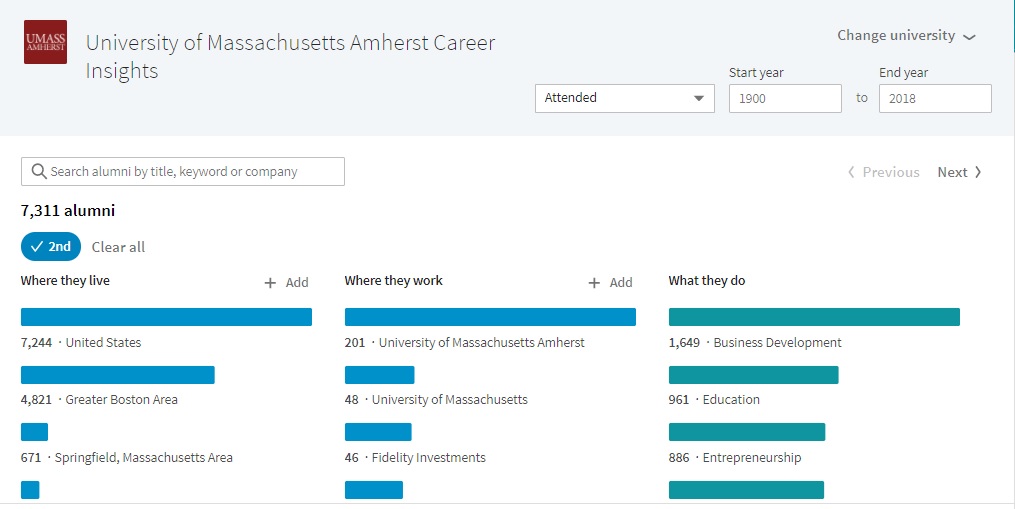
LinkedIn allows me to filter my alumni by six categories. Below is the first of two pages of See Alumni:

See Alumni 1

1. Where they live

In the United States the majority of my alumni live in the Greater Boston area (4,821), which makes sense. I also live in the Greater Boston area and choose to connect with people who are local. Only 671 of my alumni live in the Springfield, Massachusetts area. This also tells me there’s more industry in eastern Massachusetts.

2. Where they work

If I’m wondering where my alumni work, I see that 201 of them haven’t strayed far from home. Most of them work at my alma mater, while the 46 work at Fidelity. I pointed out to my client that if he clicks “See More,” he’ll see many more companies, along with other filters.

I also tell him that this filter is a great source of information, especially if he has some companies in mind. His alumni can be allies in his job search.   

3. What they do

Of my alumni connections 1,649 are in business development. And at the bottom of the truncated view are 886 people in Entrepreneurship. I recall looking through my See Alumni feature and noticing that I’m connected to many engineers, even if they’re 2nd degrees. This filter can be a good indication of the relevance of your network.

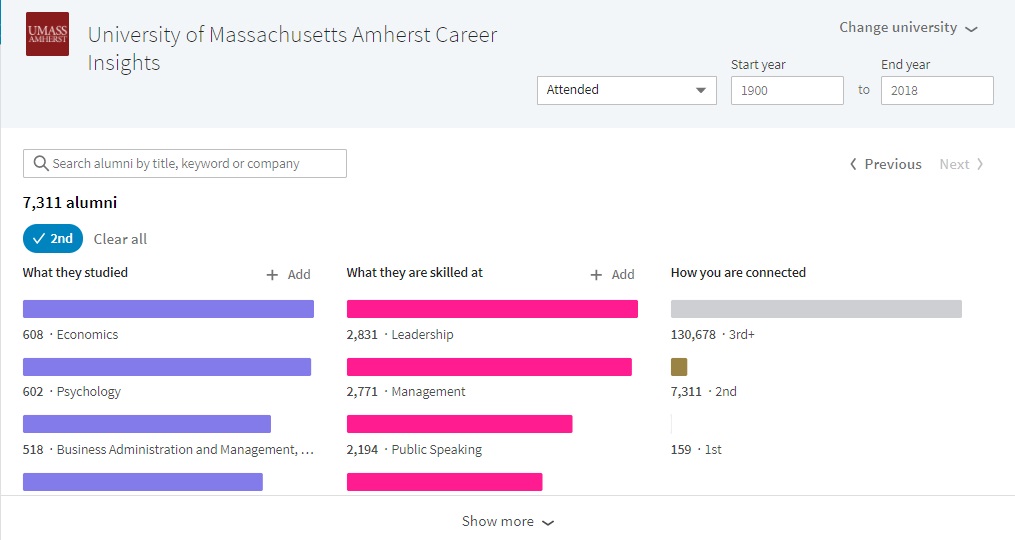
The second page of See Alumni provides the following information.

See Alumni 2

4. What they studied

Economics, Psychology, and Business Administration seem to be the choices of majors of my 2nd degree connections at my alma mater. My discipline, English Languages, is seventh on the list. Mechanical Engineering is seventh. Dad always told me not to be an engineer. Not because it’s a lousy occupation; but because I’d make a lousy engineer.

5. What they’re skilled at

My alumni are more skilled at leadership (2,831) than business development, which is hidden, (1,342). If I fashion myself skilled at public speaking, I’m in the company of 2,194 others who share this skill.  Social Media stands at 1,902. Four years ago it was at the bottom at the list at 556. This is an indicator that social media is exploding.

6. How you’re connected

Four years ago my 1st degree connections stood at a mere 32. Now I have 159. My second degrees have grown from 4,521 to 7,311 in that time frame.

What does this all mean?

This has been a fun exercise for me in terms of discovering where my alma mater live and work, what they do, etc; but the power of this feature lies in identifying specific people with whom you’d like to connect. No matter what your age is, this is a feature you should be using.

If you enjoyed this post, please share it.

Photo: UMass.edu Almuni