
7 easy ways to learn about your LinkedIn connections’ updates

I’ve written numerous times about the importance of sharing an update as a way to communicate with your connections. My LinkedIn workshop attendees will tell you I mention it a bazillion times during the workshop, and they question my suggestion that they update at least once a day.

One of the things I love about LinkedIn is the ability to learn about the connections in my community. By going to my homepage every morning and numerous times during the day, I can see with whom they’re connecting, articles they’re sharing, groups they’ve joined, jobs they’ve landed, and more. This can be time-consuming, so I narrow my search by type (see list below).

If you’re interested, like me, in focusing on certain types of updates, here’s how to do it. Click on “All Updates” just below the “Share an update” box. A drop-down menu will appear giving you many options for various types of updates to look at. For instance, if you’d like to know what changes are made to your connections’ profiles, simply choose “Profiles.” Let’s look at the various types of updates.
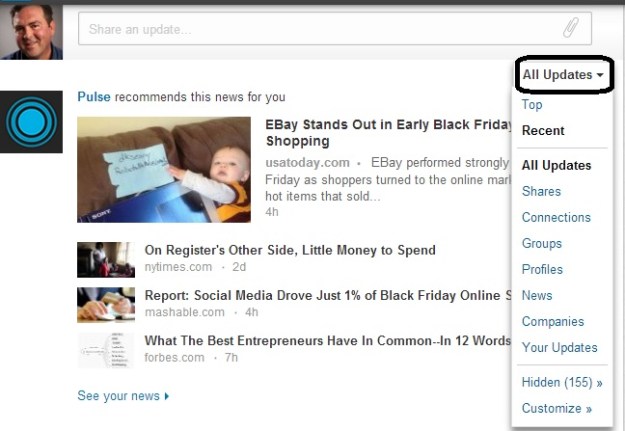
  1. HomepageAll Updates. This is the default update setting but preferred by those who like variety…or don’t know about the “All Update” feature. Below are more specific update types.
  2. Shares. If it’s blog posts/photos/videos and more you’re interested in, select this type of update to discover what your connections have been sharing.
  3. Connections. Important for those of you who are interested in who your connections are connecting with. I find this useful if I recognize a second degree with whom I’d like to connect. Now I can get an introduction to my connection’s new contact.
  4. Groups. Who in your network has joined a group? Who’s started or contributed to a discussion? Because groups are so huge, you should stay on top of what your connections are doing in their groups.
  5. Profiles. Your connections might have landed a new job, made updates to their skills and specialties, recommended someone, posted a new photo (big these days), or celebrated a birthday. By they way, you can hide this activity and changes to your profile by going to Privacy & Settings > Turn on/off broadcast activity.
  6. News. This brings me to the channels I’m following and the comments people have made, whether they’re first or third degree connections. Oh, there’s an interesting article on emotional intelligence. I’ll be back, I’m going to read it.
  7. Companies. Curious about which companies your connections are following? This could be good fodder for discussion. “So, what’s the interest in BAE?” This is another activity you can hide if you don’t want certain connections (your boss) to know.

Your Updates. This type of update is not about your connections, but it is one of my favorite features under All Updates, as I’m very forgetful. This allows me to see if or when I’ve shared a post of mine or some of my connections’. Perhaps I’ve made a statement of advice, or listed a quote. I would like to know this lest I share an identical post.

Hidden. This is a category I hope I don’t end up in, but let’s be realistic. With all the updating I do a day, I’m sure plenty of people have hidden me from their homepage. No worries. LinkedIn is kind enough to not notify you if you’ve been hidden. And you can ask yourself, “Is it better to be hidden or removed?”

My final comment on updates is the ability to customize what you want to see when you’re perusing your homepage or using the “All Updates” feature. Perhaps I’m not all that interested in what companies people are following. I can simply eliminate that update type from the list.

What the Hunger Games shows us about the job search

Join me in reminiscing about the first Hunger Games movie and the Hidden Job Market. The scene where all but two of the Tributes–one being Katniss– rush to the weapons is analogous to how the smartest jobseekers go where the majority of the jobs are, unadvertised. 

Almost two years ago I saw The Hunger Games with my daughter and one of her friends. When we got into a discussion about the various scenes in the movie, we all agreed that Rue’s death was the saddest.

There’s another scene I would classify as more bloody and kick-you-in-the-gut than sad. It’s when the tributes race from their platforms and charge to the Cornucopia to get the weapons of their choice.

Wham, like 12 kids get wiped out. It’s at this point when I thought this is not an appropriate movie for two 14-year-olds or, for that matter, me. It began to look like a scene out of Platoon or the Deer Hunter on steroids.

Prior to this scene, Haymitch tells  Katniss to head for the high grounds, not the weapons. “Water will be your best friend,” he advises. The things-career-related freak I am, I immediately saw a parallel to the career search and this scene.

Obviously the higher grounds, where the water is, represents networking one’s way to the Hidden Job Market, where 80% of the jobs exist unbeknownst to many jobseekers. It appears only two people in the movie make this wise move, Katniss and Peeta, while the others go for the desirable weapons and other goods.

The Cornucopia and the weapons, on the other hand, signify the advertised jobs, representing 20% of the available jobs. The tributes who race all at once for the weapons are the majority of jobseekers vying for the measly number of available jobs. Don’t you see it?

You may think it’s silly to equate a scene in a teenage movie to the job search and, further, you may think me a lunatic. But you don’t know me; I’m always thinking about how the job search relates to…almost anything. In this case, it’s about taking control you your job search. Shuck off the job boards (the Cornucopia), The Hunger Games tells us, and unlock the HJM.

Haymitch’s advice was wise and followed by Katniss, thus saving her life. Certainly the makers of The Hunger Games didn’t devise that scene with the job search in mind. It was merely to point out the best and worst way to survive in a battle to the death, albeit a bit extreme to compare it to the job search, that’s the way I see it. Are you as obsessed with the job search as I am? Probably not.

Beginners’ guide to using LinkedIn effectively

linkedinThis is a guest post from Rich Grant, a valued LinkedIn connection and college Career Advisor. He has a great way of explaining how to teach LinkedIn to beginners. 

When I meet with students – two to four each day – in my college’s career center I almost always ask, do you use LinkedIn? Most students say “yes’” but the real question we start exploring is, are you using LinkedIn effectively?

I’m pleased that almost every college junior or senior I meet with has a LinkedIn profile. Very few students, however, have taken full advantage of the networking power of LinkedIn. This is where I come in. I love showing students the nooks and crannies of LinkedIn.

I typically have about 10 – 15 minutes within a 30-minute appointment to provide students with an overview of LinkedIn. That’s just about enough time to cover the basics. So, here is my 10-minute tutorial on using LinkedIn to make connections and as a resource in a job or internship search.

Defining LinkedIn. For students who have not seen LinkedIn, I tell them about the similarities to Facebook (connecting with people, posting a status and / or links, joining groups, etc) and then quickly add, But it’s NOT Facebook! I also explain that social media networking (LinkedIn, Google+, Twitter, Pinterest, and others) does not replace traditional face-to-face networking, but it complements your overall networking efforts.

About the profile. I talk briefly about how to beef up your profile. Don’t set up a bare-bones profile and think you’re done. Change / expand your headline, create a summary, and describe each job with appropriate key words. Add skills and highlight projects. I talk with students about posting a professional profile photo and customizing their URL, both of which are easily found when you’re in “edit profile” mode.

Making connections. With whom should you connect? Initially, I tell new LinkedIn users to connect only with people they know and trust who also know them reasonably well. I explain the concept of 2nd degree and 3rd degree connections, that is, your connections’ connections and so on. If you connect with people who know you well, you will have better success in getting referred to your 2nd degree connections. I tell students to avoid the “LinkedIn Open Networkers” known by their acronym LION (a better description might be “Spread-thin LinkedIn Unselective Trolls”)

Participating in groups. Find your college’s alumni group and seek groups within your professional interests. Don’t just join groups, participate in them. Post discussion topics, comment on discussions. Engage with people within groups… you know, be “social” on “social media.”

Using “advanced” search. Click “advanced” to the right of the search bar. On the left side, you’ll see several fields. You can search on one variable or multiple variables. I usually show students how to search on keywords, company, college (filling in the name of our college), and zip code. You can also search by industry. I run through a couple of searches to show how easy it is to identify relevant 2nd degree connections.

Now what? Once you find a 2nd degree connection that you’d like to contact, you can see who your common connections are. You can get in touch with your connection or connections to facilitate getting through to the person you don’t know. In my job searches, I would typically contact my connections by phone or email. You can also message people on LinkedIn, or from the 2nd degree connection’s profile, click on the down arrow by the “In Mail” button and use the “get introduced” feature. It’s worth repeating a key point: connect only with people you know and who know you. If you identify a 2nd degree connection, it’s no use to you if your common connection is a LION in another country.

Basics of networking. I would be remiss if I just showed the technical aspects of LinkedIn, so I talk with students about proper networking etiquette. As you start reaching out to your 2nddegree connections, you need to follow the same guidelines / protocol as you would if you were meeting someone at a networking event… or meeting someone new on campus. You wouldn’t meet someone for the first time, and say, nice to meet you; let’s rent an apartment together. Don’t come on strong. Build a rapport before you ask for anything. Get to know people first, and don’t put them on the spot.

As you connect with new people on LinkedIn, it’s important to build your relationship with an information-seeking perspective rather than jumping in and asking about job openings. That’s a conversation killer. Most students I meet with truly can benefit from exploring career options by having conversations with people who work in those career fields (aka “informational interviewing”). Most professionals are willing to help college students who are looking into potential career fields. And by using LinkedIn properly and effectively, your connections most likely will be willing and able to help you get in touch with their connections, provided they are also connecting with people whom they know and trust.

This has been my quick tour of LinkedIn that I provide to new users of LinkedIn. I rarely talk about job postings on LinkedIn; to me, LinkedIn is about networking. I have started to show students “University Pages” found under the “Interests” pull-down menu (look for “Education”)

What do you show new LinkedIn users in your overview?

Rich Grant ● http://www.richcareer.net

Photo C. 2013 by Fred Fieldfredfield.comRich Grant has a background in business planning, freelance writing and higher education. Rich was recently the director of career services at a small four-year college in Maine and is currently filling an interim role as a career adviser and internship coordinator at a private college. He serves as the president of two professional associations. Find Rich on LinkedIn and Twitter, and become a regular visitor to his blog where he imparts his words of wisdom once or twice a week.

Just answer the Interviews questions: 6 ways to do it properly

My kids have a knack for answering my questions with concise, factual answers like “I don’t know” or “I guess so” or “nothing happened.” They’re young people, so I don’t expect enlightening answers that open doors to stimulating conversations.

On the other hand, I need more. I would like to know what happened at school, if they had a good time at the mall, how they feel about their teachers, etc.

The thing about recruiters and employers is that they want direct, factual  answers to their questions, not a long-winded response that has very little to do with the question at hand. In order to make the interview go smoothly, adhere to the following 6 requirements:

1. Listen to the questions: Some people have the tendency to formulate what they’re going to say before the interviewer finishes with his question.  This causes you to take off in a direction that is heading the wrong way and is hard to correct. If you need clarification, ask what the interviewer meant by his question…just don’t do this too often, lest you come across as daft.

2. Think before speaking: All too often we want to answer a question as soon as it’s left the employer’s lips. This is a mistake, as you want to deliver of the best possible answer before you blurt out an inadequate one. The interview is not a game where the fastest job candidate to respond wins. Occasionally taking time to reflect shows thoughtfulness on your part. It also speaks to requirement number one: listen.

3. Don’t talk too much: When you’re talking with a recruiter, over elaborating on an answer may be more harmful than helpful. Recruiter Mark Bregman says in his article Don’t be De-Selected this about being loquacious:

“You risk boring the screener, or worse, they don’t ask all their questions, because you wasted too much time on early questions.  Then, the screener might not have an opportunity to really get the key info they need to screen you in.”

When you go into too much detail, you come off as someone who talks too much. For me, and I imagine others, this is a great irritant and makes me want to end an interview.

 4. Make your answers relevant: Everything you say must be relevant to the interviewer’s direct question.  “If the question is ‘How did you improve processes?’, don’t start describing in detail the products you were making; just answer the question,” advises Mark. This is also a sign that you have no idea how to answer the question. In this case, ask for more time saying, “This is a very important question, one that I’d like to answer. Could we return to it?” Or admit that you can’t answer it.

5. Don’t ask too many questions: Career advisors encourage interviewees to ask questions during the interview to make it seem more like a discussion, as long as you have enough questions to ask at the end. Mark says this can backfire if you ask too many questions. I see his point. Interviewers are busy people and don’t want you to take over the interview.

6. Say enough: Finally it’s essential that you effectively answer the interviewers questions with enough detail and plenty of examples of your successes. Many times a job candidate won’t provide enough information for the interviewer to make a decision on whether to hire that person. You don’t want to let opportunities to pass you by. Many jobseekers I talk with regret having not sold themselves at the interview, which was due, in part, to not elaborating on an answer they knew they could have nailed.

Effective communications at an interview requires the ability to listen and then answer the questions with transparency and accuracy. Take your time, respond with accomplishments, and most importantly just answer the questions. On the other hand, don’t give answers like my children do.

Don’t disrupt my alone time, and 3 facts about introverts’ alone time

coffee shop 2Although the music is noticeable and people at the table in front of me are chatting and laughing, I’m happily engaged in one of my favorite activities, writing. I’m unfazed by the noise from the music and people as I sit in a plush chair in my favorite coffee shop.

The people and music are more like white noise than a disruption. It’s as though I’m alone. You could say I’m in the zone. The introverts’ ability to be alone, even in a loud setting, speaks to their ability to concentrate on the task at hand.

We introverts simply block out those around us. Some may see this as aloofness or even snobbishness. But it’s none of these; we just refuse to be distracted. Extraverts, who are drawn to people, may not demonstrate the same discipline; they thrive on stimuli and are more aware of their surrounding. Not me. I’m alone.

My alone time is about to be disrupted.

A man sits down next to me and after a few minutes wants to talk about the Red Sox’ World Series win; and I would gladly discuss the momentous event with him, but not now. I’m friendly, so I respond to his greeting and comments but quickly return to my writing.

It becomes obvious that he wants to talk more about the World Series, despite my obvious hint—I think it’s a clear hint. Maybe two minutes of conversation will be enough to satisfy this interloper, I reason.

Two minutes pass and soon it approaches five minutes. Then I start to feel annoyed with this man who wants nothing more than to talk baseball. He launches into Big Papi’s MVP award, followed by the duck boat parade he wanted to attend but had to watch on TV with his wife, who kept asking about the various players. The conversation seems more like an obligation than a mutual discussion.

My feeling of annoyance soon turns into the uneasy feeling of being trapped; after all, I didn’t ask for this conversation. A simple “hi” and a comment or two about the World Series would be fine, but to launch into a full-fledged conversation is ruining my focus, unlike the music and chatter that seem like they’re in the distance.

Prior to his arrival, I was pounding out sentence after sentence. Things were making sense. I had this eternal happiness that some mistake for simply being within oneself, which to an introvert is true happiness. And this man, although pleasant and gregarious, should know the following about introverts:

  1. When you see someone so focused that his eyes drift not from his computer screen, leave well enough alone. He’s probably taking advantage of what small amount of alone time he has.
  2. We like human contact, but at times we want to be alone, even if it’s in a crowded coffee house. It’s one of our pleasures which you, as stimuli-driven individuals may not understand.
  3. Conversation is not about you. If the other person is not engaged, it’s a sign that the person is not interested in the conversation. On the other hand, a welcome response signals a two-way conversation.

It’s obvious that I won’t get anything done with this person to the left of me talking incessantly, so I turn to the person who is sitting to my right, my adorable daughter, and ask, “Honey, are you ready to go?” Together my daughter and I leave the coffee shop, and on the way home she asks me who that annoying guy was. Just someone with bad timing I tell her.

Photo courtesy of lamill coffee, los angeles by oceanerin on Flickr

10 reasons why your résumé may be a zombie

zombie boyLast Halloween my son (at right) was talking about being a soccer-player zombie at least two months prior to this much-anticipated night. He explained he would paint his face white; outline his eyes with black; and, most importantly; apply fake blood to the sides of his mouth. The way he described it got me stoked for Halloween.

I shouldn’t have been surprised when his friend from up the street showed up as a zombie. Nor should I have been surprised when our adult neighbor walked over dressed as, you guessed it, a zombie. She was pregnant and had doll baby legs extruding from her large belly. I asked her what her husband was going to dress as, and she told me…a farmer zombie. Further, they dressed their one-year-old son as a zombie.

At least five zombie kids came to my door, and we were only one hour into a night of candy-crazed kids roaming the streets. I felt like I was in an episode of the Walking Dead.

What does last year’s Halloween have to do with the job search? It brings to mind how employers feel about the slew of résumés they receive that lack originality. Like nearly every kid (and adult) I saw dressed as zombies, employers are getting résumés that don’t speak to their needs; they are zombie résumés. Your résumé is a zombie if it has the following characteristics:

  1. A cookie cutter résumé. Written and done, is how some feel about their résumé. No thought about what employers need, therefore no mention of the skills and experience highlighting those needs. Like the zombies that arrived at my door, this résumé doesn’t make an impact.
  2. Failure to capitalize on your accomplishments. Quantified accomplishments are what immediately grab employers’ attention at first glance. Duty-based résumés don’t separate you from many other candidates.
  3. Contact information that lacks your LinkedIn URL. David Perry and Kevin Donlin, Co-Creators of The Guerrilla Job Search System, write, “If you’re not on LinkedIn and looking good, you don’t exist to most employers.” You have a zombie résumé if you’re not on LinkedIn and don’t proudly display it in your contact information.
  4. No branding headline. The best way to say who you are and what your areas of strength are is by having a headline that sets you apart from the other applicants. It’s where you first state keywords and phrases. Zombie résumés fail to make use of this valuable real estate.
  5. A say-nothing Performance Profile.  Zombie résumés start with statements like, Result-driven Project Manager with 20 years of experience in Manufacturing. Instead,  Project Manager who leads teams producing software that generate sales exceeding $3M in competitive manufacturing markets, would be more enticing to the employer.
  6. Your résumé isn’t prioritized. A zombie résumé fails to demonstrate your knowledge of what’s important to the employer, based on the job description. Your Profile should state your qualifications in order of the employer’s requirements, thus making her job of finding them very easy. Prioritize your statements.
  7. No core competency section. A résumé is not complete unless it has a Core Competency section that lists the skills required for a position, plus additional ones that can add to a person’s candidacy.
  8. The Work History lacks relevant accomplishments. Perhaps the most important aspect of a résumé is the Work History, but what makes it escape Zombie status is powerful accomplishment statements. Accomplishments that describe how you have contributed to the growth of an organization/company. Increased revenue, improved production, reduced costs, saved time are but a few accomplishments you should highlight.
  9. There’s no Training Section. If you were fortunate enough to receive training or took advantage of professional development, you should have a section for training. A zombie résumé contains no Training section and screams to employers that, “I have not taken advantage of bettering myself and keeping up with technologies.”
  10. The Education Section is incomplete and includes dates. All to often I have seen résumés that skimp on the Education section. Whether you earned a degree 5 years ago or 20, this section informs the employer that you started and completed something. Don’t be shy about writing that you made the Dean’s list four years running, something you accomplished through dedication and hard work.

Zombies roamed my neighborhood on Halloween walking lethargically, extending their hands for candy, just as many résumés lack the imagination and authenticity required to earn a place at an interview. Don’t submit a zombie résumé. Rather think about the ten important components of your résumé and how to make them strong. Who knows what next year’s Halloween will bring?

Our obsession with numbers; approximately 1 to 20 ways to succeed or fail

numbersI think people have a fascination with numbers, percentages, and dollars. I do. I know that 88% of the time I spend is productive and the other 12% of the time is wasted. I’m cool with that, but I don’t know how to explain it. It’s good that I’m at least getting a B+ in life. I spend approximately $3 a day on coffee, which is about 2% of what I spend weekly. So that’s not too bad. I read 25 pages of a book before I drift off to sleep—any less, any more, I’m up all night.

What is it about numbers that fascinates people, that makes their claims legitimate? Does it make the abstract concrete? Often we base success and failure on numbers because numbers give us something to grab, or understand better. No one really knows how many ways there is to write an effective résumé, except employers that choose people for an interview. Here is a look at numbers that get thrown around, including by me.

Interview numbers: I tell my workshop attendees that 99% of the time an employer will allow them to take notes at an interview. They must think I’m pulling this number out of a hat. I’ve been to approximately 25 interviews in my life, and at all interviews I was allowed to take notes. There must be some interviewers who don’t allow note taking.

LinkedIn Summary numbers: Your LinkedIn Summary allows you 2,000 characters. Did you know that? I once proposed to my customers that utilizing 90% of this space makes for an excellent Summary. That’s fine, but how does one use all 1,800 characters if one doesn’t have 100% compelling content? How do you retract a dumb statement like this? This is how hung-up on numbers I am.

Résumé numbers: I may believe there are 5 ways to write a résumé that will get you invited to an interview. But somewhere I heard there are 6 and another source cited 10. Does the person who claims there are 10 know more than the one who alleges only 6?

Somewhere I read that only 50% of recruiters read cover letters. Is this a known fact or a guestimation? If that’s true, then a jobseeker will waste 50% of her time writing a cover letter for all the positions to which she applies. This boggles my mind. I say to cover all your bases.

Networking numbers: Sixty percent of most jobs are gained through networking; however, more than 80% of executive-level jobs are a result of networking. Or is it 85%? When people ask me how effective LinkedIn is in getting a job, I’m tempted to say, “If used in conjunction with personal networking, your chances of getting a job is 80%.”

Did you also know you must contact a person 7 times before that person becomes a bona fide network connection? Again, how was this figured out? There are several connotations associated with the number 7, including biblical references, but I doubt you’d have to call or e-mail someone before you’re officially connected.

Getting-a-job numbers: Richard Bolles, What Color is Your Parachute, places a 4%-10% success rate on applying for jobs online. Because he is the guru of the job search, I believe him and tell my customers to focus their energy on other methods, e.g., networking, using a recruiter, knocking on companies doors. I say this because Bolles attaches numbers to his claim. Yet I’ve heard many customers say they got their interviews from Monster, Dice, SimplyHired, Indeed, etc.

My personal formula for getting a job is 60% personal networking + 20% online networking using LinkedIn + 6% applying online + 14% doing something else = 100%. These are good odds, don’t you think? The problem is, everyone’s different, so this can’t be proved.

I was tempted to title this entry, “10 reasons why numbers mean nothing.” But as I thought about it, I realized that there is some merit in numbers. For example: Your chances of getting a rewarding job are 0% if you use the sitting-on-the-couch-and-hoping-for-a-job-to-land-in-your-lap method. Zero percent of employers will be impressed if you send a résumé and cover letter written in crayon. Zero percent of jobseekers will get their dream job if they arrive at an interview dressed in just their underwear. So these are safe numbers to cite.

Note of apology: This writer acknowledges that there are many great authors who cite numbers in their entries, and hopes not to offend those who do. Henceforth, this writer will cite numbers whenever appropriate.

LinkedIn Endorsements: Reliable or BS?

endorsementGuest post by Brian Ahearn, CPCU, CTM, CMCT

If you’re on LinkedIn then no doubt you’re familiar with the relatively new feature where you can endorse someone for his or her skills and expertise. This feature is akin to Facebook’s “Like” option.

Not too long ago I connected with someone on LinkedIn who I’d previously had no interaction with whatsoever. The person reached out to me because we shared a common interest. Within hours of connecting he endorsed me for the following skills: management, training, marketing, leadership, and business planning. Read more


A letter to my daughter’s career advisors

college studentBelow is a letter sent from a concerned parent to a College Career Advisor as his daughter enters her freshman year of college.

Dear College Career Advisors,

I’m writing to you because my daughter has arrived at the University, and I’m hoping she’ll get some guidance from you. She and I agreed that she’d introduce herself to you after she’s settled in. Expect her to be a bit lost in the world of a major university.

As a Workshop Specialist at an urban Career Center, I occasionally see college grads in my workshops. Many of them didn’t take advantage of their college’s career centers and are hearing about the career search for the first time. I don’t want this to be the case with my girl, so I’m reaching out to you now.

My first request is that you impress upon my girl how crucial it is for her to develop her “soft skills.” In a survey by Glassdoor.com, employers feel skills such as, collaboration, verbal and written communications, and analytical thinking, are lacking in college grads.

She’ll need to learn how to write a great résumé of course. On her résumé she’ll need some real-life experience, namely internships. I’m seeing this lack of experience on some of the recent grads’ résumés I critique. If you would emphasize the importance of obtaining internships, it would be much appreciated.

Her interviewing skills will need some polish. I conduct mock interviews for my customers and I’ll tell you, they benefit from them greatly. Would you put her through a mock interview or two? Better yet, have her attend college career fairs and speak with some of the representatives there. There’s nothing like sitting in the hot seat.

Many of my customers balk at the idea of informational meetings, despite my impressing upon them the importance of gathering information; building their network; and, who knows, perhaps striking it lucky as the company is thinking of hiring. I want my daughter to go on as many informational meetings as possible.

She needs to learn about LinkedIn. Even though I teach LinkedIn, she’s never taken an interest in it. Why would I expect her to? Most high school students don’t even know about this platform; they’re wrapped up in Facebook and Twitter. Please emphasize the value of LinkedIn as an online networking application. Show her how she can reach out to the alums from the University.

One last thing and perhaps most important. Please suggest my daughter attend any networking events at the University and other venues. I think I read of a student networking group at the University that meets bi-monthly. This would be a great step in getting her to meet potential long-term contacts. Impress upon her that she should start developing her network before she needs it.

Thank you in advance for your consideration Your attention to my daughter’s success is greatly appreciated.

Sincerely,

A Concerned Dad

5 ways more business advice sounds like job search advice

I love reading articles on how to succeed in business because they speak to how to succeed at the job search. I can relate almost everything to the job search, but business is by far the easiest way for me to see a connection, as evident by an article written by Richard Branson, founder of Virgin group.

1.Listen more than you talk. “ Brilliant ideas can spring from the most unlikely places, so you should always keep your ears open for some shrewd advice,” says the author. This point the author makes is sage advice when, as examples, you’re networking or at an informational meeting.

People like to be heard, not talked at, so make fellow networkers feel appreciated. You’ll get your turn to talk if the relationship is worth nurturing. If you’re granted an informational meeting (I prefer this term over “informational interview), you’re there to gather information, not dominate the discussion.

2. Keep it simple. “Maintain a focus upon innovation, but don’t try to reinvent the wheel.” An example of this is jobseekers who are constantly thinking of the next best thing for a résumé, or have 20 people review it. (Twenty people will result in 20 different answers.)

Often it’s not your résumé that needs constant revisions; it’s the way you distribute it. Take heed of the advice job search experts, recruiters, and employers give; find the avenues by which to send your accomplishment-based and keyword-rich résumé. These can be found through networking.

3. Take pride in your work. The jobseekers who succeed at getting a job in quick fashion are those who show pride in their work. By work, I mean the effort and focus you put into developing a support system, namely your network; the pride you display by dressing the part whenever you’re in public; the professionalism you demonstrate at interviews; and the follow-up after your interviews.

4. Have fun, success will follow. I wouldn’t blame you if you felt like popping me one in the mouth. Looking for work isn’t fun—I know, having been there—but as the author said, “A smile and a joke can go a long way, so be quick to see the lighter side of life.” Your supporters and employers will respond better to positivity than a display of despair and bitterness.

I’m often impressed by the jobseekers I see who don’t give into their inner fear and frustration, but rather smile whenever they attend my workshops. This shows confidence that employers are seeking in their candidates, even in my workshops but especially at an interview.

5. Rip it up and start again. “Don’t allow yourself to get disheartened by a setback or two, instead dust yourself off and work out what went wrong.” This is perhaps the best advice we can take away from this article.

Often we’ll experience letdown during the job search, and it’s human to hope that our first interview will result in a job. But the fact remains that you’ll have as many as 7 opportunities before getting a job offer.

I’m constantly impressed by jobseekers who suffer a long unemployment before landing a job. This is a testament to their perseverance. No matter how sick and tired you are of hearing, “Don’t give up,” keep in mind that giving up will not result in a rewarding job.

The sooner you think of yourself as a small business owner who has to market and sell your product, the sooner you’ll land your next job. I would add one more point to Richard Branson’s article….Work hard at what you want. You’ve worked hard while employed, so working hard at your job search should follow naturally. This time you’re your own boss, though.