Category Archives: Career Networking

The day I messed up; my networking mistake

Screwed upThe day I messed up; it was a day you remember like when you forget your kid’s birthday. You can’t believe you made such a blunder and it stuck with you the whole day.

I had planned to meet with a fellow who is considered the premier networker in the area. He runs a business networking group called Friends of Kevin. I wanted to talk to him about expanding my LinkedIn Strategy business because I believed he could promote my business among his “Friends.”

We were supposed to meet for lunch and I was going to pay. Nothing fancy, just Mexican food from across the street. I was sitting at my desk eating a bowl of New England Clam Chowda (that’s how it’s pronounced in northeast Massachusetts). There I was enjoying my chowda, my bobbleheads on my desk looking on. I was totally oblivious to the fact that I had forgotten our lunch date.

Bobbleheads

From over my shoulder I heard something akin to, “I see you’ve already got some food.” Right then I knew I had seriously messed up. I also realized I didn’t have a viable excuse for forgetting our lunch date. There was no sense trying to hide my mistake. There was only fessin’ up.

“Dude, I’m sorry. I messed up,” I said to him.

“It’s cool,” he said. “I was going to meet someone later on. No worries.”

Over time I forgot this momentous blunder until this person shared on YouTube a similar mistake. He broadcasted to the world that he (too) had forgotten a networking meeting, hadn’t put it on his calendar. What a guy, I thought. How bold of him to admit his error and turn it into a lesson on how to follow up in the most obvious way.

Following up has always been a priority for me. I preach it in my workshops as one of the most important aspects of the job search; whether it’s calling someone after a networking event, meeting someone for coffee, making the informational meeting you asked for. Like in work, following up is essential for success. Your word is your bond. And I mean it.

Recently my friend did me a great favor by speaking to our career center on the topic of (can you guess?) networking. I’m sure during the guest speaking event he mentioned the importance of following up, and I’m pretty sure he spoke of my faux pas. I would’ve. He’s a good friend who easily forgives.

Someday I’ll make this networking mistake of mine up to him.

5 ways to be memorable in a positive way in your job search

question mark

I don’t remember much, but when I do, I never forget. There are some jobseekers I remember because they leave a lasting impression, like one woman I had in my Behavioral Interviewing workshop whose story about motivating others was so compelling. Melissa is her name.

Then there’s Mark who just got an Administrator position in healthcare. He thanked me for my help and told me he’d write an account of his job search and how LinkedIn was of great help.

Lisa landed a benefits job in human resources. Previously she was a manager, but she wanted out of that. She proved that stepping down is fine, just as long as you can still prove your value.

Armando I remember because he would always ping me with updates about his job search. He was always positive, never seemingly desperate, and sometimes he offered to help me. He still remains one of my favorite former customers, still someone I’ll reach out to. The other day, in fact, I called to see if he needed a gift in the form of a very talented jobseeker.

Kelly just landed a marketing job at a bank after being out of work for approximately a year. When she spoke with me just before securing her job, she admitted to being discouraged; but she never showed this. In fact it was just the opposite–she was positive and very active on LinkedIn.

Unfortunately there have been people who are a complete downer, but they’re far and in between. Still I remember them because of the poor impression they made. Mike Downer would constantly e-mail me about how he wasn’t going to make it. I would tell him he would if he networked and tried to be positive. He finally got a job. I won’t hear from him unless he needs another job.

The five people* I mention–yes they exist–who came across as positive and/or were willing to provide any help they could are the ones I would go out of my way to help; whereas the one that was always negative is someone I’d dread hearing from.

There’s a pattern here. People want to go out of their way to help those who make a good impression. If you want to be memorable to people who can assist you in your job search, keep in mind the following:

  1. Appearing positive, regardless of your internal struggles, attracts more people than if you’re negative. Negativity drives people away. Take Mike Downer, for example.
  2. Remind people of you by pinging them with e-mails and phone calls, but don’t annoy them with constant contact. Offer to meet them for coffee if it’s convenient for them.
  3. Always follow up after you’ve met someone who might be of assistance. Every time you follow up ask if you can be of assistance to them. If you can reciprocate in any way, it’s better than only asking for their help.
  4. Know your stories. Expert on storytelling, Katharine Hansen @ A storied Career, touts the importance of stories, how memorable they are in life and in the job search.
  5. Let people know about your successes. Had a great interview? Let people know. Finished a résumé you’re happy with? Let people know. Although your confidence may be low, announcing your achievements will make you and others feel great.

These are just a few positive things you can do to become memorable. Don’t be a downer, regardless of your internal struggles. Most people understand that being out of work is painful, including yours truly; so don’t make it the gist of your relationship with others. People like this are easy for me to remember, even if I can’t remember big name actors like Chris….See, I forgot.

*I will occasionally update this list of people and their examples of positiveness.

Job search tip #9: Knock on companies’ doors with approach letters

In the last entry we looked at making your company list. Today we’ll examine knocking on companies’ doors by using approach letters.

The other day during a résumé critique one of my customers told me how he had been networking. Something was in the works with a company as a result of him being proactive and knocking on the company’s door. Not literally; although, that’s a viable option. He had sent an approach letter to one of the directors at the company asking for an informational meeting, which then lead to further consideration.

Of course a phone call might have been quicker for my customer than sending a letter, but he felt sending an approach letter was right for him. (By the way, using LinkedIn’s Search Companies feature is a great way to find people at companies.)

For you jobseekers who lean more toward introversion, an approach letter may also feel more comfortable than calling a director, VP, or an individual contributor. There’s more to an approach letter, though, than simply sending an e-mail telling the person that you’d like to get together with her to meet for a short meeting.

With the approach letter, first you’ll research the company so you can write intelligently about why you’d like to meet. You’ll write highly of the company, selling the company to the recipient of your letter. This will show your enthusiasm. It will also show you took the time to visit the company’s website, read articles in the newspaper, and used other methods to research the company. This is the first step you’ll take to impress the recipient.

Next you’ll throw in some kudos about yourself. What makes it worth her while to meet with you? You gained some valuable skills when you worked at the medical device company in their marketing department. You’ll write about the accomplishments you had, like authoring press releases that drew the attention of many of the media, spearheading a direct mail campaign that garnered new business beyond what the company had achieved.

Don’t forget to indicate that you’ll call the recipient. Set a date and exact time. If the person picks up the phone or you have to leave a voice-mail, be ready to explain why you’d like to meet with her. You would like some information on a position you’re pursuing. You’d also like to share some knowledge of competitors or the industry.

What follows could be a networking meeting or maybe good timing on your part—there may actually be a job the company’s trying to fill, unbeknownst to other jobseekers searching the Internet for advertised positions. This is precisely why you don’t want to simply send an e-mail without laying out your skills that make you ideal for a possible job in the company.

The only thing left to do is picking up the phone and asking the recipient if she received your letter. Following up is the last component of sending an approach letter. Even if talking on the phone terrifies the heck out of you, at least you have gotten in your message without having to deliver it cold. You’re compelling writing has wooed the recipient into wanting to know more about you.

In the next article, we’ll look at using LinkedIn to network on line.

Job search tip #8: Make your company list

Last week we looked at creating a contact list and starting to network. Now we’ll look at making a list of companies for which you’d like to work.

When you buy a pair of athletic shoes, do you research the brands, consider where you’ll buy them, and decide on an acceptable price? Or do you go into any store and buy the first pair of shoes you see at any price? If you’re a smart shopper, you’ll plan before you act.

The same attitude of a smart shopper applies to a smart jobseeker. One important step you must take is to research companies for which you’d like to work. I often ask my jobseekers if they have a list of companies they’re researching and if they’re taking action.

Let’s examine the steps you need to take and why it’s important to make your company list.

Google it. As a jobseeker, you understand the necessity of a search engine. First decide what market/s you’d like to pursue. I googled Data Storage in the Boston, Massachusetts, area and came up with 22 companies within a 25 mile radius. EMC, Dell, HP, Genzyme, Iron Mountain, TJX, and other big boys were some of the companies that popped up.

Check your local business journal. The Boston Business Journal is a wealth of information on up-and-coming companies. Large corporations, as well as start-ups, are mentioned in this publication. You’ll read good news along with not so good news. Pay attention to the companies that are showing growth and add them to your list. Your local journal will also have a People Section that will give you insight as to promotions, departures, and, of course, possible hiring opportunities.

Use your network. One of your best resources may be the Mavens who attend networking events and sit in the corner, where they shout out leads to companies that are hiring. From those contacts you’ll learn of other companies that are hiring or in the process of hiring. Your list of bona fide companies will grow longer and longer as time goes on.

Expand your list. Start small and grow your list. Five is a good number to begin with, and continue to grow your list by five every week. While you’re growing your list you’ll spend more time at your computer researching your companies. Of course you’ll check out the career section of each company, but some of your most valuable information will come from press releases, annual reports, stock news, etc.

Why is creating your list and researching companies important?

You’re being proactive and penetrating the hidden job market. Instead of spending countless hours on the Internet searching for advertised positions, you’re taking steps to penetrate the hidden job market. Experts assert that 80% of all jobs are hidden, so identifying companies that are showing growth will confirm that they’ll be hiring in the near future. And who will they want to hire? That’s right, the people who work there or referrals from the people who work there. Trust is a powerful thing.

You’re on your way to being known by your targeted companies. At this point you’re an unknown, a stranger coming off the street. Making connections at your companies won’t be easy (certainly not as easy as blasting off hundreds of cookie-cutter résumés) but the rewards will be great and you’ll benefit from the connections you’ve made for the rest of your career. You’ll become a known commodity.

You’ll be seen as someone who takes initiative. Does a smile spread across your face when the neighborhood kid comes to your door asking if he can shovel your driveway? He’s showing initiative. Your initiative will come in the form of knocking on companies’ doors, just like the neighborhood kid. You may be the extraverted type who will call companies and ask for an informational meeting, or you may be more introverted and prefer writing approach letters, professional profile sheets, and sending them to hiring authorities.

Next Friday we’ll look at knocking at companies’ doors using an approach letter.


Job Search Tip #7: Creating your contact list and start networking

The last tip looked at writing your accomplishment list. Today we’ll address creating your networking list of people who may help you find your next job.

By now you know that the best way to find work is by networking. Statistics from the Department of Labor show that networking accounts for at least 60% of your success, if used alone. Throw in online networking and you increase your chances of success.

The question is not if networking will help you in your job search; it’s with whom do you network? A simple answer is, everyone.

Here are the steps to take in developing your contact list and, just as importantly, following up with your contacts.

Make a list of the people with whom you worked or attended school. Don’t limit yourself to your most recent position; go back as far as 10 to 15 years. Also consider vendors and partners you may have done business with, or professors and teaching assistants you studied under.

Don’t forget the little guy. You may think that your managers, VPs, or directors are your best bet, but often times they are too busy to help. It’s usually your colleagues and people a level or two below you who have the time to spare and, quite honestly, care the most.

Consider everyone. Do you remember the mother of your daughter’s soccer teammate? The one who works at Raytheon? She might know of an accountant position in the works or that someone in marketing is on the outs. How about your convenience store owner who listens to his customers complain about not being able to fine good managers with business acumen? These people, along with family members, relatives, your plumber, and others can be a great source of networking.

These people are called superficial connections and often provide the leads necessary to get an interview. Too many people tell me they are only networking with past colleagues and supervisors, but it’s natural networking that may grant you success.

Develop new contacts by attending local networking events. This will take getting outside your comfort zone, but to bring new people into your fold; you’ll need to expand your reach. The best people to be around are people who are currently employed and own their own business. Local business networking events and chamber of commerce meet-ups are ideal for networking with people who are aware of the goings-on in the labor market.

Once you’ve made contact it’s important to follow-up with your new connections. A timely phone call placed to inquire about your contact’s daughter’s soccer game is a nice touch and will keep your name fresh in her mind. There is no harm in mentioning your employment status, but don’t inquire about any job openings at her company. “Do you know of anyone I should contact?” is a fair question, but don’t put on the pressure—it’s a sure way to lose a contact.

The secret behind online networking is to reach out to people who can be mutually helpful and then make personal contact with them. Many people feel that virtual communications will suffice in the networking arena. This is a mistake. People don’t get to know you unless they hear your voice or meet you in person. Agreeing to meet for coffee or at a contact’s office shows commitment on your part. Get outside your comfort zone.

Next Friday we’ll look at making your company list.


11 ways to communicate with your LinkedIn connections

A blast from the past, but well worth repeating. I’ve added one more way to communicate with your connections.

Having a strong LinkedIn profile is essential to being found by other LinkedIn members and employers, but you’re job isn’t complete unless you’re communicating with your connections and the LinkedIn community as a whole.

business_communication

I tell my LinkedIn workshop attendees that I spend approximately an hour a day (it’s probably more) on LinkedIn. Their faces register surprise; and I’m sure some of them are thinking, “Does this person have a life.”

Part of the workshop is about explaining the need to communicate with their connections because networking is about communication.

1. The most obvious way to communicate with your connections is to message them directly. Awhile back LinkedIn changed the way we message our connections. Now, our messages are a running stream beginning when we first started a message.

It took a while to get used to, for me, but now it’s nice to have a history of a conversation I have with one of my connections. In addition, the ability to begin a message is available on every page you’re on. This is an obvious sign that LinkedIn wants you to communicate with your connections.

2. Another great way to communicate with your connections is by is posting Updates. How many you post is up to you, but I suggest at least one a day. This is when I get remarks from my attendees about not having time to make an update a week.
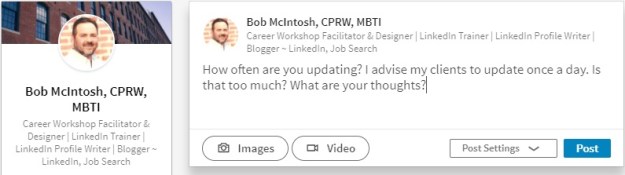
Update oftenYou’ll notice that LinkedIn has given its members the ability to create and post videos. Although a nice feature, not many people are using it. This feature is similar to what Facebook has offered for many years.

3. Another way to communicate with your connections is to “Like” their updates. Liking their updates is great, but it takes very little effort to simply click the link. Like, Like, Like. Be more creative and add a comment which can generate discussion, or reply to your connections privately.

4. I’ll visit my connection’s profiles—with full disclosure—many times a day. My connections will visit my profile many times, as well.

When they “drop in” and have disclosed themselves (not Anonymous LinkedIn User or Someone from the Entertainment Industry), I’ll show my appreciation by writing, “Thanks for visiting my profile.” This will also lead to a discussion.

5. You’ve probably read many opinions from people on the topic of Endorsementshere we go again. Add me to the list of people who prefer thoughtful recommendations, both receiving and writing them, as opposed to simply clicking a button.

But, in fairness, Endorsements have a purpose greater than showing appreciation for someone’s Skills and Expertise; they act as a way to touch base. In other words, they’re another way to communicate with your connections.

6. Participating in discussions regularly is a great way to share ideas with established and potential connections. Yes, I’ve gained connections because of the values we shared as revealed by discussions.

Just today I connected with a great resume writer who impressed me with comments she made regarding a question I asked from my homepage.

7. If your connections blog, take the effort to read their posts and comment on their writing. This is an effective way of creating synergy in the blogging community, but blog posts have made their way into the Updating scene, as well.

The majority of my Updates are posts that I’ve read and commented on.

8. I turned 50 yesterday. Not surprisingly I received happy wishes from some of my connections. When your connections have an anniversary (work, that is) or have accepted a new job, you’ll be alerted and be given the opportunity to communicate with them.

A small gesture but nice to recognize your connections and generate some discussion.

Take it a step further

So far I’ve written about how you can communicate with your online connections. You can’t lose sight of the fact that an online relationship will not come to fruition until you’ve reached out and communicated with your connections in a more personal way.

9. A very simple way to extend your communications is by e-mailing them. I know, it doesn’t require a lot of effort, but it’s another step toward developing a more personal relationship.

Because you are connected by first degree, you have access to their e-mail address, access which can come in handy at times. Note: LinkedIn users can disclose their email to anyone on LinkedIn, not just their first degrees.

10. Naturally the second act toward strengthening your relationships is to make that daunting phone call (for some it is a big step), Let your connections know, through e-mail, that you’ll be calling them.

Write the reason for the call, such as explaining who you are and what goals you have in your professional life. Nothing is as awkward as dead air and running out of things to say, because the recipient of the call is caught off guard.

11. Finally comes the face-to-face meeting at a place that is convenient for both of you. If your connection lives in a distant location, you may suggest getting together when you’ll be in their city or town. Plan to meet at a coffee shop or a personal networking event if your connection lives close by.

When you meet in person with a connection, he/she becomes a bona fide connection. This is the ultimate way to communicate with a LinkedIn connection. It may not happen often, particularly if he/she lives a great distance from you, but when it does possibilities may present themselves.


Having a great profile is not enough. It’s a start but only the beginning of communicating with your connections. I’ll write LinkedIn profiles for people, and they might have questions about what to do next. Sometimes it’s your activity on LinkedIn that really makes the difference between standing still and realizing success.

Did you like this post? Please share it if that’s the case.

4 ways for introverts to engage in small talk at a networking event

Networking EventI’m not  fond of forced small talk. There, I said it. I particularly don’t look forward to entering a room full of strangers and talking about myself.

Like at a networking event, where everyone is delivering their commercial like automatons.

But I do small talk at networking events, and I’m pretty good at it most of the time.

Small talk is important in professional pursuits; it leads to deeper conversation. An excellent article, Hate Small Talk? One Approach Anyone Can Use, talks about how to approach people and help them engage; thus, helping them conduct small talk and, as a consequence, help you with your small talk.

Jeff Hadden is the author of this article. In it, he writes: “I dread the thought of walking up to people I don’t know and making small talk. Not because I don’t like people, but because in that situation I really don’t like me. I’m not outgoing, I’m not gregarious, not extroverted. I’m the ultimate wallflower.”

I love honest writing, especially when it illustrates how I feel. But here’s the rub: introverts have to improve their small talk abilities, regardless of their comfort level or desire. Small talk generates business and the job-search leads.

If, like me, small talk doesn’t come easy, this is what can you do about it.

1) As the author of the aforementioned suggests, approach someone who is struggling to engage. Here’s how it might go: “Hi. I’m Bob. What do you think of the event?”….”Yeah, it is crowded in here.” Where’re you from?”….”No kiddin’? I’m from Lowell, a small city north of Boston…” This can lead to your elevator pitch…or not.

2) I’m fond of asking questions. My kids think I’m weird, like I’m interrogating them; but it gives me some fodder to respond to. I tell my workshop attendees I’m the King of Asking Questions. “So, what brings you here?” “What do you think of the guest speaker?” “You’re from Tampa (noticing name tag). What’s the weather like down there at this time?” Just remember not to sound like you are interrogating your fellow networkers; allow them to ask you questions, as well.

3) Go prepared to an event by arranging a date or two. I’m going to an event on Tuesday, so I invited a guy I know to attend with me. I’ve got someone with whom to talk if nothing is happening, as well as someone to introduce. “You need help with your website? I’d like to introduce you to John. He’s a wiz at fixing websites.”  If the conversation takes off, great for John. But now I’m alone, unless my second date is there.

4) Don’t bother working the room. There’s no law that says you have to collect 10 business cards, most of which will go into the circular file cabinet when you get home. You might meet someone with whom you have a great deal in common, perhaps there are business or job-search benefits to explore. Great. I’m not trying to give you an out here, just a semblance of success.

If you were to ask me where small talk rates as one of my activities, I’d place it below watching golf. I much prefer, as do most introverts, having a few lengthy conversations with people–most likely somewhere quiet. I know it’s important, but I find it extremely unnatural.

If you enjoyed this post, please share it.

Dear College Students, here are 3 steps to take when connecting with your alumni on LinkedIn

This is a follow-up of a post called Dear College Students, please the following 10 LinkedIn tips.

college student2Dear College Students,

Now that your profile is in tip top shape, it’s time to think about how, as a new college student, to connect with other LinkedIn members. It’s time to develop your online network.

To help you do this, LinkedIn has a neat feature called Find Alumni, which is located in the Connections drop-down menu

Why is it important that you’ve created a profile and must now develop your network? Because the sooner you start your network, the more useful it will be when you graduate and have to look for a job. An old adage is: in the working world, the best time to network is when you’re working. So it stands to reason the best time to network is while you’re in school.

Finding alumni with whom to connect

Assuming you haven’t made any connections with your alumni, which also include those who attended your alma mater before you arrived, you’ll want to connect with them because they’re probably currently working and may know of opportunities or, at least, people with whom you can connect.

First go to How You’re Connected to the far right of the second screen. Most likely you have very few, if any, 1st degree connections. That’s alright. Focus on your second degrees. Select your 2nd degrees by clicking on that bar. You’ll see the other categories shift, the numbers decrease. This narrows your search for potential alumni contacts.

If you’re a communications major, you’ll focus on people who are connected with you under What They Do, e.g., Media and Communication. Look at where they work, what they studied, what they’re skilled at. This will give you a sense of your commonalities, as well as some talking points when you connect with them.

Connecting with your alumni

The largest advantage you have is your common bond with people who are going to school with you or who have attended years before. When you attempt to connect with them through their profile, the option Classmate has already been chosen for you.

This is where, as an aspiring LinkedIn professional, you need to carefully craft your invite messages. Under no circumstances will you send the default LinkedIn invite; that’s plain laziness. Instead, you’ll write a personalized note, which will show the professionalism LinkedIn members expect from each other.

Note: Even though you can hit Connect under the person’s photo, it’s still best to open their profile and choose to connect after reading it thoroughly.

Here’s what you might write after reading your potential connection’s profile:

Dear Mr. Schmidt,

As you’re an alumnus at the University of Virginia and are in the field of Marketing Communications, I’d like to take this time to reach out and invite you to my network. I will contact you to see if we can be of assistance to each other.

Completing the process

Your new invite accepts your personalized invitation because both of you share an interest in Communications and, most importantly are alumni. In your invitation you mentioned being of assistance to Mr. Schmidt. Where many people fall down in the process is not following through.

Be true to your word by contacting him via e-mail when he accepts your invite. Also write down some questions you’d like to ask Mr. Schmidt regarding the line of work he does. Make them intelligent questions; don’t waste his time. Ask him if he might know of anyone who you could also speak with. Finally, tell him you’re at his disposal should he need assistance.

The process of building relationships can be  a long one, but because you’ve just begun your education, you have plenty of time developing long-lasting relationships. These are connections that can be of great help to you once you’ve graduated college.

Online networking; a matter of introversion preference?

If you’re spending all your time networking online instead of getting out there and meeting with fellow jobseekers and business people, you’re doing yourself a disservice. More than 60% of jobs are gained through personal networking, according to the DOL.

There are no statistics on the success rate for obtaining employment using online networking; although, I’m willing to bet it’s much lower than personal networking.

Through deductive reasoning, people who are extremely active on social networking sites, e.g., LinkedIn, Twitter, and Facebook, are most likely less active in their personal networking activities.

Is this a result of one’s personality type, namely introversion. In an article on Career-Intelligence.com, Jennifer B. Kahnweiler, Ph.D., author of The Introverted Leader: Building on Your Quiet Strength, writes about the introverts’ aversion to talking and preference for writing.

“Introverts prefer writing to talking. On the job, they opt for e-mail over the telephone and stop by only when necessary. Averse to excessive conversation, many gravitate toward social networking Web sites such as LinkedIn, Facebook, and Twitter.”

I’ll cite myself as an example. Here I sit typing away when I could be talking on the phone, at a social gathering, or in the next room with my children watching their mind-numbing TV programs. I freely admit that I spend too much time writing blog articles or answering questions and reading responses on LinkedIn.

I’m an introvert, and spending time online suits my personality type more than social interaction, especially after a day of leading workshops to numerous people. It’s my downtime and opportunity to recharge my batteries. More to the point, I thoroughly enjoy writing articles and answering questions and reading answers posted by others on LinkedIn.

Other introverts have told me that they enjoy the non-personal interaction that LinkedIn and the others offer. These happen to be my jobseekers who are hoping to secure jobs through the job boards or LinkedIn. They tell me they’re more comfortable looking for work this way. That said, it’s a mistake to think that doing all your networking online will aid you in your job search.

I’m not implying that all introverts conduct their job search this way, nor do I believe that extraverts avoid online networking sites. Introverts also have the capacity to personally interact with other jobseekers; it just requires more energy to sustain a whole day of being around people.

What is your best way to approach networking? A combination of personal and online networking is a great strategy, because you’ll combine the most effective method to look for work (personal networking) with a growing and proven form of gathering contacts and opportunities to reach out to them (online networking). Read my colleague Wendy Gelberg’s article on online networking to learn more about the importance of online networking; but keep in mind not to neglect personal networking.

Guest post–Introvert leadership: how to master networking in 7 simple ways

Introvert Networking TipsA person once told me that she would rather clean the floor of Grand Central Station with her own toothbrush than network. Comments like this kind of sum up our overall attitude about networking.

For many people, introvert or not, networking is like falling into the black hole. Scary, tiresome, unproductive, mysterious and endless – is this YOU?

I may not be able to turn you into the poster child for networking. However, I have successfully learned many ways that will be easy for you to use, which can turn the dreaded networking into an acceptable activity.

Try these:

  1. Redefine networking. Networking is this decade’s terminology for building relationships with other people. We’ve done this since we were infants and it comes somewhat naturally, unless you put undue pressure on yourself. I think networking has us tensed up by thinking that we need some specific outcome in our interactions with others. While that is apt to happen anyway, it won’t be the outcome if you don’t first build a relationship with someone before putting demands on that relationship.
  2. Don’t work the room. A big misconception many people have when going to a cocktail party or meeting is that you have to cover as many people as you can. Not true. No one (and most importantly those of us who tend toward introversion) likes superficial relationships. There is no way you can work the room and become meaningful with anyone. The simple idea of trying to meet everyone can drain the energy right out of an introvert. Adjust your thinking before you go.
  3. Set a goal. Rather than make an event an open-ended, never-ending activity set some goals like how long you will stay and how many people you will engage with at a deep level. My own goal for meeting people is usually three. Meeting three people is fairly easy to achieve in most settings. Knowing that there is an end in sight helps you stay focused and positive about interacting with new people.
  4. Be a Friend. When you are meeting people, particularly at business-oriented events, it’s too easy to slip into a mode of wanting something in return. That feels icky for you and the other person. Rather than thinking about other people as a potential client, resource or supporter, think of making friends with them. Find common ground and interests. You will be more genuine and you’ll feel better about your interactions. This makes networking much more worthwhile.
  5. Speak to someone without having a purpose. This is especially true while at work. Introverts tend to focus on their work and speak with a purpose in mind. That’s all good, but you also need to branch out. Make a point of chatting with someone for just a couple of minutes without having a specific purpose. Keep in mind that when it comes to relationships the biggest commodity you are trading is your time and attention. Networking or building relationships at work is one of the most important things you will do. It’s critical for your ongoing success.
  6. Follow up. When you meet someone and you feel a connection, make the first move. We are inherently lazy creatures especially when it comes to communication with others. We like this new person and even think about contacting them, but we rarely do. You are doing the other person a favor by following up and following through to make contact for further interaction. If you email them, you may also need to make a phone call, as email habits and technology cannot be relied upon.
  7. Follow up again. You’ve met for coffee and are now thinking they should call you for the next interaction. Maybe, but don’t count on it. Wait for some period of time and if you don’t hear from them, call. I know of a few people who consider me their best friend. They never call and they also love the fact that I do. Be prepared to carry an unequal weight of building a relationship.

You may never love networking or the act of building ongoing, new relationships, but with these simple actions, you will be a networking rock star.

Getting ahead as an introvert doesn’t have to be painful or difficult. I continue to share great ways to make it to the top as the climbing manager you are. Learn these skills and others that will accelerate your career. I offer an ongoing FREE newsletter full of valuable career advice and insight. When you sign up for it, you will also gain access to “Should I Stay or Should I Go?” the eworkbook to improve your job where you are today.

Get yours now: http://nextchapternewlife.com/newsletter-signup.html.

This is brought to you by Dorothy Tannahill-Moran, Introvert Whisperer & Climbing Manager Champion at: www.nextchapternewlife.com.

Dorothy Tannahill-Moran is a certified life and career coach. She works with aspiring professionals who are looking for career growth, advancement and entry into the “C” suite. As well, she works with people to overcome the sometimes daunting task of changing careers. With over 21 years in management, Dorothy has coached, trained and guided other professionals who have gone on to impressive and fulfilling careers. Her personal philosophy about careers is: “It’s not JUST a job; it’s half your life – so love your career”. You can check out her resources, blog and services at Next Chapter New Life and MBA Highway.