11 ways to communicate with your LinkedIn connections

A blast from the past, but well worth repeating. I’ve added one more way to communicate with your connections.

Having a strong LinkedIn profile is essential to being found by other LinkedIn members and employers, but you’re job isn’t complete unless you’re communicating with your connections and the LinkedIn community as a whole.

business_communication

I tell my LinkedIn workshop attendees that I spend approximately an hour a day (it’s probably more) on LinkedIn. Their faces register surprise; and I’m sure some of them are thinking, “Does this person have a life.”

Part of the workshop is about explaining the need to communicate with their connections because networking is about communication.

1. The most obvious way to communicate with your connections is to message them directly. Awhile back LinkedIn changed the way we message our connections. Now, our messages are a running stream beginning when we first started a message.

It took a while to get used to, for me, but now it’s nice to have a history of a conversation I have with one of my connections. In addition, the ability to begin a message is available on every page you’re on. This is an obvious sign that LinkedIn wants you to communicate with your connections.

2. Another great way to communicate with your connections is by is posting Updates. How many you post is up to you, but I suggest at least one a day. This is when I get remarks from my attendees about not having time to make an update a week.
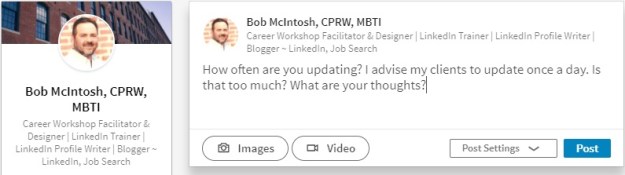
Update oftenYou’ll notice that LinkedIn has given its members the ability to create and post videos. Although a nice feature, not many people are using it. This feature is similar to what Facebook has offered for many years.

3. Another way to communicate with your connections is to “Like” their updates. Liking their updates is great, but it takes very little effort to simply click the link. Like, Like, Like. Be more creative and add a comment which can generate discussion, or reply to your connections privately.

4. I’ll visit my connection’s profiles—with full disclosure—many times a day. My connections will visit my profile many times, as well.

When they “drop in” and have disclosed themselves (not Anonymous LinkedIn User or Someone from the Entertainment Industry), I’ll show my appreciation by writing, “Thanks for visiting my profile.” This will also lead to a discussion.

5. You’ve probably read many opinions from people on the topic of Endorsementshere we go again. Add me to the list of people who prefer thoughtful recommendations, both receiving and writing them, as opposed to simply clicking a button.

But, in fairness, Endorsements have a purpose greater than showing appreciation for someone’s Skills and Expertise; they act as a way to touch base. In other words, they’re another way to communicate with your connections.

6. Participating in discussions regularly is a great way to share ideas with established and potential connections. Yes, I’ve gained connections because of the values we shared as revealed by discussions.

Just today I connected with a great resume writer who impressed me with comments she made regarding a question I asked from my homepage.

7. If your connections blog, take the effort to read their posts and comment on their writing. This is an effective way of creating synergy in the blogging community, but blog posts have made their way into the Updating scene, as well.

The majority of my Updates are posts that I’ve read and commented on.

8. I turned 50 yesterday. Not surprisingly I received happy wishes from some of my connections. When your connections have an anniversary (work, that is) or have accepted a new job, you’ll be alerted and be given the opportunity to communicate with them.

A small gesture but nice to recognize your connections and generate some discussion.

Take it a step further

So far I’ve written about how you can communicate with your online connections. You can’t lose sight of the fact that an online relationship will not come to fruition until you’ve reached out and communicated with your connections in a more personal way.

9. A very simple way to extend your communications is by e-mailing them. I know, it doesn’t require a lot of effort, but it’s another step toward developing a more personal relationship.

Because you are connected by first degree, you have access to their e-mail address, access which can come in handy at times. Note: LinkedIn users can disclose their email to anyone on LinkedIn, not just their first degrees.

10. Naturally the second act toward strengthening your relationships is to make that daunting phone call (for some it is a big step), Let your connections know, through e-mail, that you’ll be calling them.

Write the reason for the call, such as explaining who you are and what goals you have in your professional life. Nothing is as awkward as dead air and running out of things to say, because the recipient of the call is caught off guard.

11. Finally comes the face-to-face meeting at a place that is convenient for both of you. If your connection lives in a distant location, you may suggest getting together when you’ll be in their city or town. Plan to meet at a coffee shop or a personal networking event if your connection lives close by.

When you meet in person with a connection, he/she becomes a bona fide connection. This is the ultimate way to communicate with a LinkedIn connection. It may not happen often, particularly if he/she lives a great distance from you, but when it does possibilities may present themselves.


Having a great profile is not enough. It’s a start but only the beginning of communicating with your connections. I’ll write LinkedIn profiles for people, and they might have questions about what to do next. Sometimes it’s your activity on LinkedIn that really makes the difference between standing still and realizing success.

Did you like this post? Please share it if that’s the case.

2 important hints about LinkedIn endorsements

endorsemments2When you endorse your connections’ skills and expertise, do you simply click Endorse next to the skills with the highest number of endorsements? You may not be doing your connections a favor by doing this; but it’s not entirely your fault.

Your valued connections should be guiding you through the process, and you should follow their wishes.

Hint 1: guide your connections

Endorsees, you may be unaware that you can move specific skills and expertise toward the top of your list as a way to highlight their importance. Without doing this, your skills will be listed in highest to lowest number of endorsements. Which works out fine if your highest number of endorsements properly brand you.

But in some cases your skills are not being endorsed in a manner that tells others how you want to build your brand. One of my connections aptly illustrates which skills he wants endorsed to better brand him. He lists Social Selling ( a mere 13 endorsements) listed above LinkedIn (98), LinkedIn Training (74), and so forth. He’s obviously sending a message to his connections.

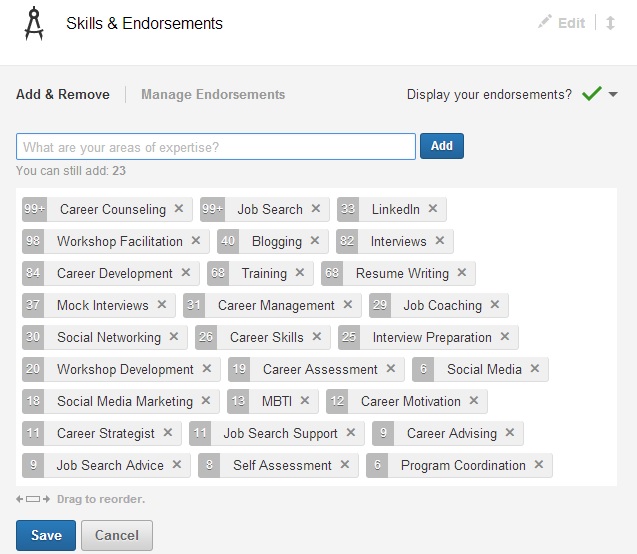
How do you rearrange your skills in the order you desire? In Edit Profile select Edit Skills and Endorsements. You’ll see a field like this:

skills

Now simply move the skills in the order you’d like them to appear. I’ve moved LinkedIn (33 endorsements) ahead of Workshop Facilitation (98+) and Blogging (41) ahead of Interviews (82), as I want these two skills highlighted.

Hint 2: those of you endorsing your connections, take the hint

So if you’re endorsing your connections, take the hint. The skills your savvy connections want endorsed first are the top five to 10, not the bottom 10. Endorse them for those skills first and then endorse them for the others.

People often ask me if I see value in endorsements. I tell them only if the endorsers are aware or have witnessed the endorsees perform the skills for which they’re being endorsed. However, if LinkedIn wants us to endorse our connections–even those we haven’t seen perform–we can only trust their word on their proficient skills.

That said, I feel it’s perfectly fine to ask a connection which skills she wants endorsed–in other words, respect your connections’ order of skills. (Don’t get me wrong, I don’t think eliciting endorsements from others is ethical.)

I asked one of my connections which of his skills he wanted endorsed. His simple response was the top five because those are the skills he is strongest at. I wouldn’t know without asking him because he lives in California, and I’ve never seen him in action. Nonetheless, like Lin Sanity, I was caught up in endorsing people.

Take the hint if you’d like to endorse me by clicking Endorse next to my top five skills, because I’ve arranged them in order of preference. I’m pretty sure I perform those skills very well. I’d do the same for you.

If you liked this post, please share it.

12 P’s for productive networking

P Words

The reason why 12 laminated,  8.5″ x 11″ pieces of paper–all with one word beginning with the letter P–are hanging on a wall in a room in our career center is because I am a Procrastinator.

These 12 words are related to productive networking. Procrastinate isn’t one of them, by the way.

Had I been more diligent, I would have had a big ass poster with all these 12 P words designed and produced by a print shop. The poster I envision will hang where our networking group meets.

Tasked with the job of writing a code of conduct, I decided that simply listing words would be more effective than handing the participants a document that describes how one should act while attending the group.

A colleague and I decided that words beginning with the letter P cover a great deal of behaviors and attitudes expected from networkers. Here are the P words networkers should use while they’re networking at any networking event.

  1. Positive: How could this word not be included? Networkers, despite their feelings, should act positive, not negative. People would rather surround themselves with positive-acting folks. If you’re one who believes in self-fulfilling prophesies, this is one.
  2. Persevere: When you feel like it’s not working and are wavering between going or not going to a networking event, perseverance will urge you on. Keep attending the group until you’ve exhausted all opportunities, or landed a job!
  3. Professional: This one encompasses many other traits, but overall marks you as positive and respected by others, and speaks to how you dress and conduct yourself at an event. Great practice for the entire job search.
  4. Participate: What’s the sense of attending a networking event if you’re going to sit in a corner or leave as soon as the Leads and Needs session is over? Approach people who may be sitting by themselves, and make them feel welcome.
  5. Polite: Being polite means not interrupting others or dominating the conversations. Listen to others as good networkers would. Saying, “Thank you” and “You’re welcome” can go along well.
  6. Prepare: This word also applies to the entire job search. You must be prepared for the interview, and you must be prepared to contribute to the networking event. This means bringing your target company list and leads for others.
  7. Personal: Show your personality at a networking event but make sure it’s appropriate for the event. Be yourself, relaxed, easy to speak with, friendly. A smile goes a long way, so show your pearly whites–this shows your welcome to be approached.
  8. Present: This can include the way you dress and how you come across while delivering your elevator pitch, or simply talking to others. There are those who dress like they mean business, and others who might be in their household attire. Who’ll be taken more seriously?
  9. Punctual: Being late is rude and shows a lack of time management. Would you be late to a job interview? Then don’t show up late for the networking event.
  10. Promote: Not only should networkers promote themselves in a tactful manner; they should promote each other. When introducing a fellow networker to a member of the group, speak highly of that person.
  11. Progress: Strive for progress. This can mean setting goals to meet three new people at an event every time you go, or if you like to mingle, come away with 10 business cards.
  12. Productive: The result of all these P words. You must be productive in your networking, or, for lack of better words, it ain’t worth it.

The words that hang on the wall in our room are a great reminder of how one should conduct their organized networking. Eventually–nay, soon–I’ll get around to having them made into a stunning poster or two. I don’t want to wear the letter P on my chest for eternity; it standing for Procrastination.

If you enjoyed this post, please share it on LinkedIn or Twitter.

Job search tip #5: Write a powerful cover letter

In the last article we talked about revising or writing your resume. Now we’re going to look at writing exciting cover letters. Your cover letters allow you to show your personality and demonstrate your strengths for a particular job.

All too often, though, the opening of a cover letter stops employers in their tracks. What’s your take on the following opening paragraph?

I read on Monster.com of a marketing communications writer position at ABC Company. Please consider my credentials for this exciting position.

Boring. That’s right, the opening paragraph of this cover letter is enough to bore employers to tears, yet this is a typical opening paragraph of many cover letters. In fact, you’ll see examples of this kind of opening paragraph in cover letter books or guides that display such apathetic, thoughtless verbiage.

You’ll be reentering the workforce, so make your mark with a cover letter that grabs the employer’s attention from the beginning. Let him know that you understand the nature of the position, the industry, and even the competition.

Are you looking for someone who has achieved success in marketing at one of your competitors? At my previous position I rose from an office clerk to authoring press releases and content for their website, as well as representing them at tradeshows in the New York City area. My supervisor at XYZ Company, John Bruce, told me to contact you regarding the marketing communications position you have in your marketing department.

Note: notice how the writer throws in a referral in her opening paragraph from her supervisor. Nice touch. 

Now you’ve grabbed their attention. But you won’t stop here. You’ll demonstrate your skills further in the second and third paragraphs.

At XYZ Company I was entrusted to write press releases that were published on the company’s website and featured in Mac World. My writing skills allowed me to pen “Words from the President” on the company’s website. So impressed was the president with my knowledge of the products and ability to promote them, that he rarely proofread the column that I wrote. I demonstrated the ability to quickly understand the company’s complex products and how to relate to our stakeholders. In addition, I became more involved in the organization of our quarterly trade shows, which was a testament to my diverse skills.

A quote from a supervisor or higher is a nice touch. The quote below can serve as the third paragraph.

“Maggie’s talent as a writer is truly impressive. She understood the direction of our organization, the value of our products, and our customers’ needs better than marketing writers that came before her. I wish we could keep her on at XYZ Company. Please don’t hesitate to call me if you have any questions regarding this fine, young talent.” Cheryl Masson, President, XYZ Company.

To conclude your cover letter, emphasize your interest in the position to show your enthusiasm and motivation.

I look forward to meeting with you to discuss this exciting position. I will contact you next Wednesday at 2:00 pm to arrange a convenient time for us to meet. If you would like to contact me before then, please call me at 815.555.0202 or at maggiejones@myemail.com.

Does this sound too forceful? Keep in mind that employers want job candidates that are confident and willing to take charge. Indicating a time you’ll call is perfectly acceptable, just as long as you follow through with your promise.

Some question the use of a postscript, but it will capture the reader’s attention. Finish with:

PS. Mr. Bruce will be willing to talk with you about my credentials.

The next tip is about creating your accomplishment list.

If you enjoyed this tip, start at the beginning with tip number one.


Your handshake matters more than you might think: 10 different ways to shake one’s hand

I wrote this article a year ago, but it’s worth reiterating how important a handshake is in your job search, business, and life.

I’m a firm believer that you can tell a lot about person’s character by his handshake. In a recent interview workshop, I told my attendees about my obsession with a good handshake and, as a result, a half  hour conversation ensued.

At the moment I’m talking about the the importance of making a great  first impression. I tell them, “Someone’s handshake tells me many things about a person. If it is firm, the person is trustworthy, open to engagement, warm spirited, confident, and basically someone who I’d allow my daughter to date.” They all laugh.

I get sidetracked and tell them about how my daughter dated a boy who shook my hand for the first time with a limp handshake. I told her soon afterward that her boyfriend better learn how to shake hands if he wants to get anywhere in life. She told me I was being ridiculous.

“If it’s limp,” an attendee speaks out, “the person is suspicious, anti-social; someone I wouldn’t want my granddaughter to date.” Laughter erupts. He has stolen my thunder.

An article on CareerBuilder.com states that a proper handshake makes employers overlook some deficiencies in jobseekers: “Prospective employers said they’re more likely to overlook visible body piercings and tattoos than an ineffective handshake, according to a 2001 survey of human resources professionals.” Though this article is dated, I think a good handshake is still a vital component of the first impression.

About.com, under an article about social disorders, talks about 10 “Bad Handshakes.” They are:

  1. “I am dominant”
  2. “Bone Crusher”
  3. “Limp Fish”
  4. “Just Fingers”
  5. “Cold, Clammy, or Sweaty”
  6. “The Double-Hander”
  7. “The Long Handshake”
  8. “Without Eye Contact”
  9. “The Miss”
  10. “Too Close”

I can relate most to the “Bone Crusher” because I’m an occasional bone crusher. I once shook a woman’s hand with such force that I thought I heard her bones being crushed, or at least shifting. She winced in pain. The handshakes that drive me mad and make me want to take a hot shower are the “Limp Fish” and “Cold, Clammy, or Sweaty.”

I reached out to my LinkedIn family and posted a question about the significance of handshakes, and there were some pretty good responses. One person, wrote, “The handshake is part of the first impression. Not so firm as to cut off my blood circulation and not limp like holding a slice of calf’s liver. And God help us, not sweaty either. So make sure your hands are dry before you extend a handshake.” I love the image of a “slice of calf’s liver.”

On the other hand, a respondent to my question wrote: “I’m interested in the information the person [has] to communicate to me, not peripheral customs like a handshake.” I appreciate his opinion; not everyone places so much stock in a handshake as I do. But I don’t buy it. The “Limp Fish” would send anyone over the edge, regardless of the information.

Wiki.answers.com writes extensively on the subject of the handshake, including the proper position. “Your body should be approximately two cubits (distance from fingertips to elbow) away from the other party. Your shaking arm should be bent so that the elbow forms a 135-degree angle, and the forearm is level with the floor. Your hand should neither be on top, nor underneath the other person’s hand. Both parties’ hands should be straight up-and-down, even with each other. The web of your hand (skin running between the forefinger and the thumb) should meet the web of theirs.”

Okay, some pundits go a bit far with their explanation of a proper handshake. I definitely feel that a person should maintain eye contact while shaking an employer’s or business person’s hand, but keeping her elbow at a 135 degree angle is a bit extreme.

My customers attend my interview workshop to learn the tricks of mastering the interview, but it’s important for them to master the first impression before the interviewer starts asking the difficult question. When I meet someone for the first time, I size them up immediately based on their handshake; but that might just be me.

Misconceptions about introverts. 4 facts about both types

I always want to know the inner thoughts of people, so on occasion I’ll ask my Myers-Briggs Type Indicator (MBTI) workshop attendees if they had their choice what they would prefer, introversion or extraversion.

Most of the participants enthusiastically say they’d prefer the latter. Usually these are the true extraverts or extravert wannabees–the introverts, secure in who they are, don’t volunteer their opinion quickly.

My next line of inquiry would be asking the group how extraverts are perceived by society. Usually the extraverts and wannabees are the first to speak. They each take turns extolling the characteristics of the extravert: fun…outgoing…full of energy…friendly…confident…they like to party…loud….

Fair enough. Now I ask the group how they perceive the introverts; again the ones who speak up first are usually the extraverts and wannabees who talk without giving it much thought: shy…quiet…secretive…withdrawn…boring…don’t say much….The introverts reserve their comments for a better time to speak.

I help the group to see a pattern; extraverts are described in more favorable terms, save for “loud”; while introverts are described in negative terms, save for “quiet.” Enough articles have dispelled the belief that introverts are shy, secretive, withdrawn, and boring; but society still sees them as the less desirable of the two…ergo my attendees’ desired preference for extraversion.

Here are some facts we learn about both dichotomies:

  1. Extraverts are talkers and learn best by bouncing ideas off one another; introverts prefer written communications and enjoy the process of researching on their own.
  2. Extraverts are great with small talk, the envy of introverts; but introverts are known for their capacity to listen.
  3. Extraverts feel confident in large groups, whereas introverts prefer smaller more intimate groups. This is not to say, however, that introverts can’t function in large groups–it takes more effort and getting outside their comfort zone.
  4. Extraverts are uncomfortable with silence, while introverts relish it. Introverts feel no need to fill empty space and need time to re-charge their batteries.

Perhaps because my workshop group trashes introverts, or because I’m an introvert, I feel the need to defend the less desired of the two. I stress that introverts can be outgoing and fun…for a certain amount of time. Then it’s time to recharge their battery. Read an article,  7 things extroverts should know about introverts (and visa versa)on how extraverts and introverts can better understand each other’s behavior.

It’s not that introverts are necessarily quiet, don’t talk, or are boring; they like to process information before speaking. What they say can be as brilliant as what extraverts say; introverts just say it when they’re ready. (Unfortunately we sometimes miss the window of opportunity.) The article mentioned above says it nicely, “If you want to hear what we have to say, give us time to say it. We don’t fight to be heard over other people. We just clam up.”

The final question I ask the group after we’ve discussed the accurate personality traits of both factors is, “What do you think I am, an introvert or extravert?”

Usually the extraverts and wannabees say without thinking, “Definitely extravert. How could you get up there and talk if you are an introvert?” Others who have been paying attention and shuck off the stereotypes say I’m an introvert who has the ability to demonstrate more “extravert” type tendencies. These are the introverts who speak up with conviction. And they’re correct.

If you enjoyed this post, please share with others. 

Job Search Tip #4: Revise…or…write your résumé

In the last article we looked at assessing your skills. Now we’ll look at revising your résumé or writing one. There are three notable challenges jobseekers are facing when revising or writing their résumé:

  1. Many haven’t kept up with writing their accomplishments while working.
  2. Some jobseekers are looking for work for the first time in 10, 20, even 30 years and now need to produce a résumé.
  3. Many college grads are looking for full-time work for the first time in a turbulent economy.

In all cases, today’s résumés have changed, with a focus on industry keywords, accomplishments, short-easy-to-read text blocks, and targeted delivery of your résumés.

Most résumés these days have a keyword-rich Branding Headline that accurately describes your occupation and areas of strengths. Each strength should be intended for a specific position. Here is an example:

Marketing Specialist | Public Relations | Program Development | Increase Visibility & Revenue.

A Performance Profile can make or break you. You have to grab the employer’s attention with a no-fluff, fact-revealing statement that serves as a snapshot of you and what is to follow for the rest of the résumé. To simply write the word, Creative does not have an impact.

However something like the following carries more weight:

Demonstrate creativity through initiating programs that have contributed to financial success by 55% annually.

More specific information should be included in your work history.

This statement should be directly related to what skill/s the employer’s looking for. As it’s relevant to one particular position, it may not be relevant to others and, therefore, shouldn’t necessarily be included on every résumé you submit.

Your Competency Section is meant to show employers what skills you possess, as well as additional skills that may be a plus to the employer. They are key words that should also show up in your headline and professional profile.

The Work History is the most important part of your résumé, so it must contain high-impact information that demonstrates your accomplishments. Duties are simply…duties; however, accomplishments sell. If you have a boatload of duties on your résumé, do your best to see how they can be turned into statements that show positive impact on the companies for which you worked.

Duty statement: Spearheaded the first continuous improvement committee at the company.

This is an accomplishment statement with a quantified result. Spearheaded the first continuous improvement process that eliminated redundant, costly programs. This resulted in an overall savings of $200,000.

Shortened one-line version: Spearheaded continuous improvement process eliminating costly programs, saving $200,000.

The final piece is your education section. For college grads, I’m a big fan of putting your hard-earned degree beside your name at the top of your résumé. In your education section fully spell the degree. And proudly list your GPA if it is higher than a 3.5/4.0 (there’s some debate over this).

Masters of Business Administration
University of Massachusetts, Amherst, MA
GPA: 3.94/4.00

Martin Yate says it best, “No one likes to write a résumé.” He also says that a résumé is our most important financial document. No one said writing  your résumé would be easy, but as time goes on it becomes easier. Remember that each résumé must be tailored to a specific job. Even in this turbulent economy, jobs are being had; so never give up on your job search.

Next Friday we’ll look at writing your cover letter.

5 components of a jobseeker’s company called Me, Inc.

My son just learned how to cut the lawn…well sort of. I still have to follow him around, helping to guide the mower and making sure he doesn’t run over any objects hidden from his sight. The first time he cut the lawn, he ran over our dog’s wire cable, causing me to wonder if this would be the first and last time he’d cut the lawn.

As I’m helping him to better learn the fine art of lawn-mowing, I fantasize about my kid starting his own business, which would ultimately depend on him (or me) creating a company.

When I think about my 11-year-old son starting his own lawn mowing business, I relate it to my jobseekers who all have their own business–it’s called Me, Inc., a term Martin Yate applies to jobseekers, who are ultimately responsible for selling a great product, themselves.

In an article Martin wrote, he talks about the five components of Me, Inc. as they apply to jobseekers, which makes total sense because jobseekers are a business of one. Here is Martin’s explanation, verbatim, of the five components necessary for jobseekers to run Me, Inc.

  • Research and Development: Every corporation invests in the ongoing identification and development of products and services that will appeal to its customers. For Me, Inc. this translates into skill-building in response to market trends, which you do by connecting to your profession and by monitoring the changing market demands for your job on an ongoing basis.
  • Marketing and Public Relations: The effective branding of Me, Inc. as a desirable product requires establishing credibility for the services you deliver and positioning those services so that your professional credibility becomes visible to an ever-widening circle, both within a company—to encourage professional growth—and within your profession—to encourage your employability elsewhere.
  • Sales: Me, Inc. needs a state-of-the-art sales program to constantly develop new strategies to sell your products and services. This will include resume, job search, interviewing, negotiation, and other career management skills that must be developed to sell your products and services effectively.
  • Strategic Planning: This encourages you to create concrete plans to achieve the goals you have for your future: plans for growth with your current employer, plans to time strategic career moves that take you to new employers or new professions. Creating actionable strategies for the realities of your professional future enables you to make your plans happen on your timetable and not as a panicked reaction to unforeseen employment disruptions.
  • Finance: Treating personal finance more seriously will ensure you invest wisely in initiatives that will deliver a return on investment. You must invest in your future success rather than fritter away your income on the instant gratification drummed into your head by 24/7 media.

My son has years to go before he establishes his prosperous lawn-mowing company, but jobseekers must put to use what Martin proposes for a successful company called Me, Inc. Only when they take ownership of their job search will they operate as a successful business that sells a great product.

Martin Yate, CPC, author of Knock ’em Dead: Secrets & Strategies for Success in an Uncertain World, is a New York Times and international bestseller of job search and career management books. He is the author of 11 job search and career management books published throughout the English speaking world and in over 50 foreign language editions. Over thirty years in career management, including stints as an international technology headhunter, head of HR for a publicly traded company and Director of Training and Development for an international employment services organization.

4 ways for introverts to engage in small talk at a networking event

Networking EventI’m not  fond of forced small talk. There, I said it. I particularly don’t look forward to entering a room full of strangers and talking about myself.

Like at a networking event, where everyone is delivering their commercial like automatons.

But I do small talk at networking events, and I’m pretty good at it most of the time.

Small talk is important in professional pursuits; it leads to deeper conversation. An excellent article, Hate Small Talk? One Approach Anyone Can Use, talks about how to approach people and help them engage; thus, helping them conduct small talk and, as a consequence, help you with your small talk.

Jeff Hadden is the author of this article. In it, he writes: “I dread the thought of walking up to people I don’t know and making small talk. Not because I don’t like people, but because in that situation I really don’t like me. I’m not outgoing, I’m not gregarious, not extroverted. I’m the ultimate wallflower.”

I love honest writing, especially when it illustrates how I feel. But here’s the rub: introverts have to improve their small talk abilities, regardless of their comfort level or desire. Small talk generates business and the job-search leads.

If, like me, small talk doesn’t come easy, this is what can you do about it.

1) As the author of the aforementioned suggests, approach someone who is struggling to engage. Here’s how it might go: “Hi. I’m Bob. What do you think of the event?”….”Yeah, it is crowded in here.” Where’re you from?”….”No kiddin’? I’m from Lowell, a small city north of Boston…” This can lead to your elevator pitch…or not.

2) I’m fond of asking questions. My kids think I’m weird, like I’m interrogating them; but it gives me some fodder to respond to. I tell my workshop attendees I’m the King of Asking Questions. “So, what brings you here?” “What do you think of the guest speaker?” “You’re from Tampa (noticing name tag). What’s the weather like down there at this time?” Just remember not to sound like you are interrogating your fellow networkers; allow them to ask you questions, as well.

3) Go prepared to an event by arranging a date or two. I’m going to an event on Tuesday, so I invited a guy I know to attend with me. I’ve got someone with whom to talk if nothing is happening, as well as someone to introduce. “You need help with your website? I’d like to introduce you to John. He’s a wiz at fixing websites.”  If the conversation takes off, great for John. But now I’m alone, unless my second date is there.

4) Don’t bother working the room. There’s no law that says you have to collect 10 business cards, most of which will go into the circular file cabinet when you get home. You might meet someone with whom you have a great deal in common, perhaps there are business or job-search benefits to explore. Great. I’m not trying to give you an out here, just a semblance of success.

If you were to ask me where small talk rates as one of my activities, I’d place it below watching golf. I much prefer, as do most introverts, having a few lengthy conversations with people–most likely somewhere quiet. I know it’s important, but I find it extremely unnatural.

If you enjoyed this post, please share it.

Job Search Tip #3: Assess your skills

Last week we looked at assessing your work values. Now we’re going to look at assessing your skills.

When asked at the interview about your greatest strength, you’ll most likely respond by talking about one or two of the three skill types: technical, transferable, or adaptive (personality). You might address your expertise in C++, market analysis, team building, or innovation, for example.

Of course the best policy is to talk about skills that relate to the job at hand. In other words, if the company or organization is looking for someone strong in communications, customer service, and Oracle, these are the skills you’ll highlight, providing you’ve demonstrated them with accomplishments.

The same strategy applies to writing your tailored résumés and cover letters, and your LinkedIn profile. Your emphasis will be on the skills required to succeed at the position for which you’re applying.

Assessing your skills. Knowledge of your skills is not only import in succeeding at the interview or when writing effective job-search documents; you’ll highlight them when networking and sending follow-up letters, as well as preparing your elevator speech. It’s important that you know the difference between the three skill types and can talk to them with conviction.

Technical skills are absolutely required to do the job. Let’s say you aspire to be a marketing manager. Technical skills for this occupation include, but are not limited to:

Product Marketing

Retail Brand Management

Pricing Distribution

Account-Based Marketing

Transferable skills are universal: If you think any job can be performed with technical skills alone, you’re sadly mistaken. (You’ll notice that the list above is shorter than the subsequent lists. Your transferable skills are necessary, if not more than your technical skills. 

When thinking about your transferable skills, think about them completing the thought, I can….Here is a list of transferable skills considered important in general, but by no means is it conclusive. 

Knowledge of Basic Marketing Principles Communications Skills (Listening, Verbal, Written) Analytical
Managing Priorities Management Multicultural Sensitivity/Awareness
Collaboration Strategic Thinking Motivating Others
Problem-Solving Research Coordination
Computer/Technical Literacy Planning Reasoning
Organizing Project Management Presentation

Adaptive skills define you as a person and worker. How would you describe your work habits? What makes you a fit in the company? The answer to these questions has a great deal to do with your adaptive skills. In fact, some employers rate these as some of the most important skills, yet some jobseekers disregard them.

You might describe yourself as a team builder who consistent, fair, insightful, and others supporting personality skills. When thinking about these skills, thing about them completing the thought, I am….Here are some common adaptive skills:

Intelligent Leader Have Vision
Honest/Moral Adaptable/Flexible Tenacious
Dependable Creative Loyal
Positive Motivated/Energetic/Passionate Professional
Self-Confident Diligent A Team Player

From this limited list of transferable and adaptive skills chose the ones that best describe you and are most important to what you do, and also what the employer seeks in his/her next employee. Keep in mind that your transferable and adaptive skills play a major role in shaping you as a productive employee.

Next Friday we’ll look at revising or writing your résumé.