Tag Archives: LinkedIn profile

7 sins you’re committing with your LinkedIn campaign

You’ve heard of the seven deadly sins—Pride, Envy, Gluttony, Lust, Anger, Greed, Sloth. Two years ago I heard a podcast talking about them. Naturally, I thought about how they could relate to the job search, so I wrote an article titled, “7 job-search sins and what to do about them.

job-search-sins

Two years later I’m writing an article focusing on the sins you’re committing with your LinkedIn campaign. They are not the deadly sins discussed in the podcast I listened to, but they can definitely hurt your campaign and, consequently, your job search.

1. Apathy

If you’re put little to no effort in creating a strong profile, developing a network of like-minded people, and engaging with your network; your campaign will hit rock-bottom. At this point you need to determine if you should even be on LinkedIn.

Instead: LinkedIn takes work. Start by attending free workshops to learn how to write a profile that sells your value, develop a network, and engage with your network. You can find free workshops at One-Stop career centers across the US.

Another option is hiring a career coach who can teach you the ropes. Look at paying your coach as an investment for the future. Your coach will teach you how to master your LinkedIn campaign, which you can use if/when you want to leave your next job.

2. Fanaticism

The opposite of apathy, you can hurt your LinkedIn campaign if you’re overdoing the three components of your campaign (profile, network, engagement). An example is trying to optimize your profile by doing a keyword dump in order to be found.

Yet another example is taking engagement too far. I’m sometimes guilty of posting too often on LinkedIn. (Some of you who know me are thinking, “No kidding, Bob.”) When you do this you come across as a fanatic or even desperate.

Instead: Understand that optimizing your profile is important but also important is branding yourself with a profile that is focused, demonstrates value with quantified accomplishments, and shows your personality.

Don’t over engage; pull back on the throttle. One golden rule to follow is to post one time a day, four-five days a week. Here’s the thing, LinkedIn’s algorythm is more interested in quality, not quantity.

3. Anger

This is one of the seven deadly sins and one that comes into play with your LinkedIn campaign. There are LinkedIn members who come across as angry and, as a result, seriously damage their on-line brand and lengthen their job search.

An example of anger is bashing recruiters and hiring managers. Do you think employers aren’t reading what you write on LinkedIn? Don’t be naive; hiring authorities are trolling LinkedIn for talent. If they see your outbursts, you will be passed over.

Instead: When you find your blood pressure rising, resist commenting something like, “All employers practice age discrimination” or “I’m qualified for positions. What more do I have to do?” Remember that hiring authorities hold the cards; keep your angry thoughts to yourself.

4. Selfishness

It is a sin to expect help from others but be unwilling to help others. In fact, helping others first should be your mindset. One of my valued connections, Austin Belcak, writes about giving on LinkedIn as his number one LinkedIn tip for 2020. I agree.

Someone who is selfish will invite a LinkedIn member to their network and immediately ask for a favor. Another example is people who steal thoughts from other LinkedIn members—perhaps profile verbiage— and use them as their own.

Instead: Think of giving before receiving. This sentiment has become somewhat of a cliche, but it’s so true. One example of this is sending an article to one of your new connections that you think they would appreciate. Just this morning a long-time connection sent me an article that I found compelling.

5. Humility

To brag is sinful. To not promote yourself within reason is more sinful. As a career strategist and LinkedIn trainer, I encourage the appropriate amount of self-promotion. Your profile, like your résumé, should express the value you’ll deliver to employers. Avoid using platitudes you can’t back up.

Connecting with only a handful of people because you think other like-minded people don’t want to connect is counter-intuitive; LinkedIn is about developing a network of like-minded people. Similarly, feeling that because you’re unemployed and don’t have the right to write long posts is absurd.*

Instead: Many times I’ll sit with our career center clients to talk about their accomplishments. Without failure they tell me they have no accomplishments. But when I ask probing questions, the accomplishments come pouring out.

You have an obligation to promote yourself in your written and oral communications. Because if you don’t, no one will.

6. Denial

There are two types of denial. The first is denying that you need to be on LinkedIn. I see this with some of my clients who don’t believe in the power of LinkedIn for job-search success; continuous learning; and connecting with others to develop enriching, life-long relationships.

The second is denying that LinkedIn isn’t for you. Contrary to what I say about needing to be on LinkedIn; some people who are on LinkedIn have to come to the realization that the platform isn’t for them. This speaks to sin number one, Apathy.

Instead: There are three considerations. First, determine if LinkedIn is of value to your job search? For many it is, for some it isn’t. Second, if you join LinkedIn, understand it will take work to be successful. Lots of work. Third, it’s a life-long process; your campaign continues throughout your career.

7. Abandonment

I’ve seen people disappear on LinkedIn after a nice run. This is a sin because you’re not finishing what you started. Yes, LinkedIn is a lifelong endeavor. This sounds extreme but let me ask you, “Do you want to abandon networking and learning?”

There are those who are diligent about using LinkedIn while searching for work, but once they land their job they do the disappearing act. This is a huge mistake that I address below.

Instead: I strongly assert that you should not only use LinkedIn to find your next gig; you should also use LinkedIn while working. There are many reasons for this.

  1. The old saying, “Dig your well before you’re thirsty” is real. If I had a dollar for every client who struggled to get up to speed upon being unemployed, I’d be a rich man.
  2. LinkedIn can help you connect with potential business parties after you’ve landed our next gig.
  3. You are the face of the organization. Therefore, you should present a strong profile and show your engagement.

If these three reasons aren’t enough, re-read the second paragraph of sin number 6. In other words, there’s no helping you.


Here we have seven sins, albeit not deadly, you should avoid committing. But if you are committing any of them, pay attention to my recommendations on how to fix them.

*I remember one of my former clients saying, “I have no right to write articles on LinkedIn because I’m unemployed.” No word of a lie. Ironically this person is a director of Marketing and an excellent writer. Repeat after me, “I HAVE A RIGHT TO SHARE MY EXPERTISE EVEN THOUGH I’M UNEMPLOYED.”


The Best Way to Direct Visitors to Your Important LinkedIn Sections

Raise your hand if you visit LinkedIn members’ profiles and get as far as their Additional sections. Don’t feel guilty if you don’t. Rarely do most LinkedIn members travel that far down the LinkedIn profile. I usually don’t.

Accomplishments2
Photo: Flickr, Amit Shetty

Now raise your hand if you list your volunteerism, publications, projects, patents, organizations, and other noteworthy achievements. I think I’m hearing crickets?

Quite honestly I don’t blame you if you didn’t raise your hand to the questions above. After all, these major achievements (classified by LinkedIn as Additional) are buried in the basement of your profile; they can’t be moved. (I wrote about this here.)

I wonder if LinkedIn users even know if these additional achievements exist.

Note: these achievements were once bundled in what was called Accomplishments but are now separate, as they should.

The question now is how do you alert visitors of your LinkedIn profile to your major achievements?

One solution: mention them in your About section

You can write about your outstanding projects and other notables in your Experience section, which is a good policy. However, I suggest making note of them in your About section.

About is most likely the first section visitors will read. Unlike your resume, it is more personal and, in my mind, more enjoyable to read.

Enjoyable in what way, you might wonder? In About you can: provide a creative hook in your first three lines; express your passion for what you do; describe the problems in your industry and how you can solve them. It’s a section where you can tell your story. Read what I wrote about here.

How to point your visitors to your Additional sections

Given that your About section can draw the attention of visitors, doesn’t it make sense to point your audience to your major achievements? Unfortunately, we don’t yet have the ability to post links to them, so words will have to do.

For Projects you can write a brief statement:

“If you would like to read about my outstanding projects in Landscape Architecture, scroll down to Projects.”

Perhaps you Published a book or article. Offhand I can think of three of my close connections who’ve written books, Jim Peacock, Brian Ahearn, and Donna Serdula. The could write in their About:

“Do you know I wrote a book called (name of book)? Well, you can find it in the Publications section at the bottom of my profile.”

Many of my clients have Patents for products that they’ve created in their career. This can’t go unnoticed. If you’ve own patents, draw your visitors’ attention to them:

“I’m proud of the patients I own in the field of medical devices. They’re listed in my Patents section below.”

College students should make use of the Courses they’ve taken and Test Scores they’ve achieved. If you earned outstanding Honors and Awards, use About to point visitors to them.

Other types of accomplishments not obvious unless you point your visitors toward them include: Languages, Test Scores, and Organizations. You now have the idea of how to help your visitors find what can be a bona fide feather in your cap.


Recently I shared a long post titled: YOUR LINKEDIN ABOUT SECTION IS MORE IMPORTANT THAN YOU THINK. This post is relevant because it shows how others feel about the importance of the About section. Thus, it can be a vehicle for directing your visitors to notable achievements.

10 LinkedIn New Year resolutions I know I WILL achieve

Like many people, I dislike New year resolutions, mainly because we rarely achieve them. But this year I’m going to set some resolutions that are attainable. The resolutions I vow to achieve are ones that relate to LinkedIn. These are ones I can do.

2020

I also hope my resolutions will benefit other LinkedIn users, namely job seekers; that they will emulate them. The following are 10 actions I will take in 2020.

1. Reach out to more people in a personal way. Admittedly of the nearly 4,000 connections, I haven’t met, in person, most of them. I plan to meet at least 40 of them. I will be a guest speaker at the Merrimack Valley LinkedInLocal, so this will be a great opportunity. Zoom and Skype count as making a personal connection.

2. Spread the word to people on LinkedIn. There are too many young adults and older adults who are not benefiting from LinkedIn. Sure, they have a LinkedIn account, but they’re not using it as it should be used.

Many people erroneously believe that a profile loaded with keywords will draw the attention of hiring authorities. Read 3 ways job seekers will be found on LinkedIn.

3. Get a newer photo taken. In 2016 I wrote an article entitled 4 ways your LinkedIn photo is an imposter. It feels as though my current photo is now an imposter. I’m thinking that my new one will be more theme-based, maybe one of me talking to a client. I’m not sure yet.

4. Produce even better content. I was awarded one of LinkedIn Top Voices for the content I delivered in 2019. I will continue to write articles, posts, and even videos for the upcoming year, but they will be more focused and relevant. Trending stuff.

5. Be more consistent in posting. Related to number 4, I aim to post at least four articles on a weekly basis. I will also follow my own words and improve how I comment on other’s posts. Sure there will be times when I will only react, but quality comments mean so much more.

6. Become a better curator. There are LinkedIn members who curate other’s content like pure champions. People like Mark Anthony Dyson, Hank Boyer, Sarah Johnston, Hannah Morgan, and Susan Joyce come to mind. Then there are others who only share their content. The ones who only share their content tend not to garner as many viewers.

7. Make my network even more focused. It’s important to create a like-minded network. I’ve done my best to do this, but there are many in my network who are…”dead wood.” They are not like-minded and, therefore, the content we share isn’t relevant.

8. Update my profile. I said earlier I’m going to update my photo but like many, I don’t visit my own profile as often as I should. I need fresh material and to add accomplishments to my Experience section.

9. Follow LinkedIn changes. Admittedly I don’t follow LinkedIn changes as best I can. I’m sure you’re familiar with the feeling of visiting LinkedIn and noticing something has changed, whether it’s small or big. My friend Keven Turner keeps me up to date on these changes.

10. Spend less time on LinkedIn; think quality, not quantity. I estimate that I spend close to an hour, if not more, on LinkedIn per day. I’m also on it every day of the week. The only time I wasn’t on LinkedIn were a few days when I vacationed in Italy. This will be the toughest one.


I’m sure I haven’t covered all I need to improve upon. So I will continue to add to this list of resolutions throughout the year. As a practice, I’m not a fan of New Year resolutions. I haven’t set any for my personal life. Better habits will be developed over time.

I’m curious if you have New Year resolutions for 2020. Feel free to list them in the comment section below or comment on LinkedIn.

Photo: Flickr, cg “Chasing the Light”

9 major areas where your LinkedIn profile brands you

It’s safe to say I’ve critiqued or written hundreds of LinkedIn profiles. What’s most important in a profile is that it brands the LinkedIn member; it sends a clear, consistent message of the value the member will deliver to employers. Does your profile brand you?

linkedin-alone

In this article we’ll look at nine sections of your profile where you should focus on branding yourself. When you accomplish this, you’ll have a profile that will help you land a job.

1. Snapshot Area

I call this section the Snapshot area because that’s exactly what it is: a snapshot of who you are. This section includes your background image, photo, and headline as the major components which have an immediate effect on your branding.

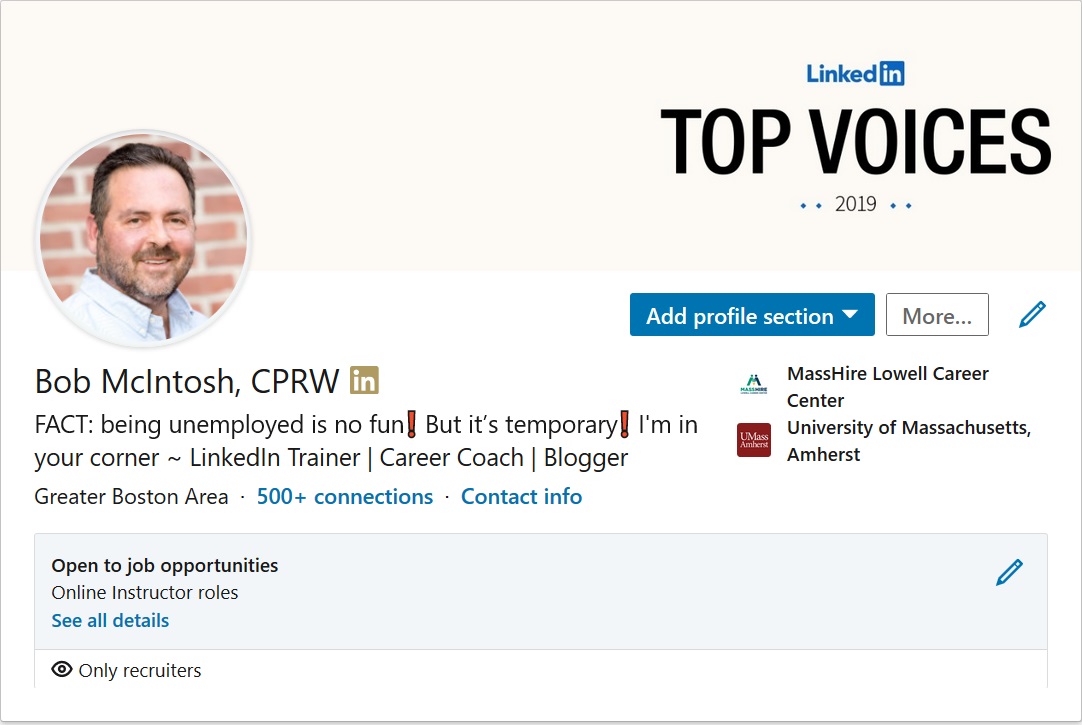
New Snapshot Bob

Your background image can serve to brand you by letting visitors know the type of work you do. For my background image, I display my LinkedIn Top Voices recognition. Other members might use a background image that speaks more to their personal interests.

If you think a photo is unnecessary, you are sadly mistaken. A profile sans photo gives the impression you can’t be trusted. In addition, people won’t recognize and remember you. LinkedIn says profiles with photos are 21 times more likely to be viewed than those without.

Perhaps most important is your headline. It’s what people first read about you and can determine if they open your profile. It might be enough for someone to accept an invite from you if written well.

Headlines that say things like “Seeking Employment” or “Finance Manager at Company X” are ineffective, as they fail to show value.

Rather, your Headline should brand you like this: “Finance Manager at Company X | Financial Planning and Analysis | Auditing | Saving Organizations Millions.”

2. About Section

This is where you tell your story, which can include the passion you have for your occupation, a statement about your expertise, or even explain how you’re changing your career. Here’s how your profile can brand you.

  1. It allows you to tell a story that can include the, why, what, who, and how. In other words, why are you passionate about what you do, who you do it for, and how you do it. Similar to your résumé’s Summary, you should list accomplishments that immediately speak to your greatness.
  2. Your About section is written in first- or third-person point of view, giving it more of a personal feel than your résumé’s Summary.
  3. It is significantly longer. You’re allowed 2,000 characters to work with, which I suggest you use.
  4. Finally, you can highlight rich media such as video, audio, documents, and PowerPoint presentations.

Read this article that describes how to craft a kick-ass About section.

3. Articles and Activity

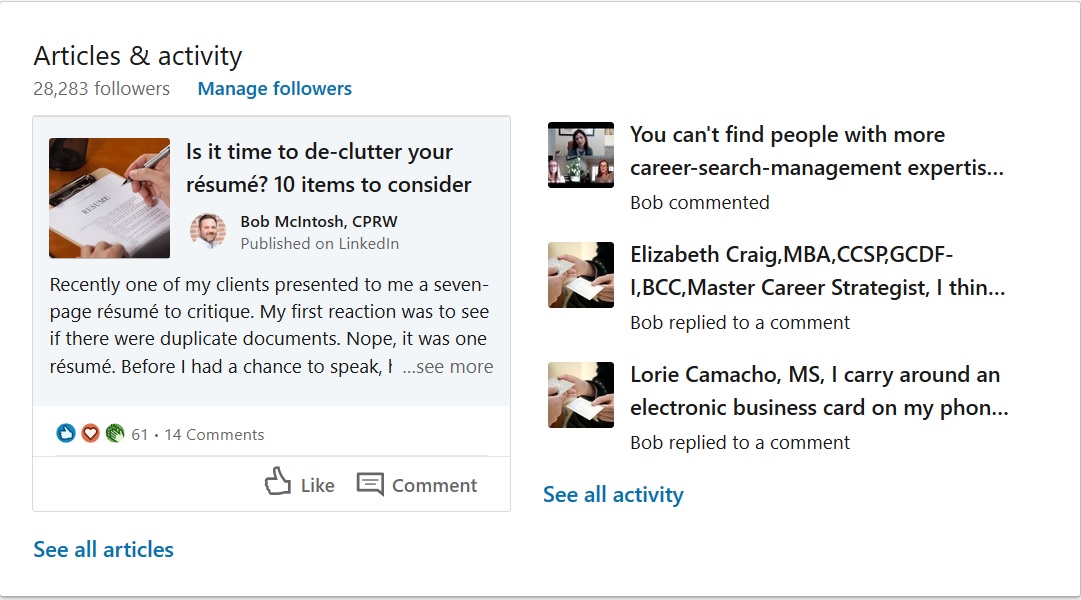
When I review people’s profiles, I pay special attention to this section. It tells me how engaged a person has been on LinkedIn. To brand yourself successfully, you want to show that you’ve engaged with your connections. Do you have to write articles? That would be ideal but not necessary.

Articles and activities

I will click “See all activity” to see how if a person is a player on LinkedIn. If I see the person hasn’t used LinkedIn in months, I will not be impressed; neither will hiring authorities.

4. Experience

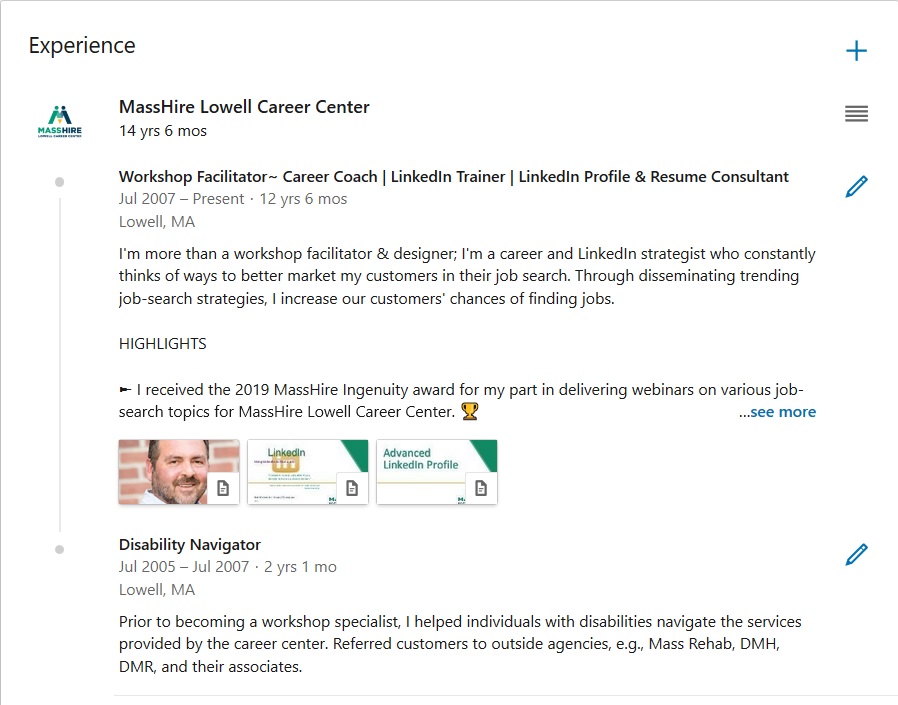
Bob Experience

I’m often asked by job seekers how they should address the experience section of their profile. I tell them they have two options: They can either write a section that resembles the work history found on their resume, or they can use their experience section to highlight only their most important accomplishments.

I favor the latter approach, but some think their profile might be the only document an employer sees, so they believe showing all is the way to go. What’s most important in building your brand is listing accomplishments with quantified results.

Good: Increased productivity by implementing a customer relations management (CRM) system.

Better: Initiated and implemented – before the deadline – a customer relations management (CRM) system that increased productivity by 58%.

It’s a good idea to use bullets to highlight your accomplishments. One of my LinkedIn connections, Donna Serdula, has created a handy list of bullets and symbols you can copy and paste for use on your own profile.

5. Education

Many people neglect this section, choosing to simply list the institution they attended, the degree they received, and their date of graduation. This might be the norm for resumes, but LinkedIn gives you the opportunity to further support your brand by telling the story of your education.

Take Mary who completed her bachelor’s degree while working full-time – a major accomplishment in itself. If she wants to show off her work ethic and time management skills, she might write a description like this:

University of Massachusetts, Lowell, MA
Bachelor of Science, Mechanical Engineering, Magna Cum Laude

While working full time at Company A, I attended accelerated classes at night for four years (two years less than typically expected). I also participated as an instructor in an online tutoring program, helping first-year students with their engineering classes. I found this to be extremely rewarding.

6. Volunteer

Build your brand by showing visitors that you are utilizing your skills and developing new ones. It’s fine to volunteer for what I call “a good cause,” but to show people you’re serious about your occupation, you’ll volunteer at a host agency that requires your expertise.

(If you volunteer for a significant amount of time, I feel it’s fine to list this experience in your Experience section, as long as you write “Volunteer Experience” beside your job title.)

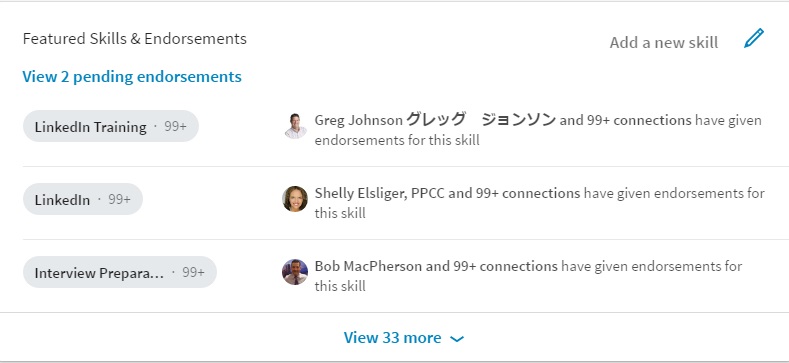
7. Featured Skills and Endorsements

A healthy Skills section consisting of 30-50 skills is another way to strengthen your brand. The skills you decide to list should demonstrate your expertise. Do not list skills you are simply familiar with.

To further enhance your brand, the skills may be endorsed by your first-degree LinkedIn connections. If you’re unsure as to which skills to endorse, here is a previous article of mine that can help you.

endorsements

8. Recommendations

This is a section I talk about in my LinkedIn workshops, and I always stress how valuable it is to receive recommendations from others, as well as write them for others. By receiving recommendations, you show the value you bring to employers. Meanwhile, writing recommendations shows your authority and what you value in workers. Either way, recommendations are a great way to brand you.

9. Accomplishments

Certifications, Organizations, and Projects are listed under Accomplishments. Prior, they had their own real estate, but now they’re buried under this header. And yes, they must be expanded like most sections.

You can still brand yourself by pointing out in your About section a project or two that you completed on time and under budget while managing a team of six.


These are just some sections on your LinkedIn profile that contribute to supporting your strong personal brand. I’m curious to know about other sections that can brand you.

Next read 5 Types of People You Should Connect with on LinkedIn.

This post originally appeared on Social-Hire.com. 

The LinkedIn quiz: 50 questions

In a recent post, I asked my LinkedIn community to take a quiz consisting of 15 questions. Those who took it were honest about their LinkedIn prowess, or lack thereof. I promised in this post that I would reveal the entire quiz I give my clients.

Jigsaw-Phishing-Quiz_sm

The quiz I give my clients consist of 50 questions. If you decide to take it and don’t score 100%, don’t worry. There is always room for improvement. I’ll be the first to admit, I don’t have a perfect score.

Some of my failures have to do with my inability to perform the “tasks,” some of them are due to caring not to perform the tasks.

We’ll start with the LinkedIn profile. I tell my clients that while it’s important to have a value-based, optimized profile, this is only one-third of the equation. Here we go.

Your Profile

Determined how you want to brand yourself, or deliver your message. Express this on your profile through the following. Answer “yes” or “no” to the following:

  1. My profile is optimized with keywords. ___
  2. I have a background image that is relevant or reflects my personality. ___
  3. My photo is professionally done, or a buddy with a good camera shot it. (No selfies) ___
  4. I have a headline that brands me with keywords or a tagline or both. ___
  5. When you look at my Articles & Activity section, you’ll see I engage on LinkedIn. ___
  6. My Summary, now called About, tells a compelling story that shows value. ___
  7. My Experience section consists of accomplishments, not simply duties. ___
  8. I utilize my Education section to the fullest. For example, I tell readers some of my accomplishments at University. ___
  9. I show my Volunteer experience because employers like people who contribute to the community. ___
  10. I list at least 30 Skills which are endorsed. (Job seekers, you’re given a break on the number of endorsements, but the employed should have at least 50 endorsements per skill.) ___
  11. In my Recommendations section, I have at least 1 recommendation from a supervisor/manager for each position. ___
  12. I’ve written recommendations for my employees, colleagues, vendors, etc. ___
  13. My Accomplishments section has at least one of these: project, publication, patent, language, grades, courses. ___
  14. I have at least media, e.g., audio, video, documents, Slideshare, in either About, Experience, or Education. ___
  15. I post videos on a consistent basis. ___

Total number of yeses ___


Another important part of your LinkedIn campaign is developing your network, which should be large, yet focused. The more homogeneous your network, the more value you’ll add to your connections.

Your network

  1. My goal is to build relationships to land a job or increase sales. ___
  2. I believe that building relationships is about giving. ___
  3. I have 500+ connections. ___
  4. At least 80% of my connections are in my industry. ___
  5. I use All Filters to search for potential connections. ___
  6. I search and connect with people using the Companies feature. ___
  7. I search for people using See Alumni. ___
  8. I know how to use Boolean Search to narrow my search. ___
  9. Before connecting with potential connections, I read their profile in full. Well, mostly. ___
  10. I send cold invites and include a personalized message. ___
  11. I send invites with a personalized message using references. ___
  12. I ask for an introduction from someone in my network to someone with whom I’d like to connect. ___
  13. I thank people for joining my network. ___
  14. I follow up with a message to new connections. ___
  15. I make an effort to call or Zoom/Skype with my new connections. ___

Total number of yeses ___

Your engagement

Here’s where the rubber meets the road; thus, more questions. You’ve created a stellar profile, connected with people in your industry and some verticals; now it’s time to engage with your network and stay top of mind.

  1. I spend at least 30 minutes a day, 4 days a week on LinkedIn. ___
  2. I message my connections on a regular basis. ___
  3. I occasionally use group messaging. ___
  4. My comments are respectful, or I don’t comment at all. ___
  5. I react (Like, Celebrate, Love, Insightful, Curious) to other’s posts. ___
  6. I react (Like, Celebrate, Love, Insightful, Curious)  to other’s posts and write a comment for each one. ___
  7. I write my own long posts. ___
  8. I react and/or share articles written by my connnections’ or online publications, for example, The Muse. ___
  9. I react and/or share and comment on articles written by my connnections’ or online publications. ___
  10. I react to people’s videos. ___
  11. I react and comment on other’s videos. ___
  12. I produce my own videos. ___
  13. I use LinkedIn’s Publisher to write articles. ___
  14. When I share someone’s communications, I @ tag them. ___
  15. I use the appropriate number of  # hashtags. ___
  16. I endorse my connections. ___
  17. I ask for and write recommendations for my connections. ___
  18. I share my connections’ profiles with other LinkedIn members. ___
  19. I give Kudos to my connections. ___
  20. I use the LinkedIn mobile app. ___

OVERALL number of yeses ___


Legend

  • 45 out of 50 correct: Grand Master
  • 40 out of 50 correct: Very Good
  • 35 out of 50 correct: Good
  • 30 out of 50 correct: Fair
  • 25 out of 50 correct: Needs work


Thank you for taking this quiz. If you are new to LinkedIn, don’t worry about your score; it will increase the more you use LinkedIn. If you are a veteran of LinkedIn, your score should be high. Maybe not perfect, but high.

As always, I’m interested in hearing about other questions I should add to this quiz. I’d like to increase the overall number of questions to at least 60.


It’s your LinkedIn profile, not your company’s: 4 areas to show it

Recently I viewed a profile from a gentleman whose current job description was…well a job description. Or I should say all about the company for which he works and nothing about him.

Company Hallway

This left me wanting to know more about him in his current role. I reached out to him, telling him it’s nice to be a company man, but that his profile should be more about him.

His response was gracious, saying he just hasn’t gotten around to updating his latest position. Fair enough.

This also got me to thinking what if your current company requires you to reference it throughout your LinkedIn profile? How do you address this in certain sections of your profile?

Abide by your company’s rules, to a point. If the company insists that you mention them on your profile, heed their request. After all, you work for them and want to keep your job. Heeding their request doesn’t mean your profile should be an advertisement for the company, though.

Important to note: my valued LinkedIn connection and Personal SEO Researcher, Trainer, Writer, Susan Joyce, believes describing the company for which one works is beneficial. She writes:

“More words, done well, about the company usually means more keywords—like the industry name, names of products and/or services; even names of corporate officers and locations can be important keywords to include.”

There are four sections on our profile where you can promote the company, while still expressing your value to the company.

Background image

This is not as problematic as with other areas on you profile, particularly if the company has an impressive image (below) that fits this space on your profile (1,584 x 396 pixels recommended).

Raytheon background

A smart company will provide its employees with a background image that supports consistent branding.

Headline

The company for which you work might require that its name is in your headline. That’s fine. In fact, some recruiters and other visitors like to see in your Headline where you’re currently working.

Simply list your company name first or last.

 New Business Development Director at (Company Name) ~ Global Marketing | Training | ~ Generating $50+ million in sales

About section

Don’t use this valuable real estate for your company’s benefit only; rather you’ll dedicate approximately one-third of it in your About section. The remaining content will be about you.

Where you place your company’s information is up to you; however, I suggest listing it at the end of your About section. The reason for this is because the first three lines should be used to highlight your value, not your company’s.

Here is an example for our New Business Development Manager.

ABOUT ME

Forging partnerships with domestic and international partners, I enhance businesses’ internal management processes. In turn, they become more productive and realize growth and prosperity.

My start in business development began five years after graduating from university. With a drive to strive for more experience and knowledge I rose to various managerial roles (10+ years) before becoming Director of Business Development.

In 2018 I conceived and marketed, on a global level, a software solution that increased office production by 210%, garnering (Company) $56 million in revenue. This solution is in use in eight countries in Western and Eastern Europe, as well as  the U.S.

A product will not sell itself. I am highly adept at training and educating inside sales and distributor sales staff in all aspects of selling. I have trained more than 2,500 sales people in 12 countries.

ABOUT (COMPANY)

(Company) sells products to many B2B distributors, as well as numerous B2C outlets. It provides business management solutions to industries that include the USDA, EPA, DoD, Energy, Higher Ed, Health Science, Transportation, and more. (Company) has gained recognition for its solutions’ ease of use in helping businesses support and automate their processes.

Experience section

It was in my subject’s Experience section that he described the company for which he works and nothing about what he accomplished. It does no good to dedicate most of the content to the company’s successes. In terms of selling yourself, this is where you do it.

Instead of denying yourself the opportunity to describe your quantified accomplishments, briefly describe the attributes of the company in your Job Summary. Let’s look at our Dir. of Business Development’s Experience section which follows my suggestion.

ABOUT COMPANY

(Company) delivers to market business management software serving the USDA, EPA, DoD, Energy, Education, Life Sciences, Food & Beverage, Transportation, and more. In this role, I led all aspects of business development including:

NEW BUSINESS DEVELOPMENT AND MARKETING

► Conceived three software solutions within a three-year time-frame, while also overseeing the global marketing efforts. The Top Tier solution:
»» Commands 30% of business management software market.
»» Has generated more than $56 million in worldwide business.

► Established (Company) as a contract vendor to (7) leading regional, national and international distributors in multiple business sectors.

SALES & TRAINING

► Increased EBITDA margin 12% while simultaneously improving margins, continually cutting costs, without sacrificing quality of brand or brand performance.

► Created sales programs, marketing initiatives and pricing matrices for all levels of customers.

HELPING BUSINESSES GROW

My success as a New Business Product Director is due in large part to the ability understand companies’ needs based on the business management market. I have an instinct to foresee what’s coming down the road and act on it.


One Exception

There is one exception to the rule. If you’re the top employee of the of a company—perhaps CEO—it’s assumed that anything under your charge has your name on it.

Also, describing in detail what you do as the CEO of the company might draw attention to the fact that you’re pursuing other opportunities.


I hope the subject of this article has taken the time to describe more of what he does in his position than the details of the company for which he works. After all, I’m more interested in his accomplishments than those of the company.

Photo: Raytheon

Photo: Flickr, stefgibson01


9 essential components of your job-search marketing campaign: Part 1

Every successful business requires a marketing campaign to promote its products or services. Businesses utilize a variety of delivery methods—social media, websites, television, radio, and other methods—to deliver their message to their consumers. Their campaign must be convincing, impactful, and informational, or it will fail.

social media phone

Like any company, a successful job search requires a marketing campaign to deliver a strong message. Obvious methods to deliver your message are the résumé and interview. But your job-search marketing campaign must consist of more than these two elements.

Part 1 of this article focuses on your written communications, as well as what comes before. Part 2 addresses engaging with your LinkedIn network and your oral communications. I’ve asked nine career-development pundits to contribute to this article. Read both parts of this series to learn about your job-search marketing campaign.

Labor market research

Before you write your résumé, it might make sense to know which skills, qualifications, and experience employers seek, wouldn’t it? This general information can be ascertained by researching the labor market. This should be your first task in you job-search marketing campaign.

Ask yourself these questions: What kind of work do I want to perform? What is my ideal salary? Is my occupation growing or declining? Take it further and ask yourself which types of companies I want to work for? Do I have a list of 15 companies for which I’d like to work?

Sarah J

Sarah Johnston, is an Executive Coach and Résumé and LinkedIn Profile Writer who understands the importance of researching the labor market. She writes:

There is a famous French quote that says, ‘a goal without a plan is just a wish.’ I’d like to go down in history for saying, ‘a job search without research and a strategy is like a trip with no destination.’

After getting crystal clear on your own personal strengths and career needs, one of the best places to start a job search is identifying a target list of companies that you’d be interested in working for or learning more information about.”

Any strong company will conduct consumer market research to determine if its products or services will be successful in a given geographic location. If they fail in this component of their market research, they will go under.


Résumé

One thing most job-search pundits and hiring authorities will tell you is that your résumé is a key component of your job-search marketing campaign. It is your ticket to interviews. However, few job seekers understand what employers are looking for in a résumé. Adrienne Tom, Executive Résumé Writer, knows what employers are looking for.

Adrienne T

To make your résumé stand out, Adrienne recommends two important strategies: making your résumé relevant and including powerful accomplishment statements. In terms of relevance, she advises:

Focus on creating good quality content. Align every point with the reader’s needs. For every point you write down in your résumé ask, ‘So what?’ and ‘Will this matter to this reader?'”

And when it comes to creating impactful accomplishment statements, she recommends listing the most important information at the beginning, which she calls “frontloading.”

Lead bullet points with results. Make it easy for hiring personnel to spot important details, fast; don’t make them hunt for it. Walk the reader through your career story, start to finish, by sharing relevant, measurable details that matter.

ashley

Ashley Watkins, Executive Résumé Writer, spent 15 years as a corporate recruiter, so she understands what employers are looking for in a résumé. She echos what Adrienne says about accomplishment statements:

Hiring managers want to know what you can do to positively impact the company’s bottom line. Use every opportunity to include numbers, dollar amounts, and percentages to validate your results. It’s crucial that job seekers bring their achievements to life and convince employers that hiring them will solve their immediate problem.

Ashley warns against writing generic, one-fits-all résumés.

Although having a clearly defined career target is the most effective way to land a job, many job seekers use a very generic résumé strategy when applying for positions online and when networking with their referral contacts. When you do not have a keyword-rich, targeted résumé focus, you are leaving it up to the reader of your résumé to figure out what you do. Therefore, increasing your chances of winding up in the ‘no pile.

Both résumé writers stress the importance of crafting a résumé that will pass the applicant tracking system. You will only accomplish this if, like Ashley advises, your résumé is key-word rich.

Successful businesses deliver a strong message that encourages consumers to buy. Your goal is to encourage employers to invite you to interviews.


LinkedIn profile

Ana L

Does your LinkedIn profile resemble your résumé? If it does, you’re hurting your chances of impressing people who read your profile.

Ana Lokotkova is a Personal Branding & Career Search Advisor, who specializing in writing résumés and LinkedIn profiles, as well as coaching interviewing. She sees the LinkedIn profile as a digital handshake.

The days of using your LinkedIn profile as a copy-pasted version of your résumé are long gone. Today, you can drop the résumé lingo and humanize every section of your profile. Your headline is the first thing people see when they come across your profile. Forget your most recent job title, and turn your headline into a slogan-like value proposition.

“Include relevant keywords that will help others find you on LinkedIn more easily. Write your summary section in 1st person. Help others learn about your WHY and what sets you apart from other professionals in your industry.

Vriginia

Another authority on LinkedIn is Virginia Franco, Executive Career Storyteller. According to her, the headline and new About section are critical to your LinkedIn profile’s success:

Storytelling as a concept is prevalent across our media today from newspapers to magazines. This is important to recognize because, in reality, readers skim LinkedIn profiles in THE EXACT SAME WAY they digest the news.

At first glance or when in a rush, readers skim the headline and the first section of the article tell them 1) what the story is going to be about and 2) help determine if the story is worth a deeper read when there is more time. Applying this methodology to LinkedIn, it is essential that a profile contains a headline and About section tells the reader what your story is about, and intrigues them to want to read more when they have time!”

Successful businesses recognize that their audiences vary. Whereas a document as factual as a résumé is appropriate for one audience, a document like the LinkedIn profile might be more appealing to another audience.

Approach letter

A little known tool for your written communications is a networking document referred to as the approach letter. In the days of digital communications, this is usually sent as an email or even a LinkedIn message.

The idea is to send this to companies for which you’d like to work but haven’t yet advertised a position. You want to penetrate the Hidden Job Market by being known by companies before they advertise a position.

In your approach letter you can ask for a networking meeting where you will ask questions about the company, a position you’re interested in, and the individual who has granted you the informational meeting.

Your questions must be illuminating, not a waste of time for the individual. Ask about potential problems the company might be facing. What are the major requirements for the position. How the individual came to working in their role and at the company. What they see the role or industry evolving in the future.

If your timing is right, the company might be trying to fill a position it hasn’t yet advertised. You could impress the person granting the meeting so much that they might suggest you to the hiring manager. At the very least ask if you can speak to two other sources.


In this article I’ve covered the written communications of your job-search marketing campaign. In part 2 we’ll look at the verbal side, which will include personal branding, networking, the interview, and following up.

8 common excuses for neglecting LinkedIn in your job search

“Are you using LinkedIn in your job search?” That’s one of the first questions I ask my clients when I sit with them. Most of them say they are using it frequently.

no-excuses

Others say they rarely are, and a few admit they aren’t using it at all and give excuses for not being on the greatest online networking application there is.

Here are 8 of the most common excuses I’ve heard from people who neglect LinkedIn.

1. I was told to join LinkedIn when I was working but haven’t used it

This is basically saying you don’t use LinkedIn. I have a Pinterest account but don’t know my user name or password. I didn’t see any reason for using it. How ignorant on my part.

I get this. Your boss or colleague suggested you join but you weren’t encouraged to use it for your benefit or the benefit of the the organization.

Smart organizations, especially those who believe in the power of B2B, will strongly suggest that LinkedIn be part of your routine.

2. My LinkedIn profile is great as is

One day I received a phone call from a gentleman who wanted to skip my LinkedIn Profile workshop so he could attend the more challenging workshop, Using LinkedIn to Find a job.

While he was talking, unbeknownst to him I was looking at his profile which was sparse and only showed 94 connections. His inflated opinion of his profile was definitely faulty. Perhaps he’d been given poor advice.

3. I posted my résumé on LinkedIn, so I’m done

Similar to excuse number 3. Whoever believes this has their head in the sand. Start your profile by copying and pasting the contents of your résumé to your profile. But that’s just a start. From there, you’ll turn it into a networking document.

Your résumé is a document you send out when applying for a job, while your profile is a place people come to learn about you as a person and professional.

Read this popular article on How to optimize your LinkedIn profile.

4. I don’t want to connect with people I don’t know

Here’s the thing, networking—whether it’s in person or online—is about meeting people and developing relationships.

Not everyone will turn out to be a valued connection, but if you don’t extend yourself, you’ll never know the potential networking offers.

Read The ultimate LinkedIn guide how to connect on LinkedIn.

5. I don’t have the time to use LinkedIn

I hear this often in my LinkedIn workshops. This is a huge excuse. I only ask them to spend 20 minutes, four days a week on LinkedIn. I see some of them shift in their seats, their eyes roll, some groans.

Using LinkedIn to find a job is an important tool in your tool chest. It’s worth it to put in the effort to help supplement your overall networking campaign.

Just because I am on LinkedIn approximately 30 minutes a day, seven days a week, 365 days a year doesn’t mean my workshop attendees have to do the same. That would be crazy.

6. I don’t want to brag

Related to the previous excuse, what you’re really saying is you don’t want to promote your value to employers and potential business partners.

You’re not bragging if you state facts and provide proof of your accomplishments. And avoid using superlatives, like “excellent,” “expert,” “outstanding.” They’re empty promises.

Too many people have given me this excuse for not promoting themselves both on their résumé and LinkedIn profile. These are people who have a more difficult time getting to the interview.

7. I don’t know how to post a status update

I get this. You’re not sure how you can provide your connections with relevant information.

You’ve just been laid off and lack the confidence to write words of wisdom. Don’t sweat it. At first share blog posts from your connections or from publications you enjoy reading.

This article provides ways to engage with your connection as opposed to just being active.

8. LinkedIn is too complicated

This must be what my daughter is feeling, as I haven’t seen her on LinkedIn…at all. I’ve also heard this from older job seekers who feel they can’t master the technology.

Granted I use LinkedIn on a regular basis, read articles from my colleagues, and have taught it to thousands of job seekers; you don’t have to be an authority on LinkedIn to use it.

LinkedIn might not be as sex as Instagram, but it’s purposes are to help you land a job and, once you’ve landed that job, use it for business purposes. What’s complicated about this?


Ending thought

One young, smug man told me he’d never have to use LinkedIn; he would always have a job as the assistant to the Mayor. He was attending the workshop I was delivering out of curiosity.

After our discussion, he went on a stint of serving coffee, a far cry from what he was doing. He contacted me and asked if I’d review his LinkedIn profile. At first I was inclined to say no, but I couldn’t hold his ignorance against him.

7 reasons why you should be on LinkedIn

In almost every LinkedIn workshop I deliver someone asks me if it’s necessary to be on LinkedIn. Secretly I think they don’t want to make the effort to create a profile, develop a network, and engage with their connections. I get it. It’s like taking up jogging and wanting immediate results.

linkedin-alone

To go into explaining why these few hesitant people should be on LinkedIn would take hours to explain. Instead, I’ll direct them to this article which gives seven sound reasons why job seekers and business people should be on LinkedIn.

1. Your industry/occupation is well represented

The first thing to consider is if you’re in an industry/occupation that’s well represented on LinkedIn. If so, you definitely should be on LinkedIn. From an article on LinkedIn I found the following table:

INDUSTRYRanking 2019# PeopleRanking 2020# PeopleRanking 2021# People
Information Technology and Services119,197000120,100,000120,400,000
Hospital & Health Care214,504,000215,200,000215,700,000
Construction314,258,000314,900,000315,1000,00
Retail511250000412100000412600000
Education Management411429000512000000511800000
Financial Services610379000611100000611300000
Accounting79463000710200000710400000
Computer Software888450008992000089640000
Higher Education10822700011900000099350000
Automotive9852000099230000109210000
Government Administration128191000128860000118910000
Marketing & Advertising118201000109010000128720000
Banking138051000138790000138580000
Health, Welness & Fitness147265000147950000147770000
Real Estate157190000157850000157600000
Food & Beverages186476000177290000167370000
Telecommunications166643000167640000176950000
Oil & Energy176486000187040000186830000
Hospitality195690000196260000196110000
Mechanical or Industrial Engineering205610000206190000205970000

“While there was some movement among the industries, the top industries remained largely unchanged. The five most popular industries were ‘Information technology and services,’ Hospital Health Care,’ ‘Construction,’ ‘Retail,’ and ‘Education management,'”

5. You want to present yourself well on LinkedIn

First and foremost, you need a Powerful LinkedIn profile. If creating a LinkedIn profile gives you panic attacks, simply copy what you have on your resume and past it to your profile. But….You’ll need to further develop your profile to the point where it resembles personal resume. In other words, you’ll have to include and develop the following:

  1. Background image that reflects your occupation, industry, or interests.
  2. Quality photo that is professional (headshot and shoulders) or theme-based.
  3. Headline that brands you with keywords or a branding statement.
  4. Kick-ass Summary that tells your story. Write this in first person point of view.
  5. Robust Article & Activities section
  6. Experience section laden with accomplishments, also written in first person point of view. Yes, it can be done.
  7. Education section that goes beyond your resume’s. Talk about what happened when you were in school.
  8. Licenses and Certifications. Volunteer experience. Skills to be endorsed. Recommendations. Accomplishments.

These are the sections that constitute your LinkedIn profile. However, too many people make the mistake of stopping here.

Read this popular article on creating a powerful LinkedIn profile.

You want to build your online network. The second piece of the LinkedIn Campaign puzzle is developing a focused, yet large network. Your network should consist of people who are like-minded. My goal is to maintain a network that comprises 80% of people who are in the same occupation and industry.

However, everyone, job seeker or employed, should extend beyond people in their occupation and industry. Below is a pyramid of various types of potential connections. I list the most important people with whom you should connect from the bottom up.

pyramid-of-connections-21

Read this post to learn how to optimize your network: The ultimate LinkedIn guide: how to optimize your network

You want to engage with your network. You’re finally there. Now you need to communicate with your connections to solidify your community, or tribe. There are many ways to to engage with your connections. Here are some examples:

  • Direct messaging your connections.
  • Writing long posts to express your views. Yes, even if you’re unemployed, you should share your expertise.
  • Share articles that will be of value to your connections.
  • Create videos, if you’re daring. This is something that I’ve tried but realize my strength lies more in writing than producing video.
  • Writing your own articles and using LinkedIn as a vehicle, or writing directly on LinkedIn’s Publishing feature.
  • At the very least, reacting to your connections’ posts.
  • If you don’t engage with your connections, you ‘ll be forgotten. Out of sight, out of mind, as they say. As well, you get more views when you engage with your network.

Read this popular article on engaging with your connections.

6. You want to support your strong personal brand

You worked hard to brand yourself by the work you’ve done in the past. Further, you were respected by your colleagues. Now you have to present yourself to the world as someone who will add value to an organization.

In the job search, you will offer insightful information to your audience (network), whether it’s posts you write and comment on, articles you share or write, consistently pinging your connections, etc.

You’ve also refrained from being negative on LinkedIn. And this has benefited you in the long run. Some people don’t realize that employers and other LinkedIn members take note of negativity, whether it’s bashing recruiters, employers, other LinkedIn members, etc.

7. You want to continue using LinkedIn when you’re working

I’ve spoken about using LinkedIn to find a job. Now I want to reinforce the message that you should not stop using LinkedIn once you’ve found a job. All too often I see this happen.

Continue to grow your network. The old saying, “Build your well before you need to drink” is partially true. More accurately would be, “Continue to build your well and engage with your network to strengthen your opportunities for future employment.” If you have to look for another job, you’ll want to have an established network.

You’ll want to be a passive candidate. Sadly, some recruiters wrongfully believe that only passive candidates (those already working) are the best ones. You’ve proven that you’re hireable; now prove that you will be a right fit for a position you desire.

Hint: make sure you have Career Interests on your Dashboard on. Only you can see this.

You’ll need to accumulate endorsements and recommendations. I see my clients lament over having four endorsements for their skills, so I tell them they need to accumulate them when they are working. Listing skills is important. Are endorsements vital? The jury is still out on this.

The same applies to recommendations. As you were asking for recommendations when looking for work, continue to ask for them. Also write recommendations for others, as it shows your leadership responsibilities.

It’s great for business. Did you know that LinkedIn was originally build to generate business opportunities? Most LinkedIn members are using it for business, not the job search. However, job seekers see it as a great way to network online for work. This said, if your job entails B2B networking, using LinkedIn is a no-brainer.


Should you be on LinkedIn? You should if:

  • Your industry or occupation is well represented.
  • Because recruiters and other hiring authorities are looking for you.
  • You might be not considered for a position.
  • LinkedIn is one big party with more than 650 million people on it.
  • You can create a strong profile, develop a focused network, and engage with your connections.
  • You want to support your strong personal brand.
  • You’re committed to using it after you’ve landed your job.

These seven components make you a strong candidate for being on LinkedIn.

*Your search will produce a slightly different number than Jim’s list did, but generally his numbers are accurate.

The (now) 50 most important words on your LinkedIn profile

By now I’m sure you’ve noticed that the new LinkedIn profile Summary has been dramatically altered. You’ve noticed that it no longer has a section header and that it is included in the Snapshot area, where only three lines are displayed—or approximately 50* words. To see your whole Summary, visitors will have to click “See More.”

50

What you might not know is that you must revise your Summary, at least the first 50 words or so. And you should do this quickly. Furthermore, you might want to develop a branding statement that grabs the readers’ attention with those 50 words.

Previously approximately 39 words were visible to your visitors, so this is progress.

The reality is that your Summary is not the one you wrote a year, two years, or three years ago. The folks at LinkedIn have sent a clear message that its new, slimmed down profile has no room for the expanded Summary of old. Too bad.

With the former expanded Summary, your value statement/s could be seen at a quick glance, particularly if they were placed within a HIGHLIGHTS section; or if you set them apart with “THE VALUE I DELIVER.” Your value statements could be placed anywhere in your Summary.

What if busy hiring authorities only read those three revealing lines of 50 words to decide if they’d read the rest of your profile? It’s live or die then. Some hiring authorities have indicated that the profile Summary is something they’ll return to. Why not entice them to click “See more”?

Writing an eye-catching opener

To see what I mean, here are some eye-catching openers from my LinkedIn connections.

Take the direct approach with your call to action. Bobbie Foedisch lets her visitors know how to contact her right off the bat and follows with a branding statement, telling visitors that CCI drives business results.

✉bobbie.raffetto@trinet.com ➡ https://ptdrv.linkedin.com/4wifrr8 ☎(610) 457-2561 ➡https://calendly.com/BobbieRaffetto-Foedisch Life Sciences benefit from an HR solution that supports innovation. TriNet Life Sciences reduces the time you spend on HR issues, so you can focus on achievin

There’s no hiding her contact information; she wants to be contacted and is making it easy to do so. Perhaps job seekers should take the same approach. Another thing I like about her opening are the colorful icons, which say something about her character.


Talk about your industry. A former client of mine, Gerald Schmidt, begins his Summary with a statement of how new technologies are relevant to product development, and that he’s a player in this arena.

New technologies have the power to transform a business, especially when brought to market in the form of new products and services. That is what I enjoy doing. Advanced materials and processes can form the basis for a product portfolio that will generate repeat revenues for years to come – if a compa

Read the rest of his profile to see his major accomplishments. They’ll blow you away.


Show you can help. Sarah Elkins is a storyteller coach who has a strong passion for helping people gain success through telling their stories.

Improve Relationships Through Storytelling <> Experiential Workshops, Keynotes <> No Longer Virtual Creator and Chief Storymaker <> Podcast Host: Your Stories Don’t Define You <> Gallup Certified Strengths Coach When we create an environment that encourages and inspires authentic connection, p

This is a clear statement about the services Sarah provides for helping people tell their stories.


Say it with confidence. Laura Smith-Proulx is an executive resume writer who makes a very strong opening statement.

Executive Resume Writer for C-Suite, Board, & Rising Leaders ● Gain a Powerful, Competitive Edge With a Razor-Sharp Message of ROI. ● As a former recruiter and the #1 US TORI Award-Winning Executive Resume Writer), I work directly with you to get RESULTS, differentiating you in a competitive job market.

Laura’s goes on to tout her achievements. She is one who believes that achievements should be stated up front. I agree.


Use humor. Sell pens to sharks? This is how Donna Serdula explains the difficulty of trying to sell oneself. A little bit of humor can grab a viewer’s attention.

➡ It doesn’t matter who you are or what you do, it’s not easy to write about yourself. You can manage complex projects, sell pens to sharks, or lead exceptional teams… but sell yourself? That’s HARD! Besides,do you even have the time (or desire) to write your LinkedIn profile yourself? You know this: People are

Donna’s statement rings true for many job seekers and salespeople. Her opening makes people want to click “See more.”


Start with your story. Mario M. Martinez is a CEO and founder of Vengreso who had a dream. His dream came true, and he wants to help you succeed.

I had a dream. That dream came true on June 20, 2017, when I announced a merger of the world’s top Digital Selling minds now under one brand. Vengreso is committed to one thing – your sales success! As a former VP of Sales, now a Speaker & Digital Sales Evangelist, I am #SalesObsessed! I’ve spent 82 cons

I like Mario’s message of meeting a goal and dreaming big.


Start with a quote. Brian Ahearn, Chief Influence Officer, let’s Robert B. Cialdini, PhD speak for him. This is a very effective way of demonstrating his value.

“You hit it out of the park! The last time I’ve seen such high marks was when we had Colin Powell as our keynote a few years ago.” – Jim Hackbarth, President & CEO, Assurex Global “When Brian Ahearn speaks, people listen. That’s because he knows his material thoroughly, and he knows how to present it supe..

I tell my clients that others’ words can speak louder than theirs. Brian starts with a bang to draw viewers’ attention to his Summary.


Have a strong branding statement like Michael Spence. There’s a lot of strength behind Michael’s 26-word opening statement.

Exec’s, Boards, and IT departments work with me to improve operational excellence and be known as forward thinking business leaders. We infuse transformative technology into your business so you can achieve more. If you want the benefits of tech and peace of mind of security, with the best TCO…let’s ta

I read the rest of his Summary and was impressed with the statement: “My teaching roots proved to be a great tool, equipping me to train and boost the intellectual capital, skill development, and performance of others. ”


The situation is more dire on your smart phone

The bigger challenge is writing a Summary opener for LinkedIn’s app. First of all, visitors only see approximately 10 words. And secondly, they have to know to tap on these words to open your Summary.

So now LinkedIn users have to ask themselves, is the Summary on their computer adequate for their smart phone app? Give it a spin to find out.


*How I came up with the number 50 words

My Summary opener contains 47 words. I’m sure the ones I included above contain more or less than 47 words.

I empower job seekers to land rewarding careers by ◆ delivering today’s job-search strategies in group and individual settings ◆ training job seekers to strengthen their LinkedIn strategy and profile ◆ writing popular articles that educate job seekers on the job search and LinkedIn. If you’re unemployed, you do

When I wrote my 47-word opener, as soon as LinkedIn truncated the Summary, I thought about my contribution to what I do. Although I couldn’t quantify my results with job placement numbers, I tried to think of the most powerful verb I could, “empower.”

If you want to learn more about LinkedIn, visit this compilation of LinkedIn posts.