
6 suggestions for paying someone to write your résumé; and my thoughts on installing a screen door

Last spring I made an attempt, albeit a weak one, to install a screen door on my house. As my wife stood watching hopeful that our house wouldn’t look like something from a ghetto, I kept thinking, “No way is this going to happen.” So it didn’t.

It should have gone this way: first, install the top, hinge, and latch trim; second, attach the 40 lb. door to the hinge trim; third, install the hardware that would make all this work, such as the handle, and the thingy that makes the door close slowly….

This is how it went: I called a contractor who said he would do the job for $35 an hour. I happily agreed.

Putting the screen door on my house got me to thinking about how writing a résumé for some people seems out of the realm of possibility; much like getting that damn screen door on my house to satisfy my wife. I started to empathize for people who feel paralyzed when they have to write their résumé.

Look, I come across people who haven’t written a résumé in years, maybe never. They haven’t used a word-processing application, don’t have a relative who has the time or inclination to write their résumé, and the thought of writing a résumé scares the hell out of them.

Here’s what I suggest for paying someone to write your résumé. Get the help you need immediately if you’re one of these folks who is paralyzed by writing the most important document in your life. Find a reputable agency that will take the time to write your résumé right the first time, and thereafter will update it for a very reasonable fee. Make sure of the following:

  1. Said agency has a stock of samples to show you and one that fits your needs in terms of a résumé and cost. A work history time-line and a list of keywords does not constitute a résumé. Believe me, I’ve seen these so called résumés.
  2. The person writing your résumé should guarantee you at least an hour or more to interview you to understand exactly what you do. Not someone who will note your occupation, go to his/her computer, create a cookie-cutter résumé, and take your $700.00.
  3. Those who require an executive résumé and can afford more than what is charged by an agency, should seek the help of a high-level writer who will focus more on accomplishments than simple duties. These expert résumé writers will charge significantly more, but their services will return your payment tenfold.
  4. My colleague, Bill Florin, makes a valid point. “An objective third party (pro writer) will see things in your history that are marketable, often things that you would discount or downplay entirely, Many people don’t like talking about and selling themselves.” Professional résumé writers make you talk about yourself.
  5. If you only require a basic résumé—truth be told, some people have minimal experience or have only done an adequate job—don’t be satisfied with a statement like, “Drove a truck from here to there.” You and your writer must get creative with your basic résumé. “Hauled an average of 20 tons of retail product, traversing the U.S.A. Driving record is spotless and time of delivery consistently met employers’ expectations.” Remember, you still have to separate you from the rest of the pack.
  6. Lastly, make sure a “soft copy” of your résumé is provided . Some writers will choke you for updating your résumé every time you need it sent out–this is after you’ve already coughed up $700.00.

Oh, if you’re a contractor who can install screen doors and perform other household tasks for less than $35.00 an hour, contact me. My house requires stucco repair and a bunch of other upgrades, as well.

The best way to answer an interview question; Prove It.

Woman Job CandidateYou’re asked the interview question, “what is your greatest strength?” To which you answer, “I would say customer service is my greatest strength.”  Paus…. Long silence between you and the interviewer…. Interviewer writes on her notepad…. She clears her throat…. Next question….

What did you do wrong?

If you say you did nothing wrong, that you answered the question by addressing the major skill the employer is seeking; you’re partly correct. What you failed to do is prove that customer service is your greatest strength. Here’s how to prove your greatest strength.

Take a breath before answering this question. “I would say customer service is my greatest strength. I listen to the customer’s needs, always asking how I can help him/her. When I understand the customer’s needs, I do my best to meet them. Can I give you an example?”

The interviewer nods and waits with anticipation for you to prove what you assert. To do this you’ll tell a story using the STAR formula, which may go like this:

Situation: One of our longstanding customers had left us prior to my arrival at Company X. I had heard the customer was unhappy to the point where he said he no longer needed our services.

Task: My vice president wanted me to persuade the customer to return. As the new manager of a group of five furnace technicians, it was my mission to win back this customer.

prove itActions:To begin with, I had to understand what made our customer unhappy, so I asked one of my subordinates who was close to the situation. He told me it was because the person who previously worked on his furnace did shoddy work and wasn’t responsive.

With this information in hand, I called out customer to introduce myself as a new manager of the company and ask him why he was unhappy with our service. At first he was justifiably angry, telling me he would never use us again. He revealed that his furnace was never cleaned, that it still smoked..

This was going to be a tough one, based on the tone in his voice. I listened to what he said and told him I really couldn’t blame him for being upset. I agreed with him that he wasn’t treated properly. I was going to make it right. Too late, he told me; he was going to go with a competitor of ours. He hung up before I had the chance to talk with him further.

I decided to go unannounced to his house to introduce myself from Company X, I was met with, “Boy, you’re persistent. I apologized for coming without warning and asked him if I could look at his furnace. He didn’t seem to mind and told me to go to the basement through the back.

“But I ain’t paying for nothing,” he told me. Fair enough, I told him. We want to regain your trust, and if I can’t fix what’s broken, I wish you the best. I am still sharp with my technical skills, so I was sure I could fix his furnace and win back his business.

I spent two hours fixing what was broken, namely the exhaust pipe was full of soot, which required vacuuming. In addition, the oil pump had to be replaced. This was not news our customer wanted to hear, but he was happy I was honest with him and for the work I had done. He also said the former technician didn’t catch these problems, or didn’t care.

When he asked me what he owed me, I told him there was no charge. I just wanted to be assured that he’d stay with our company.

Result: My customer told me that I had regained his trust. Further, he appreciated my honesty and concern that his furnace would be fixed right the first time. He returned to our company. For my efforts, he tried to give me forty dollars “to take the missus out for dinner.” Of course I refused his money.

From the above story, you see how the job candidate proves how he provided customer service in this instance. Of course the interviewer will ask more questions about customer service, both requiring positive and negative outcomes. Although this story exceeded two minutes, the job candidate was able to grab the interviewer’s attention.

Still talking about “we” during an interview?

Well, knock it off.

Commission having a Job interview.Some job candidates don’t think it’s a big deal to say “we” during an interview, when what the interviewers want to know is what the candidates have accomplished. Hiring authorities are sensitive to the constant use of “we.” If you’ve been saying “we” instead of “I,” you need to knock it off.

Employers want to know what you’ve accomplished, what value you’ll bring to the organization, what roles you played in your teams’ efforts. They could care less about what your past teammates accomplished. You are in consideration for the job, not your former teammates.

I tell my workshop attendees that now is the time to talk about themselves. Some of them struggle with this concept; they’re so proud of what they and their team members managed to accomplish because of the Herculean efforts to complete the projects or assignment. I couldn’t do it without them, they’d say. To that I say, “Where are your teammates now?”

Not to rain on your parade, but where are your teammates now? Who’s on your team in the job search?

As a former manager or a team leader, the use of “we” is more understandable, as you were the one who oversaw the team; your name is on the projects and assignments. But you should still insert “I” whenever you can; for example,

“Some of my sales people needed some guidance on installing our software at user sights, so I went with them and led them through the process. This cut down installs by at least half the time it would take. In addition, I liked interacting with the customers.”

Job candidates should answer questions by using a story format whenever possible. Given the following question: “Tell us about a time when your manager opposed one of you ideas, but you were able to persuade him/her t to adopt it.” In this case use the C.A.R formula.

Challenge: I approached the vice president of marketing to suggest we implement social media marketing, as there was none at the credit union at that time. He was reluctant to start a social media marketing campaign, especially since this was a small credit union.

Actions: Instead of arguing with him about my idea, I decided to persuade him by showing him the benefits. I took a number of actions.

  1. The first of which was to find as many credit unions and banks as possible on LinkedIn, Facebook, and Twitter. I was somewhat amazed by the number credit unions represented on each platform.
  2. Once I had a sampling of ten institutions, I next began studying how many connections, followers, and friends each one had.
  3. I determined that 8 of the 10 credit unions had a good presence on all three platforms, so I developed a spreadsheet that would show the analytic data of each company.
  4. I felt the best way to really figure out how prominent a role social media played for each company would be to enlist help from my assistant. I asked him to call the companies to ask them if they new the ROI from their social media campaigns.
  5. With a great deal of hard work, he was able to determine that six credit unions benefited greatly from all three platforms and came up with some great figures. With his information, I was ready to approach the VP of marketing and make my case.
  6. At first my VP seemed agitated that I continued to press him on this matter, but I stood my ground. I showed him the research on a detailed PowerPoint presentation my assistant and I created, letting him look at it for half the day.

Result: By the time I approached him to finish the conversation, he asked me how I would have the time to head up this new social media marketing campaign. If you’d like to hear about how I instituted a very successful social media marketing campaign, I’d be happy to tell you the story.

In my Interview Boot Camp workshops, and when I conduct mock interviews, I occasionally hear the absence of “I” in my participants’ answers, and I call them on it. What’s more, so do the other participants who are there to critique each others’ answers. When they hear “we” instead of “I,” they realize how important it is to take credit for their work. You have permission to take credit for your work.

You’ll receive many opinions of your résumé; rely on 10 sure things

Whose advice should you follow when you’re writing your résumés? Knowing the answer to this dilemma may require a crystal ball, for without it you won’t be 100% sure of who will provide the right answers.

10

Do you heed the advice of professional résumé writers, recruiters, HR, or hiring managers? They all offer good advice, but their advice will be different. In fact, you can ask 20 résumé experts their opinions on how you should write your résumés, and you’ll get 20 different answers. So who is correct?

The answer is the person who invites you in for an interview is correct. Résumé reviewers are somewhat subjective when they read résumés, and sometimes there’s no rhyme nor reason.

While one person may like accomplishments listed upfront, another may prefer them listed in your employment section. While one person prefers two-page résumés, another might favor one-pagers. While one person may not be concerned with flowery prose in your professional profile, another may hate it, as I do.

The point being, you’re the one who needs to decide if your résumé is ready to go. Do you want to drive yourself nuts by having a slew of people give you their “expert” advice, revising your résumé twenty times over?

Now, there are certain rules on writing effective résumés that you should heed in no particular order. These are ten sure things that need to be in place to offer you the best chance of success.

  1. Quantified results are a must*. Employers are not interested in a grocery list of duties; they’re drawn to significant accomplishments that are quantified with numbers, dollars, and percentages. Did you simply increase productivity? Or did you increase productivity by 55% percent?
  2. Please no clichés or unsubstantiated adaptive skills. The new rule is to show rather than tell. Yes, you may be innovative; but what makes you innovative? Did you develop a program for inner-city youth that promoted a cooperative environment, reducing violent crime by 50%? If so, state it in your profile as such.
  3. Tailor your résumé to each job, when possible. Employers don’t want a one-fits-all résumé that doesn’t address their needs or follow the job description. It’s insulting. By the way, for all you job board junkies, a résumé using the Target Job Deconstruction method is an adequate alternative to tailoring hundreds of résumés.
  4. Your résumé needs to show relevance. Employers are interested in the past 10 or 15 years of your work history; in some cases less. Anything you did beyond 20 years isn’t relevant; the technology is obsolete. Age discrimination may also be a concern, so don’t show all 25-30 years of your work life.**
  5. Keywords are essential for certain occupations that are technical in nature. They’re the difference between being found by the applicant tracking system (ATS) at the top of the list or not at all. (ATS are said to eliminate 75% of applicants.) Again, job board faithfuls must have their keywords peppered throughout their résumé.
  6. Size matters. Some employers are reading hundreds of résumés for one job, so do them a favor and don’t submit a résumé that doesn’t warrant its length. The general rule is two pages are appropriate providing you have the experience and accomplishments to back it up. More than two pages requires many relevant accomplishments. In some cases a one-page résumé will do the job.
  7. No employer cares what you need. That’s right; employers care about what they need. If you happen to care what they need and can solve their problems and make them look good, they’ll love you. So drop the meaningless objective statement that speaks only about you and not how you can meet the employer’s needs.
  8. Start your résumé with a punch. Below your name and contact information lies your branding headline. Within approximately 90 characters you can capture the employer’s attention with stating what you do and in what capacity. Project Manager doesn’t do it like: Project Manager | Lean Six Sigma | Team Building | Enhanced Product Line.
  9. Make it easy to read. Your résumé should  not only be visually appealing, it should be visually readable. Employers who read hundreds of résumé s will glance at them for as few as 10 seconds before deciding to read them at length. Make your résumé scannable by writing shorter paragraphs, three to four lines at most.
  10. WOW them. Use accomplishments in your Performance Profile. That’s right, grab their attention with quantified accomplishments early on. “Volunteered to assume the duties of website development and design, while also excelling at public relations, resulting in $50,000 savings for the company” will entice the reviewer to continue reading.

At some point you need to go with what works—a résumé that will land you interviews. I don’t care if it’s written on a napkin and delivered in a Starbucks’ cup (it’s been done). If it’s getting you interviews, go with it. If it isn’t getting you interviews, there’s something lacking on your résumé, but carefully chose one or two people who can offer you sound advice. And remember the 10 must have’s on your résumé.

* It is agreed that not every positive result can be quantified with numbers, dollars, or percentages, particularly if you don’t have access to these figures. To simply say you increased…or decreased…can be enough.

** In some cases, executive-level jobseekers, more years of experience may be more helpful. A superintendent of schools with 30 years of experience will probably have more luck than one with only five years of experience.

Photo from Andrea, Flickr

6 tips for getting out of the house during your job search

Silly as it sounds, I can’t think of a better piece of advice than this one. It’s so simple, yet it can be a game changer….

Walking

One bit of advice I give my career center orientation attendees is to get out of the house every day. I know that some of them are sitting behind their computers until their eyes ache and the computer is humming at them. I also know it’s not healthy to be alone with one’s despondency. Been there.

When I tell them, “Get out of the house,” some laugh and nod with approval, others look at me with interest, and others with amusement. This advice, I give them, is perhaps the most important message they’ll leave with.

Having been out of work for 10 months more than 14 years ago, I understand how it is important to leave the house to escape the computer, the kids, the television, the cleaning. All of it. You know the saying, “If I knew then what I know now…” So let me offer you some suggestions for getting out of the house.

1. Go where people are. If this means going to your local career center, a library, Panera Bread, Starbucks, a park; then do it. Being around people has a therapeutic effect. Hearing the voice of others provides you with the distractions you need in order to avoid the deep well of despondency. It can reduce the loneliness you may feel from being cooped up at home.

Talk to people, even if you don’t know them. But understand if they’re not amenable to a discussion. Keep it short if you sense they’re busy or focused on something else. When they keep their eyes on the computer screen, this is a hint that they’re not open to a dialog.

2. Go to the gym or take long walks. How you prefer to exercise and let off steam is up to you. I find walking to be a great way to clear my mind, as well as strategize about what I need to do. While I was out of work, I increased my walking regiment from 45 minutes a day to 90 minutes. I walked and walked and walked. Bonus: it’s free.

Keep your routine. You’re no longer waking to go to your former place of employment, but you will continue to rise at the same time to exercise. I always suggest to my career center customers that they increase their exercise or start exercising if they’re not already doing it. Develop a plan that is doable for you, whether it’s everyday, or every other day.

3. Coordinate a small networking meeting, better known as a meetup. This might include gathering with other professionals, such as project managers who have an interest or knowledge in Lean Six Sigma. Although the meetup is for educational purposes, it’s a great place to connect and share employment possibilities. Here is the link for Meet Up.com.

An alternative to a professional meetup could be gathering for various interests. Perhaps one of your interests is reading, and a group of locals meet to pontificate on science fiction or nonfiction. Use this opportunity to unwind and put the job search behind you for those two hours. You need a break from your search.

4. Attend networking events. For some people networking is a bit intimidating because they feel forced to talk to people they don’t know. Attend a few networking events to get the hang of it. If you need to stay back and listen at first, that’s fine. However, eventually you’ll get the hang of it and feel more comfortable.

Determine some goals before you go to the networking events. You may decide you only want to talk with a few people at each event. Perhaps you plan to meet someone you know or, better yet, you travel together to an event. Some groups specialize in particular industries, such as IT, medical, finance, legal, etc., so you may want to focus on one where you’ll be with people of the same interests.

5. Volunteer at an organization that needs your talents. You’ve probably heard a great deal about how volunteering is great for your job search. And you probably think, why should I offer my services for free? I get your concern. Who wants to work without getting paid?

Think about it logically. By volunteering you’ll enhance the skills you possess, as well as possibly learning new skills. You’ll not only increase your skill set; you’ll also put yourself in a place to gather labor market information and network. Keep in mind that some say one’s chance of landing a job increases by 27% by volunteering.

6. Ask for networking meetings. I don’t call these informational interviews for a reason. When you ask someone for an informational interview, their reaction won’t be as positive as if you were to ask them for some advice. Tell them you’re interested in gathering some information about a career in their type of company.

You’re the one asking the questions, so make them intelligent questions. The goal is to impress the person with whom you’re speaking so if there’s a position developing at the company, they might suggest your name to the hiring manager. At the very least, try to leave the meeting with other people with whom you can speak.


As simple as it sounds, getting out of your house can greatly help your job search. It helps your fragile state of mind to get away from your computer or, worse yet, the television; and increases your networking opportunities. My strong suggestion is to dress business casual when you’re out and about, as well as present a positive attitude. You never know when you’ll meet a potential employer.

Also keep in mind that your job search is important and that others’ needs will have to take a backseat to your activities. In other words, be selfish. You can’t watch the kids or grandchildren when you have a workshop or networking event to attend. You have to meet with a networking colleague for coffee, no questions asked. In other words, BE SELFISH.

Photo: Flickr, David

Procrastination: the curse of the Perceiver

I’m supposed to be writing a résumé for a customer but instead am sitting at Panera Bread at 8:30 pm checking my e-mail. After I check my e-mail, I’ll go to LinkedIn to see what my connections are up to. Most of my connections are connecting with others, some are posting articles, and others are  joining groups.

So I check if any of the articles are interesting. Cool, one of my connections  posted an article on…procrastination. Gotta check this out for sure. I read it and it’s a great article on how procrastination is not a desirable trait but not the end of the world.

One take-away for me is that one must avoid perfectionism, something I truly detest. I mean, if you can complete a task in one hour rather than three, all the better, even if the quality isn’t the best it possibly can be.

Another statement the author makes is that one’s way of not doing the important thing is to do something else. Like reading instead of completing their expense report before it’s due. In my case it’s perusing my e-mails instead of tending to this darn résumé I’m supposed to be writing.

My daughter recently took the MBTI for a psychology class she’ll be taking. She came out as an ENFP. When she told me, I told her she’s screwed. Why, Perceivers often tend to procrastinate even though they end up getting their work done. My wife and I are still waiting for her to complete a project she could have crossed off the list at the beginning of the summer. She’s a procrastinator for sure.

I often tell my MBTI workshop attendees that two very important dichotomies are Judging and Procrastinating…I mean Perceiving. Although we try to avoid harping on the stereotypes of each dichotomy, it is important to note that those who prefer Perceiving can have the tendency to procrastinate.

What this means in the job search is that Perceivers tend to produce and deliver their résumé, cover letter, and application later than those who prefer Judging. Those Judgers would never be turning to Twitter when they’re supposed to be writing a résumé. In some cases a Perceiver might fail to send in the necessary information and, thus, lose out on a potential interview.

I know for sure that the more demanding and more undesirable the work I have to do, the more I’ll tend to put it off till the 11th hour. I’m not racked with anxiety but, as you can tell, I am a bit uncomfortable having this assignment hanging over my head. So why don’t I just finish writing the résumé now, instead of waiting till the last moment? (Read this article about how difficult it is to “flex” between Perceiving and Judging.”

I’m much better at giving advice than following it. So I tell jobseekers who are having difficulty getting their résumé written to perfection to send in their best work when a deadline is looming. It doesn’t have to be perfect (because perfection doesn’t exist); it’s more important to get it in than miss the deadline.

The Judging types don’t understand this conundrum, as they’re prone to making lists and schedules and following their plans to a T. They wouldn’t be sitting at Panera Bread reading their e-mails and tweets, thinking of ways to avoid writing a darn résumé, wondering if a bagel is in order. No, they would be concerned about getting that résumé done and then ordering a bagel, which they’d eat in good conscience.

For all that’s great about preferring Perceiving, such as spontaneity, adaptability, a laid-back demeanor; it sometimes sucks procrastinating and putting undue anxiety on yourself. Take it from me.

5 ways (each) to brand yourself with your résumé and LinkedIn profile

Resume2

Now what? You have a personal brand that is great; it clearly shows your value to employers, so now you have to show it to the world. You’ve heard it over and over that you’re a product to be sold to employers, the buyers.

However, if your brand isn’t consistent, you’re not an established product. Consider how you’ll brand yourself with your résumé and LinkedIn profile.

Résumé

Your résumé is most likely the first document the employers will see, so your personal brand must have an immediate impact. If not, your chances of getting an interview are very slim.

Purpose of your résumé. You will send a tailored résumé in response to a specific job. Your résumé employs push technology, as you are reacting to an advertised job. The following components of your résumé will contribute to your personal brand:

  1. A branding headline tells potential employers exactly who you are, as well as what you’re capable of doing. It should consist of approximately 10 words that describe what you do, perhaps the industry/ies in which you work, and some strong areas of expertise.
  2. Performance Profile is a section on a résumé that sometimes gets overlooked in a reviewer’s rush to get to the Work History. However, if you throw in phrases that immediately expresses your value, such as a bolded  accomplishment statement, your Performance Profile will not be overlooked. Example: Operations manager who increases companies’ revenue in excess of 60% annually through shrewd business acumen.
  3. Key skills for the positions you’re pursuing are listed in your Core Competency section. These are skills that are specific to the position for which you’re applying. Don’t highlight skills that are irrelevant for a particular position, e.g., strong written communication skills when verbal communication skills are essential.
  4. Job-specific accomplishments will effectively send a consistent branding message. While a show of your former/current responsibilities might seem impressive, accomplishments speak volumes. Provide quantified results in the form of numbers, dollars, and percentages.
  5. Keywords and phrases common to each position are not only necessary to be located by Applicant Tracking Systems (ATS); they’ll rouse attention from employers in a Core Competency section.

LinkedIn profile

Purpose of you LinkedIn profile. Your profile is NOT focused on a specific job; it is static and more general. It uses push technology, as recruiters and hiring managers will find you by entering your title and areas of expertise.

Your consistent message demonstrated through your résumé carries over to your LinkedIn profile. While your profile and résumé are different, they are similar in how you deliver your branding message.

  1. Like on your résumé, a branding headline will tell potential employers exactly who you are, as well as what you’re capable of doing. However, it is general and includes more areas of expertise. Your branding headline and photo are what visitors to your profile will see first. Together they must make a great first impression.
  2. Your profile Summary will be different from your résumé’s Performance Profile; it is written in first- or third-person, but it must brand you as someone who demonstrates direction and potential greatness. You may use content from your commercial in your Summary. To some this is considered the most important section of your profile. You’re allowed 2,000 characters.
  3. List your outstanding technical and transferable skill in the Skills section. This section on your profile is similar to the Core Competency section on your résumé. The skills you list must show your proficiency, as opposed to your familiarity. You will be endorsed for your skills, which arguably demonstrate your expertise.
  4. Your Employment section will be briefer than your résumé’s, highlighting just the outstanding accomplishments from each job. Accomplishments that are quantified with numbers, dollars, and percentages speak louder than simple duty statements and are the most effective way to brand yourself.
  5. Keywords are just as important to have on your profile as they are on your résumé. Employers will only find you if your profile contains the keywords they enter into Advanced People Search. LinkedIn has a new Skill feature that analyzes your technical and transferable skills, indicating their projections and offering more suggestions, among other cool features.

Some additional components of your LinkedIn profile which will cement your consistent branding are ones not found on your résumé. The most obvious is a highly professional or business casual photo. Another useful area of your profile is Media which allows you to share PowerPoint or Prezi presentations, copies of your résumés, videos, and various other files.

Combining both documents, your brand with be more powerful than if you use a résumé alone. The résumé to respond to job ads and your LinkedIn profile to pull employers to you will be the powerful punch you need in your job search.

Photo: Flickr, Ploymint HQ

My nomination for 2014 Person of the Year Runner-Up.

On December 10, 2014, Time announced its Person of the Year, The Ebola Fighter. I can think of no better Person of the Year. How can we argue against the brave people who fought against the most deadly disease I’ve witnessed in my lifetime–official death count is higher than 6,300 people.

jobseekers 2The disease that continues to ravage Africa invaded the rest of the world, requiring people worldwide to combat it. The Ebola Fighters were courageous as they risked death to help those in need. That said, I will not argue with Time’s choice. The Ebola Fighters truly deserve the nod. But as traditions go, I want to honor The Jobseeker as Person of the Year Runner-Up.

The Jobseeker. Although the Jobseeker is not the Ebola Fighter–he or she demonstrated dignity and professionalism, networked and paid it forward, wrote compelling marketing material resulting in interviews, and finally (after more than a year, in some cases), did their best to land. There were many Jobseekers who demonstrated true heroism throughout the entire year, simply by the way they handled themselves. They:

  • Woke up every morning to put in a full day of hunting for work, leaving no stones upturned and considering every possibility.
  • Maintained that screw-the-economy-I-will-get-a-job attitude.
  • Knew that every day was a day when they might have run into a person who could hire them, or someone who knew a person who could hire them.
  • Took a break every once and awhile to recharge their batteries, but not too long of a break. A day or two at the most. They even networked during the holidays.
  • Followed their career plan of revising their résumé, creating a list of companies they research and contacted, building a LinkedIn profile that meets today’s standards, and other best practices.
  • Attended workshops and took advantage of job-search pundits’ advice, learning that things have changed in the past ten years, but, nonetheless, trudge on.
  • Accepted and embraced the Hidden Job Market, making penetrating it a priority in their job-search plan.
  • Attended interview after interview until they hit a home run with an employer smart enough to hire them. The Jobseeker will never give up, despite the challenges they encounter.
  • Never forgot the important things in life, like family and friends, and taking care of their health. They didn’t let the job search consume them.
  • They stayed positive and upbeat in all their interactions, knowing that people can sense a positive attitude.
  • Faced despondency or depression with courage and perseverance.

These are just a few of the reasons why The Jobseeker  is my Person of the Year Runner-Up. If you think of other reasons, let me know by commenting on this article. I think I should send my reasons to Time and demand a recount.

Dear college students, 7 signs that you’re probably an introvert

college student studyingIt seems at times like you’re living your life looking from the outside in. When you’re asked to describe yourself, words like these come to mind: “quiet,” “contemplative,” “reflective,” “creative,” “thoughtful.”

You’ve never taken the Myers-Briggs Type Indicator, so you’re not sure if you’re included in approximately 50% of of the U.S. population that are introverts. (Estimates range from 35%-51%.)

Are you an introvert? Chances are great if you relate to the following preferences:

1. You’d rather write a paper and communicate via email than communicate verbally. Your forte is writing papers because you have the time to research the topic and write down your thoughts. You have the ability to concentrate on the topic at hand, take time to formulate your sentences and paragraphs.

Group discussions can go either way for you; great because you’re hitting each point, or poorly because you prefer to think before speaking, unlike your counterpart, the extravert. If the class is being dominated by the extraverts, you may have a hard time speaking up. You have the correct answers but hesitate and miss your opportunities.

Note: Times like these will be a good lesson for when you enter the workforce where the extraverts can dominate the meetings, unless you find those small breaks in discussion to express your thoughts. No, don’t bother raising your hand.

2. You’d prefer to work alone or with one other classmate. While many people–mainly extraverts–think teamwork and brainstorming are the key to creativity, other wiser people know creativity can come from individual work. Susan Cain, author of Quiet: The Power of Introverts in a World that Can’t Stop Talking, asserts that creativity has little to do with group collaboration:

“There’s a lot of nonsense floating around these days about how creativity is fundamentally social act. Ignore this. Yes, creativity is social in the sense that we all stand on the shoulders of those who came before us….But for many people, the creative thinking process is a solo act,” she writes in a blog post.

Note: In the workplace a great deal of emphasis is placed on working as a team. You’ll have to contribute to your team’s efforts, ignore the useless prattle that may ensue. Take time alone to decompress from the many meetings and brainstorming.

3. Parties aren’t your thing. Alone you enter a crowded room blaring with loud music, scan the scene for a familiar face or two; and not recognizing a soul, simply leave unbeknownst to the host. Or you’ve been at a party for two hours and feel it’s time to leave, even though your classmates are just warming up. You’re tired and weary of making small talk that feels shallow to you.

Here’s a different scenario that is more palatable: some close friends ask you if you’d like to spend Friday night going to a movie or sporting event and then going back to the dorm room to engage in deep, meaningful conversation. Even though it’s 12:00 am, you’re thoroughly enjoying yourself.

Note: Your job out of college might include attending networking events, where you’ll have to engage in small talk. Always make sure you’re ready with talking points about current events, industry news, even sports.

4. You have fewer but deeper friendships. You marvel at your extraverted classmates who seem to know someone wherever they go. But when you look closer at their relationships, many of them are superficial and merely acquaintances. Your friends, on the other hand, know each others’ idiosyncrasies, secrets…in other words, know the whole self.

The drawback to having fewer but deeper friendships is that when the urge strikes you to go out for a party or a movie, your close friends may be too busy to hang out. This leaves you alone to go out for a quiet meal or a cup of coffee.

Note: You may be expected to interact with your future colleagues, lest you come across as aloof. Short conversations will be your preference with your acquaintances, so learn the art of breaking away smoothly.

5. You’re called a great listener. Your acquaintances marvel at your ability to listen to their problems and provide solutions. Justin’s girlfriend is showing signs of indifference, perhaps breaking off the relationship. You suggest not jumping to conclusions because the girlfriend is deep into her Engineering finals. You’ve become Justin’s, an extravert, new best friend, as he and his girlfriends are making amends.

Note: Similar to Justin’s story you don’t want to be cornered listening to your colleagues’ problems or simple chatter. Politely tell them you have work to do.

6. Tell her I’ll call back. It’s Mom calling, but you don’t have time to get into a long conversation about your sister’s wedding plans. You love Mom. But you hate the phone. At least if feels that way at the moment. Introverts have an aversion to the phone, because there are no boundaries when you talk with someone over the phone, not like e-mail.

Note: In the workplace customer relations often develop through telephone conversation, followed by face-to-face interactions. You’ll have to push yourself to pick up the phone at times to make or answer a call, even if it’s Mom.

7. There are times you’d rather…read. “Come on,” your dorm mate says excitedly. A bunch of your classmates are going out to do whatever. They’ve all agreed that they’ll let the wind take them where it may. It’s not like you’re not adventurous; you’ve shown the wild side of you in the past. It’s just that you’ve had a long day and would like to read a great book and maybe start another. This is your alone time and how you recharge your batteries.

Note: To fit in the organization, you may have to suck it up and go out to socialize with your colleagues, even the night before a workday. Do this sporadically to keep in good stead with your colleagues.


These are seven signs you might be an introvert. Your preference for introversion is not something to dread; rather it’s something to embrace, it’s you. I suggest you read Susan Cain’s book. It’s the best one I know of that explains the benefits of introversion in layman’s terms.

If you enjoyed this post, please share it with those who can benefit from it.

7 interesting facts about LinkedIn Groups you should know

LinkedIn Groups3Which LinkedIn feature is your favorite for the job search? Is it Companies which allows you to locate and connect with people who can open doors for you? How about Jobs which, according to some, has become the second most effective job board, two notches above Monster.com. Or Who’s Viewed Your Profile, Find Alumni, Pulse?

There’s one I’ve not mentioned yet. It’s a feature that provides you with an arena to express your views, ask questions, share articles, connect or communicate with people who are outside your first degree connections, and more. Groups is high on the list of my favorite features, quite possibly my number one.

That said, I’m going to give you a rundown of Groups functions, some of which are very useful, others not very, and others a waste of time.

Your Groups’ Feed

Goups

1. Your Groups at a glance. When you first choose Groups in the Interests drop-down (silly that one of LinkedIn’s best features doesn’t have its own link), you’ll see a page that allows you to take immediate action. Rather than having to open a group, you can do the following:

Keep up with discussions. This is an easy way to see what’s going on in each of your groups (providing there are discussions happening) and contributing to said discussions. Depending on how much time you have on your hands, you can scroll and scroll down your screen to see if there is anything of interests.

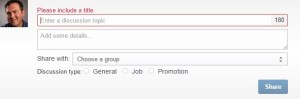
start a discussion in GroupsStart a conversation (New). How easy can LinkedIn make starting a discussion in a particular group. Begin your discussion by selecting a title (LinkedIn provides some suggestions) and adding details, choosing a group (only one group. Sorry), and post it.

Manage your groups’ settings. This function allows you to rearrange your groups in the order you want them to appear. You can also adjust Member Settings, e.g., Visibility, Contact Settings, Update Settings, and Leave the Group. In terms of visibility, I tell my jobseekers to not show their Job Search groups on their profile. Rather the groups that are related to their occupation.

Open One of Your Groups and Go to Town

2. Discussions. Probably the best feature Groups has to offer, as it allows you to show your expertise through intelligent questions, thoughtful answers, relevant shares. One of my valued connections, Hank Boyer, constantly shows up on my Groups feed posting articles that are relevant to his connections.

3. Promotions. No man’s land. Promotions are ignored in most groups because any type of information posted and deemed as self-promotional end up here. One of my valued connections informed me that when he posts anything in a group I started, it is automatically placed in Promotions. I removed this page from my group.

4. Jobs. This is feature that is sometimes ignored by group members and, therefore, they don’t learn about jobs posted by their fellow members. I’ve sent messages to the members of my group informing them to look in Jobs, but this isn’t something that I can do on a constant basis.

5. Members. A valuable feature if you’re looking for someone whose occupation is closely related to yours. Type in “Project Manager” in the search field and you will be able to access the full profiles of group members who have “Project Manager” on their profile. Better yet, you can:

  1. Follow
  2. See activity
  3. Send message
  4. Connect

with any member in your group, even if he/she is a 3rd degree. I tell my workshop attendees that if they want to communicate directly with someone who’s not in their direct network, they can join a group of which the person is a member. The same goes for connecting with 2nd and 3rd degree connections.

6. Search. This is where you can search for discussions from the group’s members. When I want to search for a discussion started by one of my fellow group members, or when he’s been mentioned in a discussion; I type in his name in the field and am granted this information. There are other items you can search:

  1. Latest Activity
  2. All Discussions
  3. Manager’s Choice
  4. Discussions You’ve Started
  5. Discussions You’re Following
  6. Pending Submissions

7. Number of groups to join. I tell my LinkedIn workshop attendees that LinkedIn allows them to join up to 50 groups, but I advise them to join groups only if they will be active participants. This leads me to conclude that a good rate of participation should be at least once a week—whether you ask an illuminating question or answer one.

This further leads me to confess that I was once banished from a group because of lack of activity–yes, it’s possible. Thus, I made it my mission to participate in more groups or quit them. Should I get my hand slapped again, I will gladly apologize to the owner or manager who banishes me from that group.

My advice to you is shed the groups you’re ignoring. Treat it like spring cleaning; purge your proverbial LinkedIn house of those groups you’ve stopped visiting. Trust me, it will feel great.


If you know of other functionality of Groups not mentioned here, let us know.

As always, if this post helped you, please share it with others.