5 services your alumni association offers, as well as best practices

career

As a volunteer for my alma mater’s alumni association, I have witnessed some savvy networking from students, recent, and not-so recent alumni. I’ve been impressed with the level of professionalism they’ve demonstrated and their focus on gaining employment.

At one event held in Boston, alumni and current students (as young as sophomores) showed up dressed to impress, took advantage of a free photo shoot, and lined up for the duration of the event for resume and LinkedIn profile critiques I was giving.

My alma mater’s alumni association has held other events in the past that were geared toward helping our alums in their job search. They were well coordinated and of great benefit to the attendees.

Not all alumni services are equal, but generally they offer the services explained below. To take advantage of there services, you must adhere to best practices which are also explained below.

Services

Career advice

Established alumni from your college can provide you with a plethora of career advice, most of which is valuable because your alums have been in their industry, in some cases, for many years. Some have read tons of resumes, cover letters, and interviewed candidates.

Call on alumni for practical advice. Look for people at your level or, better yet, managed employees who work in your occupation and industry. Ask them what they expect from resumes and job candidates in interviews. Pick their brains for this important information.

At my alma mater, there is a list of alumni who can help grads with their resumes, networking and interview techniques, LinkedIn profile, job-search etiquette, and other job-search topics. I have been contacted by recent and not-so-recent grads seeking my services.

A vast network

If you’re fortunate, you have access to vast database of people in the space you want to enter. This database provides you with email addresses, telephone numbers, and LinkedIn profile URLs. If you don’t have access to this information, use LinkedIn’s Find Alumni feature.

Your potent network can span the world, but you might want to focus on your local area. If I want to access my local network, I’ll contact the president of the alumni association. However, if I am interested in seeking employment in North Carolina, I’ll contact the president of that charter.

Once you have located alumni who can help you in your job search, you’ll approach them as you would any potential connection. You can call them, send email, or send Inmail through LinkedIn.

Informational interviews

One of the best ways to pick your alumni’s brains is asking for an informational interview, which I prefer to call a networking meeting, because that’s what you’re doing; you’re networking. But more to the point, you’re gathering important information and advice.

You’re the one who’s asking the questions, so they need to be intelligent ones. Little do you know, but there may be a position developing at your alum’s company. If you impress your alum with the dialog you generate, you may be referred to the hiring authority.

But that’s when the stars are aligned. Along with gaining valuable information, you need to leave the networking meeting with additional contacts with whom you can speak. You are building your network. You’re always building your network.

Alumni and other events

The event I mentioned above was organized to perfection. It was held in Boston at my alma mater’s club, a stunning building with a great view of the city. The event was designed to introduce people to those who could help them in their job search.

At the event, I critiqued resumes and LinkedIn profiles. Other pundits spoke about networking, job-search etiquette, and other job-search topics. And the students and recent grads came to soak up information.

Job fairs are also a great event that are held, for the most part, by career services. However, some alumni associations also conduct job fairs or smaller networking opportunities, such as sports gatherings, social events, etc.

If your alumni association puts on job fairs, check out the companies that are attending and go to the job fairs to make connections. Again, you’re in control of your destiny. Impress some of the reps, and you might create opportunities.

Mentor opportunities

Alumni associations encourage alumni to reach out to professionals in their industry who can mentor them in the job search. The mentors are not career counselors, but they can provide great insight into their industry.

Mentors give valuable time out of their day to gain an understanding of what you’re looking for in employment, how you should approach your search with the correct attitude, suggest people with whom you can speak, and give you the motivation you need.

Mentors will guide you from the start of your job search to the end. They are dedicated to the success of their mentees. They are a special group.

Best practices

To utilize the services explained above requires appropriate behavior, especially since the alumni volunteers are acting out of the goodness of their heart. Here are some best practices:

Be polite is rule number one. Do what you were taught as a child and carried throughout your life. The words, “please” and “thank you” go a long way. Represent your alma mater the proper way.

Be assertive but in a respectful way. Not all volunteers will follow through in a timely manner. Some may simply forget to return your calls. In this case, leave a polite message reminding them of your meeting.

Be accommodating to your alumni volunteer. One of my alumni clients said he’d feel more comfortable meeting face-to-face, but because we live 50 miles apart and I have a busy personal life, he agreed to communicate via phone. Alumni volunteers will also accommodate their alumni clients when possible.

Be knowledgeable when you attend a networking meeting. Don’t arrive without intelligent questions. Contribute to the conversation with appropriate comments. Show yourself as someone who could work at that company if a position exists.

Be focused on your job search. Nothing is more frustrating than talking with someone who is vague about their career goals. However, if you are unsure about what you want to do, you should be able to describe your transferable skills and experience required for a career change.

Be on LinkedIn is a no-brainer these days. Nothing impresses me more these days than a student or someone fresh out of school who has a strong profile and engages with their connections on a regular basis. You should be one of the 450 million LinkedIn users.

Following up is essential to your relationship with your alumni volunteer. After you’ve spoken with them or met them in person, send a thank you via email or card. Ping them every once in awhile so they know how your search is going. Stay top of mind.


It’s been a pleasure volunteering for my alma mater’s alumni association. I’ve had the opportunity to educate alumni of various ages on LinkedIn and resumes and the job search. Be assured that there are alumni volunteers who would like to help you.

If you appreciate your alumni association, I’d love to hear why.

Photo: UMass Alumni Association


Don’t Take the Telephone Interview Lightly; Be Prepared for 4 Potential Problem Areas

Plus additional advice from LinkedIn members.

Recently a former customer of mine told me he was offered an engineering position. He was extremely happy about getting the job and thought he’d enjoy working for the company. I noticed some hesitation in his voice.

man-on-phone

It took five interviews before he was offered the job. These interviews were all conducted over the phone—he never had a face-to-face. This is why he seemed ambivalent about his new position.

If you think a telephone interview isn’t a real interview, you’re sadly mistaken. Telephone interviews are generally thought of as a screening device, but they carry a lot of weight and, in some cases, they’re full-fledged interviews. Often times job seekers don’t take the telephone interview seriously, and this is a huge mistake.

This is the type of response I sometimes get from my workshop attendees when they tell me they have a telephone interview, “It’s just a telephone interview. I hope I get a face-to-face.” I tell them to prepare as hard as they would for a personal interview and not get caught off guard.

Yes, the face-to-face is the next step, but you can’t get there without impressing the interviewer on the other end of the phone, whether she’s a recruiter, hiring manager, HR, or even the owner of a company.

Generally the interviewer is trying to obtain four bits of information from you, areas to which you can respond well or fail.

1. Do you have the skills and experience to do the job?

The first of the interviewer’s interests is one of the easiest to meet. This is a public relations manager position you’re applying for, and it’s “perfect” for you.

You have experience and accomplishments required of a strong public relations manager. Your communications skills are above reproach, demonstrated by excellent rapport with the media, business partners, and customers.

In addition, you’ve written press releases, customer success stories, and assisted with white papers. You’ve added content to the company’s website that even project managers couldn’t supply. One of your greatest accomplishments was placing more than 50 articles in leading trade magazines.

2. Are you motivated and well-liked?

Your former colleagues describe you as amiable, extremely goal-oriented, and one who exudes enthusiasm. The last quality shows motivation and will carry over nicely to your work for the next company. You’ve done your research and have decided that this is the company you want to work for; it’s on your “A” list.

When the interviewer asks why you want to work for the company, you gush with excitement and feel a bit awkward telling her you love the responsibilities set forth in the job description.

Further, through your networking you’ve learned about the corporate culture, including the management team. You tell her it sounds a lot like your former company and will be a great fit.

3. Why did you leave your last company?

This one is tough for you because even though you were laid off, you feel a bit insecure and wonder if you were to blame. But of the three reasons; you were laid off, you were let go, or you quit; this is the easiest to explain.

Your company was acquired and there would be duplication with the marketing department that exists for the company that bought yours. You keep this answer brief, 15 seconds and there are no follow-up questions. You’re doing great so far.

4. What is your salary expectation?

“So Bill, what are your needs?” The question hits you like a brick. “Excuse me,” you say. “What do you expect for salary? What will it take to get you to the next step?” the interviewer says. Your mind goes blank. You’ve been instructed to handle the question in this order:

  1. Try to deflect the question.
  2. If this doesn’t work, ask for their range.
  3. And if this doesn’t work, give them your range.
  4. When all else fails, you cite an exact figure based on your online research and networking.

You’ve forgotten everything your job coach told you and blurt out, “At my last job I made $72,000.” But this isn’t the question asked. The interviewer wants you to tell her what you expect for salary, not what you made at your last company. “Is this what you had in mind?” you timidly say.

There’s a pause at the other end, and finally the voice thanks you for your time. She tells you if you’re suitable for an interview at the company, you’ll be notified within a week. She says it looks promising for you…

But you know right then that the position hangs in the balance. You’ve spoken first and within 10 seconds said something you can’t take back. You were prepared, but not prepared enough. You didn’t think this interview counted; you’d do better at the face-to-face if you get there.


The additional advice

Recently I shared a popular long post on LinkedIn about telephone interviews, in which many LinkedIn members added additional concerns. You’ll note that a common theme is prepare for telephone interviews. Here are some of them:

Madeline Mann: The phone calls are difficult because they are often short – 30 min or less. So many of my hiring managers reject candidates because they rambled and didn’t articulate their value concisely and clearly enough. Make sure your answer to “Tell me about yourself” is tight and fits into 1 maybe 2 minutes.

Laura Smith-Proulx: It’s a good idea to record yourself (both audio and video) responding to common behavioral interview questions. I believe most people would be surprised to hear what is conveyed in tone of voice and cadence.

Adrienne Tom: If for some reason they call you out of the blue and want to talk on the spot – ask the recruiter/interviewer if you can book a time to reconnect soon. Be gracious and polite, but it is ok to ask for time. The call is too important to rush into.

Virginia Franco: I agree the phone interview has become more important than ever Bob McIntosh, CPRW. This is the stage where people are assessing you skills and aptitude (where the face to face is focused more on assessing cultural fit). Be sure to have examples that address as many points as possible from the job description!

Paula Christensen: Not taking the phone interview seriously is a personal pet peeve held over from my recruiting days. You are competing against others who DO take phone interviews just as seriously as face-to-face interviews, and this could cost you. Be prepared to concisely talk about what makes you different and the unique skills you bring to the table.

Marcy Depew….And a reminder – phone interviews are usually scheduled for a half-hour – make sure the interviewer gets as many of their questions answered about you as possible – keep your answers concise and to the point.

Phil Kasieki: If anything, I’m more concerned with the phone interview than going on-site. Because phone interviews are almost always the first step nowadays – I can probably count on one hand the number of companies with which I didn’t have one before going on-site – one would be wise to not gloss over it.

Lorie Comacho: One of the best ways to prepare for a phone interview is to practice phone networking by calling people regularly (especially if this is a pet peeve of yours) and skyping with contacts when possible to discuss your job search.

Sarah Styles: One more thing, you may not be told that it is an interview. A recruiter calls and says, “Do you have 5 minutes? I just want to ask a few questions.” This is a screening interview and you may or may not get an in-person based on your performance in this call!

Lezlie Garr: My advice to jobseekers is to treat a phone interview almost exactly like an in-person interview: 1) Use open body language, even if they can’t see you; 2) Smile, because you will sound happier; 3) Be animated (if that fits your personality); 4) Be as true to your in-person self as possible;  5) Finally, use headphones, so your hands are free, just like you would be in person! (I would advise against using speakerphone, though.)

Fiona Bryan: More and more hiring managers are simplifying their schedules and work lives by starting with a telephone interview, Skype/Zoom. Yet they really are more complicated, as there is less of an energy connection… And as people hiring people, we still HIRE people we “like”/can work with! Everyone has to prep for interviews. No one should wing them nor expect the call/meeting to be “just a chat.” PREPARE and understand [interviewers] can ask you anything. It really is an interview. You don’t get a second chance to make a good first impression.

Photo: Flickr, Dwight Anthony

Job seekers, surround yourselves with these 6 people

Increasingly more job seekers are opening up to me saying the hardest part of being unemployed is the emotional drain they feel. Some will tell me they’ve never felt worse in their life. Sure, money is an issue, but it’s the fear, uncertainty, anger, despair, the whole bundle that affects them the most.

positive-woman

I was out of work 14 years ago and found there were people with whom I should have surrounded myself. The people I found helpful made my job search bearable. They helped me deal with the highs and lows of the job search.

Here are five people you should have on your side.

Positive people

You know the type I’m referring to. They wear a smile on their face most of the time, and they speak positively about people and situations. They’re not downers, and they won’t let you dwell on your problems.

People like this exude positivism that’s contagious. They make it possible for you to forget your negative thoughts for a moment. That moment can be enough for you to realize that your unemployment will be temporary.

Unemployment can wear on relationships, particularly between your spouse. It is natural for your spouse to also feel the effects of your unemployment. So you will want to seek people who can provide you with the positivism you need.

People who give great advice

For free professional career advice your best bet is your nearest One-Stop career center or your alumni career center; although not all universities provide this service. There are public career centers throughout the US, and they are free.

Workshop facilitators and career advisors can provide the most up to date job-search advice. They are empathetic to your needs. However, they will not let you dwell on your situation.

Another option is networking groups in your area. The area in which I live offers networking groups that meet every day of the week. It’s important that you find people who are knowledgeable about the job search.

Connected people

I don’t mean to make this sound like a gangster movie, but you should also seek out people who know others. Start with people who are know connectors, who know almost everyone in your industry and/or occupation.

It’s important that you don’t just call on these people when you need help. Keep in touch with them on a social basis. You don’t need to mention you’re still looking for work every time you correspond; they’ll usually ask.

Be prepared to offer help in return. He or she who only takes will soon find themselves empty handed.

People who believe in you

giving-advice

At this point, you might feel that no one believes in you. This isn’t the case. You can’t discount family members, friends, neighbors, former colleagues, past bosses, etc.

These are people who will assure you with words as simple as, “You can do it, Bob.” or “I have faith in you.” or “You’ll turn the corner.” And you can tell by their tone if they’re sincere. I, for one, can’t lie to save my life; so when I say these words, I mean them.

The ultimate sign of people believing in you is when they are willing to deliver your résumé to someone in a company, or agreeing to be a reference, or going to a hiring manager and recommending you for a job.

 Non-judgmental people

Non-judgmental people will not put you down because of your situation. If you were laid off due to your previous company’s poor performance, they will not insinuate that you could have prevented being laid off.

If you were let go, they won’t blame you when it was a conflict of personality between you and your manager. I tell my job seekers that there are bad bosses who have an agenda, and no matter how hard my job seekers try, they can’t make it right.

Non-judgmental people don’t throw stones in glass houses, as the saying goes. They are empathetic because they’ve made mistakes of their own. To me, they demonstrate emotional intelligence and can be a great source of comfort.

People who want to have fun

picnicOne way to take your mind off your problems is by enjoying a laugh or two with friends or relatives. I’m sure you’ve been among friends who were recalling hilarious memories that had you in stitches.

When the laughter ceased and you were brought back to the fact you were unemployed they took notice and gave you a punch in the arm. They told you to snap out of it, so you did. Your friends wouldn’t allow you to dwell on what you couldn’t change at that moment.

You must remember that there are people like your friends or family who are counting on you to be the same ole Bob. Don’t drag them down with you. Sure they will offer a shoulder to cry on, but only for so long. They believe in you, are confident that you’ll bounce back, and instill positivism in you.


If you’re unemployed, seek out people who have one or more traits explained above. They’ll keep you positive, give you sound advice, believe in you, won’t judge you, and will keep moments light.

Photo: Flickr, Chris “Paco” Camino

LinkedIn status update etiquette. How often should you update?

man-walking-with-phone

I posted a status update asking LinkedIn members how often they update. Asking a question, after all, is one of the many updates you should post. The response wasn’t as great as I would have like, much like when I ask my 14 year-old son how his day went.

I did, however, receive answers like “once a day,” “four times a week,” etc. But I didn’t get the answer I wanted to hear: “four times a day.” Do I hear a pin drop? I can hear some of you thinking, “That’s crazy, dude.” And, “Get a life.” Perhaps, “I’d hide* that guy.” And I’m sure I have been hidden.

Some of my workshop attendees tell me that posting even once a week is too difficult. They also say that they don’t know what to post. (I refer them to Hannah Morgan’s great infographic of what you can update. Yes, one of them was posting a question.)

I’ve read from some LinkedIn pundits that once a day is the limit. How did they come up with that arbitrary number? Why not two updates a day, one in the morning, one in the afternoon for a total of 14 updates a week? Wouldn’t that make more sense?

I posted an article awhile back called 11 reasons why I share LinkedIn updates so often in response to an article called 6 Bad LinkedIn Habits That Must Be Broken, in which the author writes with conviction that one must update only once a day. He states:

“People don’t check LinkedIn nearly as often as Facebook or most other Social Networks for that matter. So I recommend that statuses are updated no more than once or twice a day. This is more for your benefit than for your network. Oversimplify here and focus on sharing much less frequently, while trying to find highly interesting content that will benefit your connections.”

In my counter article I explain that I update for nine reasons, two of which are to make LinkedIn a better place. I know that sounds conceited but I figure I manage to accomplish this 20% of the time. And the other times because I really enjoy it.

In my opinion, you should update as much as you like as long as you’re adding value for you connections. What defines value? Quite literally it means, according to Webster’s II dictionary, “A standard or principle regarded as desirable or worthwhile.”

Educational articles you share add value and can earn you the illustrious title of “curator.” In a long post on LinkedIn, I list 14 of my connections who do a great job of educating their networks, as well as write great articles themselves. Great industry advice adds value. And asking illuminating questions or even making intelligent statements also add value.

Another reason why you should update as much as you like is if you’re not annoying your connections. One barometer I use to determine if I’m annoying my connections is when they see me in public. If they say, “I see you a lot on LinkedIn. Good stuff,” that’s a good sign. But if they say nothing after telling me they see me a lot on LinkedIn, I figure that’s a bad sign.

Recently I hid one of my connections because her face appeared at least ten times in a row on my timeline; she was really annoying me. Worse of all was that the information she was sharing was inconsistent with her industry; it was all over the map. I imagined her clicking on every post or inspirational quote/photo that popped up. In this case, more is definitely not better.

Finally, if you are treating LinkedIn like Twitter, where there are little or no reasons why you’re updating, it’s time to take stock of why. If there’s no strategy, it would probably be best to develop some strategy behind your updating activity, or chill for awhile.

Do you remember when you LinkedIn’s status updates and Twitter’s tweets were synced to each platform? LinkedIn did away with Tweets migrating to its platform; people were tired of reading about what Twitterers were doing on the beach or eating for breakfast. We still get tweet-like updates on LinkedIn.

I can’t say for sure how often I update a day, but I haven’t been told to my face that I over due it. In fact, I receive compliments for what I share. When I’m told more than once that people are sick of seeing my face on LinkedIn, I will curve my action. By how much I can’t say. I’m just having too much fun.

*To hide someone, just hover to the far right of his/her name and a dropdown will appear with the Hide option.

Please share if you enjoyed this post!

Photo: Flickr, Tom Waterhouse

Create a kick-ass LinkedIn profile summary with these 4 elements

When was the last time you touched your LinkedIn profile Summary? Was it eight years ago? Longer? Does it fit you still? Maybe it’s like a pair of corduroys that are out of style, more suited for the ’80s. I bet it’s time to revamp your Summary. Blow it up.

body-builder

You might be thinking, “Why fix something when it ain’t broken?” My response to this is how do you know it ain’t broken? Maybe no one told you your Summary doesn’t demonstrate your value; didn’t want to hurt your feelings.

If your profile Summary is similar to many of the ones I see, it lacks creativity. In fact, it resembles a résumé. This is what I call the bare minimum. You’re telling the world you don’t give a rat’s ass about your online image.

This will be liberating. And when you’re done you’ll celebrate with a massage, or a shopping spree, or a five mile hike, or whatever turns you on. Here are four elements of a kick-ass Summary.

1. Opening statement that grab visitors’ attention. What is the Why for what you do? For me it’s about how unemployment is a major impediment to peoples’ happiness, and what I do to help them get through unemployment.

Here’s one from one of my clients which illustrates his knowledge of the industry and the value he brings to companies.

Advanced materials and processes can form the basis for a product portfolio that will generate repeat revenues for years to come – if a company is able to leverage those innovations. I have been fortunate to participate in several technology firms where we did exactly that.

Then he backs up his claim with examples in his Experience section.

Important note: with the new LinkedIn profile, only the first three lines, or approximately 50 words, are displayed on a laptopTherefore it must grab the readers attention immediately, show value off the bat.

2. The way you attack this problem. This is the How you do what you do. If you go this route, yours might be, attacking hunger, managing data, writing compelling copy, programming software, etc.

Here’s one from one of my clients on how he leads his sales force.

As a VP of sales, my leadership style empowers employees to succeed, while also providing the support they need. It’s been said that I’m a leader who commands excellence from my employees in a fair and consistent manner. These are only a few traits of a successful VP of Sales.

I appreciate the fact that he is a successful VP of sales who understands the value of treating his employers with respect. This comes through in this statement.

3. Gotta back it up. These are the accomplishments with quantified Results. People won’t care what you do as much as they care about how well you do it. “What about having accomplishments in my Experience section?” you may wonder.

‘S alright. You’ll have other accomplishments to tout and there really is no harm in repeating some information. Make  your accomplishments vague. Like, “Increase visibility of organizations through social media and digital marketing.” Or be more specific.

Here are a few accomplishment statements my client lists in his Summary statement.

  • Re-engineered the procurement function resulting in a 20% reduction in head count and over 50% reduction in OT costs during a period in which volume increased by 22%.
  • Cut month-end closing cycle from 7 to 2 days by implementing cycle count procedures, thus improving the accuracy of book to physical reconciliations.
  • Reduced the frequency of complete physical inventories from a monthly to a quarterly basis, cutting overtime labor costs and rental expenditures.

My client has plenty of accomplishments to tout in his Experience section. By stating a few in your Summary, you’re immediately showing value.

4. How do people find you? This is where you you state your call to action. You’ll include your email address and, if you like, your telephone number. Don’t make people hunt for you. Recruiters, hiring managers, and potential customers want to find you quickly.

Here’s a perfect example of a call to action, clearly illustrating this person’s desire to be found by people who require his services.

(full name)@gmail.com
949-395-5555

Showing your eagerness to be found, can also be stated at the start of Your Summary or even the middle. This isn’t as common as listing contact information at the end.


These are four elements of a kick-ass LinkedIn profile Summary. You may structure your Summary differently. What matters is that you show value to an employer. If you don’t accomplish this, what’s the sense of having one?

Photo: Flickr, marcellospeziali

This post originally appeared in recruiter.com.

3 factors that motivate you in your job search


motivated-girl

For some of you reading this, the bad news is that you’re unemployed; but the good news is that you are in complete control of finding your next job.

In Drive: The Surprising Truth About What Motivates Us Daniel Pink writes about how science and the business operation paradigm are out of sync. Job seekers can learn how to better conduct their job search by embracing Pink’s theories.

Watch Drive: The Surprising Truth About What Motivates Us on TED.

Pink asserts that most people are motivated by intrinsic values, which he calls Motivation 3.0. More specifically, we’re driven by autonomy, mastery, and purpose. Smart companies recognize this as the way to motivate their employees.

How motivation plays a role in our job search.

Motivation to get back to work must come from within. Certainly earning a paycheck is an extrinsic motivator, we need money to pay our bills, but what really motivates us is regaining our sense of identity and the daily routine we’ve grown accustomed to.

Given that we are ultimately internally motivated, we need to take action and conduct a proper job search. Here are the steps you need to take:

Autonomythe urge to direct our own lives. Pink gives Google as an example of autonomy as a motivator, where employees are given 20% of their time to work on whatever they want. This, as a result, promotes creativity; and creativity often leads to better ideas and better products.

The Job Search: I ask my job seekers who is rewarding or reprimanding them for working hard and smart in their job search. Similarly, who is standing over them to make sure they network, engage on LinkedIn, and write compelling résumés and cover letters? The answer is no one.

They have complete autonomy in their job search—they’re in complete control of their actions. Further, job seekers can conduct their job search however they see fit. There are “rules,” but breaking some rules can lead to success, not reprisal or being fired.

For example, you’ve decided that you’ll dedicate 30 hours a week to your search, but one week you decide some downtime is more important, so you only search 20 hours that week. It’s all good…as long as you get back on track.

Masterythe desire to get better and better at something that matters. The idea is to challenge yourself to be better and willing to accept failure. Some believe they never learn without failing and given the chance to correct their mistake/s. Smart companies allow the opportunity to fail.

The Job Search: Job seekers must master the job search in order to be successful. Some haven’t written a résumé or been on an interview in 10, 20, even 30 years. There will be a lot of attempts and failures along the way.

Many résumés will be rejected because they’re poorly written and don’t talk to the needs of each employer; many interviews won’t go well. But job seekers must not lose their resolve—when they master the process, results will start pouring in.

As well, many job seekers will make attempts at networking and fail miserably the first few times, by asking people if they know of any jobs. Then they’ll master networking by first listening to others, offering help, and receiving help.

PurposeThe yearning to do what we do at the service of something that is better than ourselves. What is your purpose in life? Is it to do what is simply required and receive an adequate performance review, or is your purpose to accomplish goals that grow you as an individual and, as a result, make the company better?

The job search: Without purpose, the other two elements of Motivation 3.0 are a moot point. When I ask job seekers what their purpose is, some will say getting a job; but this is not enough.

Their purpose should be getting a job they find rewarding; a job that meets their values; a job that offers them autonomy, mastery, and…purpose. Purpose closes the loop.

To those who simply say they’ll do anything, I tell them to think harder about what they really want to do. Have purpose, I’m telling them. Purpose is what truly makes us happy.


Not all job seekers will employ motivation 3.0. Instead they will go through their job search blindly and take whatever comes their way. Ultimately they will be unhappy and, thus, unproductive.

The obvious way to look for work is to take ownership of the job search and embrace the three factors of motivation. Operate your job search like smart companies that successfully motivate their employees.

Electronic business cards. How cool is that?

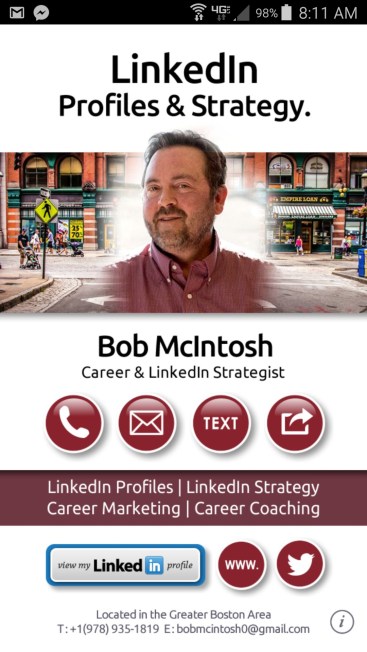
Screenshot_2016-09-04-08-11-55I have four questions for you.

Where do you keep your personal business cards? I keep mine in the top drawer of my dresser and in the glove compartment of my car.

I keep two or three in my wallet. They’ve also been know to show up between the cushions on our couch.

During networking events, I keep them in my shirt pocket along with the ones I collect.

I don’t have a silver business card case. Tried one of those but quickly lost it.

When do you carry your personal business cards? The answer should be, “Always.” This means even when you go to family gatherings or anywhere in your community.

(I quizzed my networking group about this one and one person came up with the winning answer.)

Have you ever forgotten your business cards? If you’re honest, you’ll say you’ve forgotten them on occasion. I have. I’ve forgotten to retrieve them from my drawer before I left for a networking event. You might have left them on the desk in your study.

Now, where do you keep your smart phone? It’s always on you, isn’t it? Mine is. I can count on one hand when I’ve forgotten my phone. I’m also constantly checking it.

My phone has become an extension of my arm. I’ve been scolded for taking it out during dinner, at home or in a restaurant. What have I become? I’m an older version of my kids.


For many people, a lot of important information is stored on their phone, such as contact information, access to their bank, a calendar, family photos, etc.

So, why not keep another important item on your phone? I’m talking about your personal business card. That’s right, an HTML-based business card that’s always with you. One you’ll never forget, unless you forget your phone; but I doubt that.

I recently learned about business cards you can store on your phone. I happened upon a company, kwikcards, that designs and installs your business card on your phone. And I thought, “How cools is this?” Very cool. And I can’t wait to use it.

I imagine I’ll be at an event having a great conversation with a network companion and would like to have his card so I can follow up with them. They give me their paper card.

In turn, I don’t reach for my paper card. Rather I take out my phone and quickly pull up my personal business card, the the image above.

(The design was created by kwikcards after I sent them some information. I didn’t have to do anything but wait for a link to show up in my email.)

My networking partners look at my electronic business card—right there on my phone. And the say, “How cool is that?” Their first comment is that there’s a photo of me, which is not common on paper business cards.

My card clearly states what I do: LinkedIn and Profile Strategy. As well as what I do: LinkedIn Profiles | LinkedIn Strategy | Career Marketing | Career Strategy.

But wait. If they want to see my LinkedIn profile, there’s a button I can tap on my phone. It’s below my list of expertise. If they want to see my blog and Twitter handle, I tap those.

There’s only one problem, they’re thinking; they can’t take my phone with them.

No problem. I ask for their tired, boring, personal business card telling them I’ll send my electronic card to their email or text them. Or I can share it with them on the spot; some of them prefer that.

I meet other people at the event and go through the same process. They’re similarly impressed.

Follow Up

As promised I send my electronic business card to my networking partners. In the email subject header I’m sure to write: Bob’s personal business card.

When they open it on their computer or smart phone, they see the same card I showed them the night before.

They’ll notice they can take quick action by calling me (from their smart phone), sending me email, and texting me. The buttons are clearly marked, and my email address and phone number are attached to the buttons.

As well, they can access my LinkedIn profile, Twitter account, even Facebook page if I thought to include that. It’s simply a click of a button.

This, I think, is more convenient than bumbling through their pockets for traditional business cards. If they’re like me, they dump the business cards in their office desk drawer and eventually get to them later that day. Maybe the cards are forgotten.

But not when they open the email or text from me. They’re presented with my interactive electronic business card. They can even download the image on their phone or computer, if they like.

I think my electronic person business card is very cool and am going to abandon my paper cards, which will eliminate the stress I feel when I have to find them or, worse yet, forget them.


Keywords are important to have on your résumé

Dumping Ground

But don’t make it a dumping ground for keywords.

I don’t believe a résumé’s greatest attribute is its layout. Don’t get me wrong, how your résumé is structured matters a great deal; but content is by far the most important component.

Included in the content must be keywords and key phrases (KWs & KPs) that are related to the job for which you’re applying. They must be evident throughout your entire résumé.

We’re all aware that large-and mid-sized companies use an applicant tracking system (ATS) which allows them to easily pluck the candidates, who possess the most KWs & KPs, from an unearthly pile of résumés.

Harried HR and internal recruiters type in necessary KWs & KPs, and the résumés that contain a majority of them are the first—if not the only—ones seen. It’s estimated that ATSs eliminated 75% of all résumés submitted for jobs.

While content is important—and having the necessary KWs & KPs is essential—where they’re placed is just as important.

Some assert that merely listing them in a section at the top of your résumé (this is where the Professional Profile lies) is the most effective way to get your résumé to float to the top of the employers’ list.

This is where I draw the line between playing the system at the expense of strategic layout.

The Professional Profile is a section of your résumé that needs to demonstrate your outstanding job-related and transferable skills, not be comprised of as many KWs & KPs you can muster up.

It must be written extremely well, providing compelling reasons why you should be brought in for an interview. Keep in mind the following objectives:

  1. You must prioritize your statements, matching the requirements of the position and other similar positions, not just all the KWs & KPs you capture from a job posting.
  2. The Professional Profile is a brief outline of what’s to follow in the body of your résumé. Anything you assert in this section must be proven henceforth.
  3. Consider using WOW statements or accomplishment statements. You’ll state other accomplishments in the body. This will certainly grab the employer’s attention.
  4. Do not offend the employer with empty claims of greatness by throwing adjectives around. Instead focus on action, e.g., (I) Direct teams of marketing and sales professionals to reach sales projections; exceeded goals by more than 85% in the past two years.
  5. Don’t write a novel. Your Professional Profile should not be longer than five or six lines. This may even be too long.

There is a better place for the key words and phrases. Where the KWs & KPs should be listed is in a Core Competency or Technical Skill sections below the Professional Profile. In this section you can empty the can and list the relevant KWs & KPs you’d like. However, don’t simply dump them there.

Martin Yate, author of the Knock em Dead series, writes in How keywords create a customer-centric résumé, “A Professional Skills section should list all the skills (keywords) required to execute the responsibilities of the job. It should come right after a Target Job Title and a Performance Summary at the top of your resume because the ATS programs that help recruiters search databases reward both the presence of keywords and the placement of keywords – those keywords found near the top of a document are seen to make that doc potentially more relevant to the user.”

The ATS will detect all the keywords and phrases throughout your entire résumé. Many recruiters encourages not only listing the job-related KWs & KPs; they recommend repeating wherever possible.

Density of KWs & KPs will also determine where your résumé lands in the pile. This means employing them in the Experience and Educations sections. Be sure you use the headers “Experience” and “Education,” as that’s what the ATS recognizes.

Another way job seekers try to to game the system is to write their keyword and phrases in white font at the end of your résumé. This trick is as old as the hills, and most ATSs can detect them and reject you.

Let’s not be too obvious about our intent. Simply write a résumé that shows you have all the skills and include KWs & KPs throughout your résumé.

5 reasons to tell your children you lost your job

Family Dinner

I tell my customers the first thing they need to do is tell everyone they know that they are unemployed. This includes former colleagues; friends; neighbors; relatives; hair stylists; convenience store owners; LinkedIn connections; Facebook friends; and even people they meet for the first time, providing the moment is right.

Most of my customers are amenable to spreading the word far and wide. They know that at any time someone may be able to provide a lead or offer sage advice. Sometimes this happens in my workshops.

But some don’t consider telling the people who should be some of the first to know, their children. Too often people tell me they wouldn’t consider telling their kids because they don’t want to let them down, don’t want them to worry, are afraid their children will lose faith in them.

Hogwash, I tell them. Your children need to know about your situation if you want them to understand the meaning of life.

Dr. Julie Olson, Ph.D. a clinical psychology, at the Santa Margarita Solutions Center, asserts, “Whether you lost your job, had a pay cut or lost hours at work, as much as this could upset you and create anxiety about your financial situation, the main job you have as a parent is to give your children a sense of security and teach them how to cope with whatever comes their way.”

I lost my job in marketing about 12 years ago. It was devastating, but I felt it was important to share the news with my three kids. I told them the day I was laid off. Yes it was a humbling experience, but they had to know for a number of reasons.

  1. There would be changes around the house. There wouldn’t be any more shopping sprees. My eldest daughter’s steady flow of GAP and Abercrombie and Fitch clothing would be cut significantly. The quality and quantity of food was going to change; but we would still eat.
  2. Daddy wouldn’t be going to work every morning. Instead I would be conducting a job search, which meant I would need time to be out of the house to visit the career center or local library, hit the pavement to knock on companies’ doors, and network. I would need a quiet environment to write résumés and cover letters, or make follow-up calls.
  3. I would be acting a little different. I might be moody or distracted, but I would still love them very much. I would need them to understand that it would be a sad and frustrating time but they shouldn’t feel they were at fault. If I seemed distanced while with them, it was because I was thinking about finding work. For little people this can be hard to understand.
  4. Losing a job is a fact of life. People sometimes lose their jobs more than once. It’s not a pleasant thing, but it’s temporary and will eventually pass. I couldn’t be Superman. I would need support from them and other people. In a way, this would be a great lesson for them about persevering in times of trouble.
  5. We would focus on the important things in life. Although a job loss is temporary, the duration of unemployment can be longer than expected. That year Christmas was celebrated like usual. The kids didn’t get all they wanted, and my wife and I went without gifts; but we still celebrated the holiday. I don’t think the kids thought once about our situation.

All came to pass after six months of unemployment. I was delighted to tell my three kids the good news. The funny thing about that day was when my son told me he didn’t want me to go back to work. Who, he wondered out loud, would take him to playgroup, or play Lego with him?

At the time he told me he wanted me to stay home, I was more concerned about getting back in a working groove. Now, I miss the time I had with my children who understood at that bleak time more about life than they did when I was still working.

If you haven’t told your kids about losing your job, do it soon. As Dr. Julie Olson writes,  “…teach them how to cope with whatever comes their way.”

Photo: Flickr, Steve Kerrison

A little advice for my angry LinkedIn connection

When I was a youth, I had a friend who was angry all the time. Johnny was his name. He had a younger brother, Billy, who was a better athlete than him and more affable. Johnny was jealous of his younger brother.

angry man

When we played pick up football, Johnny was the slower and less nimble of the group. Billy and I were the better football players. This, I suppose, made Johnny even more angry.

At times Johnny would lash out at me for no apparent reason. I would disagree with him and BAM he would hit me. One time I ducked his punch and smacked him in the face. And then I ran like hell. I was a lover, not a fighter.

The other kids in the neighborhood couldn’t understand why Johnny was so angry; why he lashed out at me.

At the time I didn’t understand his anger. And then one day my father told me that some people are just plain angry, and there’s only one thing you can do about it; distance yourself from them.

So that’s what I did.

My angry LinkedIn connection, I see some of your posts on LinkedIn, and I think that you are angry. Angry all the time, like Johnny. And I think there’s no reason for you to show your anger, especially when others are watching you.

I recently read a post on LinkedIn that made a helluva lot of sense to me. It is called, “An open letter to Obama haters on LinkedIn.” The author of this post is Sherry Nouraini, PhD.

I took away from the article that employers/possible business partners are looking at what you write and think to themselves that angry verbiage is a sign of a problem maker, not a problem solver. Johnny was a problem maker.

What broke the proverbial camel’s back was the relentlessness smear campaign against LinkedIn. You made it your goal to bring LI to its knees by using long posts to do this. But what you wrote before was also full of anger.

I must profess that I have written out of anger, but not with as much vehemence as you do. I have, at times, criticized LinkedIn (I still can’t let go of losing unlimited searches). But how I criticize LinkedIn is nothing like the smear campaign you’ve started.

It’s not only your attack on LinkedIn that rubs me wrong, it’s also expressing your opinions on politics and religion that are inappropriate. First of all, I don’t care who you support in the upcoming primaries. Second, there’s no room for politics on LinkedIn.

Simply liking an article or photo that is politically minded is further evidence of your anger and negative attitude. To like something politically or religiously minded implies that you agree with its message, that you might also write it.

Have you not read that people don’t think LinkedIn is the forum for politics and religion? (Hint: Facebook is a better forum for expressing one’s political and religious views. I’m quite enjoying my new foray on Facebook.)

If you read the aforementioned article, the author talks about how bashing politicians or any other public figures is noticed by potential employers who are looking for people to solve their problems, not to create problems.

Your confrontational attitude will cause employers to think the latter of you; that you will cause problems.

You are currently unemployed, yet you continue to criticize how employers fail in the hiring process. I get it; employers don’t always make the best decisions–68% of them admit to making a bad hire at least once–but what good does it do you to criticize their practices.

Again, I admit to throwing mud at some recruiters, but not every single time I get the opportunity. If I did this, many of my connections would disown me.

Have you thought that it may be you who is at fault for not getting hired? Keep in mind that employers troll LinkedIn to find talent and if they see the way you bash them, you’re seen as an excuse maker and a complainer; both of which employers try to avoid.

It’s not only what you write that makes you come across as angry; it’s your photo. Your photo looks like a mug shot. You look angry enough to kill someone.

Johnny always looked angry, too. Your photo is your first impression. Do you want to turn away employers before they even read your profile?

What I find ironic is that you have the word “Professional” in your headline. You don’t come across as professional, not by my standards.

And in your Summary you talk about demonstrating a willingness to help others achieve their goals. I don’t buy any of it when I read your updates or spiteful long posts.

I’m sorry, connection, your anger is obvious, and I fear it is hurting your chances of getting a job. When you land your next job, I’m afraid that what you wrote on LinkedIn prior will come back to bite you in the ass.

I can only assume that 1) you don’t care if people are turned off by your angry verbiage, or 2) you don’t know you come across as angry. If it’s the former, I hope you read this and right the ship. If it’s the latter, I fear, like Johnny, there’s no hope for you.

Photo: Flickr, Oliver Nispel