Tag Archives: resume

Job Search Tip #4: Revise…or…write your résumé

In the last article we looked at assessing your skills. Now we’ll look at revising your résumé or writing one. There are three notable challenges jobseekers are facing when revising or writing their résumé:

  1. Many haven’t kept up with writing their accomplishments while working.
  2. Some jobseekers are looking for work for the first time in 10, 20, even 30 years and now need to produce a résumé.
  3. Many college grads are looking for full-time work for the first time in a turbulent economy.

In all cases, today’s résumés have changed, with a focus on industry keywords, accomplishments, short-easy-to-read text blocks, and targeted delivery of your résumés.

Most résumés these days have a keyword-rich Branding Headline that accurately describes your occupation and areas of strengths. Each strength should be intended for a specific position. Here is an example:

Marketing Specialist | Public Relations | Program Development | Increase Visibility & Revenue.

A Performance Profile can make or break you. You have to grab the employer’s attention with a no-fluff, fact-revealing statement that serves as a snapshot of you and what is to follow for the rest of the résumé. To simply write the word, Creative does not have an impact.

However something like the following carries more weight:

Demonstrate creativity through initiating programs that have contributed to financial success by 55% annually.

More specific information should be included in your work history.

This statement should be directly related to what skill/s the employer’s looking for. As it’s relevant to one particular position, it may not be relevant to others and, therefore, shouldn’t necessarily be included on every résumé you submit.

Your Competency Section is meant to show employers what skills you possess, as well as additional skills that may be a plus to the employer. They are key words that should also show up in your headline and professional profile.

The Work History is the most important part of your résumé, so it must contain high-impact information that demonstrates your accomplishments. Duties are simply…duties; however, accomplishments sell. If you have a boatload of duties on your résumé, do your best to see how they can be turned into statements that show positive impact on the companies for which you worked.

Duty statement: Spearheaded the first continuous improvement committee at the company.

This is an accomplishment statement with a quantified result. Spearheaded the first continuous improvement process that eliminated redundant, costly programs. This resulted in an overall savings of $200,000.

Shortened one-line version: Spearheaded continuous improvement process eliminating costly programs, saving $200,000.

The final piece is your education section. For college grads, I’m a big fan of putting your hard-earned degree beside your name at the top of your résumé. In your education section fully spell the degree. And proudly list your GPA if it is higher than a 3.5/4.0 (there’s some debate over this).

Masters of Business Administration
University of Massachusetts, Amherst, MA
GPA: 3.94/4.00

Martin Yate says it best, “No one likes to write a résumé.” He also says that a résumé is our most important financial document. No one said writing  your résumé would be easy, but as time goes on it becomes easier. Remember that each résumé must be tailored to a specific job. Even in this turbulent economy, jobs are being had; so never give up on your job search.

Next Friday we’ll look at writing your cover letter.

5 components of a jobseeker’s company called Me, Inc.

My son just learned how to cut the lawn…well sort of. I still have to follow him around, helping to guide the mower and making sure he doesn’t run over any objects hidden from his sight. The first time he cut the lawn, he ran over our dog’s wire cable, causing me to wonder if this would be the first and last time he’d cut the lawn.

As I’m helping him to better learn the fine art of lawn-mowing, I fantasize about my kid starting his own business, which would ultimately depend on him (or me) creating a company.

When I think about my 11-year-old son starting his own lawn mowing business, I relate it to my jobseekers who all have their own business–it’s called Me, Inc., a term Martin Yate applies to jobseekers, who are ultimately responsible for selling a great product, themselves.

In an article Martin wrote, he talks about the five components of Me, Inc. as they apply to jobseekers, which makes total sense because jobseekers are a business of one. Here is Martin’s explanation, verbatim, of the five components necessary for jobseekers to run Me, Inc.

  • Research and Development: Every corporation invests in the ongoing identification and development of products and services that will appeal to its customers. For Me, Inc. this translates into skill-building in response to market trends, which you do by connecting to your profession and by monitoring the changing market demands for your job on an ongoing basis.
  • Marketing and Public Relations: The effective branding of Me, Inc. as a desirable product requires establishing credibility for the services you deliver and positioning those services so that your professional credibility becomes visible to an ever-widening circle, both within a company—to encourage professional growth—and within your profession—to encourage your employability elsewhere.
  • Sales: Me, Inc. needs a state-of-the-art sales program to constantly develop new strategies to sell your products and services. This will include resume, job search, interviewing, negotiation, and other career management skills that must be developed to sell your products and services effectively.
  • Strategic Planning: This encourages you to create concrete plans to achieve the goals you have for your future: plans for growth with your current employer, plans to time strategic career moves that take you to new employers or new professions. Creating actionable strategies for the realities of your professional future enables you to make your plans happen on your timetable and not as a panicked reaction to unforeseen employment disruptions.
  • Finance: Treating personal finance more seriously will ensure you invest wisely in initiatives that will deliver a return on investment. You must invest in your future success rather than fritter away your income on the instant gratification drummed into your head by 24/7 media.

My son has years to go before he establishes his prosperous lawn-mowing company, but jobseekers must put to use what Martin proposes for a successful company called Me, Inc. Only when they take ownership of their job search will they operate as a successful business that sells a great product.

Martin Yate, CPC, author of Knock ’em Dead: Secrets & Strategies for Success in an Uncertain World, is a New York Times and international bestseller of job search and career management books. He is the author of 11 job search and career management books published throughout the English speaking world and in over 50 foreign language editions. Over thirty years in career management, including stints as an international technology headhunter, head of HR for a publicly traded company and Director of Training and Development for an international employment services organization.

Checklist for 26 job-search topics for the New Year

For Christmas my wife sent me to the grocery store for various ingredients for our holiday dinner. I knew trying to remember all the ingredients was going to challenge my waning memory, so I asked her to write a list of said ingredients.

She rolled her eyes but understood how important it was for me to return with the proper ingredients–so important that her list numbered in the area of 25.

The lesson I learned from my shopping spree–by the way, I got all ingredients–was that it was akin to the list of must do’s in the job search.

In reading the list of must do’s below, ask yourself if you’re doing each one in your job search. For example, do you have an elevator speech? Have you attended informational meetings? Consider this the checklist below a partial list of your “ingredients” for the job search.

  1. Understand your workplace values.
  2. Determine what you want to do…what you really want to do. The Myers-Briggs Type Indicator is a great tool.
  3. Hannah Morgan, Career Sherpa, suggests, “a personal marketing plan. It ensures better information gathering during networking meetings and more proactive rather than reactive job search actions.”
  4. Ask for an informational meeting to talk to someone to make sure you’re on the right track, or to introduce yourself to a company.
  5. Assess your skills and accomplishments. Make a list for both.
  6. Learn how to write your résumé. Attend workshops offered by your college or local career center.
  7. Write a targeted résumé with highlighted experience and accomplishments.
  8. Write a cover letter template, which will later be targeted for particular positions.
  9. Create a personal commercial or elevator speech which explains your value to the employer.
  10. Determine how you’ll approach the job search, making networking your primary method.
  11. Join LinkedIn with full intention of engaging, not using it as a place mat on the Internet.
  12. Copy and paste the contents of your new résumé to your LinkedIn profile, which you’ll modify to be a better networking tool.
  13. Develop a networking list that includes past colleagues and managers, as well as others who we’ll call your superficial connections.
  14. Formally let people know you’re out of work. How can they help you if they don’t know you’re looking?
  15. Develop business cards for your business—the product you’re selling is you.
  16. Attend networking events. Make sure you bring your business cards.
  17. Follow up with everyone with whom you’ve conversed and exchanged business cards.
  18. Send approach letters/e-mails to companies for which you’d like to work.
  19. Organize your job search by keeping track of your inquiries, contacts, résumés sent out, etc.
  20. Prepare for telephone interviews. Make sure all of the above written communications are in place.
  21. Ask for mock interviews which should be recorded and critiqued by a professional career consultant.
  22. Do your research on the jobs and the companies to which you apply.
  23. Double check your first impression, including attire, body language, small talk, and portfolio.
  24. Be prepared to answer the difficult questions concerning job-related, transferable, and personality skills.
  25. Have your stories ready using the STAR formula.
  26. Write thank you notes via e-mail or hard copy.

Have you been doing everything on this list, or the majority of them? If you are missing any of the above, make sure to nail them this year. Let me know of others I’m missing. Perhaps we can double this list. And yes, the meal was excellent.

10 reasons why your résumé may be a zombie

zombie boyLast Halloween my son (at right) was talking about being a soccer-player zombie at least two months prior to this much-anticipated night. He explained he would paint his face white; outline his eyes with black; and, most importantly; apply fake blood to the sides of his mouth. The way he described it got me stoked for Halloween.

I shouldn’t have been surprised when his friend from up the street showed up as a zombie. Nor should I have been surprised when our adult neighbor walked over dressed as, you guessed it, a zombie. She was pregnant and had doll baby legs extruding from her large belly. I asked her what her husband was going to dress as, and she told me…a farmer zombie. Further, they dressed their one-year-old son as a zombie.

At least five zombie kids came to my door, and we were only one hour into a night of candy-crazed kids roaming the streets. I felt like I was in an episode of the Walking Dead.

What does last year’s Halloween have to do with the job search? It brings to mind how employers feel about the slew of résumés they receive that lack originality. Like nearly every kid (and adult) I saw dressed as zombies, employers are getting résumés that don’t speak to their needs; they are zombie résumés. Your résumé is a zombie if it has the following characteristics:

  1. A cookie cutter résumé. Written and done, is how some feel about their résumé. No thought about what employers need, therefore no mention of the skills and experience highlighting those needs. Like the zombies that arrived at my door, this résumé doesn’t make an impact.
  2. Failure to capitalize on your accomplishments. Quantified accomplishments are what immediately grab employers’ attention at first glance. Duty-based résumés don’t separate you from many other candidates.
  3. Contact information that lacks your LinkedIn URL. David Perry and Kevin Donlin, Co-Creators of The Guerrilla Job Search System, write, “If you’re not on LinkedIn and looking good, you don’t exist to most employers.” You have a zombie résumé if you’re not on LinkedIn and don’t proudly display it in your contact information.
  4. No branding headline. The best way to say who you are and what your areas of strength are is by having a headline that sets you apart from the other applicants. It’s where you first state keywords and phrases. Zombie résumés fail to make use of this valuable real estate.
  5. A say-nothing Performance Profile.  Zombie résumés start with statements like, Result-driven Project Manager with 20 years of experience in Manufacturing. Instead,  Project Manager who leads teams producing software that generate sales exceeding $3M in competitive manufacturing markets, would be more enticing to the employer.
  6. Your résumé isn’t prioritized. A zombie résumé fails to demonstrate your knowledge of what’s important to the employer, based on the job description. Your Profile should state your qualifications in order of the employer’s requirements, thus making her job of finding them very easy. Prioritize your statements.
  7. No core competency section. A résumé is not complete unless it has a Core Competency section that lists the skills required for a position, plus additional ones that can add to a person’s candidacy.
  8. The Work History lacks relevant accomplishments. Perhaps the most important aspect of a résumé is the Work History, but what makes it escape Zombie status is powerful accomplishment statements. Accomplishments that describe how you have contributed to the growth of an organization/company. Increased revenue, improved production, reduced costs, saved time are but a few accomplishments you should highlight.
  9. There’s no Training Section. If you were fortunate enough to receive training or took advantage of professional development, you should have a section for training. A zombie résumé contains no Training section and screams to employers that, “I have not taken advantage of bettering myself and keeping up with technologies.”
  10. The Education Section is incomplete and includes dates. All to often I have seen résumés that skimp on the Education section. Whether you earned a degree 5 years ago or 20, this section informs the employer that you started and completed something. Don’t be shy about writing that you made the Dean’s list four years running, something you accomplished through dedication and hard work.

Zombies roamed my neighborhood on Halloween walking lethargically, extending their hands for candy, just as many résumés lack the imagination and authenticity required to earn a place at an interview. Don’t submit a zombie résumé. Rather think about the ten important components of your résumé and how to make them strong. Who knows what next year’s Halloween will bring?

A letter to my daughter’s career advisors

college studentBelow is a letter sent from a concerned parent to a College Career Advisor as his daughter enters her freshman year of college.

Dear College Career Advisors,

I’m writing to you because my daughter has arrived at the University, and I’m hoping she’ll get some guidance from you. She and I agreed that she’d introduce herself to you after she’s settled in. Expect her to be a bit lost in the world of a major university.

As a Workshop Specialist at an urban Career Center, I occasionally see college grads in my workshops. Many of them didn’t take advantage of their college’s career centers and are hearing about the career search for the first time. I don’t want this to be the case with my girl, so I’m reaching out to you now.

My first request is that you impress upon my girl how crucial it is for her to develop her “soft skills.” In a survey by Glassdoor.com, employers feel skills such as, collaboration, verbal and written communications, and analytical thinking, are lacking in college grads.

She’ll need to learn how to write a great résumé of course. On her résumé she’ll need some real-life experience, namely internships. I’m seeing this lack of experience on some of the recent grads’ résumés I critique. If you would emphasize the importance of obtaining internships, it would be much appreciated.

Her interviewing skills will need some polish. I conduct mock interviews for my customers and I’ll tell you, they benefit from them greatly. Would you put her through a mock interview or two? Better yet, have her attend college career fairs and speak with some of the representatives there. There’s nothing like sitting in the hot seat.

Many of my customers balk at the idea of informational meetings, despite my impressing upon them the importance of gathering information; building their network; and, who knows, perhaps striking it lucky as the company is thinking of hiring. I want my daughter to go on as many informational meetings as possible.

She needs to learn about LinkedIn. Even though I teach LinkedIn, she’s never taken an interest in it. Why would I expect her to? Most high school students don’t even know about this platform; they’re wrapped up in Facebook and Twitter. Please emphasize the value of LinkedIn as an online networking application. Show her how she can reach out to the alums from the University.

One last thing and perhaps most important. Please suggest my daughter attend any networking events at the University and other venues. I think I read of a student networking group at the University that meets bi-monthly. This would be a great step in getting her to meet potential long-term contacts. Impress upon her that she should start developing her network before she needs it.

Thank you in advance for your consideration Your attention to my daughter’s success is greatly appreciated.

Sincerely,

A Concerned Dad

5 ways more business advice sounds like job search advice

I love reading articles on how to succeed in business because they speak to how to succeed at the job search. I can relate almost everything to the job search, but business is by far the easiest way for me to see a connection, as evident by an article written by Richard Branson, founder of Virgin group.

1.Listen more than you talk. “ Brilliant ideas can spring from the most unlikely places, so you should always keep your ears open for some shrewd advice,” says the author. This point the author makes is sage advice when, as examples, you’re networking or at an informational meeting.

People like to be heard, not talked at, so make fellow networkers feel appreciated. You’ll get your turn to talk if the relationship is worth nurturing. If you’re granted an informational meeting (I prefer this term over “informational interview), you’re there to gather information, not dominate the discussion.

2. Keep it simple. “Maintain a focus upon innovation, but don’t try to reinvent the wheel.” An example of this is jobseekers who are constantly thinking of the next best thing for a résumé, or have 20 people review it. (Twenty people will result in 20 different answers.)

Often it’s not your résumé that needs constant revisions; it’s the way you distribute it. Take heed of the advice job search experts, recruiters, and employers give; find the avenues by which to send your accomplishment-based and keyword-rich résumé. These can be found through networking.

3. Take pride in your work. The jobseekers who succeed at getting a job in quick fashion are those who show pride in their work. By work, I mean the effort and focus you put into developing a support system, namely your network; the pride you display by dressing the part whenever you’re in public; the professionalism you demonstrate at interviews; and the follow-up after your interviews.

4. Have fun, success will follow. I wouldn’t blame you if you felt like popping me one in the mouth. Looking for work isn’t fun—I know, having been there—but as the author said, “A smile and a joke can go a long way, so be quick to see the lighter side of life.” Your supporters and employers will respond better to positivity than a display of despair and bitterness.

I’m often impressed by the jobseekers I see who don’t give into their inner fear and frustration, but rather smile whenever they attend my workshops. This shows confidence that employers are seeking in their candidates, even in my workshops but especially at an interview.

5. Rip it up and start again. “Don’t allow yourself to get disheartened by a setback or two, instead dust yourself off and work out what went wrong.” This is perhaps the best advice we can take away from this article.

Often we’ll experience letdown during the job search, and it’s human to hope that our first interview will result in a job. But the fact remains that you’ll have as many as 7 opportunities before getting a job offer.

I’m constantly impressed by jobseekers who suffer a long unemployment before landing a job. This is a testament to their perseverance. No matter how sick and tired you are of hearing, “Don’t give up,” keep in mind that giving up will not result in a rewarding job.

The sooner you think of yourself as a small business owner who has to market and sell your product, the sooner you’ll land your next job. I would add one more point to Richard Branson’s article….Work hard at what you want. You’ve worked hard while employed, so working hard at your job search should follow naturally. This time you’re your own boss, though.

3 elements of a successful job search and playoff soccer

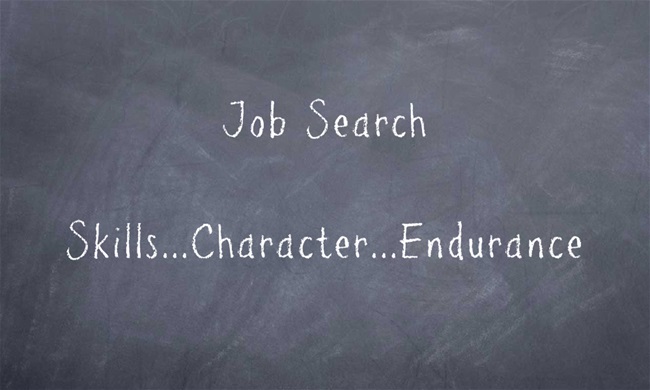
SkillsCharacterEnduranceThis past weekend my son participated in a soccer tournament for the state championship.

What this means is he played eight additional games for a total of 18 this spring.

This also means I coached 18 games. I never thought I’d say I’m sick of the world’s most popular sport, but I am.

The teams that succeed in reaching the state finals had three things going for them: skill, character, and endurance. The coaches and parents were just plain crazy for sticking it out.

Similarly jobseekers who succeed in landing a job—the winner of a state final in soccer of the job search—demonstrate the same three traits throughout the entire process.

Skills. Not enough to have the required skills and accomplishments, jobseekers must be able to display them in their written and verbal communications. I tell the participants who attend my Job Search 101 workshop that bringing their written and verbal communications together makes for a successful marketing campaign.

The most obvious example of written communications would be the résumé, which above all else must address employers’ needs by demonstrating the required qualifications. Employers want to see the skills and accomplishments needed to do the job well, not a generic, one-fits-all document.

The interview is the ultimate display of verbal communications. Let’s face it, if you can’t pass the interview, you don’t get hired. Only one person gets hired, and this is the person who shows he/she has the skills and accomplishments that fit the job. Know what skills the employer requires, so you can better predict the questions that will be asked.

Character.  This is a vague term but is essential to achieving likability, demanding respect, and showing humor. You must show your character when networking. Networkers appreciate other networkers who they understand—think clarity of skills and goals—as well as those who are willing to help them.

Your character is essential at the interview, as it demonstrates your interpersonal skills, motivation, enthusiasm, ability to work as a member of a team, and other desired “soft skills” the employer is seeking.

Your character also shows itself in your written communications. Many of us have received LinkedIn messages that are negative in verbiage and tone. The writers complain and make excuses about their past failures, showing a lack of self-awareness. This is another way for people to show a lack of character.

Endurance. This is perhaps one of the most difficult of the three components to sustain. Sadly I must admit I was willing–nay hoping–for the soccer tournament to end, because I felt my energy drain from me with each game.

Jobseekers sometimes feel this way, especially if the interview process stretches to five interviews over a period of 5 weeks. Some of  my customer have described this hellish situation to me.

This is when a jobseeker must reach down deep in his soul to move on, not dwelling on the worse–he doesn’t get the job. Maintaining endurance is a matter of treating yourself well during the process.

Get enough sleep, spread your research out over a period of days and not cramming like a college student, and take a well advised break are some of the things you should do to keep the endurance. My response to jobseekers during these times is stay the course and do your best.

Endurance is also required when writing tailored documents for each job, as opposed to blasting 20-30 resumes and cover letters over the Internet, or should we say into the black whole. Every resume and cover letter is unique to every job.

Jobseekers must faithfully attend networking events or network in public whenever they get the opportunity. LinkedIn is a great way to network online, but it should not replace face-to-face networking. Demonstrating excellent skills and character is essential when speaking with others who may be able to help you, so consistency is important as you brand yourself.

My son’s team was eliminated from the tournament in the semi-finals. You might think I was relieved, and up to the point where the final whistle blew, I thought I’d be happy for it to end; but I was actually disappointed that the games were over. The boys demonstrated skills, character, and endurance throughout the whole season. This is what I hope my customers are able to sustain. Of course the stakes are much higher–after all soccer is a game–but the same principles apply.

The word “innovative”; is it a crime to have it on your résumé?

Innovation

Innovation (Photo credit: masondan)

Did you know the word “innovative” is a cliché? According to some job search pundits it is. It made some notorious list that circulated on the blogosphere. TheFreeDictionary.com defines a cliché as “a trite or overused expression or idea.” If “innovative” has become overused, than it is by definition a cliché, but could it be called trite?

I have to admit that I’ve been telling my jobseekers to keep “innovative” and other adjectives off their résumé and out of their vocabulary, as they are subjective–it’s better to show than tell how you’re innovative. In fact, I wrote an article bemoaning the use of words that are considered clichés, some good words at that. So it appears I’m contradicting myself, but this wouldn’t be a first.

But I had an epiphany when I was talking on the phone with a customer whose résumé I’m writing. As I was going over her résumé pointing out some of her accomplishments, I told her she is innovative, at which she agreed with great delight that, yes, she is. To get her to realize this made the word “innovative” special, not a cliché.

I once described myself as innovative but when I read that it was one of the 10 clichés to avoid on your LinkedIn profile, I stopped writing and saying that I’m innovative. After all, it’s a cliché, right? This was like the time my brother said Miso soup tastes like low tide. His expert opinion ruined the soup forever for me.

I just sent my customer her résumé with the adjective “innovative” included in the professional profile, and I didn’t feel the least bit guilty–considering she had initiated social media at her current company, implemented a preventative care program at yet another company, and more accomplishments that clearly show her as innovative.

In fact, my customer also demonstrated that she’s “creative” and “dynamic,” which are also considered taboo by the cliché police. With all of what I’ve expressed, I’m beginning to question the validity of experts who trash some great words just because they’re considered overused.

What if there are a lot of jobseekers and workers who are “innovative,” “creative,” and “dynamic,” and these are the best words to use to describe them? Should we use words that don’t mean quite the same, or should we use words from a different language? No, we need to show rather than tell, right?

“Designed a (an innovative) social media curriculum for students at risk that taught them how to market the school’s English Language Art’s program, earning Department of the Year.

I suppose this secondary teacher’s accomplishment statement shows innovation, but what’s wrong with using “innovation” in the sentence to give it more flavor. Further, when a job description calls for someone who’s “innovative,” and you’re trying to meet as many of the keywords to pass the Applicant Tracking System’s test, do you exclude this word? Just a thought.

I’m now beginning to think a little too much emphasis is being placed on finding ways to reinvent ways to describe jobseekers and workers. To hell with worrying about what the pundits consider to be clichés. They’re ruining the pleasure I get when writing a résumé or advising jobseekers on how to describe themselves, just as my brother had ruined my appetite for Miso soup.

Your résumé should make the employers choice to interview you easy

easySome jobseekers have a misconception that, like a buffet dinner, more is always better on their résumé. What results from this misguided belief is a ton of unfocused and untargeted information that usually leads to information overload for the recruiter, human resources manager, or hiring manager.

These jobseekers feel that the more duties they list on their résumé increases their chance of getting an interview. (The person with the most toys wins.) What they fail to realize is a very logical point Colleen Roller raises in her article, “Abundance of Choice and Its Effect on Decision Making.” It’s this: if we give the reviewer too many choices, she gets bombarded by information and is likely to lose focus on the message the jobseeker is trying to convey.

I often take time to look at my Résumé Writing workshop attendees’ résumés; and at first glance I get the sense that a reviewer might see reading their résumés as a chore. This is not the case with all my attendees, but some of the résumés read like a novel…not good. Can you imagine how a reviewer must feel if she has to select 10 candidates from among 100 résumés, most of which are full of unnecessary text?

Ms. Roller is a usability/decision architect and her eloquent article is about how we take in and remember information, which is essential in creating an effective website. She tells us that when given a choice of chocolate, for example, on the surface we’d prefer 30 different varieties. (I bet you chocolate lovers can think of at least 15.) However, when presented with so many varieties of chocolate, we become overwhelmed. Instead, a choice of six chocolates is what we’re capable of handling.

So how different is selecting from among 30 kinds of chocolate than deciphering a résumé that is nothing more than a list of duties? Not much different.

Ms. Roller says, “As the number of options increases, the evaluation process can become overwhelming and intimidating, especially when it feels like making a choice requires expert information or skill.”

Take advice from résumé reviewers who have been clamoring for résumés that are rich with quantified accomplishments and fewer duties, than ones that only list duties and look more like a grocery list. The overwhelming consensus is that they want résumés that provide the information they need upfront—I refer to it as prioritizing one’s statements as they relate to the job requirements. When jobseekers list only what’s important, the reviewer is quickly able to see the value in jobseekers.

So the question is, “How do jobseekers know which skills and experience to list on their résumé?” The answer lies in a complete understanding of the positions they seek. They must examine and dissect the job ad, and focus on all of the competencies required by the employer. By doing this jobseekers will not overload the reviewer with 30 varieties of chocolate; they will make the choice an easier one to make.

7 approaches to Customercentric Marketing in the job search

imagesWhen I first heard Jim Grenier’s voice-over on his topic of customercentric marketing, I thought, “Bingo.” I was drawn to the message about customer focus, and I saw a parallel to to the job search. It also helped that my good friend Jim has a smooth. alluring voice. Jim’s a college instructor but has had extensive experience in business.

Customercentric in the job search means satisfying every need of the employer, beginning with an accomplishment-rich résumé that shows a complete understanding of the job and the organization. The résumé sings to the employer, “Hey, this guy understands my needs,” and makes the employer think she is a valued customer. The employer, in my mind, is the focus of your job search. She is your customer. Six other components of the job search include:

  • The cover letter. Sent with the résumé, it expresses your enthusiasm for serving the customer and adds a dimension to your candidacy.
  • The approach letter. This is your introduction to a customer who hasn’t advertised the job and doesn’t yet know he’ll need you.
  • The LinkedIn profile. Your profile should shout out your skills and accomplishments. The customer sees other dimensions to your ability to serve her needs.
  • Networking. Here’s how you form relationships that precede your contact with the customers, forming a solid foundation for your written communications and the interview.
  • The informational meeting. Part of your networking, this is a valuable tool to get known by the customer, breaking through the Hidden Job Market.
  • The interview. The big ballgame. Your big chance. Don’t neglect to make the customer know your customercentric attitude and practices.

Every step in between the résumé and job offer must also center upon the customer, the employer. I often ask my workshop attendees, “Who is the buyer?” To which they say, “The employer.” Better put would be to ask, “Who is the customer?” There’s a distinction. In my mind, the buyer is someone to whom you sell your product–you–the customer is someone to whom you offer the best possible solution, regardless of the sale.

Listen to Jim’s message on customercentric markeing. I promise you’ll relate to it, and I think you will see the customer and employer as one.