Lost Touch no longer exists, making it harder to re-connect with your long forgotten connections

Well don’t I feel foolish. LinkedIn has done it to me again; it has changed its functionality and removed a feature I thought was so outstanding that I wrote a post on it. The feature to which I refer was called Lost Touch.  Lost touch allowed you to traverse immediately to the connections with whom you communicated long ago. So if I hadn’t sent messages to people four years ago, I would know exactly who they are and can renew our relationships.

I could see the removal of this feature as a kick in the gut, or I could take it as an opportunity to reach out to all of you by writing another post on what one has to do in order to contact connections who they haven’t seen in oh…two years or more. So I’m opting for the latter. But there is bad news and good news; I’m going to give you the bad news followed by the good.

The bad news is that it’s not as easy to access your long forgotten connections. Don’t follow the instructions I provided in my last post on this subject, which was written a whopping four days ago. Can you imagine something becoming obsolete in just four days?

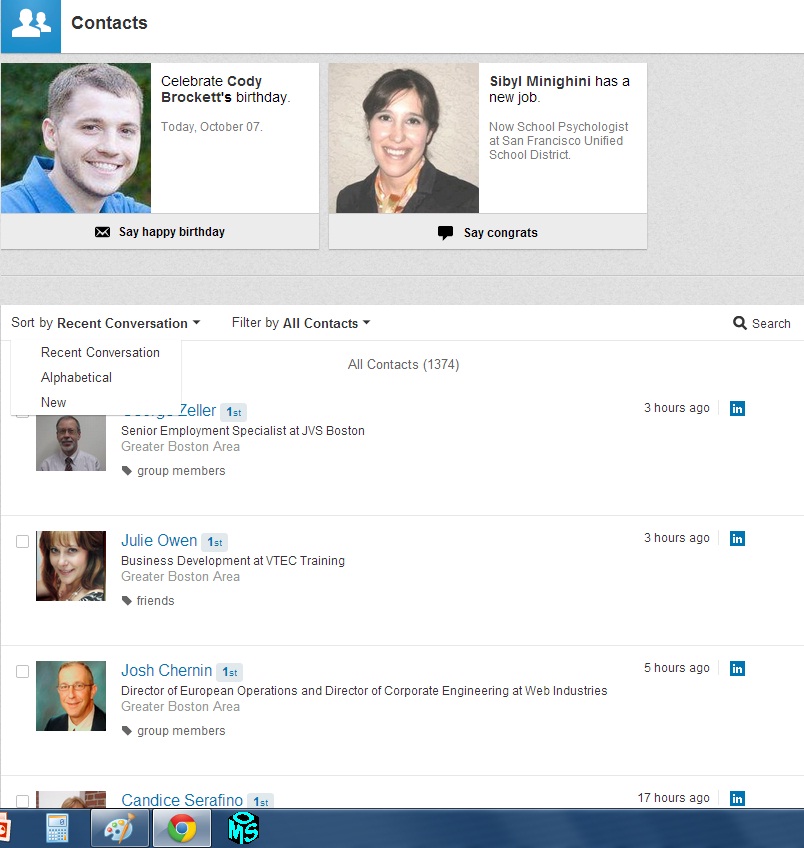
lost touch newTo get to your connections with whom you spoke eons ago, simply click on Network and select Contacts.

You will see a screen that looks similar to mine.

Select the drop-menu Sort by Recent Conversation. Next select New (circled in the diagram).

This is where the maddening work begins. Scroll down the screen to the point where you want to make contact with your connections.

For some of you Super Connectors, this process might take days.

I wish there were an easier way to do this, but I’ve searched near and far for my beloved “Last Touch” with no success.

(I’ve sent a request to LinkedIn asking, “Where is Lost Touch?” No response.)

Once you’ve selected the connections with whom you’d like to reconnect, select (you got it) the envelop that appears at the top of your connections list beside the word Message.

You are on your way to sending a mass message to your long forgotten connections.

My message, by the way reads: Wow. According to LinkedIn, we haven’t communicated in at least two years. What’s been happening in your live? I’d love to re-connect.

The good news. Many of my long forgotten connections have written back and thank me for re-connecting. They’ve let me know how things are going for them. Some who read my previous article were confused by my instructions, desperately wanting to know how to access Lost Touch. Now I need to deliver the ultimate bad news; it no longer exists.

Guest post–Introvert leadership: how to master networking in 7 simple ways

Introvert Networking TipsA person once told me that she would rather clean the floor of Grand Central Station with her own toothbrush than network. Comments like this kind of sum up our overall attitude about networking.

For many people, introvert or not, networking is like falling into the black hole. Scary, tiresome, unproductive, mysterious and endless – is this YOU?

I may not be able to turn you into the poster child for networking. However, I have successfully learned many ways that will be easy for you to use, which can turn the dreaded networking into an acceptable activity.

Try these:

  1. Redefine networking. Networking is this decade’s terminology for building relationships with other people. We’ve done this since we were infants and it comes somewhat naturally, unless you put undue pressure on yourself. I think networking has us tensed up by thinking that we need some specific outcome in our interactions with others. While that is apt to happen anyway, it won’t be the outcome if you don’t first build a relationship with someone before putting demands on that relationship.
  2. Don’t work the room. A big misconception many people have when going to a cocktail party or meeting is that you have to cover as many people as you can. Not true. No one (and most importantly those of us who tend toward introversion) likes superficial relationships. There is no way you can work the room and become meaningful with anyone. The simple idea of trying to meet everyone can drain the energy right out of an introvert. Adjust your thinking before you go.
  3. Set a goal. Rather than make an event an open-ended, never-ending activity set some goals like how long you will stay and how many people you will engage with at a deep level. My own goal for meeting people is usually three. Meeting three people is fairly easy to achieve in most settings. Knowing that there is an end in sight helps you stay focused and positive about interacting with new people.
  4. Be a Friend. When you are meeting people, particularly at business-oriented events, it’s too easy to slip into a mode of wanting something in return. That feels icky for you and the other person. Rather than thinking about other people as a potential client, resource or supporter, think of making friends with them. Find common ground and interests. You will be more genuine and you’ll feel better about your interactions. This makes networking much more worthwhile.
  5. Speak to someone without having a purpose. This is especially true while at work. Introverts tend to focus on their work and speak with a purpose in mind. That’s all good, but you also need to branch out. Make a point of chatting with someone for just a couple of minutes without having a specific purpose. Keep in mind that when it comes to relationships the biggest commodity you are trading is your time and attention. Networking or building relationships at work is one of the most important things you will do. It’s critical for your ongoing success.
  6. Follow up. When you meet someone and you feel a connection, make the first move. We are inherently lazy creatures especially when it comes to communication with others. We like this new person and even think about contacting them, but we rarely do. You are doing the other person a favor by following up and following through to make contact for further interaction. If you email them, you may also need to make a phone call, as email habits and technology cannot be relied upon.
  7. Follow up again. You’ve met for coffee and are now thinking they should call you for the next interaction. Maybe, but don’t count on it. Wait for some period of time and if you don’t hear from them, call. I know of a few people who consider me their best friend. They never call and they also love the fact that I do. Be prepared to carry an unequal weight of building a relationship.

You may never love networking or the act of building ongoing, new relationships, but with these simple actions, you will be a networking rock star.

Getting ahead as an introvert doesn’t have to be painful or difficult. I continue to share great ways to make it to the top as the climbing manager you are. Learn these skills and others that will accelerate your career. I offer an ongoing FREE newsletter full of valuable career advice and insight. When you sign up for it, you will also gain access to “Should I Stay or Should I Go?” the eworkbook to improve your job where you are today.

Get yours now: http://nextchapternewlife.com/newsletter-signup.html.

This is brought to you by Dorothy Tannahill-Moran, Introvert Whisperer & Climbing Manager Champion at: www.nextchapternewlife.com.

Dorothy Tannahill-Moran is a certified life and career coach. She works with aspiring professionals who are looking for career growth, advancement and entry into the “C” suite. As well, she works with people to overcome the sometimes daunting task of changing careers. With over 21 years in management, Dorothy has coached, trained and guided other professionals who have gone on to impressive and fulfilling careers. Her personal philosophy about careers is: “It’s not JUST a job; it’s half your life – so love your career”. You can check out her resources, blog and services at Next Chapter New Life and MBA Highway.

Job search experts, 7 tips for networking

students networkingOne of my LinkedIn connections, Rich Grant, ponders the question, “Why do college seniors have a hard time networking?” In an outstanding article, Teaching Networking and Professionalism to College Students, he writes: “I’m not speaking out of line, or disclosing any deep secrets, when I say that, generally speaking, college students and recent graduates are not adept at face-to-face networking.”

My observations of jobseekers in age groups older than college students, and as high as mature workers, is similar to the sentiment Rich expresses; networking doesn’t come natural to many people. After pondering the reasons why networking is such a task for students, he provides seven sound tips to help people network.

Read the article in its entirety to learn Rich’s excellent tips:

  1. Define “networking” before you name it.
  2. Recommend they start with the people they know.
  3. Practice makes perfect.
  4. Show, don’t tell.
  5. Provide opportunities for students to build confidence in speaking.
  6. Watch for outside events where the topic of networking is being addressed.
  7. Connect with experts to support your efforts.

If you are a college career advisor, job coach, or a job-search advisor at any level; following Rich’s advice can help you guide your jobseekers to better network. Read Teaching Networking and Professionalism to College Students realizing that this advice applies to all age groups, not just college students.

Do first impressions matter in the job search? Not as much as performance, according to Lou Adler

First ImpressionWhen someone gives me a limp handshake or, worse yet, a sweaty palm, I cringe inside. The handshake, to me, says a great deal about a person’s character. It says, I’m a stand-up guy or gal. Really nice to meet you. The handshake should be firm but not crush one’s bones.

Eye contact means a great deal to me, as well. Steady eye contact says, “I’m paying attention. I’m interested. I’m not hiding anything, etc.” A pleasant smile helps to create a great first impression, as well.

But Lou Adler downplays the importance of first impressions in his article Performance Matters, First Impressions Don’t.  Now what would Lou Adler know about interviewing and hiring quality candidates? A boatload. He wrote the books: Hire With Your Head and The Essential Guide for Hiring, the second of which I own. What do I know? Not as much as him. I’ve interviewed people before but not the thousands he has. Here’s what he writes in his article:

“The only common trait among the best people is their track record of solid performance, not the quality of their first impression.”

Were this to be true, that’s great, because some people’s first impression simply suck. They come across as approachable as Sheldon on The Big Bang Theory, devoid of character; or they maintain eye contact like a shy child being interrogated…I mean questioned by adults; or they shake your hand like they’re afraid to touch you. I agree with Mr. Adler that performance is paramount, but a terrible first impression? Read Mr. Adler’s article, a wonderful tale.

Anonymous LinkedIn Member, who art thou?

I’ll tell you. You’re one notch below “Someone in the Architectural  & Planning industry” in my “Who’s Viewed Your Profile”  area. That’s akin to being nobody. Why would you want to be “nobody?”

I’m not alone in decrying your secrecy. Firebrand Marketing Director Carolyn Hyams wrote an article called 13 things that really annoy people on LinkedIn , in which she writes, “And whilst I’m on this subject, don’t change your privacy settings to “anonymous” when you’re looking at other people’s profile. It makes them feel like someone is stalking them.” The article is quite good.

To be accused of stalking someone is strong language, but I agree. At least have the decency to tell me what company or industry you’re from. I tell my LinkedIn workshop attendees that not declaring who you are is like spying on people…don’t do it.

Help me figure out why you are secretive. Is it 1) because you think I’m an employer who is about to interview you 2) you don’t want me to read your profile for privacy reasons 3) you’re just naturally distrustful? Here’s the thing: I’m not an employer who is going to interview you. If you’re concerned about privacy, you shouldn’t be on LinkedIn, let alone the Internet. And networking is all about trust and building relationships.

One other thing: I’m delighted when someone looks at my profile. I’m thankful when they declare who they are.

So, who art thou? I’d be happy to meet you via reading your profile, and I might even want to connect with you…if you’ll let me. Until then, please declare your complete name and let me see your photo. I bet you’re a pretty decent person.


The introvert extra and extravert ham

One thing I hate about a party is a loudmouth who demands the attention of the whole room. That’s why when my wife said we were invited to a good friend’s party last week, my jaw clenched and I told her I’m not staying past 10:00 pm, and oh yeah, we’re traveling in two cars.

I really dig our friends and the majority of cast of characters who comprise the group, but there’s one woman who exhibits one trait of an extravert–the propensity to speak. Except, in her case she dominates a group with her incessant talking.

On the flip side is a male member of the group who is as quiet as a mouse, but when the time is right, he’ll tell a story that will make you laugh until it hurts. Like the story about going camping with a bunch of his buddies. How they had one match between them to light a fire and how they relied on their  Boy Scout experience to light that fire.

Other than a story like this, he rarely says much, preferring to stand among the men in the group and stare into the glow of the fire. I attempt to prompt him with talk of sports and our children, but there’s little in return.

After my friend and the rest of the fathers have it with warming our hands by the fire that night it’s time to go inside where the wives and children are gathered around the woman who is talking about nothing in particular and, it seems to me, literally sucking the air out of the room.

A reader commented on one of my blog posts saying that an extravert who exerts herself excessively can be a ham, whereas an introvert who stays in the background too much runs the risk of being an extra. I see the woman of whom I speak the ham and the man who delivers the hilarious story, albeit infrequently, the extra. I also ponder the question of how introverts and extraverts can better communicate with each other.

  1. First, each type needs to be cognizant of the need for the other to be heard.
  2. Second, active listening must be involved, not merely the appearance of listening.
  3. Lastly, each type must be willing to contribute to the conversation. As I think about the times my male companion and I stand by the fire in silence, I wonder if both of us are doing our part in building a conversation.

My good friend and champion of introverts, Pat Weber, adds about the need for extraverts to be considerate of introverts, “Often times as introverts we aren’t going to share much personal information in a conversation. Extroverts who are aware of this will fare better by giving us some space, with silence, to let us have a moment or so to think! Silent space is one of the most appreciated gifts of better communications with us. Then we can keep our end of things up.”

Introverts have an obligation to contribute to the conversation and not be content with listening to a one-way dialog. Although it may require more energy and adaptability, the introvert doesn’t have to sustain the effort forever. A lack of effort indicates to others aloofness and disinterest–it’s insulting. When all the words are distinguished like the fire in London’s short story, it’s perfectly fine to leave the party…in the second car.

3 elements of a successful job search and playoff soccer

SkillsCharacterEnduranceThis past weekend my son participated in a soccer tournament for the state championship.

What this means is he played eight additional games for a total of 18 this spring.

This also means I coached 18 games. I never thought I’d say I’m sick of the world’s most popular sport, but I am.

The teams that succeed in reaching the state finals had three things going for them: skill, character, and endurance. The coaches and parents were just plain crazy for sticking it out.

Similarly jobseekers who succeed in landing a job—the winner of a state final in soccer of the job search—demonstrate the same three traits throughout the entire process.

Skills. Not enough to have the required skills and accomplishments, jobseekers must be able to display them in their written and verbal communications. I tell the participants who attend my Job Search 101 workshop that bringing their written and verbal communications together makes for a successful marketing campaign.

The most obvious example of written communications would be the résumé, which above all else must address employers’ needs by demonstrating the required qualifications. Employers want to see the skills and accomplishments needed to do the job well, not a generic, one-fits-all document.

The interview is the ultimate display of verbal communications. Let’s face it, if you can’t pass the interview, you don’t get hired. Only one person gets hired, and this is the person who shows he/she has the skills and accomplishments that fit the job. Know what skills the employer requires, so you can better predict the questions that will be asked.

Character.  This is a vague term but is essential to achieving likability, demanding respect, and showing humor. You must show your character when networking. Networkers appreciate other networkers who they understand—think clarity of skills and goals—as well as those who are willing to help them.

Your character is essential at the interview, as it demonstrates your interpersonal skills, motivation, enthusiasm, ability to work as a member of a team, and other desired “soft skills” the employer is seeking.

Your character also shows itself in your written communications. Many of us have received LinkedIn messages that are negative in verbiage and tone. The writers complain and make excuses about their past failures, showing a lack of self-awareness. This is another way for people to show a lack of character.

Endurance. This is perhaps one of the most difficult of the three components to sustain. Sadly I must admit I was willing–nay hoping–for the soccer tournament to end, because I felt my energy drain from me with each game.

Jobseekers sometimes feel this way, especially if the interview process stretches to five interviews over a period of 5 weeks. Some of  my customer have described this hellish situation to me.

This is when a jobseeker must reach down deep in his soul to move on, not dwelling on the worse–he doesn’t get the job. Maintaining endurance is a matter of treating yourself well during the process.

Get enough sleep, spread your research out over a period of days and not cramming like a college student, and take a well advised break are some of the things you should do to keep the endurance. My response to jobseekers during these times is stay the course and do your best.

Endurance is also required when writing tailored documents for each job, as opposed to blasting 20-30 resumes and cover letters over the Internet, or should we say into the black whole. Every resume and cover letter is unique to every job.

Jobseekers must faithfully attend networking events or network in public whenever they get the opportunity. LinkedIn is a great way to network online, but it should not replace face-to-face networking. Demonstrating excellent skills and character is essential when speaking with others who may be able to help you, so consistency is important as you brand yourself.

My son’s team was eliminated from the tournament in the semi-finals. You might think I was relieved, and up to the point where the final whistle blew, I thought I’d be happy for it to end; but I was actually disappointed that the games were over. The boys demonstrated skills, character, and endurance throughout the whole season. This is what I hope my customers are able to sustain. Of course the stakes are much higher–after all soccer is a game–but the same principles apply.

Don’t Let a Colleague Get You Down

Red Sox fans will recall a talented baseball player called Manny Ramirez who could hit the cover off the ball and win the big games. They’ll also recall how Manny pulled antics that drove us nuts and almost got him traded. The phrase “Manny being Manny” lost its allure after awhile and even his teammates grew fed up with his jogging to first base instead of running out a ground ball.

I saw Manny as a detriment to my beloved Red Sox—not worth the hits he produced and home runs that seemed to come at the right time. He was bad for the team’s morale, in my mind. How could he not be? I honestly wouldn’t want to play with him no matter how outstanding he was. Although only a few of his teammates spoke poorly about him, I’ll bet many others thought he was bad for company morale.

At a previous company I worked with someone who was bad for company morale. I’ll call him Ted (not to be confused with the great Ted Williams). When I met Ted, I tried befriending him, despite his crude behavior and total indifference for the job. I joked with him at lunch and listen to his incessant stories about things unrelated to work. “No wait, Bob, there’s a point to my story,” he would say as I was backpedaling.

At first he seemed like a pleasant man, despite his overtly loquaciousness, but I soon came to see him for who he really was, a saboteur. (In all fairness, I don’t know if he realized what he was doing to me and others.)

At times I would come to him during lunch to discuss an issue of a customer he and I shared in common. In response he would tell me that he never talked business at lunch. I’d have to wait before we could talk about our customer. “No seriously, Ted,” I told him. “I want to run something by you.”

“No seriously, Bob,” he would say, concentrating on his sandwich, “I’m eating. I don’t talk business during lunch.” At first I thought he was joking; I only needed a few seconds of his precious time.

Ted was also a clock watcher; he was someone who came in a minute before work started and left a minute before work ended. None of this went unnoticed by the entire staff; they would merely shake their heads in resignation. But he didn’t care. It was as if he were mocking those of us who were trying to work hard. He more than once asked me why I was still at work half an hour after the “official” quitting time, and acted as if I were breaking a rule.

One time I saw one of Ted’s customers sitting in his office alone, hands between his knees and looking around anxiously waiting. I asked the customer where Ted was. He said Ted was smoking a cigarette and had told him to wait five minutes. The customer shook his head, as if he knew Ted had given up on the job. This customer was perceptive.

Ted’s attendance at company meetings epitomized the total disregard he had for work. He would come in late, often moaning and rolling his eyes, and frequently leave to visit the restroom. I considered that he was ill because he looked and sounded like a 100-year-old man; but it so happened that meetings were the only time he arrived late and left often. He just didn’t like meetings, I guess.

The advice we always give people when they’re in the presence of someone like Ted is to disengage and avoid contact. Rather, surround yourself with positive colleagues who inspire you and want to work in a cooperative environment.

This is precisely what I did after months of trying to be a supportive colleague to Ted. I felt more alive and less stressed when I avoided this guy. When I saw him in the hallways, I would duck into another room, or I would simply ignore him. Or if I needed information, I would try to seek it from someone other than him.

As Ted would count down the days till retirement, I would secretly count them as well. When 65 days were left, they couldn’t come too soon. “How many days left, Ted?” I asked in an expectant tone.

“Sixty,” he said. “I can’t wait.”

I couldn’t wait either. I was five days off and floating on air.

The sad thing about finally seeing Ted go was that he was a humorous man. He often provided me with wisdom and worldly advice. He loved to talk about fishing while floating on a lake in his canoe. One of his missions in life was to study all religions and become an expert on them. I don’t doubt he can do it. Ted coached youth lacrosse and talked about his laidback coaching style, smiling as he spoke of his players. There were many endearing qualities to Ted. But they were overshadowed by his total distain for work.

Something had gone wrong, something in his past life he was reluctant to discuss with me. I think we have an easier time accepting poor behavior when we know the reasons for it. So maybe I would have had an easier time accepting Ted for who he was if I knew what was wrong. Others accepted him, but they also kept their distance. They, like me, knew what kind of bad affect he had on those around him. No one hears from Ted because he wants it that way.

I’m not sad that Ted is gone, even as I remember the things I liked about him. I just hope he finds peace where he goes. I also hope that people who inexplicably hate work know when it’s time to jump ship and seek a more amiable work environment.

The word “innovative”; is it a crime to have it on your résumé?

Innovation

Innovation (Photo credit: masondan)

Did you know the word “innovative” is a cliché? According to some job search pundits it is. It made some notorious list that circulated on the blogosphere. TheFreeDictionary.com defines a cliché as “a trite or overused expression or idea.” If “innovative” has become overused, than it is by definition a cliché, but could it be called trite?

I have to admit that I’ve been telling my jobseekers to keep “innovative” and other adjectives off their résumé and out of their vocabulary, as they are subjective–it’s better to show than tell how you’re innovative. In fact, I wrote an article bemoaning the use of words that are considered clichés, some good words at that. So it appears I’m contradicting myself, but this wouldn’t be a first.

But I had an epiphany when I was talking on the phone with a customer whose résumé I’m writing. As I was going over her résumé pointing out some of her accomplishments, I told her she is innovative, at which she agreed with great delight that, yes, she is. To get her to realize this made the word “innovative” special, not a cliché.

I once described myself as innovative but when I read that it was one of the 10 clichés to avoid on your LinkedIn profile, I stopped writing and saying that I’m innovative. After all, it’s a cliché, right? This was like the time my brother said Miso soup tastes like low tide. His expert opinion ruined the soup forever for me.

I just sent my customer her résumé with the adjective “innovative” included in the professional profile, and I didn’t feel the least bit guilty–considering she had initiated social media at her current company, implemented a preventative care program at yet another company, and more accomplishments that clearly show her as innovative.

In fact, my customer also demonstrated that she’s “creative” and “dynamic,” which are also considered taboo by the cliché police. With all of what I’ve expressed, I’m beginning to question the validity of experts who trash some great words just because they’re considered overused.

What if there are a lot of jobseekers and workers who are “innovative,” “creative,” and “dynamic,” and these are the best words to use to describe them? Should we use words that don’t mean quite the same, or should we use words from a different language? No, we need to show rather than tell, right?

“Designed a (an innovative) social media curriculum for students at risk that taught them how to market the school’s English Language Art’s program, earning Department of the Year.

I suppose this secondary teacher’s accomplishment statement shows innovation, but what’s wrong with using “innovation” in the sentence to give it more flavor. Further, when a job description calls for someone who’s “innovative,” and you’re trying to meet as many of the keywords to pass the Applicant Tracking System’s test, do you exclude this word? Just a thought.

I’m now beginning to think a little too much emphasis is being placed on finding ways to reinvent ways to describe jobseekers and workers. To hell with worrying about what the pundits consider to be clichés. They’re ruining the pleasure I get when writing a résumé or advising jobseekers on how to describe themselves, just as my brother had ruined my appetite for Miso soup.

Want great customer service, go to Starbucks

starbucksI’m a coffee snob. But I’m frugal. I buy a pound of Starbucks dark roasted coffee at the grocery store to brew at home; and when I’ve brewed a full pot, I’ll pour what my wife and I don’t drink into a container, which goes in the refrigerator.

As a treat, I’ll go to Starbucks drive-through and buy a Venti ice coffee with half ice. (Yes, I use the word “Venti.”) When time and the funds permit, I’ll frequent a Starbucks café. (Read Chief Influence Officer Brian Ahearn‘s post on 5 Reasons Why Starbucks is so Persuasive.)

Starbucks has not only won my loyalty for its excellent coffee; it’s won me over for its customer service, as well.

Customer service is such a priority to me that I’ve abandoned a famous hamburger joint up the street from us because it takes forever to get served. I’ve also traveled miles out of my way to give my money to another branch of a large retail store because I’ve been treated rudely by some teenager whose main concern is texting his girlfriend.

Customer service weighs so heavily on my mind that my kids get sick of hearing me say, “That was great customer service,” or the opposite, which is more the case than the former these days. My kids also get embarrassed when I ask for the store’s manager so I can commend an associate who did his/her job the way it should be done.

As much as I hate poor customer service (maybe we’ve come to expect it), I feel much stronger about superior customer service. And thus, I feel Starbucks “is all that” when it comes to customer service. Why? Let me reenact a greeting from a Starbucks associate at the drive-through I frequent when driving home from my mother’s-in-law house.

“Good evening. Welcome to Leominster’s Starbucks. How may I help you?” the young man wearing the headsets says.

At this point my wife and I look at each other and mouth, “Great customer service.”

“I’d like a Venti ice coffee with half the ice,” I reply. Less ice, more coffee.

“Venti ice coffee light on the ice. Will that be all?”

“Yes, thank you,” I say driving forward. My kids in the back seats drone, “Great customer service.”

“Thank you, my friend,” I hear as I’m approaching the bend. Now I think, here is a guy who really loves his job.

And here’s the kicker—Starbucks’ coffee associates always get my order correct, whether it’s at a café or drive through.

I think about customer service wherever I shop, but there aren’t many retailers that prompt me to ask a manager what contributes to their associates’ excellent customer service. I’ve spoken to a few Starbuck’s managers about why their  customer service is so great. Perhaps this is because great customer service isn’t all that prevalent; maybe not enough businesses are focusing on training their employees on this seemingly lost art.